

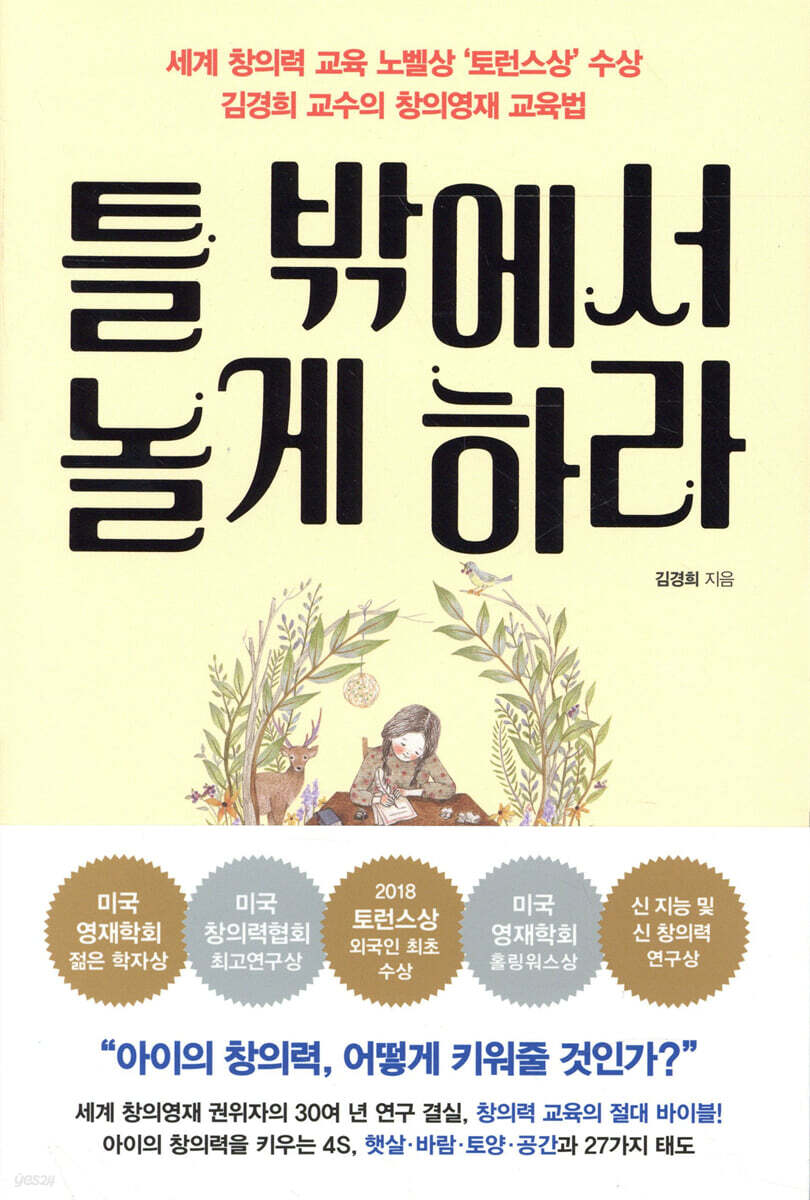
Let them play outside the box
 |
Description
Book Introduction
First foreigner to win the Torrance Award (2018)
Creativity Society of America's Best Research Award The Early Scholar Award from the American Society for Gifted Young Scholars Hollingworth Award from the American Society for Gifted Children New Intelligence and New Creativity Research Award The fruit of 30 years of research by the world's leading authority on creative gifted education. A creative education method for our children who will become future talents! Professor Kim Kyung-hee, a world-renowned authority on creativity education, has dedicated herself to research on creativity education for over 30 years and is a world leader in the field of creativity. Father of Creativity E. Dr. Paul Torrance (E. Professor Kim, who studied directly with Paul Torrance, studied innovators who ‘changed the world for the better’, including Nobel Prize winners, Einstein, and Steve Jobs, to uncover the secret of ‘creativity’ and devised the ‘CAT theory’, an educational method to develop creativity. This book was written by Professor Kim with a love for his country and a single-minded determination to foster the creativity of our children for the future of the Republic of Korea. Professor Kyunghee Kim, the first foreigner to win the 2018 Torrance Award, the “Nobel Prize in Creativity,” introduces the “Creative Gifted Education Method,” which parents can use to foster their children’s creativity, based on the CAT theory developed through thorough and scientific research. |
- You can preview some of the book's contents.
Preview
index
Prologue | Let them play outside the box
Don't 'work hard', do 'differently' / Why creativity now? / What is creativity? / The greatest gift for a child's future is 'creativity' / Let them play outside the box / How can creativity be fostered? / A creative genius created by a mother
Part 1: Sunlight, Wind, Soil, and Space: Nurturing Creativity
1 Sun
A sunny environment that fosters children who enjoy learning
Positive Attitude | Bright Children Win the Battle Against Themselves
Gift positive experiences/ Avoid comparing yourself to others/ Express gratitude for even the little things/ Build immunity to failure
A Big Attitude | Children who dream big become great people.
Parents are a child's first role model/Read stories of great people together/Drawing the invisible
Spontaneity | A child who expresses himself without worrying about what others think breaks the mold.
Change your routine/break out of a rut
Humorous Attitude | Studying Like Play, Playing Like Studying
Make your child laugh and smile/practice humor together
Passionate Attitude | A child's endless driving force is passion.
Developing passion in one area through learning
Curious Attitude | Curious Children Enjoy Learning
Seeing familiar things in a new light / The fun of discovering things one by one that one did not know / Fostering curiosity about nature / Practicing how to ask questions / Learning, expressing, and imagining through reading / Using microscopes and telescopes / Making others feel mysterious / Talking about life's problems in advance
·Outside the Box Playground 1
·One-page summary for parents
2 WindStorm
An environment that fosters professional development and fosters strong children
Goal-Driven Attitude | Children with Goals Develop Expertise
Instilling parental expectations early on / Setting and achieving your own goals / Creating an organized environment but not disrupting immersion
A thorough attitude | Raise children who achieve more than their goals.
Develop the habit of being thorough/Discipline consistently and thoroughly
Self-Efficacy Attitudes | How to Build True Confidence in Your Child
Praise the process more specifically than the outcome/Unconditional praise is detrimental/Focus on positive behavior and emotions
Independent Attitude | How to Develop Independence in Your Child
Give your child a voice and foster responsibility/let them make their own choices.
Unwavering Attitude | How to Build Resilience in Your Child
Give constructive feedback
Risk-Taking Attitude | How to Develop the Audacity to Take Small Risks
Be tolerant of failure
Perseverance | How to Raise a Child Who Never Gives Up
Gradually increase the level of the task / Practice increasing concentration in everyday life / Encourage imagination at a distance
Embracing Uncertainty | How to Raise Innovators Who Will Change the World
Solve a problem that has no answer/Tell us about the unpredictable/Tell us about someone who turned uncertainty into certainty
·Outside the Box Playground 2
·One-page summary for parents
3 Soil
Soil and climate that allows for diverse experiences
Multicultural Attitudes | Exposure to diverse cultures creates a unique identity.
To establish strong roots/ Learn foreign languages as a means of communication, not study/ Accept and integrate diverse cultures
Strategic Attitude | A child with a goal develops a strategy.
Focus your efforts on your strengths instead of your weaknesses/ Provide limitations to help you strategize/ Leverage what's around you/ Create opportunities to collaborate and interact with others
Open-mindedness | Cultivate a mind open to new experiences
Overcoming the fear of the unfamiliar / Sometimes experiencing something out of the ordinary
Complex Attitudes | Developing Complexity Develops Convergence Thinking
Creating a horizontal and lively atmosphere / Fostering complex thinking skills
Attitude toward seeking mentors | Raising children to become self-directed learners.
6 Steps to Finding a Mentor
·Outside the Box Playground 3
·One-page summary for parents
4 Space
A space that fosters unique and confident children
Emotional Attitude | Children who discover their true selves grow emotionally.
Knowing and loving yourself/ Understanding your feelings/ Learning to express your emotions/ Using your feelings as a tool
Empathetic Attitude | How to Develop Consideration Through Empathy
Teach them to care about others/Teach them the skills of consideration/Teach them that empathy and consideration do not mean giving in unconditionally.
A Rethinking Attitude | How to Raise Children with the Power to Think Deeply on Their Own
Don't be afraid of being alone / Develop a habit of reflecting on the day / Focus on something unusual or simple / Give your child the gift of leisure
Self-Directed Attitude | How to Develop Self-Directedness in Your Child
Protecting your child's autonomy/ Respecting your child's own pace/ Raising your child to be stubborn/ Encouraging them to find what they want and pursue it on their own
A Fantastic Attitude | How to Develop Your Child's Imagination
Stimulate your child's imagination with interesting questions/Open the door to imagination through print/Play games that enhance imagination/Follow up imagination with critical thinking
A Bold Attitude | How to Raise a Unique Child
Teach them to love themselves/ Encourage them to act outside the box/ Teach them that all colors combined make black
Positive Attitude | A Child Who Transcends the Frames of Male and Female
Breaking Free from Gender Stereotypes / Teaching Girls to Become Creative Geniuses
A brash attitude | A child who proudly shouts against the rules of the world
Raising proactive children / Teach them to break rules / Practice disagreeing with parents
·Outside the Box Playground 4
·One-page summary for parents
Part 2: ION Thinking: Growing into a Far-sighted Child
Expertise within 5 frames
Thinking skills that develop expertise
Developing memorization skills/Developing comprehension skills/Developing application skills
·One-page summary for parents
6. Imagination outside the box
Imagination that creates innovators
The skill of imagining without restraint, developing a fluid imagination / The skill of thinking in various directions, developing a flexible imagination / The skill of thinking ingeniously, developing an original imagination
Imagination that develops problem-solving skills
Conceiving alone and together
Imagination that creates Eureka
·Outside the Box Playground 5
·One-page summary for parents
Critical thinking within 7 frames
Critical thinking that creates balanced thinking
The art of critical thinking, analytical and evaluative skills/fighting with logic/analyzing using the 'weak and strong' principle/raising questions
·One-page summary for parents
8 New Frame Fusion Power
The power of convergence to combine diverse ideas
View larger/ Skip the frame/ Find the pattern/ Connect the dots
The power of convergence to create self-directed thinking
Elaborate/Simplify/Promote Your Creation
·One-page summary for parents
Epilogue | Create an Environment That Will Raise Your Child to Become a Creative Genius
To create an environment that nurtures our children as creative geniuses, a child's success depends on their mothers. Schools must also change. An environment that fosters creativity and innovation.
Don't 'work hard', do 'differently' / Why creativity now? / What is creativity? / The greatest gift for a child's future is 'creativity' / Let them play outside the box / How can creativity be fostered? / A creative genius created by a mother
Part 1: Sunlight, Wind, Soil, and Space: Nurturing Creativity
1 Sun
A sunny environment that fosters children who enjoy learning
Positive Attitude | Bright Children Win the Battle Against Themselves
Gift positive experiences/ Avoid comparing yourself to others/ Express gratitude for even the little things/ Build immunity to failure
A Big Attitude | Children who dream big become great people.
Parents are a child's first role model/Read stories of great people together/Drawing the invisible
Spontaneity | A child who expresses himself without worrying about what others think breaks the mold.
Change your routine/break out of a rut
Humorous Attitude | Studying Like Play, Playing Like Studying
Make your child laugh and smile/practice humor together
Passionate Attitude | A child's endless driving force is passion.
Developing passion in one area through learning
Curious Attitude | Curious Children Enjoy Learning
Seeing familiar things in a new light / The fun of discovering things one by one that one did not know / Fostering curiosity about nature / Practicing how to ask questions / Learning, expressing, and imagining through reading / Using microscopes and telescopes / Making others feel mysterious / Talking about life's problems in advance
·Outside the Box Playground 1
·One-page summary for parents
2 WindStorm
An environment that fosters professional development and fosters strong children
Goal-Driven Attitude | Children with Goals Develop Expertise
Instilling parental expectations early on / Setting and achieving your own goals / Creating an organized environment but not disrupting immersion
A thorough attitude | Raise children who achieve more than their goals.
Develop the habit of being thorough/Discipline consistently and thoroughly
Self-Efficacy Attitudes | How to Build True Confidence in Your Child
Praise the process more specifically than the outcome/Unconditional praise is detrimental/Focus on positive behavior and emotions
Independent Attitude | How to Develop Independence in Your Child
Give your child a voice and foster responsibility/let them make their own choices.
Unwavering Attitude | How to Build Resilience in Your Child
Give constructive feedback
Risk-Taking Attitude | How to Develop the Audacity to Take Small Risks
Be tolerant of failure
Perseverance | How to Raise a Child Who Never Gives Up
Gradually increase the level of the task / Practice increasing concentration in everyday life / Encourage imagination at a distance
Embracing Uncertainty | How to Raise Innovators Who Will Change the World
Solve a problem that has no answer/Tell us about the unpredictable/Tell us about someone who turned uncertainty into certainty
·Outside the Box Playground 2
·One-page summary for parents
3 Soil
Soil and climate that allows for diverse experiences
Multicultural Attitudes | Exposure to diverse cultures creates a unique identity.
To establish strong roots/ Learn foreign languages as a means of communication, not study/ Accept and integrate diverse cultures
Strategic Attitude | A child with a goal develops a strategy.
Focus your efforts on your strengths instead of your weaknesses/ Provide limitations to help you strategize/ Leverage what's around you/ Create opportunities to collaborate and interact with others
Open-mindedness | Cultivate a mind open to new experiences
Overcoming the fear of the unfamiliar / Sometimes experiencing something out of the ordinary
Complex Attitudes | Developing Complexity Develops Convergence Thinking
Creating a horizontal and lively atmosphere / Fostering complex thinking skills
Attitude toward seeking mentors | Raising children to become self-directed learners.
6 Steps to Finding a Mentor
·Outside the Box Playground 3
·One-page summary for parents
4 Space
A space that fosters unique and confident children
Emotional Attitude | Children who discover their true selves grow emotionally.
Knowing and loving yourself/ Understanding your feelings/ Learning to express your emotions/ Using your feelings as a tool
Empathetic Attitude | How to Develop Consideration Through Empathy
Teach them to care about others/Teach them the skills of consideration/Teach them that empathy and consideration do not mean giving in unconditionally.
A Rethinking Attitude | How to Raise Children with the Power to Think Deeply on Their Own
Don't be afraid of being alone / Develop a habit of reflecting on the day / Focus on something unusual or simple / Give your child the gift of leisure
Self-Directed Attitude | How to Develop Self-Directedness in Your Child
Protecting your child's autonomy/ Respecting your child's own pace/ Raising your child to be stubborn/ Encouraging them to find what they want and pursue it on their own
A Fantastic Attitude | How to Develop Your Child's Imagination
Stimulate your child's imagination with interesting questions/Open the door to imagination through print/Play games that enhance imagination/Follow up imagination with critical thinking
A Bold Attitude | How to Raise a Unique Child
Teach them to love themselves/ Encourage them to act outside the box/ Teach them that all colors combined make black
Positive Attitude | A Child Who Transcends the Frames of Male and Female
Breaking Free from Gender Stereotypes / Teaching Girls to Become Creative Geniuses
A brash attitude | A child who proudly shouts against the rules of the world
Raising proactive children / Teach them to break rules / Practice disagreeing with parents
·Outside the Box Playground 4
·One-page summary for parents
Part 2: ION Thinking: Growing into a Far-sighted Child
Expertise within 5 frames
Thinking skills that develop expertise
Developing memorization skills/Developing comprehension skills/Developing application skills
·One-page summary for parents
6. Imagination outside the box
Imagination that creates innovators
The skill of imagining without restraint, developing a fluid imagination / The skill of thinking in various directions, developing a flexible imagination / The skill of thinking ingeniously, developing an original imagination
Imagination that develops problem-solving skills
Conceiving alone and together
Imagination that creates Eureka
·Outside the Box Playground 5
·One-page summary for parents
Critical thinking within 7 frames
Critical thinking that creates balanced thinking
The art of critical thinking, analytical and evaluative skills/fighting with logic/analyzing using the 'weak and strong' principle/raising questions
·One-page summary for parents
8 New Frame Fusion Power
The power of convergence to combine diverse ideas
View larger/ Skip the frame/ Find the pattern/ Connect the dots
The power of convergence to create self-directed thinking
Elaborate/Simplify/Promote Your Creation
·One-page summary for parents
Epilogue | Create an Environment That Will Raise Your Child to Become a Creative Genius
To create an environment that nurtures our children as creative geniuses, a child's success depends on their mothers. Schools must also change. An environment that fosters creativity and innovation.
Detailed image
.jpg)
Into the book
I am a world authority on creative talent.
What Nobel Prize winners and innovators who benefit the world have in common is not 'high intelligence' but 'outstanding creativity.'
It's okay if your child is a bit distracted and erratic.
Rather, we should guide children to think differently and stand out from others.
--- p.17
Curiosity is also the raw material of creativity, so if you give curiosity the raw material, creativity will be triggered.
This kind of curiosity and excitement should be naturally fostered in children from an early age.
There are still many parents who believe that 'effort' is the only way for their children to do well in school.
(…) But what actually makes you study well is not ‘effort’ but ‘inspiration’ and ‘curiosity’.
(…) In order to develop creativity, parents should encourage their children’s curiosity in various ways, such as sharing experiences or activities, sparking conversations with unexpected questions, or raising various animals.
--- p.72~73
By meeting and experiencing diverse people and learning about diverse perspectives and positions, children learn to think complexly, not in black and white dichotomies, but in the many shades of gray between black and white.
A child who thinks complexly and integratively like dㅇ is a creative genius.
--- p.162
You may be concerned if your child has difficulty paying attention and concentrating.
Although these children have a hard time concentrating on their studies or assignments, they are more likely to become creative geniuses.
The reason children can't focus on one thing wholeheartedly is because their interests change so quickly.
This child has the ability to instantly capture new elements as they appear around him.
Then, you will feel and experience more than others, and your broad imagination will increase the possibility of coming up with unusual and unique ideas.
--- p.232~233
For parents, hearing criticism or arguing with their children can be difficult and exhausting.
It may feel unfamiliar because it is different from the way you were raised.
However, these unfamiliar feelings are essential to gifting children with the creativity education we have not learned.
Starting horizontal communication with your child from a young age makes it easier to build trust and respect.
--- p.257
ION thinking ability is much more helpful than IQ in the education of gifted children.
If a child develops expertise in his or her field of interest from a young age, through ION thinking, he or she can grow into a gifted child in the general sense, not just a good student, but an innovative and creative gifted child required by the world that will unfold in the future.
--- p.265
A child's imagination is not only a path to becoming a creative genius, but it also provides answers to the future that lies ahead.
It is every parent's wish to foster their child's imagination and creativity.
However, no matter how much you nurture your child's thinking skills through private education, when they return home, all the imaginations they've had outside, the "Aha!" creative ideas, the ideas they've been thinking about, all vanish like smoke.
If a creative culture isn't fostered first in the home where children spend most of their time, everything can be a waste of time and energy.
--- p.310
I believe that the teachings of parents, especially mothers, are the driving force behind children's success.
Korean children memorize their coursework better and score higher on tests than Western children, regardless of whether they attend school in Korea or the United States.
However, after graduating from college and entering the real world, many people feel frustrated because they cannot come up with new ideas or create new things to solve problems.
These differences are due to the teachings of caregivers who spend the most time with their children at home.
A child's future innovation depends on whether the mother is currently making the child into a bonsai tree or raising the child into an apple tree.
What Nobel Prize winners and innovators who benefit the world have in common is not 'high intelligence' but 'outstanding creativity.'
It's okay if your child is a bit distracted and erratic.
Rather, we should guide children to think differently and stand out from others.
--- p.17
Curiosity is also the raw material of creativity, so if you give curiosity the raw material, creativity will be triggered.
This kind of curiosity and excitement should be naturally fostered in children from an early age.
There are still many parents who believe that 'effort' is the only way for their children to do well in school.
(…) But what actually makes you study well is not ‘effort’ but ‘inspiration’ and ‘curiosity’.
(…) In order to develop creativity, parents should encourage their children’s curiosity in various ways, such as sharing experiences or activities, sparking conversations with unexpected questions, or raising various animals.
--- p.72~73
By meeting and experiencing diverse people and learning about diverse perspectives and positions, children learn to think complexly, not in black and white dichotomies, but in the many shades of gray between black and white.
A child who thinks complexly and integratively like dㅇ is a creative genius.
--- p.162
You may be concerned if your child has difficulty paying attention and concentrating.
Although these children have a hard time concentrating on their studies or assignments, they are more likely to become creative geniuses.
The reason children can't focus on one thing wholeheartedly is because their interests change so quickly.
This child has the ability to instantly capture new elements as they appear around him.
Then, you will feel and experience more than others, and your broad imagination will increase the possibility of coming up with unusual and unique ideas.
--- p.232~233
For parents, hearing criticism or arguing with their children can be difficult and exhausting.
It may feel unfamiliar because it is different from the way you were raised.
However, these unfamiliar feelings are essential to gifting children with the creativity education we have not learned.
Starting horizontal communication with your child from a young age makes it easier to build trust and respect.
--- p.257
ION thinking ability is much more helpful than IQ in the education of gifted children.
If a child develops expertise in his or her field of interest from a young age, through ION thinking, he or she can grow into a gifted child in the general sense, not just a good student, but an innovative and creative gifted child required by the world that will unfold in the future.
--- p.265
A child's imagination is not only a path to becoming a creative genius, but it also provides answers to the future that lies ahead.
It is every parent's wish to foster their child's imagination and creativity.
However, no matter how much you nurture your child's thinking skills through private education, when they return home, all the imaginations they've had outside, the "Aha!" creative ideas, the ideas they've been thinking about, all vanish like smoke.
If a creative culture isn't fostered first in the home where children spend most of their time, everything can be a waste of time and energy.
--- p.310
I believe that the teachings of parents, especially mothers, are the driving force behind children's success.
Korean children memorize their coursework better and score higher on tests than Western children, regardless of whether they attend school in Korea or the United States.
However, after graduating from college and entering the real world, many people feel frustrated because they cannot come up with new ideas or create new things to solve problems.
These differences are due to the teachings of caregivers who spend the most time with their children at home.
A child's future innovation depends on whether the mother is currently making the child into a bonsai tree or raising the child into an apple tree.
--- p.363
Publisher's Review
Why creativity now?
A child who jumps out changes the world!
After the Fourth Industrial Revolution, most jobs we know will disappear.
In the past, there were many jobs available to children who were good at studying and hard-working.
So, even without creativity education, there was no major problem in living.
But the era of memorizing and applying knowledge is over, and the positions for specialized technicians are becoming increasingly limited.
What kind of people will move and change the world in the future? They will be those with the ability to add a little extra to their knowledge—in other words, "creativity."
In 10 years, a completely new world will unfold that we cannot even imagine now.
The essential survival skill for our children who will live in the future society is ‘creativity.’
Fortunately, creativity is not something that is innate like intelligence, genetics, or family, but rather an ability that can be developed later in life.
Moreover, what is important to note is that the ability that parents can sufficiently foster is the child's 'creativity.'
The research results showed that the factor that had the greatest influence on a child's success was the 'mother'.
It is said that it is not the good school or teachers, but the parents, especially the mother, who have as much as 80% of the influence on a child.
If you are a mother who has confined your precious children to the mold of spoon-fed education out of anxiety about the future or fear of them falling behind others, you should pay attention to the 'Creative Gifted Education Method' in this book, which Professor Kim has created through his lifelong research, and start educating your children about creativity right now.
The '4S' Needed to Foster a Child's Creativity
Sun, Storm, Soil, Space
A child's creativity is created in the 'home'.
Professor Kyunghee Kim, who shocked American society with her article “America’s Creativity Crisis” that graced the cover of Newsweek and received awards such as the Creativity Association’s Best Research Award, the American Society for Gifted Young Scholar Award, the Hollingsworth Award, the Berlin Award, and the New Intelligence and New Creativity Research Award, has devoted herself to research on creativity education for over 30 years and defined the “27 attitudes” necessary to foster creativity in children.
The '27 attitudes' that Professor Kim defines to foster creativity do not require good school districts, private education, or good teachers.
Only parents, especially mothers, can foster their children's creativity through a '4S culture' at home.
Part 1 of this book introduces the '4S': sunlight, wind, soil, and space, which foster a child's creativity.
The 4S culture contains everything about how to develop children's creativity, including parents' mindset and attitude, conversation methods that foster children's creativity, questioning methods, and play methods.
A sunny climate allows children to enjoy learning through warm words and attention from parents, while a windy climate allows children to not give up and be discouraged by failure through parental encouragement and support.
Soil climate helps children discover their own unique identity through parental questions and diverse experiences, and space climate creates a free environment to help children grow into unique and confident individuals.
This book, the culmination of 30 years of research by a world-renowned authority on creative gifted education, introduces creative education methods for our children, who will become future talents.
I want to develop my child's creativity and convergent thinking skills.
A must-read for moms!
Creativity is a multifaceted ability that requires critical thinking, imagination, and reasoning skills.
Creativity develops through 27 creative attitudes fostered through the 4S culture, enabling creative thinking in novel ways and progressing step by step to find valuable answers through convergent thinking.
Creativity is never simply a unique idea.
The 'ION thinking ability' described in Part 2 of this book is an 'essential asset' for our children who will survive in the future.
The author says that ION thinking, which consists of 'inbox thinking', 'outbox thinking', 'inbox thinking', and 'newbox thinking', is much more helpful than IQ in educating children with gifts.
Once a child becomes accustomed to these four ways of thinking, parental worries such as, “I’m worried because my child has a low IQ,” or “My child’s test scores are so poor, what should I do?” will disappear completely.
A child who jumps out changes the world!
After the Fourth Industrial Revolution, most jobs we know will disappear.
In the past, there were many jobs available to children who were good at studying and hard-working.
So, even without creativity education, there was no major problem in living.
But the era of memorizing and applying knowledge is over, and the positions for specialized technicians are becoming increasingly limited.
What kind of people will move and change the world in the future? They will be those with the ability to add a little extra to their knowledge—in other words, "creativity."
In 10 years, a completely new world will unfold that we cannot even imagine now.
The essential survival skill for our children who will live in the future society is ‘creativity.’
Fortunately, creativity is not something that is innate like intelligence, genetics, or family, but rather an ability that can be developed later in life.
Moreover, what is important to note is that the ability that parents can sufficiently foster is the child's 'creativity.'
The research results showed that the factor that had the greatest influence on a child's success was the 'mother'.
It is said that it is not the good school or teachers, but the parents, especially the mother, who have as much as 80% of the influence on a child.
If you are a mother who has confined your precious children to the mold of spoon-fed education out of anxiety about the future or fear of them falling behind others, you should pay attention to the 'Creative Gifted Education Method' in this book, which Professor Kim has created through his lifelong research, and start educating your children about creativity right now.
The '4S' Needed to Foster a Child's Creativity
Sun, Storm, Soil, Space
A child's creativity is created in the 'home'.
Professor Kyunghee Kim, who shocked American society with her article “America’s Creativity Crisis” that graced the cover of Newsweek and received awards such as the Creativity Association’s Best Research Award, the American Society for Gifted Young Scholar Award, the Hollingsworth Award, the Berlin Award, and the New Intelligence and New Creativity Research Award, has devoted herself to research on creativity education for over 30 years and defined the “27 attitudes” necessary to foster creativity in children.
The '27 attitudes' that Professor Kim defines to foster creativity do not require good school districts, private education, or good teachers.
Only parents, especially mothers, can foster their children's creativity through a '4S culture' at home.
Part 1 of this book introduces the '4S': sunlight, wind, soil, and space, which foster a child's creativity.
The 4S culture contains everything about how to develop children's creativity, including parents' mindset and attitude, conversation methods that foster children's creativity, questioning methods, and play methods.
A sunny climate allows children to enjoy learning through warm words and attention from parents, while a windy climate allows children to not give up and be discouraged by failure through parental encouragement and support.
Soil climate helps children discover their own unique identity through parental questions and diverse experiences, and space climate creates a free environment to help children grow into unique and confident individuals.
This book, the culmination of 30 years of research by a world-renowned authority on creative gifted education, introduces creative education methods for our children, who will become future talents.
I want to develop my child's creativity and convergent thinking skills.
A must-read for moms!
Creativity is a multifaceted ability that requires critical thinking, imagination, and reasoning skills.
Creativity develops through 27 creative attitudes fostered through the 4S culture, enabling creative thinking in novel ways and progressing step by step to find valuable answers through convergent thinking.
Creativity is never simply a unique idea.
The 'ION thinking ability' described in Part 2 of this book is an 'essential asset' for our children who will survive in the future.
The author says that ION thinking, which consists of 'inbox thinking', 'outbox thinking', 'inbox thinking', and 'newbox thinking', is much more helpful than IQ in educating children with gifts.
Once a child becomes accustomed to these four ways of thinking, parental worries such as, “I’m worried because my child has a low IQ,” or “My child’s test scores are so poor, what should I do?” will disappear completely.
GOODS SPECIFICS
- Publication date: December 24, 2019
- Page count, weight, size: 368 pages | 660g | 150*223*30mm
- ISBN13: 9788965709596
- ISBN10: 8965709598
You may also like
카테고리
korean


korean

![GQ KOREA Mark (Monthly): December [2025]](http://librairie.coreenne.fr/cdn/shop/files/8ef265dbbfbf186523ed75ba7319009d.jpg?v=1765340328&width=3840)


