

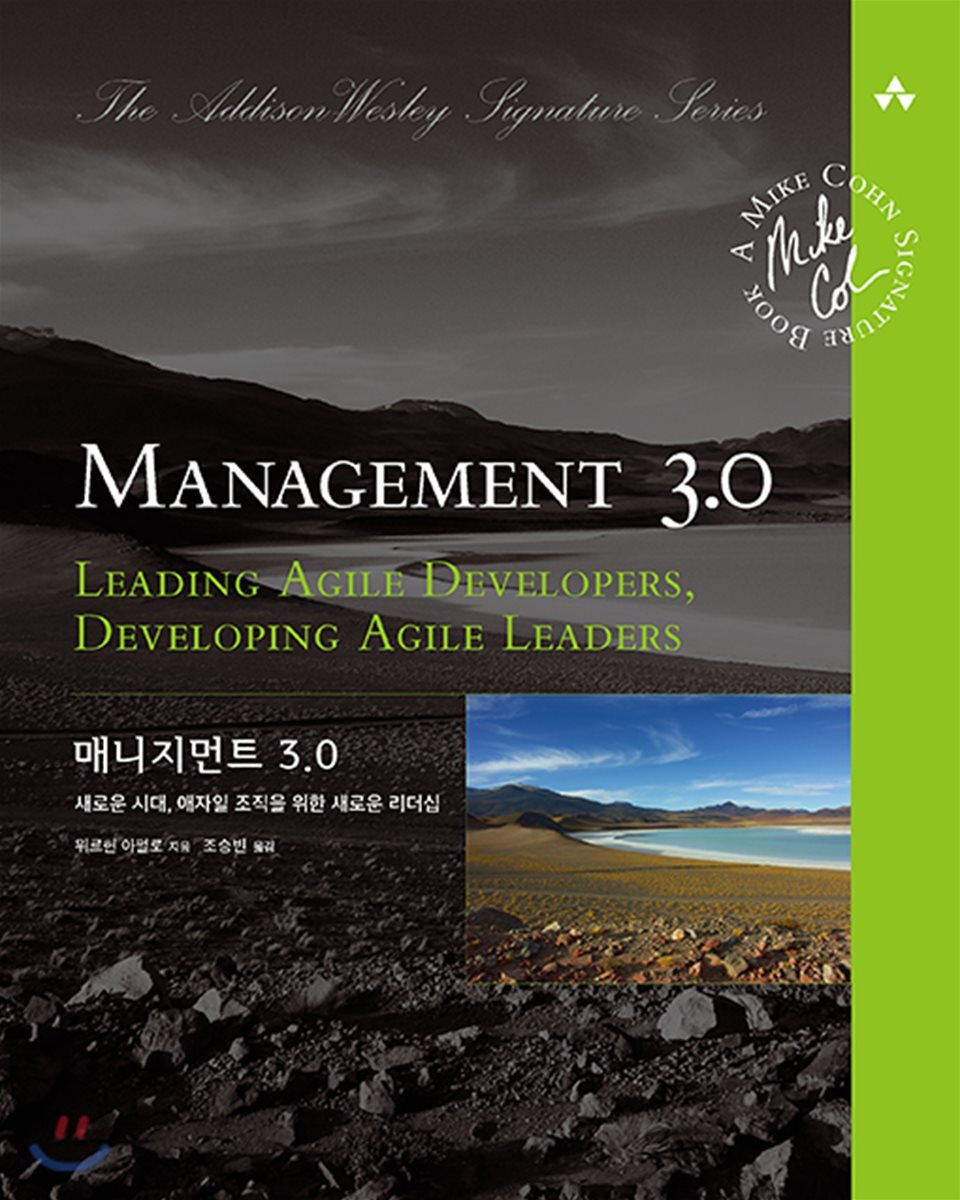
Management 3.0
 |
Description
Book Introduction
Agile is rapidly spreading across various fields, and it is no longer possible to say that it is exclusive to the software development field.
Many organizations hope that adopting agile will help them survive in volatile, uncertain, complex, and ambiguous environments, but this is often difficult.
At the center of it all is the manager.
A review of various research results shows that the biggest obstacle to organizational change is management.
It is also true that management has been overlooked in the agile world, as most agile practitioners have held the position that management is unnecessary or a necessary evil.
This book will fill that gap.
If you want to successfully implement agile in your organization, managers and leaders must learn to lead and manage the organization in a different way than before.
World-renowned leadership expert Jürgen Apferlo introduces the method through interesting and diverse theories and practices.
Many organizations hope that adopting agile will help them survive in volatile, uncertain, complex, and ambiguous environments, but this is often difficult.
At the center of it all is the manager.
A review of various research results shows that the biggest obstacle to organizational change is management.
It is also true that management has been overlooked in the agile world, as most agile practitioners have held the position that management is unnecessary or a necessary evil.
This book will fill that gap.
If you want to successfully implement agile in your organization, managers and leaders must learn to lead and manage the organization in a different way than before.
World-renowned leadership expert Jürgen Apferlo introduces the method through interesting and diverse theories and practices.
- You can preview some of the book's contents.
Preview
index
Chapter 1.
Why can't things in this world be that simple?
__causal relationship
__complexity
__Linear thinking
__Reductionism
__Holism
__Hierarchical Management
__Agile Management
__All my theories
__Books and Models
__organize
__Reflection and Practice
Chapter 2.
Agile software development
__The Prelude to Agile
__Agile Book
__The Basics of Agile
__Agile's competitors
__Agile Obstacles
Line Management vs. Project Management
__organize
__
Chapter 3.
Complexity theory
__Exchange in the field of science
__General Systems Theory
__Cybernetics
__Dynamic Systems Theory
__Game theory
__theory of evolution
__Chaos theory
__System Knowledge Framework
__Simplicity: A New Model
__Revisiting Simplification
__Maladaptation vs. Adaptation
__Are we misusing science?
__A New Era: Complexity Thinking
__organize
__Reflection and Practice
Chapter 4.
Information Innovation System
__Innovation is the key to survival
__knowledge
__Creativity
__Motivation
__manifold
__personality
__Only humans can control it
__From idea to implementation
__organize
__Reflection and Practice
Chapter 5.
How to energize people
__creative stage
__Managing a Creative Environment
__Creative techniques
__Extrinsic motivation
__intrinsic motivation
__Loss of motivation
__Ten Desires of Team Members
__What Motivates You: Find Balance
__intrinsic rewards
__Diversity? It's connection!
__Personality Diagnosis
__Team Personality Diagnosis 4-Step
__DIY Team Values
__Definition of personal values
__No Door Policy
__Reflection and practice
Chapter 6.
The Fundamentals of Self-Organization
__Situational self-organization
__Value-oriented self-organization
Self-organization vs. anarchy
Self-organization vs. emergence
__Team Creation
Self-organization vs. self-direction vs. self-selection
__The Principle of Ignorance
Conant-Ashby theorem
__Distributed Control
__The concept of authorization
__The need for authorization
__Like a gardener
__organize
__Reflection and Practice
Chapter 7.
How to grant permissions to a team
__Let's not create debt
__Let's put on the wizard's hat
__Let's choose a wizard, not a politician
__Authorization vs. Delegation
__Reducing fear increases status
__Choosing the right maturity stage
__Choosing the right permission level
__Team assignment or individual assignment
__Delegation Checklist
__To do things right, cultivate patience
__Let's resist the resistance of the manager
__Let's address the ten inherent needs of people.
__Let's handle the environment carefully
__faith
__esteem
__organize
__Reflection and Practice
Chapter 8.
Leading and Dominating with Purpose
__Life Game
__Universality class
__False analogy
__You are not a game designer
__Self-organization is not enough
__Let's manage the system, not the people
__Are you a manager or a leader?
__The Right Distinction: Leadership vs. Governance
__The meaning of life
__Team's purpose
__Assigning an extrinsic purpose
__organize
__Reflection and Practice
Chapter 9.
How to sort constraints
__Let's present a common goal
__Agile Goal Checklist
__Let's announce the goal
__Vision vs. Mission
__Organizational Goal Case Study
Let the __team set its own goals.
__Let's compromise between your goals and the team's goals.
Let's create a list of permission boundaries
__Choose the right management perspective
__Let's protect people
__Protect shared resources
__Quality constraints
Let's create a social contract
__organize
__Reflection and Practice
Chapter 10.
The art of making rules
__Learning System
__Agile's Blind Spots
__What's Important: Craftsmanship
__positive feedback loop
__Voice feedback loop
__Discipline * Skill = Competence
__Diversity of rules
__principle of complementarity
__Risk Perception and False Security
__Memetics
__broken window
__organize
__Reflection and Practice
Chapter 11.
How to develop competencies
__Seven ways to develop competencies
__Full optimization: multiple layers
__Overall Optimization: Multiple Aspects
__Performance Metrics Tips
__Four Elements of Self-Development
__Management vs. Coaching vs. Mentoring
Consider __certification
__Let's use social pressure
__Let's use adaptable tools
__Consider the supervisor
__Let's have a one-on-one conversation
Let's have a 360-degree meeting
__Let's develop standards
__Let's deal with systems, not rules or people.
__organize
__Reflection and Practice
Chapter 12.
Communication and Structure
__Is it a bug or a feature?
__Communication and Feedback
__Misunderstandings are commonplace
__Communicator's Competency
__Network Effect
__Connection adjustment
__Competition and Cooperation
__Groups and Boundaries
__Superproductivity or autocatalysis
__pattern formation
__Scale symmetry: large and small patterns
__How to develop: More? Bigger?
__organize
__Reflection and Practice
Chapter 13.
How to develop a structure
__About the environment, products, size, and people
__Consider specialization first… ..
__… generalization follows
__Broad title
__Informal Leadership Development
__Looking at team boundaries
__The optimal team size is (probably) five people
__Functional teams vs. cross-functional teams
__Two design principles
__Choose an organizational style
__Let's turn each team into a small unit of value
__Team separation
__layer separation
__How many managers does an organizational change require?
__Let's create a hybrid organization
__Anarchy is dead, long live Panarchy
__Let's not keep secrets
__Let's make everything visible
__Let's connect people
__Aiming for adaptability
__organize
__Reflection and Practice
Chapter 14.
The terrain of change
The __environment does not exist “out there”
__Fear of uncertainty
__Law of Change
__All products are successful.
Until it fails
__Success and Fit: It's All Relative
__How to Embrace Change
__Adaptation, exploration, prediction
__Red Queen's Run
__Can complexity be measured?
Are __products becoming more complex?
__The Shape of Everything: Topological Space
__Attractor and convergence
__Stability and Disturbance
__suitability terrain
__Topography
__Artificial adaptation vs. natural adaptation
__organize
__Reflection and Practice
Chapter 15.
How to improve everything
__Linear improvement vs. nonlinear improvement.
__Let's figure out our current location
Tips for Traveling on Unstable Terrain
__Let's change the environment and bring the mountain.
__Let's make change desirable
__Let's make the situation uncomfortable
__Honor your mistakes
__Noise Strategy
__Mating strategy
__Propagation strategy
__Don't copy and paste improvements
__A few final tips for lasting change
__Let's keep going.
__organize
__Reflection and Practice
Chapter 16.
They are all wrong.
But there are also useful things
Six Perspectives of Management 3.0
__Yes, my model is “wrong”
__But other models are also “wrong”
__The Decline of the Agileist
__Complexity Pamphlet
__organize.
__Reflection and Practice
Why can't things in this world be that simple?
__causal relationship
__complexity
__Linear thinking
__Reductionism
__Holism
__Hierarchical Management
__Agile Management
__All my theories
__Books and Models
__organize
__Reflection and Practice
Chapter 2.
Agile software development
__The Prelude to Agile
__Agile Book
__The Basics of Agile
__Agile's competitors
__Agile Obstacles
Line Management vs. Project Management
__organize
__
Chapter 3.
Complexity theory
__Exchange in the field of science
__General Systems Theory
__Cybernetics
__Dynamic Systems Theory
__Game theory
__theory of evolution
__Chaos theory
__System Knowledge Framework
__Simplicity: A New Model
__Revisiting Simplification
__Maladaptation vs. Adaptation
__Are we misusing science?
__A New Era: Complexity Thinking
__organize
__Reflection and Practice
Chapter 4.
Information Innovation System
__Innovation is the key to survival
__knowledge
__Creativity
__Motivation
__manifold
__personality
__Only humans can control it
__From idea to implementation
__organize
__Reflection and Practice
Chapter 5.
How to energize people
__creative stage
__Managing a Creative Environment
__Creative techniques
__Extrinsic motivation
__intrinsic motivation
__Loss of motivation
__Ten Desires of Team Members
__What Motivates You: Find Balance
__intrinsic rewards
__Diversity? It's connection!
__Personality Diagnosis
__Team Personality Diagnosis 4-Step
__DIY Team Values
__Definition of personal values
__No Door Policy
__Reflection and practice
Chapter 6.
The Fundamentals of Self-Organization
__Situational self-organization
__Value-oriented self-organization
Self-organization vs. anarchy
Self-organization vs. emergence
__Team Creation
Self-organization vs. self-direction vs. self-selection
__The Principle of Ignorance
Conant-Ashby theorem
__Distributed Control
__The concept of authorization
__The need for authorization
__Like a gardener
__organize
__Reflection and Practice
Chapter 7.
How to grant permissions to a team
__Let's not create debt
__Let's put on the wizard's hat
__Let's choose a wizard, not a politician
__Authorization vs. Delegation
__Reducing fear increases status
__Choosing the right maturity stage
__Choosing the right permission level
__Team assignment or individual assignment
__Delegation Checklist
__To do things right, cultivate patience
__Let's resist the resistance of the manager
__Let's address the ten inherent needs of people.
__Let's handle the environment carefully
__faith
__esteem
__organize
__Reflection and Practice
Chapter 8.
Leading and Dominating with Purpose
__Life Game
__Universality class
__False analogy
__You are not a game designer
__Self-organization is not enough
__Let's manage the system, not the people
__Are you a manager or a leader?
__The Right Distinction: Leadership vs. Governance
__The meaning of life
__Team's purpose
__Assigning an extrinsic purpose
__organize
__Reflection and Practice
Chapter 9.
How to sort constraints
__Let's present a common goal
__Agile Goal Checklist
__Let's announce the goal
__Vision vs. Mission
__Organizational Goal Case Study
Let the __team set its own goals.
__Let's compromise between your goals and the team's goals.
Let's create a list of permission boundaries
__Choose the right management perspective
__Let's protect people
__Protect shared resources
__Quality constraints
Let's create a social contract
__organize
__Reflection and Practice
Chapter 10.
The art of making rules
__Learning System
__Agile's Blind Spots
__What's Important: Craftsmanship
__positive feedback loop
__Voice feedback loop
__Discipline * Skill = Competence
__Diversity of rules
__principle of complementarity
__Risk Perception and False Security
__Memetics
__broken window
__organize
__Reflection and Practice
Chapter 11.
How to develop competencies
__Seven ways to develop competencies
__Full optimization: multiple layers
__Overall Optimization: Multiple Aspects
__Performance Metrics Tips
__Four Elements of Self-Development
__Management vs. Coaching vs. Mentoring
Consider __certification
__Let's use social pressure
__Let's use adaptable tools
__Consider the supervisor
__Let's have a one-on-one conversation
Let's have a 360-degree meeting
__Let's develop standards
__Let's deal with systems, not rules or people.
__organize
__Reflection and Practice
Chapter 12.
Communication and Structure
__Is it a bug or a feature?
__Communication and Feedback
__Misunderstandings are commonplace
__Communicator's Competency
__Network Effect
__Connection adjustment
__Competition and Cooperation
__Groups and Boundaries
__Superproductivity or autocatalysis
__pattern formation
__Scale symmetry: large and small patterns
__How to develop: More? Bigger?
__organize
__Reflection and Practice
Chapter 13.
How to develop a structure
__About the environment, products, size, and people
__Consider specialization first… ..
__… generalization follows
__Broad title
__Informal Leadership Development
__Looking at team boundaries
__The optimal team size is (probably) five people
__Functional teams vs. cross-functional teams
__Two design principles
__Choose an organizational style
__Let's turn each team into a small unit of value
__Team separation
__layer separation
__How many managers does an organizational change require?
__Let's create a hybrid organization
__Anarchy is dead, long live Panarchy
__Let's not keep secrets
__Let's make everything visible
__Let's connect people
__Aiming for adaptability
__organize
__Reflection and Practice
Chapter 14.
The terrain of change
The __environment does not exist “out there”
__Fear of uncertainty
__Law of Change
__All products are successful.
Until it fails
__Success and Fit: It's All Relative
__How to Embrace Change
__Adaptation, exploration, prediction
__Red Queen's Run
__Can complexity be measured?
Are __products becoming more complex?
__The Shape of Everything: Topological Space
__Attractor and convergence
__Stability and Disturbance
__suitability terrain
__Topography
__Artificial adaptation vs. natural adaptation
__organize
__Reflection and Practice
Chapter 15.
How to improve everything
__Linear improvement vs. nonlinear improvement.
__Let's figure out our current location
Tips for Traveling on Unstable Terrain
__Let's change the environment and bring the mountain.
__Let's make change desirable
__Let's make the situation uncomfortable
__Honor your mistakes
__Noise Strategy
__Mating strategy
__Propagation strategy
__Don't copy and paste improvements
__A few final tips for lasting change
__Let's keep going.
__organize
__Reflection and Practice
Chapter 16.
They are all wrong.
But there are also useful things
Six Perspectives of Management 3.0
__Yes, my model is “wrong”
__But other models are also “wrong”
__The Decline of the Agileist
__Complexity Pamphlet
__organize.
__Reflection and Practice
Publisher's Review
★ Recommended Article ★
I hate secret books like '5 steps to guaranteed success'.
I like books that give me new ideas and inspiration.
The book by Wirhen Apulo falls into the latter category.
This book will help you think about how to manage complex tasks in today's rapidly changing world.
This book will make managers who want to transform to agile/lean seriously consider how they can 'become' agile.
- Jim Highsmith/ThoughtWorks, Inc.
Top Consultant,
www.jimhighsmith.com, author of 『Agile Project Management』(Addison-Wesley, 2009)
A compelling, compelling summary of the latest research and practices on complexity and management.
- David Harvey, Teams and Technology Personal Consultant
『Management 3.0』 is a book that effectively introduces agile to executives.
I've never seen anything like this book for agile team managers.
A must read and share.
- Olav Maassen (Xebia)
If you want rules like 'To solve X, do Y', you'd better give up on this book.
In addition, let's completely give up on our management career.
But if you want countless ideas about how your team becomes more productive, which leads to fun, which leads to productivity, and that productivity leads to fun again, read this book! Once you understand the fundamentals, this virtuous cycle will begin.
- Jens Schauder/LINEAS Software Developer
There are many books that explain how to manage agile projects or become a project manager suitable for an agile environment.
But there are few books for managers suited to an agile environment.
This book fills that gap.
This book talks about how to be an effective manager in any situation.
Additionally, the extensive research presented as a backdrop to the specific advice adds a whole new dimension to the book.
And all of this is done in a delightful style.
- Scott Duncan/Agile Software Qualities Agile Coach/Trainer
Don't be fooled by the word "agile" in the subtitle.
This book is not about agile, but about healthy, rational, and realistic management.
These things are still quite unfamiliar to us.
- Pawel Brodzinski/Software Project Manager
When I heard from Wirgen Apferlo that he was writing a book based on complexity theory, I thought, "That's a cool idea, but it's going to be a difficult book."
Because books that include words like entropy, chaos theory, and thermodynamics can feel a bit scary.
However, this book is easy to understand and can be applied right away.
We're fortunate to understand that software teams are complex adaptive systems and to know how to apply these ideas to achieve optimal performance.
Whether you're a software team manager or a member of a team, this book will be of great help to you.
- Lisa Crispin/ePlan Services, Inc.
Agile tester,
Co-author of Agile Testing (Information Culture Publishing, 2012)
This book is essential for managers who want to move beyond "management by chance" and understand the foundations of trust, motivation, and complexity that are overlooked in almost all teams.
- Cory Foy, Senior Consultant, Net Objectives
★ Korean version recommendation ★
As the business environment becomes increasingly complex and the pace of change accelerates, the demand for agile leadership that adapts to environmental changes is increasing, rather than for formalized leadership.
Accordingly, the agile development methodology, which is considered as one of the software development methodologies, is providing a hint, and this is leading to a demand to apply it to the management environment not only in the IT industry but also in general industries.
This book is a revival of this need.
Rather than simply introducing content related to agile management, it systematically organizes various theories accumulated over the years and utilizes them as a great asset, connecting them to agile management.
We expect this book to be an excellent introductory book for entry-level managers, while also providing new insights to seasoned managers.
Park Sung-jin, SK Telecom HRD Manager, International Association of Certified Facilitators (IAF CPF)
This book offers engaging, practical guidance that answers the questions of managers struggling in complex organizations.
I find myself asking every leader, manager, or executive I coach, “Are you still managing without reading this book?”
This book is full of excellent questions.
The “Reflections and Practice” at the end of each chapter is a highlight of the book’s practicality.
As you read each chapter, seeking answers to the questions asked by Wirhen Aperlo, you will encounter know-how to revitalize your organization.
This book is highly recommended not only to managers of agile organizations, but also to any leader who seeks to nimbly respond to the demands of the world and customers, and create a more enjoyable and meaningful workplace with colleagues.
Why keep this book to yourself? It's a book worth reading and practicing together.
Park Young-jun, Director of the Question Design Research Institute, Author of "Questions of Innovators" (Bookshop Ilgongchil, 2017)
The most impressive part of this book is where the author compares his own experiences with agile.
He looked back at the software he had developed before the “Agile Manifesto” and discovered and organized his own principles.
And through that principle, you gain confidence in yourself.
I recommend that you read this book while organizing and questioning the experiences and lessons you have already accumulated within yourself.
You will gain a wealth of experience and insights in developing agile teams and organizations.
I hope that the solid theory, deep experience, and insightful practices of the systems covered in this book will come to life and breathe in the lives of readers.
- Park Jun-pyo/Odd-e Agile Coach
It is very important to make managers understand and practice agile during the agile introduction process.
That's why, while there are many books on leadership, it's difficult to find one that focuses on a single topic as thoroughly as this one, drawing on extensive theory and extensive experience.
It also asks appropriate questions to help readers come up with solutions for each situation, making them think a lot.
While I'm thinking about the answer to that question, I sometimes fall into the illusion of receiving personal coaching.
It's just amazing.
I sincerely hope that many people will quench their thirst for leadership through this book.
- Shinwon/11st Agile Coach
This book provides in-depth scientific/management/organizational/leadership theory and practical guidance to anyone striving to improve their teams and organizations in complex and volatile times.
In addition, the “Reflection and Practice” section at the end of each chapter allows you to reflect on and discuss the situation of your team and organization through the core questions of Wirhen Aphel.
- Woo Kyung-woo/Samsung Electronics Agile Coach
I'm often surprised at how many people don't study management.
Why do we believe we need to study software development, but not management? Many teams, despite being aware of challenges related to communication, vision, and schedule management, ultimately resort to solutions based on their own experiences.
Since the birth of Agile, numerous books on Agile have been published, but many of them are collections of solutions for specific cases.
Because not all organizations have the same problems, I had to read the book with the mindset of picking a winner and hoping it would solve my problem.
But you can read this book without such worries.
This book doesn't just give you some solutions; it helps you think about solutions.
It explains how people and organizations operate in a complex world and how to deal with unpredictable realities.
I personally recommend this book to numerous startup CEOs because it will be helpful to those struggling to understand how rapidly changing and growing organizations should operate.
This will definitely be helpful, especially for IT-based startups.
- Lee Dong-in, CEO of Wattab Labs
This happened a long time ago when I attended a conference hosted by the Scrum Alliance.
Firstly, I was surprised by the number of people from various fields in attendance, and secondly, by the fact that most of them were quite old.
At the time, I was younger than the other attendees, so I was curious and tried to talk to them during meals and social time.
But interestingly, their answer came down to one word: 'leadership.'
Most of the attendees were European, and although Western software organizations are relatively better off culturally than their counterparts in other cultures, they said they feel pressure to take on leadership roles within their organizations as they age and gain experience.
So they were full of passion to cultivate leadership in Agile and Scrum and find techniques for organizational change that could be applied in the field.
Although it has been about 20 years since the Agile Manifesto was announced, the situation in Korea remains unclear.
Fortunately, the term "agile" has become more commonly used, but many organizations still have a superficial understanding of its meaning.
Like many management techniques or processes that have been around for a while, such as Six Sigma or CMMI, Agile is often seen as nothing more than a fad.
However, for professionals concerned about organizational productivity and trying to achieve both stability and agility, agile will feel like a weighty burden that cannot be dismissed as a passing fad.
I am very grateful for the publication of this translated version, as I have been greatly indebted to the techniques taught by Wirhen Apulo while helping my colleagues in the field.
In particular, his experience and logic, which unfold while considering both the complex nature of organizations and the self-evident context of management, are of great help.
But as he explains in his book, no single technique can be a panacea for every organization.
We must inevitably focus on the context of our own organization.
Through this book, readers will be able to acquire key concepts that will enable them to identify the problems their organizations face and explore directions for improvement.
- Seunghwa Lee / Agile Coach, Productivity Consultant, Certified Scrum Professional
The days of relying on individual capabilities and experience to run and manage an organization are over.
While many management and organizational management theories and books have been published to keep pace with the changing times, I believe this book, based on the most up-to-date theories and case studies, will serve as a beacon for managers of this era.
A lighthouse can show us where to go, but reaching our destination will only be possible through the efforts and practice of all of us.
I think this book will shine more when read together than when read alone.
My heart is already racing at the thought of reading this book and discussing it with my colleagues.
- Hong Young-ki/Riot Games Agile Coach
★ What this book covers ★
■ Controlling “Management 1.0” and Overcoming the “Management 2.0” Trend
■ Understanding how complexity affects organizations
■ How to keep people active, creative, innovative, and motivated
■ How to give your team the care and authority they need to grow on their own.
■ How to define boundaries to help your team succeed in alignment with business goals
■ How to Sow the Seeds of a Culture of Software Craftsmanship
■ How to build an organizational network that promotes success
■ Continuous improvement methods that actually work
★ Target audience for this book ★
Research shows that the biggest obstacle to transitioning to agile software development is management (Version, 2009).
If the “leader” of a software team is stuck in an old-school management style, it will be difficult to make the team agile and implement processes like Scrum, XP, and Kanban.
Managers need to define their new role for the 21st century and understand how to empower agile software teams to reach their full potential.
This book is intended for managers who want to become agile and agile developers who want to learn management.
★ Structure of this book ★
Chapter 1, "Why Things Aren't So Simple," explains how linear thinking often leads to wrong conclusions.
And we introduce six perspectives of the Management 3.0 model, which can be said to be the core idea of this book.
Chapter 2, "Agile Software Development," and Chapter 3, "Complexity Theory," explain agile software development and complexity theory.
These two are the foundation of agile management and the six perspectives that will follow.
Chapter 4, "Information-Innovation Systems," and Chapter 5, "How to Energize People," explain the concept of "Energizing People," the first perspective of the Management 3.0 model.
One chapter deals with the theoretical side, the other with the practical side.
He explains that the most important part of an organization is its people, and that managers must do everything they can to encourage people's initiative, creativity, and motivation.
Chapter 6, "The Fundamentals of Self-Organization," and Chapter 7, "Empowering Teams," explain the second perspective of the Management 3.0 model: "Empowering Teams," the notion that teams can self-organize.
This perspective requires empowerment, delegation, and trust.
Again, one chapter covers the theoretical side, the other the practical side.
Chapter 8, "Leading and Dominating with Purpose," and Chapter 9, "Aligning Constraints," explain the third perspective of the Management 3.0 model: "Aligning Constraints."
Because self-organization can occur in any direction, it means recognizing that protecting people and shared resources requires clear purpose and defined goals.
Chapter 10, "The Art of Creating Rules," and Chapter 11, "How to Develop Competencies," explain the fourth perspective of the Management 3.0 model: "Let's Develop Competencies."
It shows the problem that a team cannot achieve its goals if its team members are not competent enough.
Therefore, managers must contribute to the development and discipline of people's skills.
Chapter 12, "Communication and Structure," and Chapter 13, "How to Develop Structure," explain the fifth perspective of the Management 3.0 model: "Let's Develop Structure."
Because many teams operate within complex organizational contexts, it is important to consider what forms of social networking facilitate communication.
Chapters 14, "The Landscape of Change," and 15, "How to Improve Everything," explain the sixth and final perspective of the Management 3.0 model: "Let's improve everything."
As before, this perspective is divided into theoretical and practical parts, explaining that if you want to postpone failure for as long as possible, you must continuously improve your people, teams, and organizations.
Chapter 16, 'All Wrong.'
But there are also useful ones', which compares and examines the Management 3.0 model with several other management models.
★ Author's Note ★
This book covers agile management, a topic that is particularly relevant to agile software development.
I think agile management is underrated in the agile world.
There are plenty of books for agile developers, testers, coaches, and project managers, but few for agile managers and team leaders.
However, if team leaders and development managers want to implement agile practices in their organizations, they must learn how to lead and manage their teams in better ways.
★ Translator's Note ★
This happened in early 2011 when I was taking the Certified ScrumMaster training.
“Raise your hand if any of you are developers.” Most of the training participants raised their hands.
At the time, most people interested in Agile were software developers.
“Then, planners and designers, please raise your hands.” About five people raised their hands.
“Now, managers, please raise your hands.” A few people, including me, cautiously raised their hands (in fact, at the time, I was acting as half developer, half manager).
So when developers raise their hands, we raise them too).
I can't forget what the trainer said next.
“You can all go home now.
“Because Scrum doesn’t need managers.”
Of course, I said it half-jokingly, half-seriously, but the complex and subtle feelings I had back then are still vivid.
"We don't need all these evil managers? We can really do our jobs!" (Exciting hope)
"Wouldn't everything be fine without a manager? Sounds too idealistic." (A hint of doubt)
"Managers won't like agile. How can I explain it to them when I get back?" (Now disappointed that it's ruined)
"Should I go home too?" (Worries about making a living)
Since then, I have continued to ponder what the role of a manager is in Agile.
However, even after searching through a lot of materials, I could not find a clear answer.
My conclusion from many years of experience as a manager and agile coach is that self-organization in a desired direction does not happen by itself (self-organizing). As you will see in the book, the current state of all organizations is the result of self-organization.
However, that is not the direction we want to go.)
If we want to transform into an agile organization that can respond nimbly to environmental changes, the role of managers as we have known them until now needs to change in a direction suited to an agile organization.
Agile organizations can only become more agile when managers break free from the traditional framework of command and control, monopolization of information and decision-making, hierarchy and authority, and reposition themselves as entirely new roles: energizing people, empowering teams, aligning constraints, developing capabilities, evolving structures, and improving everything.
In this sense, it is only right that the old managers go home and new managers take their place.
However, it is regrettable that perceptions such as 'the role of a manager is something that should be done naturally when the time comes', 'management skills are not learned but innate', 'people with outstanding practical skills should take on the role of manager', and 'managers are just a necessary evil that torments us' still persist.
Technology is advancing rapidly, but management seems to be standing still and not moving.
Managers must play a key role in transforming from the traditional management styles of the 20th century to a new organizational culture and new ways of working suited to the volatile, uncertain, complex, and ambiguous VUCA era.
These are the biggest obstacles to innovation, but they are also the ones that can exert the greatest power.
Agile, without a future for managers, cannot realistically achieve greater power.
This is why we must shake off the simplistic logic that managers are a necessary evil.
Therefore, I am confident that this book will become a must-read not only for software development but also for organizations in all fields seeking to innovate.
This book, through various theories and interesting case studies, explains what managers fit for the new era should look like and what they should do, but it also has many other advantages.
First of all, reading this book will make the concept of agile more clear.
Even after working as an agile coach for several years, I still found it difficult to clearly explain agile to others, especially those who were not familiar with the software development field.
This book helped me answer the question, "What is Agile?" more clearly to myself and to others.
Another thing this book emphasizes is the connection between different fields.
If you find any of the various concepts and theories presented in this book particularly interesting, I recommend that you consult the relevant literature to learn more deeply.
This will give you a much broader perspective on the world and allow you to think about it.
Agile is no longer just for software developers.
And this book is also a network of diverse people from all over the world.
If you visit the Management 3.0 website (http://management30.com) or the Happy Melly website (http://happymelly.com), you can connect with countless people who are struggling with the same issues and share their experiences.
In addition, for those who want to understand Management 3.0 more broadly, I would like to recommend the author's other two books: How to Change the World and Managing for Happiness (Wiley, 2016).
I hate secret books like '5 steps to guaranteed success'.
I like books that give me new ideas and inspiration.
The book by Wirhen Apulo falls into the latter category.
This book will help you think about how to manage complex tasks in today's rapidly changing world.
This book will make managers who want to transform to agile/lean seriously consider how they can 'become' agile.
- Jim Highsmith/ThoughtWorks, Inc.
Top Consultant,
www.jimhighsmith.com, author of 『Agile Project Management』(Addison-Wesley, 2009)
A compelling, compelling summary of the latest research and practices on complexity and management.
- David Harvey, Teams and Technology Personal Consultant
『Management 3.0』 is a book that effectively introduces agile to executives.
I've never seen anything like this book for agile team managers.
A must read and share.
- Olav Maassen (Xebia)
If you want rules like 'To solve X, do Y', you'd better give up on this book.
In addition, let's completely give up on our management career.
But if you want countless ideas about how your team becomes more productive, which leads to fun, which leads to productivity, and that productivity leads to fun again, read this book! Once you understand the fundamentals, this virtuous cycle will begin.
- Jens Schauder/LINEAS Software Developer
There are many books that explain how to manage agile projects or become a project manager suitable for an agile environment.
But there are few books for managers suited to an agile environment.
This book fills that gap.
This book talks about how to be an effective manager in any situation.
Additionally, the extensive research presented as a backdrop to the specific advice adds a whole new dimension to the book.
And all of this is done in a delightful style.
- Scott Duncan/Agile Software Qualities Agile Coach/Trainer
Don't be fooled by the word "agile" in the subtitle.
This book is not about agile, but about healthy, rational, and realistic management.
These things are still quite unfamiliar to us.
- Pawel Brodzinski/Software Project Manager
When I heard from Wirgen Apferlo that he was writing a book based on complexity theory, I thought, "That's a cool idea, but it's going to be a difficult book."
Because books that include words like entropy, chaos theory, and thermodynamics can feel a bit scary.
However, this book is easy to understand and can be applied right away.
We're fortunate to understand that software teams are complex adaptive systems and to know how to apply these ideas to achieve optimal performance.
Whether you're a software team manager or a member of a team, this book will be of great help to you.
- Lisa Crispin/ePlan Services, Inc.
Agile tester,
Co-author of Agile Testing (Information Culture Publishing, 2012)
This book is essential for managers who want to move beyond "management by chance" and understand the foundations of trust, motivation, and complexity that are overlooked in almost all teams.
- Cory Foy, Senior Consultant, Net Objectives
★ Korean version recommendation ★
As the business environment becomes increasingly complex and the pace of change accelerates, the demand for agile leadership that adapts to environmental changes is increasing, rather than for formalized leadership.
Accordingly, the agile development methodology, which is considered as one of the software development methodologies, is providing a hint, and this is leading to a demand to apply it to the management environment not only in the IT industry but also in general industries.
This book is a revival of this need.
Rather than simply introducing content related to agile management, it systematically organizes various theories accumulated over the years and utilizes them as a great asset, connecting them to agile management.
We expect this book to be an excellent introductory book for entry-level managers, while also providing new insights to seasoned managers.
Park Sung-jin, SK Telecom HRD Manager, International Association of Certified Facilitators (IAF CPF)
This book offers engaging, practical guidance that answers the questions of managers struggling in complex organizations.
I find myself asking every leader, manager, or executive I coach, “Are you still managing without reading this book?”
This book is full of excellent questions.
The “Reflections and Practice” at the end of each chapter is a highlight of the book’s practicality.
As you read each chapter, seeking answers to the questions asked by Wirhen Aperlo, you will encounter know-how to revitalize your organization.
This book is highly recommended not only to managers of agile organizations, but also to any leader who seeks to nimbly respond to the demands of the world and customers, and create a more enjoyable and meaningful workplace with colleagues.
Why keep this book to yourself? It's a book worth reading and practicing together.
Park Young-jun, Director of the Question Design Research Institute, Author of "Questions of Innovators" (Bookshop Ilgongchil, 2017)
The most impressive part of this book is where the author compares his own experiences with agile.
He looked back at the software he had developed before the “Agile Manifesto” and discovered and organized his own principles.
And through that principle, you gain confidence in yourself.
I recommend that you read this book while organizing and questioning the experiences and lessons you have already accumulated within yourself.
You will gain a wealth of experience and insights in developing agile teams and organizations.
I hope that the solid theory, deep experience, and insightful practices of the systems covered in this book will come to life and breathe in the lives of readers.
- Park Jun-pyo/Odd-e Agile Coach
It is very important to make managers understand and practice agile during the agile introduction process.
That's why, while there are many books on leadership, it's difficult to find one that focuses on a single topic as thoroughly as this one, drawing on extensive theory and extensive experience.
It also asks appropriate questions to help readers come up with solutions for each situation, making them think a lot.
While I'm thinking about the answer to that question, I sometimes fall into the illusion of receiving personal coaching.
It's just amazing.
I sincerely hope that many people will quench their thirst for leadership through this book.
- Shinwon/11st Agile Coach
This book provides in-depth scientific/management/organizational/leadership theory and practical guidance to anyone striving to improve their teams and organizations in complex and volatile times.
In addition, the “Reflection and Practice” section at the end of each chapter allows you to reflect on and discuss the situation of your team and organization through the core questions of Wirhen Aphel.
- Woo Kyung-woo/Samsung Electronics Agile Coach
I'm often surprised at how many people don't study management.
Why do we believe we need to study software development, but not management? Many teams, despite being aware of challenges related to communication, vision, and schedule management, ultimately resort to solutions based on their own experiences.
Since the birth of Agile, numerous books on Agile have been published, but many of them are collections of solutions for specific cases.
Because not all organizations have the same problems, I had to read the book with the mindset of picking a winner and hoping it would solve my problem.
But you can read this book without such worries.
This book doesn't just give you some solutions; it helps you think about solutions.
It explains how people and organizations operate in a complex world and how to deal with unpredictable realities.
I personally recommend this book to numerous startup CEOs because it will be helpful to those struggling to understand how rapidly changing and growing organizations should operate.
This will definitely be helpful, especially for IT-based startups.
- Lee Dong-in, CEO of Wattab Labs
This happened a long time ago when I attended a conference hosted by the Scrum Alliance.
Firstly, I was surprised by the number of people from various fields in attendance, and secondly, by the fact that most of them were quite old.
At the time, I was younger than the other attendees, so I was curious and tried to talk to them during meals and social time.
But interestingly, their answer came down to one word: 'leadership.'
Most of the attendees were European, and although Western software organizations are relatively better off culturally than their counterparts in other cultures, they said they feel pressure to take on leadership roles within their organizations as they age and gain experience.
So they were full of passion to cultivate leadership in Agile and Scrum and find techniques for organizational change that could be applied in the field.
Although it has been about 20 years since the Agile Manifesto was announced, the situation in Korea remains unclear.
Fortunately, the term "agile" has become more commonly used, but many organizations still have a superficial understanding of its meaning.
Like many management techniques or processes that have been around for a while, such as Six Sigma or CMMI, Agile is often seen as nothing more than a fad.
However, for professionals concerned about organizational productivity and trying to achieve both stability and agility, agile will feel like a weighty burden that cannot be dismissed as a passing fad.
I am very grateful for the publication of this translated version, as I have been greatly indebted to the techniques taught by Wirhen Apulo while helping my colleagues in the field.
In particular, his experience and logic, which unfold while considering both the complex nature of organizations and the self-evident context of management, are of great help.
But as he explains in his book, no single technique can be a panacea for every organization.
We must inevitably focus on the context of our own organization.
Through this book, readers will be able to acquire key concepts that will enable them to identify the problems their organizations face and explore directions for improvement.
- Seunghwa Lee / Agile Coach, Productivity Consultant, Certified Scrum Professional
The days of relying on individual capabilities and experience to run and manage an organization are over.
While many management and organizational management theories and books have been published to keep pace with the changing times, I believe this book, based on the most up-to-date theories and case studies, will serve as a beacon for managers of this era.
A lighthouse can show us where to go, but reaching our destination will only be possible through the efforts and practice of all of us.
I think this book will shine more when read together than when read alone.
My heart is already racing at the thought of reading this book and discussing it with my colleagues.
- Hong Young-ki/Riot Games Agile Coach
★ What this book covers ★
■ Controlling “Management 1.0” and Overcoming the “Management 2.0” Trend
■ Understanding how complexity affects organizations
■ How to keep people active, creative, innovative, and motivated
■ How to give your team the care and authority they need to grow on their own.
■ How to define boundaries to help your team succeed in alignment with business goals
■ How to Sow the Seeds of a Culture of Software Craftsmanship
■ How to build an organizational network that promotes success
■ Continuous improvement methods that actually work
★ Target audience for this book ★
Research shows that the biggest obstacle to transitioning to agile software development is management (Version, 2009).
If the “leader” of a software team is stuck in an old-school management style, it will be difficult to make the team agile and implement processes like Scrum, XP, and Kanban.
Managers need to define their new role for the 21st century and understand how to empower agile software teams to reach their full potential.
This book is intended for managers who want to become agile and agile developers who want to learn management.
★ Structure of this book ★
Chapter 1, "Why Things Aren't So Simple," explains how linear thinking often leads to wrong conclusions.
And we introduce six perspectives of the Management 3.0 model, which can be said to be the core idea of this book.
Chapter 2, "Agile Software Development," and Chapter 3, "Complexity Theory," explain agile software development and complexity theory.
These two are the foundation of agile management and the six perspectives that will follow.
Chapter 4, "Information-Innovation Systems," and Chapter 5, "How to Energize People," explain the concept of "Energizing People," the first perspective of the Management 3.0 model.
One chapter deals with the theoretical side, the other with the practical side.
He explains that the most important part of an organization is its people, and that managers must do everything they can to encourage people's initiative, creativity, and motivation.
Chapter 6, "The Fundamentals of Self-Organization," and Chapter 7, "Empowering Teams," explain the second perspective of the Management 3.0 model: "Empowering Teams," the notion that teams can self-organize.
This perspective requires empowerment, delegation, and trust.
Again, one chapter covers the theoretical side, the other the practical side.
Chapter 8, "Leading and Dominating with Purpose," and Chapter 9, "Aligning Constraints," explain the third perspective of the Management 3.0 model: "Aligning Constraints."
Because self-organization can occur in any direction, it means recognizing that protecting people and shared resources requires clear purpose and defined goals.
Chapter 10, "The Art of Creating Rules," and Chapter 11, "How to Develop Competencies," explain the fourth perspective of the Management 3.0 model: "Let's Develop Competencies."
It shows the problem that a team cannot achieve its goals if its team members are not competent enough.
Therefore, managers must contribute to the development and discipline of people's skills.
Chapter 12, "Communication and Structure," and Chapter 13, "How to Develop Structure," explain the fifth perspective of the Management 3.0 model: "Let's Develop Structure."
Because many teams operate within complex organizational contexts, it is important to consider what forms of social networking facilitate communication.
Chapters 14, "The Landscape of Change," and 15, "How to Improve Everything," explain the sixth and final perspective of the Management 3.0 model: "Let's improve everything."
As before, this perspective is divided into theoretical and practical parts, explaining that if you want to postpone failure for as long as possible, you must continuously improve your people, teams, and organizations.
Chapter 16, 'All Wrong.'
But there are also useful ones', which compares and examines the Management 3.0 model with several other management models.
★ Author's Note ★
This book covers agile management, a topic that is particularly relevant to agile software development.
I think agile management is underrated in the agile world.
There are plenty of books for agile developers, testers, coaches, and project managers, but few for agile managers and team leaders.
However, if team leaders and development managers want to implement agile practices in their organizations, they must learn how to lead and manage their teams in better ways.
★ Translator's Note ★
This happened in early 2011 when I was taking the Certified ScrumMaster training.
“Raise your hand if any of you are developers.” Most of the training participants raised their hands.
At the time, most people interested in Agile were software developers.
“Then, planners and designers, please raise your hands.” About five people raised their hands.
“Now, managers, please raise your hands.” A few people, including me, cautiously raised their hands (in fact, at the time, I was acting as half developer, half manager).
So when developers raise their hands, we raise them too).
I can't forget what the trainer said next.
“You can all go home now.
“Because Scrum doesn’t need managers.”
Of course, I said it half-jokingly, half-seriously, but the complex and subtle feelings I had back then are still vivid.
"We don't need all these evil managers? We can really do our jobs!" (Exciting hope)
"Wouldn't everything be fine without a manager? Sounds too idealistic." (A hint of doubt)
"Managers won't like agile. How can I explain it to them when I get back?" (Now disappointed that it's ruined)
"Should I go home too?" (Worries about making a living)
Since then, I have continued to ponder what the role of a manager is in Agile.
However, even after searching through a lot of materials, I could not find a clear answer.
My conclusion from many years of experience as a manager and agile coach is that self-organization in a desired direction does not happen by itself (self-organizing). As you will see in the book, the current state of all organizations is the result of self-organization.
However, that is not the direction we want to go.)
If we want to transform into an agile organization that can respond nimbly to environmental changes, the role of managers as we have known them until now needs to change in a direction suited to an agile organization.
Agile organizations can only become more agile when managers break free from the traditional framework of command and control, monopolization of information and decision-making, hierarchy and authority, and reposition themselves as entirely new roles: energizing people, empowering teams, aligning constraints, developing capabilities, evolving structures, and improving everything.
In this sense, it is only right that the old managers go home and new managers take their place.
However, it is regrettable that perceptions such as 'the role of a manager is something that should be done naturally when the time comes', 'management skills are not learned but innate', 'people with outstanding practical skills should take on the role of manager', and 'managers are just a necessary evil that torments us' still persist.
Technology is advancing rapidly, but management seems to be standing still and not moving.
Managers must play a key role in transforming from the traditional management styles of the 20th century to a new organizational culture and new ways of working suited to the volatile, uncertain, complex, and ambiguous VUCA era.
These are the biggest obstacles to innovation, but they are also the ones that can exert the greatest power.
Agile, without a future for managers, cannot realistically achieve greater power.
This is why we must shake off the simplistic logic that managers are a necessary evil.
Therefore, I am confident that this book will become a must-read not only for software development but also for organizations in all fields seeking to innovate.
This book, through various theories and interesting case studies, explains what managers fit for the new era should look like and what they should do, but it also has many other advantages.
First of all, reading this book will make the concept of agile more clear.
Even after working as an agile coach for several years, I still found it difficult to clearly explain agile to others, especially those who were not familiar with the software development field.
This book helped me answer the question, "What is Agile?" more clearly to myself and to others.
Another thing this book emphasizes is the connection between different fields.
If you find any of the various concepts and theories presented in this book particularly interesting, I recommend that you consult the relevant literature to learn more deeply.
This will give you a much broader perspective on the world and allow you to think about it.
Agile is no longer just for software developers.
And this book is also a network of diverse people from all over the world.
If you visit the Management 3.0 website (http://management30.com) or the Happy Melly website (http://happymelly.com), you can connect with countless people who are struggling with the same issues and share their experiences.
In addition, for those who want to understand Management 3.0 more broadly, I would like to recommend the author's other two books: How to Change the World and Managing for Happiness (Wiley, 2016).
GOODS SPECIFICS
- Publication date: December 27, 2018
- Page count, weight, size: 488 pages | 901g | 188*235*23mm
- ISBN13: 9791161752372
- ISBN10: 1161752374
You may also like
카테고리
korean


korean

![GQ KOREA Mark (Monthly): December [2025]](http://librairie.coreenne.fr/cdn/shop/files/8ef265dbbfbf186523ed75ba7319009d.jpg?v=1765340328&width=3840)


