

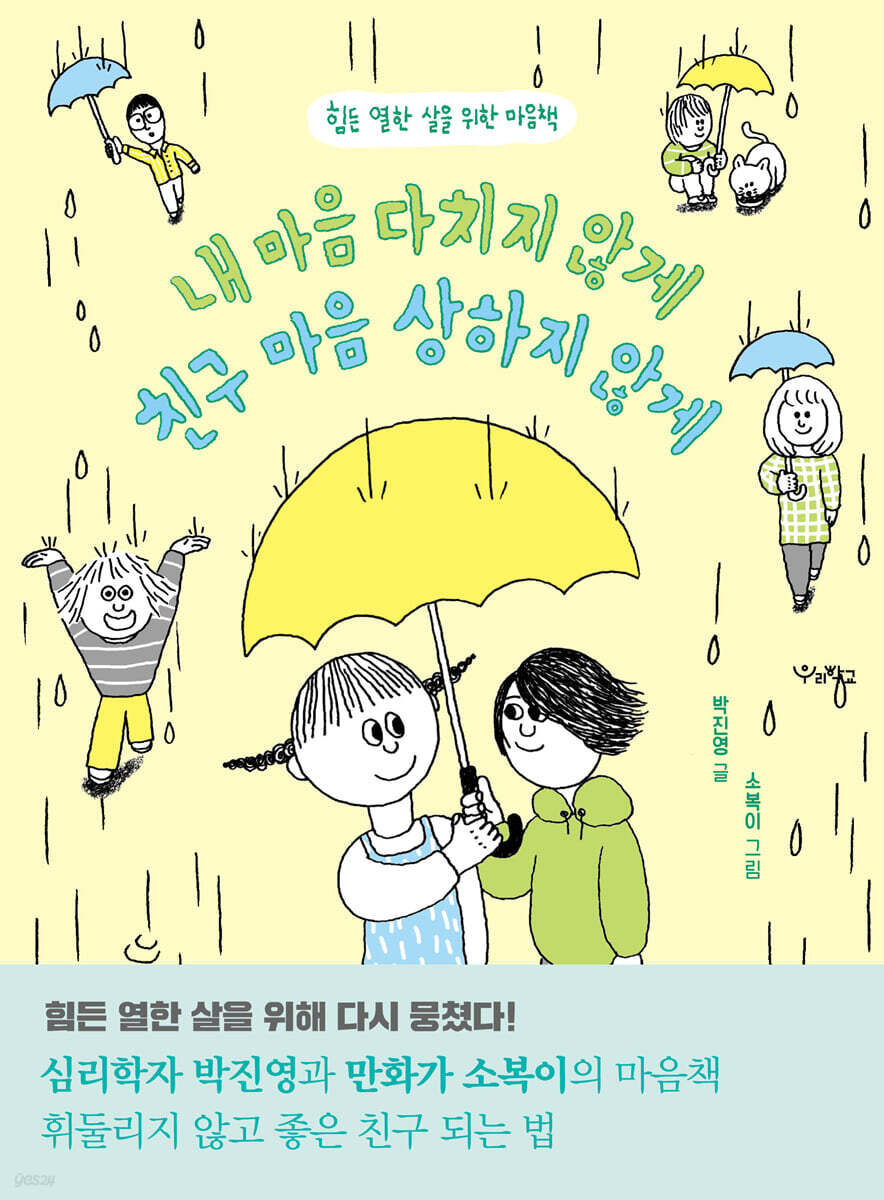
Don't hurt my heart, don't hurt my friend's heart
 |
Description
Book Introduction
We've come together to help eleven-year-olds struggling with relationship issues!
Psychologist Park Jin-young and cartoonist Sobok's eleven-year-old mind book
Psychologist Park Jin-young and cartoonist Sobok meet again to help a struggling eleven-year-old struggling with friendships.
Eleven is an age when your heart grows and your relationships with friends deepen. It is an age when you want to become closer to your friends and have your heart respected.
Sometimes we get hurt by our friends' trivial words and actions, and sometimes we get embarrassed when we hurt our friends' feelings with our own mistakes.
How can I become close to a friend I like without being swayed?
"Don't Hurt My Heart, Don't Hurt My Friend's Heart" looks at the relationship concerns of an eleven-year-old, focusing on how to protect oneself and respect one's friends, and how to be a good friend without being swayed.
We'll encounter a variety of relatable everyday concerns of eleven-year-olds, explore them through psychological lens, and work together to find ways to protect our hearts and become true friends.
Young readers will encounter the inner thoughts they've been curious about and confused about but never asked anyone about in this book, and will empathize with the story, thinking, "Is this my story?"
As you read the heartwarming illustrations of cartoonist Sobok and the refreshing advice of psychologist Jinyoung Park, you'll imagine the friendly faces of the friends you'll meet in class tomorrow, and gain the courage to approach them with confidence and affection.
Psychologist Park Jin-young and cartoonist Sobok's eleven-year-old mind book
Psychologist Park Jin-young and cartoonist Sobok meet again to help a struggling eleven-year-old struggling with friendships.
Eleven is an age when your heart grows and your relationships with friends deepen. It is an age when you want to become closer to your friends and have your heart respected.
Sometimes we get hurt by our friends' trivial words and actions, and sometimes we get embarrassed when we hurt our friends' feelings with our own mistakes.
How can I become close to a friend I like without being swayed?
"Don't Hurt My Heart, Don't Hurt My Friend's Heart" looks at the relationship concerns of an eleven-year-old, focusing on how to protect oneself and respect one's friends, and how to be a good friend without being swayed.
We'll encounter a variety of relatable everyday concerns of eleven-year-olds, explore them through psychological lens, and work together to find ways to protect our hearts and become true friends.
Young readers will encounter the inner thoughts they've been curious about and confused about but never asked anyone about in this book, and will empathize with the story, thinking, "Is this my story?"
As you read the heartwarming illustrations of cartoonist Sobok and the refreshing advice of psychologist Jinyoung Park, you'll imagine the friendly faces of the friends you'll meet in class tomorrow, and gain the courage to approach them with confidence and affection.
- You can preview some of the book's contents.
Preview
index
Entering_To an eleven-year-old who is curious about his friend's feelings
Part 1_ There is an invisible line between us
1.
The closer you are to someone, the more likely you are to get hurt.
(Looking) I feel like my friends don't value me.
(Find out) The reason you get hurt is because you like that person.
(Protection) When you feel sad about someone precious, think about it for a moment.
2.
It's important to keep boundaries and lines.
(Looking) If we're close, can I tell you everything?
(Learn) There is a line in relationships
You can become close while keeping the line
3.
There are boundaries to be observed even in physical contact.
(Looking) Is it not allowed to touch between friends?
(Learning) Be careful with physical contact
(Protection) I cherish my mind and body
Part 2_ Do you have a friend who doesn't fit with you?
1.
Conflicts arise even between friends.
(Looking) Why do we fight over trivial things?
(Learn more) Conflicts arise even among close friends.
(Guarding) People's thoughts and habits are all different.
2.
Should I always give in to my friend?
(Looking) I feel like an idiot
(Learn more) There is a line even in concessions
(Protection) Become friends who care for each other
3.
Why would your friend do that?
(Looking) I don't understand my friend's behavior.
Think about it and say, 'That could be true.'
(Guarding) Think before you get disappointed
Part 3_ I want to take a step closer
1.
You may feel left out
(Looking) I feel like I'm the only one left out
(Learning) Alienation is an opportunity to examine relationships.
(Protection) Feeling alienated is a natural emotion.
2.
I'm worried about what other people think of me
(Looking) I'm scared of people's gaze
(Learn) Don't be afraid of being evaluated
(Protection) It is also necessary to listen to it
3.
Not everyone can like me
(Looking) What if you hate me?
(Find out) Don't worry in advance about being rejected
(Keeping) It's not easy to become close with people.
Part 4_The Heart that Stops Violence
1.
No matter how close you are, violence is absolutely not allowed.
(Looking at it) Shouldn't we be more considerate of each other as we get closer?
(Learn more) Violence happens even in close relationships.
(Protection) You must keep your distance to avoid getting hurt.
2.
Fight without backing down
(Looking) I'm scared that I'll be bullied too
(Learn more) If you remain silent, violence will get worse.
(Protection) Wrong behavior must be corrected
3.
Violence also happens online.
(Looking) Can comments also be terrorism?
(Learn more) Cyber violence is also violence.
Cyberbullying, we can stop it
4.
Protect me even in places I can't see
(Looking) I thought we were friends, but we weren't
(Learn more) I need to protect myself better online
(Protection) Say no to things that can't be done
Part 5_ I want to be real friends with you
1.
Please open your heart and show me
(Looking) Why does it feel awkward at first?
(Get to know) If you open your heart, it becomes easier to approach
(Guarding) Find something that feels tingly
2.
Gratitude has power
(Looking) Why is it so hard to say thank you?
(Learning) When you know gratitude, your bond becomes stronger.
(Keeping) Express your gratitude often
3.
Sharing compliments makes me happy
(Looking) It's a little awkward to compliment
(Learn more) Praise makes even a whale dance
(Protect) Take a close look at your friends
4.
Helping can be inconvenient
(Looking) Isn't it a good thing to help?
(Find out) There are ways to help too
To give and receive help appropriately
Going Out_ Three Ways to Protect Our Relationship
one.
I need to take care of my heart first
two.
No matter how close we are, we need time to ourselves.
three.
There are times when you have to choose your friends too.
Part 1_ There is an invisible line between us
1.
The closer you are to someone, the more likely you are to get hurt.
(Looking) I feel like my friends don't value me.
(Find out) The reason you get hurt is because you like that person.
(Protection) When you feel sad about someone precious, think about it for a moment.
2.
It's important to keep boundaries and lines.
(Looking) If we're close, can I tell you everything?
(Learn) There is a line in relationships
You can become close while keeping the line
3.
There are boundaries to be observed even in physical contact.
(Looking) Is it not allowed to touch between friends?
(Learning) Be careful with physical contact
(Protection) I cherish my mind and body
Part 2_ Do you have a friend who doesn't fit with you?
1.
Conflicts arise even between friends.
(Looking) Why do we fight over trivial things?
(Learn more) Conflicts arise even among close friends.
(Guarding) People's thoughts and habits are all different.
2.
Should I always give in to my friend?
(Looking) I feel like an idiot
(Learn more) There is a line even in concessions
(Protection) Become friends who care for each other
3.
Why would your friend do that?
(Looking) I don't understand my friend's behavior.
Think about it and say, 'That could be true.'
(Guarding) Think before you get disappointed
Part 3_ I want to take a step closer
1.
You may feel left out
(Looking) I feel like I'm the only one left out
(Learning) Alienation is an opportunity to examine relationships.
(Protection) Feeling alienated is a natural emotion.
2.
I'm worried about what other people think of me
(Looking) I'm scared of people's gaze
(Learn) Don't be afraid of being evaluated
(Protection) It is also necessary to listen to it
3.
Not everyone can like me
(Looking) What if you hate me?
(Find out) Don't worry in advance about being rejected
(Keeping) It's not easy to become close with people.
Part 4_The Heart that Stops Violence
1.
No matter how close you are, violence is absolutely not allowed.
(Looking at it) Shouldn't we be more considerate of each other as we get closer?
(Learn more) Violence happens even in close relationships.
(Protection) You must keep your distance to avoid getting hurt.
2.
Fight without backing down
(Looking) I'm scared that I'll be bullied too
(Learn more) If you remain silent, violence will get worse.
(Protection) Wrong behavior must be corrected
3.
Violence also happens online.
(Looking) Can comments also be terrorism?
(Learn more) Cyber violence is also violence.
Cyberbullying, we can stop it
4.
Protect me even in places I can't see
(Looking) I thought we were friends, but we weren't
(Learn more) I need to protect myself better online
(Protection) Say no to things that can't be done
Part 5_ I want to be real friends with you
1.
Please open your heart and show me
(Looking) Why does it feel awkward at first?
(Get to know) If you open your heart, it becomes easier to approach
(Guarding) Find something that feels tingly
2.
Gratitude has power
(Looking) Why is it so hard to say thank you?
(Learning) When you know gratitude, your bond becomes stronger.
(Keeping) Express your gratitude often
3.
Sharing compliments makes me happy
(Looking) It's a little awkward to compliment
(Learn more) Praise makes even a whale dance
(Protect) Take a close look at your friends
4.
Helping can be inconvenient
(Looking) Isn't it a good thing to help?
(Find out) There are ways to help too
To give and receive help appropriately
Going Out_ Three Ways to Protect Our Relationship
one.
I need to take care of my heart first
two.
No matter how close we are, we need time to ourselves.
three.
There are times when you have to choose your friends too.
Detailed image

Publisher's Review
“I’m curious about my friend’s feelings, but I also want to protect my own.”
A counseling center for 11-year-olds struggling in relationships
How's your eleven-year-old heart doing today? Studying is becoming increasingly difficult and challenging, and relationships with friends you meet every day at school and at the academy aren't always easy.
I have no idea why my close friend, who I was close with yesterday, isn't talking to me today, and I'm also upset because it seems like my close friend doesn't respect me.
‘Do I always have to give in to my friend?’ ‘Why do I fight with my friend over trivial things?’ ‘I want to know what my friend is thinking, but I also want to protect my own feelings…’ As the desire to make a real friend grows, the inner suffering of an eleven-year-old who secretly worries about problems with friends deepens.
"Don't Hurt My Heart, Don't Hurt My Friend's Heart" is a heart-warming book that comforts and encourages children who want to protect their own hearts and respect their friends' hearts.
It contains the concerns of an eleven-year-old's relationships that extend beyond oneself to others.
The book contains 28 vivid relationship concerns from children's daily lives.
Psychologist and bestselling author Jinyoung Park provides empathy and understanding tailored to children's concerns, and then shares his insights on "relationship psychology," gleaned from various psychological theories and experiments, in a way that readers can easily understand, as if he were giving counseling.
Also, the drawings of cartoonist Sobok, who is loved by both children and adult readers, resemble the face of a playful and affectionate eleven-year-old friend.
As readers turn the pages, they will naturally find themselves and their partner in the book, and will comfortably immerse themselves in the book's concerns and advice.
From physical contact requiring consent, to harassment, to cyberbullying.
How to wisely protect yourself even when you're confused or afraid
Today's eleven-year-olds are going through a slightly different eleven-year life than their parents and teachers did.
Children's lives continue not only at home, at school, and in the academy, but also in the online world.
Relationships formed in game chat windows and with online friends we meet every day on social media are also considered important human relationships.
You can freely talk with older siblings and older sisters and brothers, and you can build a sense of pride and intimacy by learning about a world you didn't know about.
As a result, we sometimes receive recognition and affection from strangers we have never met in person, but on the other hand, we also get hurt by judgment and insults.
In such times, how do children organize and express their feelings, and with whom do they share their concerns?
"Don't Hurt My Heart, Don't Hurt My Friends" also contains expert advice on various situations and concerns about cyberbullying that children can encounter through chats, comments, and DMs (Direct Messages).
From how to refuse requests for money or photos to what to do when you encounter malicious comments or feel you've been victimized, psychologist Jinyoung Park offers concrete and helpful strategies for eleven-year-olds to put into practice.
Also, not only online, but also in the classroom, at school, and on the street, including bullying and violence experienced or witnessed, the closer you are to each other, the more unpleasant situations that happen with a "Hey, between us" attitude, and the uncomfortable situations caused by excessive physical contact even with a friend you like, I do not miss them, and I do not spare affectionate and strong advice to help you think of yourself and protect your own heart.
Because in relationships with others, the first thing you must protect is yourself.
“It’s okay to not try too hard to be nice to everyone to maintain relationships.
You don't necessarily have to have a lot of friends to be a good person.
It's important to choose friends who you get along well with, who support you, and who understand you well.
“Don’t forget that relationships are ultimately one of the things I need to live happily in this world.” (Page 98)
Psychologist and author Jinyoung Park says that good friendships are not one-sided, but two-way.
This is because it is a relationship where both parties respect each other and approach each other, rather than one party making efforts and worrying about only one side.
The closer you are to each other, the more important it is to respect and maintain an invisible line between you and your partner.
We support the growth of an eleven-year-old who looks beyond 'my heart' to 'my friend's heart' and their deepening friendship.
A counseling center for 11-year-olds struggling in relationships
How's your eleven-year-old heart doing today? Studying is becoming increasingly difficult and challenging, and relationships with friends you meet every day at school and at the academy aren't always easy.
I have no idea why my close friend, who I was close with yesterday, isn't talking to me today, and I'm also upset because it seems like my close friend doesn't respect me.
‘Do I always have to give in to my friend?’ ‘Why do I fight with my friend over trivial things?’ ‘I want to know what my friend is thinking, but I also want to protect my own feelings…’ As the desire to make a real friend grows, the inner suffering of an eleven-year-old who secretly worries about problems with friends deepens.
"Don't Hurt My Heart, Don't Hurt My Friend's Heart" is a heart-warming book that comforts and encourages children who want to protect their own hearts and respect their friends' hearts.
It contains the concerns of an eleven-year-old's relationships that extend beyond oneself to others.
The book contains 28 vivid relationship concerns from children's daily lives.
Psychologist and bestselling author Jinyoung Park provides empathy and understanding tailored to children's concerns, and then shares his insights on "relationship psychology," gleaned from various psychological theories and experiments, in a way that readers can easily understand, as if he were giving counseling.
Also, the drawings of cartoonist Sobok, who is loved by both children and adult readers, resemble the face of a playful and affectionate eleven-year-old friend.
As readers turn the pages, they will naturally find themselves and their partner in the book, and will comfortably immerse themselves in the book's concerns and advice.
From physical contact requiring consent, to harassment, to cyberbullying.
How to wisely protect yourself even when you're confused or afraid
Today's eleven-year-olds are going through a slightly different eleven-year life than their parents and teachers did.
Children's lives continue not only at home, at school, and in the academy, but also in the online world.
Relationships formed in game chat windows and with online friends we meet every day on social media are also considered important human relationships.
You can freely talk with older siblings and older sisters and brothers, and you can build a sense of pride and intimacy by learning about a world you didn't know about.
As a result, we sometimes receive recognition and affection from strangers we have never met in person, but on the other hand, we also get hurt by judgment and insults.
In such times, how do children organize and express their feelings, and with whom do they share their concerns?
"Don't Hurt My Heart, Don't Hurt My Friends" also contains expert advice on various situations and concerns about cyberbullying that children can encounter through chats, comments, and DMs (Direct Messages).
From how to refuse requests for money or photos to what to do when you encounter malicious comments or feel you've been victimized, psychologist Jinyoung Park offers concrete and helpful strategies for eleven-year-olds to put into practice.
Also, not only online, but also in the classroom, at school, and on the street, including bullying and violence experienced or witnessed, the closer you are to each other, the more unpleasant situations that happen with a "Hey, between us" attitude, and the uncomfortable situations caused by excessive physical contact even with a friend you like, I do not miss them, and I do not spare affectionate and strong advice to help you think of yourself and protect your own heart.
Because in relationships with others, the first thing you must protect is yourself.
“It’s okay to not try too hard to be nice to everyone to maintain relationships.
You don't necessarily have to have a lot of friends to be a good person.
It's important to choose friends who you get along well with, who support you, and who understand you well.
“Don’t forget that relationships are ultimately one of the things I need to live happily in this world.” (Page 98)
Psychologist and author Jinyoung Park says that good friendships are not one-sided, but two-way.
This is because it is a relationship where both parties respect each other and approach each other, rather than one party making efforts and worrying about only one side.
The closer you are to each other, the more important it is to respect and maintain an invisible line between you and your partner.
We support the growth of an eleven-year-old who looks beyond 'my heart' to 'my friend's heart' and their deepening friendship.
GOODS SPECIFICS
- Date of issue: September 29, 2025
- Page count, weight, size: 100 pages | 276g | 168*228*7mm
- ISBN13: 9791167553454
- ISBN10: 1167553454
- KC Certification: Certification Type: Conformity Confirmation
You may also like
카테고리
korean


korean

![GQ KOREA Mark (Monthly): December [2025]](http://librairie.coreenne.fr/cdn/shop/files/8ef265dbbfbf186523ed75ba7319009d.jpg?v=1765340328&width=3840)


