

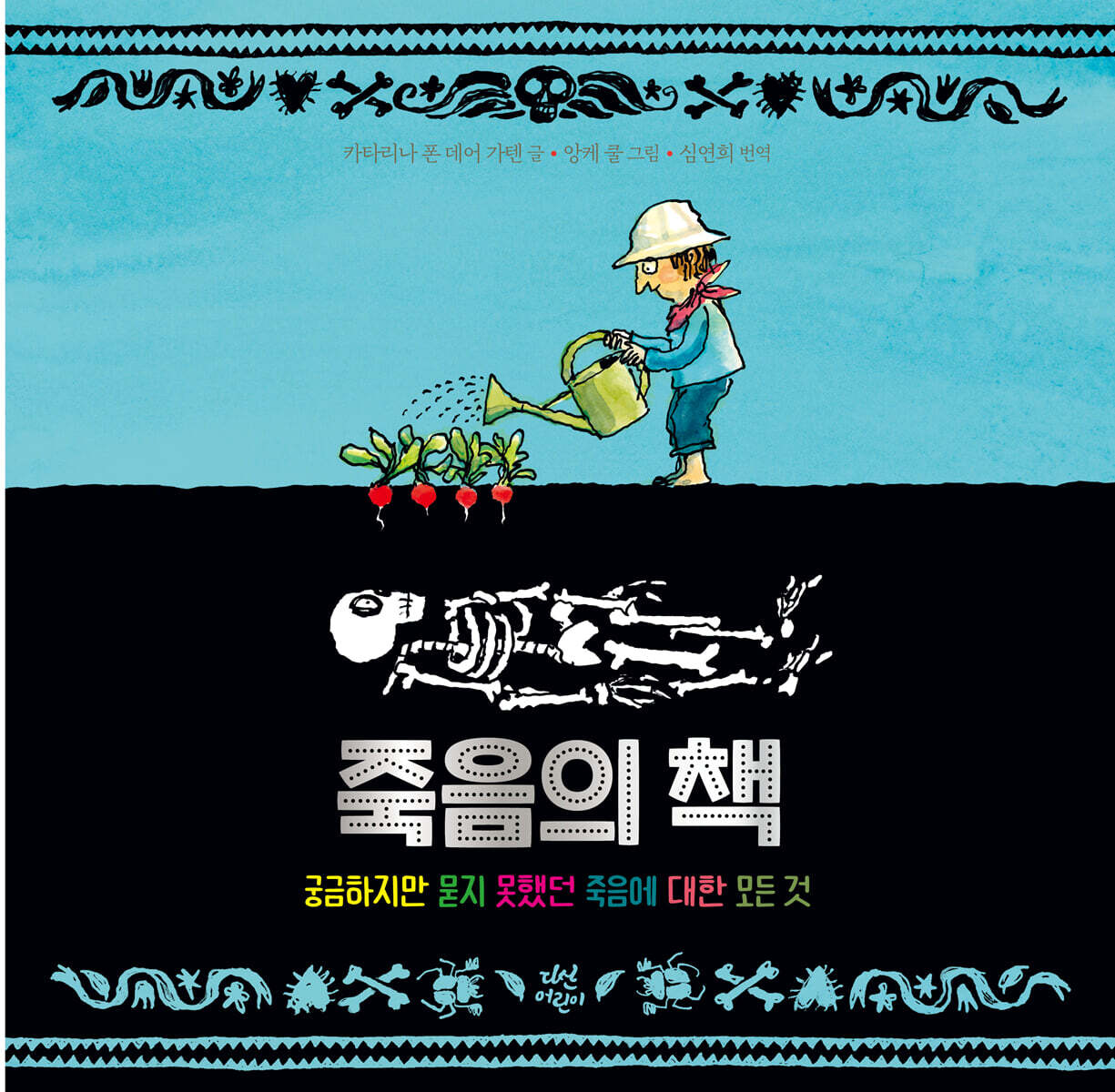
Book of the Dead
 |
Description
Book Introduction
“Where do you go when you die?”
A place you must go to at least once in your life
A book for children exploring the unknown world of death.
Have you ever stepped on an ant at the playground? Swatted a mosquito or a fly? Have you ever cried watching someone die in a movie? You've probably died in a game and gotten a game over, right?
All these situations are related to death.
There is more death around us than we think.
And this death is an inseparable and important part of our lives.
This book takes us to death.
Precisely, in many ways, and above all, humorously.
It's still far away, and sometimes I want to avoid it, and somehow I'm afraid, but as I read the book, I find that it's not like that naturally.
There is a wealth of anthropological, cultural, and scientific information about death, including how people have treated the dead since ancient times, what they imagined would happen after death, what to prepare for when someone actually dies, how it feels, and how to cope with the loss.
Approaching death intellectually will help alleviate the vague fear of death and help us accept death as a part of life.
Let's go together into the secret room of the world of death, which is always by our side but has been treated as distant.
A place you must go to at least once in your life
A book for children exploring the unknown world of death.
Have you ever stepped on an ant at the playground? Swatted a mosquito or a fly? Have you ever cried watching someone die in a movie? You've probably died in a game and gotten a game over, right?
All these situations are related to death.
There is more death around us than we think.
And this death is an inseparable and important part of our lives.
This book takes us to death.
Precisely, in many ways, and above all, humorously.
It's still far away, and sometimes I want to avoid it, and somehow I'm afraid, but as I read the book, I find that it's not like that naturally.
There is a wealth of anthropological, cultural, and scientific information about death, including how people have treated the dead since ancient times, what they imagined would happen after death, what to prepare for when someone actually dies, how it feels, and how to cope with the loss.
Approaching death intellectually will help alleviate the vague fear of death and help us accept death as a part of life.
Let's go together into the secret room of the world of death, which is always by our side but has been treated as distant.
- You can preview some of the book's contents.
Preview
index
Prologue: Before starting the book
1 The moment life ends
Beginning and End
Why do humans die?
absurd death
Speaking of Death: The Tao Story
Funny stories about death
2 What is death like?
Deathbed
Together in that place
dying
salt raid
Speaking of Death: The Martin Story
I'm scared of dead people
Meeting the Dead: Martin's Story
Lyrics status
Old rituals
Saying goodbye for the last time
Speaking of Death: The Story of the Sword
corruption
3 All About Funerals
Which one should I choose?
In the makeup room
At the graveyard
Speaking of Death: The Glass Story
Changing funerals
Speaking of Death: The Story of Barbara and Julia
Funerals involve a lot of decisions.
Attend a funeral
Speaking of Death: Cecil's Story
Funny stories about death
4 Mourning Heart
Suddenly changed daily life
The emotion of sadness
What's left
What happens after death
Speaking of Death: Anna's Story
5 Living with the Dead
Religion, era, culture
immortality
Images and symbols of death
Funny stories about death
Key words
Making a Skull Mask
Making a mini coffin
1 The moment life ends
Beginning and End
Why do humans die?
absurd death
Speaking of Death: The Tao Story
Funny stories about death
2 What is death like?
Deathbed
Together in that place
dying
salt raid
Speaking of Death: The Martin Story
I'm scared of dead people
Meeting the Dead: Martin's Story
Lyrics status
Old rituals
Saying goodbye for the last time
Speaking of Death: The Story of the Sword
corruption
3 All About Funerals
Which one should I choose?
In the makeup room
At the graveyard
Speaking of Death: The Glass Story
Changing funerals
Speaking of Death: The Story of Barbara and Julia
Funerals involve a lot of decisions.
Attend a funeral
Speaking of Death: Cecil's Story
Funny stories about death
4 Mourning Heart
Suddenly changed daily life
The emotion of sadness
What's left
What happens after death
Speaking of Death: Anna's Story
5 Living with the Dead
Religion, era, culture
immortality
Images and symbols of death
Funny stories about death
Key words
Making a Skull Mask
Making a mini coffin
Detailed image

Into the book
When we look around nature like this, we often see two opposing sides of one thing.
At first glance, those two things may seem incompatible, but in fact, they are often inseparable.
Just as there is no day without night, no summer without winter, and no waking hours without sleeping hours,
Birth and death cannot be divided into two either.
Perhaps the reason life between birth and death is so unique and special is because death serves as its boundary.
--- From "The Beginning and the End"
Everyone has a different way of saying their final goodbyes.
It's like a scene of parting at a train station.
Some people think it's cool to ride a train and say goodbye to lots of friends on the train platform.
Let's all hug each other and reminisce about the times we spent together.
And when you get on the train, everyone feels both sadness and gratitude at the same time.
On the other hand, there are people who like to go to the platform alone and quietly.
I think it's better to say a brief goodbye to these people in advance.
And when the train departs, I am content to leave alone without looking back.
--- From "Saying Final Goodbyes"
Q: Should we talk to children about death?
A: I think we need to talk about death and dying just as we do about any other topic or thing.
It's better to speak up without fear.
Children are all well aware that death exists.
It is not at all strange to children that people live and die.
But when I'm with my children, I want to focus on life rather than death.
With all the strength and joy that has been given to us.
--- From "Talking About Death: The Story of the Knife (Palliative Medicine Specialist)"
Q: What do children do at funerals?
A: Children are usually in the front row.
And it's when the coffin goes down into the pit that it gets the most interesting.
Suddenly, from somewhere, a child's voice is heard saying, "Wow! It's really deep!"
Then the children themselves pick up shovels and dig up the dirt or pick up flowers and throw them on the grave.
And then most of them say, 'I did something too.
I proudly walk out of the grave with the feeling that 'I was helpful too.'
--- From "Talking About Death: The Story of Barbara and Julia (Funeral Director)"
Grief is accompanied by tears, sobs, and whimpers.
Sometimes I feel so hopeless that I can't believe life will ever get better.
There are times when we all have to cry together because everyone around us is in despair.
Tears are easily contagious.
But crying like this has a very good effect.
So feel free to cry.
--- From "The Emotion Called Sadness"
Q: Is there a difference in grief between adults and children?
A: I think so.
If an adult's grief is like diving into a large, deep lake and not coming out for a long time, a child's grief is like jumping into a puddle.
So, the moment I jump in, I feel the sadness very intensely.
But you'll soon get out of the puddle again.
At first glance, those two things may seem incompatible, but in fact, they are often inseparable.
Just as there is no day without night, no summer without winter, and no waking hours without sleeping hours,
Birth and death cannot be divided into two either.
Perhaps the reason life between birth and death is so unique and special is because death serves as its boundary.
--- From "The Beginning and the End"
Everyone has a different way of saying their final goodbyes.
It's like a scene of parting at a train station.
Some people think it's cool to ride a train and say goodbye to lots of friends on the train platform.
Let's all hug each other and reminisce about the times we spent together.
And when you get on the train, everyone feels both sadness and gratitude at the same time.
On the other hand, there are people who like to go to the platform alone and quietly.
I think it's better to say a brief goodbye to these people in advance.
And when the train departs, I am content to leave alone without looking back.
--- From "Saying Final Goodbyes"
Q: Should we talk to children about death?
A: I think we need to talk about death and dying just as we do about any other topic or thing.
It's better to speak up without fear.
Children are all well aware that death exists.
It is not at all strange to children that people live and die.
But when I'm with my children, I want to focus on life rather than death.
With all the strength and joy that has been given to us.
--- From "Talking About Death: The Story of the Knife (Palliative Medicine Specialist)"
Q: What do children do at funerals?
A: Children are usually in the front row.
And it's when the coffin goes down into the pit that it gets the most interesting.
Suddenly, from somewhere, a child's voice is heard saying, "Wow! It's really deep!"
Then the children themselves pick up shovels and dig up the dirt or pick up flowers and throw them on the grave.
And then most of them say, 'I did something too.
I proudly walk out of the grave with the feeling that 'I was helpful too.'
--- From "Talking About Death: The Story of Barbara and Julia (Funeral Director)"
Grief is accompanied by tears, sobs, and whimpers.
Sometimes I feel so hopeless that I can't believe life will ever get better.
There are times when we all have to cry together because everyone around us is in despair.
Tears are easily contagious.
But crying like this has a very good effect.
So feel free to cry.
--- From "The Emotion Called Sadness"
Q: Is there a difference in grief between adults and children?
A: I think so.
If an adult's grief is like diving into a large, deep lake and not coming out for a long time, a child's grief is like jumping into a puddle.
So, the moment I jump in, I feel the sadness very intensely.
But you'll soon get out of the puddle again.
--- From "Talking About Death: Anna's Story (Psychological Counselor)"
Publisher's Review
Children are more interested in death than you might think.
The day after it rains, you can easily see children holding earthworm funerals.
When you find a bug or a dead animal in the forest, you feel disgusted but also want to examine it closely.
In fact, it is said that there are many children who want to look inside the coffin at the funeral home.
I want to see my deceased grandfather's face and touch his hands.
In this way, children tend to have less prejudice against death.
I wonder what death is and I want to know.
This book is a good guide for these children.
It tells a variety of stories about death that adults find difficult to talk about.
Above all, people in professions closely related to actual death—palliative care specialists, funeral directors, nursing home nurses, and bereavement counselors—tell vivid stories of their own experiences with death.
If you're unsure how to answer questions about death, I recommend handing someone this book and reading it together.
If you need to know about death, there's only one book you need.
Death is very complex and comes with great emotions.
Some scholars explain that death goes through five stages: denial, anger, bargaining, depression, and acceptance.
You can see that the process is long and there are many different emotions swirling around.
So this book approaches death in a number of different ways.
You can choose and read by topic of your choice.
If death is too scary for you, try this page of death-related humor.
As you laugh out loud, you will become curious about other things.
If you know someone who is grieving a loss, read the section on grief.
You can learn how to do it better.
Also, if you feel burdened while reading this book, please feel free to put it down.
You can take a break from thinking about death by taking a walk or eating something delicious.
Because you can always read it again later.
This book talks about death, but above all, it talks about life.
The day after it rains, you can easily see children holding earthworm funerals.
When you find a bug or a dead animal in the forest, you feel disgusted but also want to examine it closely.
In fact, it is said that there are many children who want to look inside the coffin at the funeral home.
I want to see my deceased grandfather's face and touch his hands.
In this way, children tend to have less prejudice against death.
I wonder what death is and I want to know.
This book is a good guide for these children.
It tells a variety of stories about death that adults find difficult to talk about.
Above all, people in professions closely related to actual death—palliative care specialists, funeral directors, nursing home nurses, and bereavement counselors—tell vivid stories of their own experiences with death.
If you're unsure how to answer questions about death, I recommend handing someone this book and reading it together.
If you need to know about death, there's only one book you need.
Death is very complex and comes with great emotions.
Some scholars explain that death goes through five stages: denial, anger, bargaining, depression, and acceptance.
You can see that the process is long and there are many different emotions swirling around.
So this book approaches death in a number of different ways.
You can choose and read by topic of your choice.
If death is too scary for you, try this page of death-related humor.
As you laugh out loud, you will become curious about other things.
If you know someone who is grieving a loss, read the section on grief.
You can learn how to do it better.
Also, if you feel burdened while reading this book, please feel free to put it down.
You can take a break from thinking about death by taking a walk or eating something delicious.
Because you can always read it again later.
This book talks about death, but above all, it talks about life.
GOODS SPECIFICS
- Date of issue: October 31, 2025
- Format: Hardcover book binding method guide
- Page count, weight, size: 160 pages | 674g | 230*225*16mm
- ISBN13: 9791130670874
- ISBN10: 1130670872
- KC Certification: Certification Type: Conformity Confirmation
You may also like
카테고리
korean


korean

![GQ KOREA Mark (Monthly): December [2025]](http://librairie.coreenne.fr/cdn/shop/files/8ef265dbbfbf186523ed75ba7319009d.jpg?v=1765340328&width=3840)


