

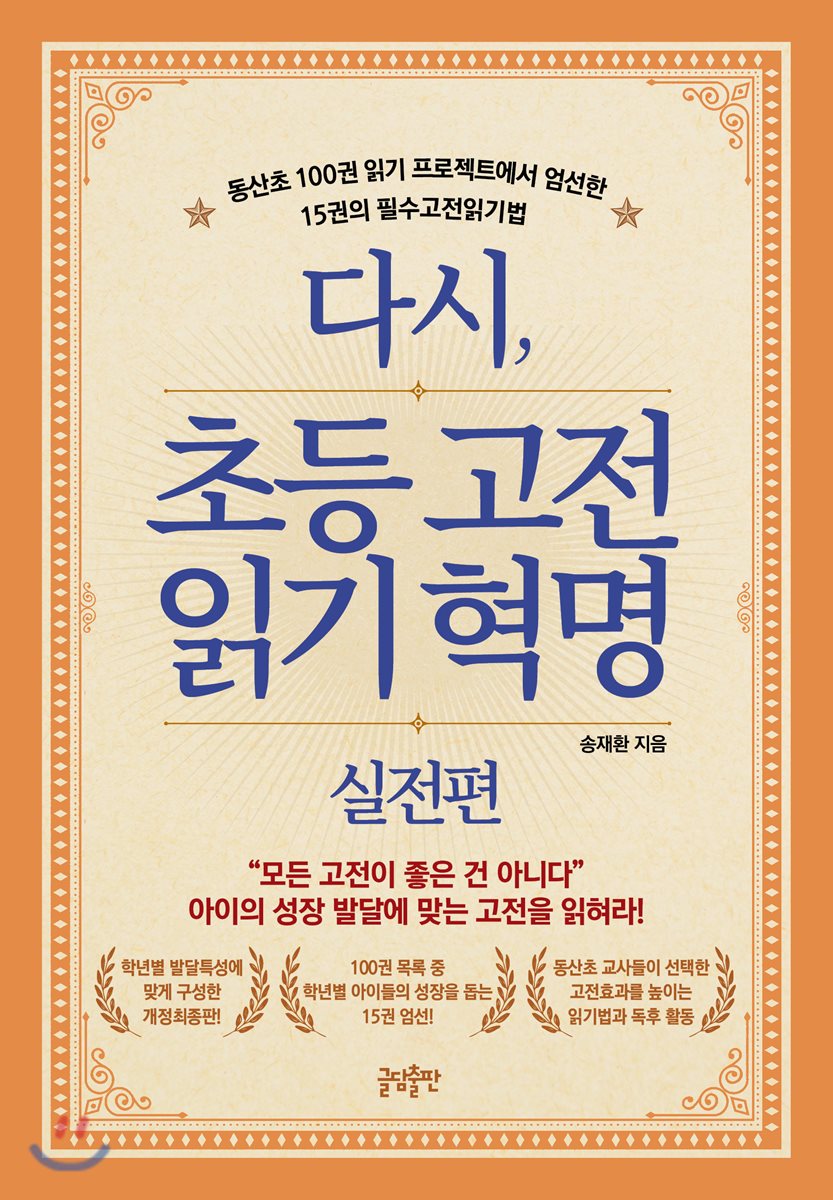
Again, the elementary classic reading revolution practical edition
 |
Description
Book Introduction
“Elementary school students have large differences in growth and development depending on their age.
“Can we read the classics in the same way?”
Considering the developmental characteristics of each grade, 15 essential classics were carefully selected.
Includes effective reading methods and a variety of reading activities you can try yourself!
“Are all classics good for children?”
15 classic books and reading methods to help elementary school children grow!
『Again, Elementary Classic Reading Revolution Practical Edition』 is the final and revised edition, with a major overhaul in everything from the structure to the content, so that anyone, even those who have never read a classic before, can easily follow along.
Among the list of classics and reading methods revealed through the Dongsan Elementary School 100 Classics Reading Project, only 15 classics that are beneficial to elementary school children's development were carefully selected and effective reading methods are introduced.
We received a steady stream of calls from parents and teachers asking for help, saying, “I want my children to read the classics, but I just don’t know where or how to start.”
He complained about the difficulties he faced after hitting the wall called the classics.
To actively collect the opinions and requests of these readers and provide assistance, we have published a new book, 『Again, Elementary Classics Reading Revolution: Practical Edition』.
In particular, it was organized by grade level to reflect the characteristics of elementary school children who have large developmental differences depending on their age.
Teacher Song Jae-hwan advises, “Not all classics are good for children. Children should read classics that are appropriate for their growth and development.”
It is divided into 1st and 2nd grades, which should start with a long-term attitude, 3rd and 4th grades, which are the real start, and 5th and 6th grades, which are the fun and in-depth learning, and the developmental characteristics of children in each grade are read.
Based on these characteristics, we carefully select 5 essential classics for each grade level to help children grow and teach them how to read them.
This allows you to get practical and specific help according to your child's age.
Furthermore, we have included a variety of reading activity sheets so that you can read carefully selected essential classics at home.
In addition to the book's features, significance, and key reading points, each classic book includes a variety of post-reading activities to help readers understand the content and broaden their thinking.
By engaging children in various activities related to essential classics and writing about them, we ensured that they could fully experience the benefits of the classics.
“Can we read the classics in the same way?”
Considering the developmental characteristics of each grade, 15 essential classics were carefully selected.
Includes effective reading methods and a variety of reading activities you can try yourself!
“Are all classics good for children?”
15 classic books and reading methods to help elementary school children grow!
『Again, Elementary Classic Reading Revolution Practical Edition』 is the final and revised edition, with a major overhaul in everything from the structure to the content, so that anyone, even those who have never read a classic before, can easily follow along.
Among the list of classics and reading methods revealed through the Dongsan Elementary School 100 Classics Reading Project, only 15 classics that are beneficial to elementary school children's development were carefully selected and effective reading methods are introduced.
We received a steady stream of calls from parents and teachers asking for help, saying, “I want my children to read the classics, but I just don’t know where or how to start.”
He complained about the difficulties he faced after hitting the wall called the classics.
To actively collect the opinions and requests of these readers and provide assistance, we have published a new book, 『Again, Elementary Classics Reading Revolution: Practical Edition』.
In particular, it was organized by grade level to reflect the characteristics of elementary school children who have large developmental differences depending on their age.
Teacher Song Jae-hwan advises, “Not all classics are good for children. Children should read classics that are appropriate for their growth and development.”
It is divided into 1st and 2nd grades, which should start with a long-term attitude, 3rd and 4th grades, which are the real start, and 5th and 6th grades, which are the fun and in-depth learning, and the developmental characteristics of children in each grade are read.
Based on these characteristics, we carefully select 5 essential classics for each grade level to help children grow and teach them how to read them.
This allows you to get practical and specific help according to your child's age.
Furthermore, we have included a variety of reading activity sheets so that you can read carefully selected essential classics at home.
In addition to the book's features, significance, and key reading points, each classic book includes a variety of post-reading activities to help readers understand the content and broaden their thinking.
By engaging children in various activities related to essential classics and writing about them, we ensured that they could fully experience the benefits of the classics.
- You can preview some of the book's contents.
Preview
index
prolog
· Chapter 1 ·
Prepare a classic reading environment
◆ The reading environment and the classic reading environment are different.
No environment can surpass parents.
◆ 4T Strategy for Successful Reading of Classics
Trust: Knowing and believing are different things. Time: Even time requires strategy.
Together: Doing it together unconditionallyㅣTransform: Transforming me
◆ How prepared is our house?
Chapter 2
Reading classics for first and second graders with a long-term mindset
2-1 Classical Reading Methods Utilizing the Development and Characteristics of 1st and 2nd Graders
◆ 1st and 2nd grades are a preparatory period for reading classics.
◆ Pay attention to your child's thinking and value formation.
Characteristics of lower grades as seen through classroom scenes | Just knowing the characteristics reveals books you should read.
◆ Read a lot of classic literature
Expand your child's world | Imagination training from the best teachers
Why We Fail at Reading Classic Literature
◆ A welcome gift that guides first and second graders to the classics
Even children who only search for comics are now listening.
◆ 1st and 2nd grades are the best time to develop good habits.
Even if it's difficult and annoying, read out loud and read a book with a pencil in hand.
Reading by hand allows for deeper reading.
◆ 1st and 2nd graders, what classics should they read and how?
Don't get bored with repetition | Understanding changes depending on posture
Avoid questions that have answers | Active post-reading activities enhance the enjoyment of books.
Classic Book List for Younger Students
2-2 Reading Methods for 1st and 2nd Graders: Learning with 5 Classic Books
◆ How were the representative classics selected?
Reading method, how was it structured?
◆ "It's Okay to Be Wrong"
◆ 『Children's Lion Elementary School』
◆ 『The Giving Tree』
Charlotte's Web
◆ 『Hope for Flowers』
Chapter 3
Reading classics in earnest for 3rd and 4th graders
3-1 Classical Reading Methods Utilizing the Development and Characteristics of 3rd and 4th Graders
◆ 3rd and 4th graders, a child's reading life is determined
◆ Pay attention to your child's vocabulary and desire to learn.
Characteristics of Middle School through Classroom Views | The Beginning of Vocabulary Puberty
◆ 3rd and 4th graders need heroes
Electric Literature: Read It This Way
◆ 3rd and 4th graders, what classics should they read and how?
Leverage your friends | Visualize your results | Use book reviews actively.
Train your children to read long classics | Encourage them to read poetry | List of classic books for middle school students
3-2 Reading Methods for 3rd and 4th Graders: Learning with 5 Classic Books
◆ 3rd and 4th graders, pay attention to this when reading classics
◆ 『The Treasure of Mind』
◆ 『Elementary Learning』
◆ 『15 Boy's Diary』
◆ 『The Seagull's Dream』
◆ 『Shower』
Chapter 4
Fun and In-Depth Classic Reading for 5th and 6th Graders
4-1 Classical Reading Methods Utilizing the Development and Characteristics of 5th and 6th Graders
◆ 5th and 6th grades are the best time to read classics.
◆ Immerse yourself in the world of knowledge and logic
Characteristics of Upper Grades as Seen Through Classroom Scenes | From Extensive Reading to Purpose-Oriented Reading
Make them keep writing
◆ Let them experience the taste of humanities classics.
Humanities classics enhance children's emotional intelligence and encourage self-transformation.
Reading for pleasure vs. reading for enjoyment
◆ How to Read Humanities Classics
The backstories behind the books pique curiosity. Unfamiliar vocabulary becomes more fun when you know it.
Why You Need a Rigorous Reading Schedule | A List of Classic Humanities Books for Elementary School Children
◆ 5th and 6th graders, what classics should they read and how?
The "Tail-Chasing" Reading MethodㅣClassics: Don't Just Read Them
The most enjoyable post-reading activity for childrenㅣChoose a main characterㅣA passage that touched my heart
Encourage Your Thoughts | Classic Books for Older Students
4-2 Reading Methods for 5th and 6th Graders: Learning from 5 Classic Books
◆ Reading the humanities classics with the Analects
◆ 『The Analects of Confucius』
◆ 『Korean Masterpieces You'll Want to Read 100 Years Later』
◆ 『Meditation Record』
◆ 『The Remarkable Pilgrim's Progress』
Pride and Prejudice
Chapter 5
10 Questions Parents Ask Most
◆ What if I start to hate books more?
◆ Is there a specific order for reading classics by subject?
◆ Can I read classic comics or abridged classics?
◆ Is it too late for middle school students to start reading classics?
◆ Do I have to buy the book and read it?
◆ Is it difficult for kindergarteners to read classics?
◆ What should I pay attention to when reading at school?
◆ Do you choose books based on whether your child is older or younger?
◆ What should I do with a child who hates post-reading activities?
◆ Can you just show the movie instead of the original?
Epilogue
· Chapter 1 ·
Prepare a classic reading environment
◆ The reading environment and the classic reading environment are different.
No environment can surpass parents.
◆ 4T Strategy for Successful Reading of Classics
Trust: Knowing and believing are different things. Time: Even time requires strategy.
Together: Doing it together unconditionallyㅣTransform: Transforming me
◆ How prepared is our house?
Chapter 2
Reading classics for first and second graders with a long-term mindset
2-1 Classical Reading Methods Utilizing the Development and Characteristics of 1st and 2nd Graders
◆ 1st and 2nd grades are a preparatory period for reading classics.
◆ Pay attention to your child's thinking and value formation.
Characteristics of lower grades as seen through classroom scenes | Just knowing the characteristics reveals books you should read.
◆ Read a lot of classic literature
Expand your child's world | Imagination training from the best teachers
Why We Fail at Reading Classic Literature
◆ A welcome gift that guides first and second graders to the classics
Even children who only search for comics are now listening.
◆ 1st and 2nd grades are the best time to develop good habits.
Even if it's difficult and annoying, read out loud and read a book with a pencil in hand.
Reading by hand allows for deeper reading.
◆ 1st and 2nd graders, what classics should they read and how?
Don't get bored with repetition | Understanding changes depending on posture
Avoid questions that have answers | Active post-reading activities enhance the enjoyment of books.
Classic Book List for Younger Students
2-2 Reading Methods for 1st and 2nd Graders: Learning with 5 Classic Books
◆ How were the representative classics selected?
Reading method, how was it structured?
◆ "It's Okay to Be Wrong"
◆ 『Children's Lion Elementary School』
◆ 『The Giving Tree』
Charlotte's Web
◆ 『Hope for Flowers』
Chapter 3
Reading classics in earnest for 3rd and 4th graders
3-1 Classical Reading Methods Utilizing the Development and Characteristics of 3rd and 4th Graders
◆ 3rd and 4th graders, a child's reading life is determined
◆ Pay attention to your child's vocabulary and desire to learn.
Characteristics of Middle School through Classroom Views | The Beginning of Vocabulary Puberty
◆ 3rd and 4th graders need heroes
Electric Literature: Read It This Way
◆ 3rd and 4th graders, what classics should they read and how?
Leverage your friends | Visualize your results | Use book reviews actively.
Train your children to read long classics | Encourage them to read poetry | List of classic books for middle school students
3-2 Reading Methods for 3rd and 4th Graders: Learning with 5 Classic Books
◆ 3rd and 4th graders, pay attention to this when reading classics
◆ 『The Treasure of Mind』
◆ 『Elementary Learning』
◆ 『15 Boy's Diary』
◆ 『The Seagull's Dream』
◆ 『Shower』
Chapter 4
Fun and In-Depth Classic Reading for 5th and 6th Graders
4-1 Classical Reading Methods Utilizing the Development and Characteristics of 5th and 6th Graders
◆ 5th and 6th grades are the best time to read classics.
◆ Immerse yourself in the world of knowledge and logic
Characteristics of Upper Grades as Seen Through Classroom Scenes | From Extensive Reading to Purpose-Oriented Reading
Make them keep writing
◆ Let them experience the taste of humanities classics.
Humanities classics enhance children's emotional intelligence and encourage self-transformation.
Reading for pleasure vs. reading for enjoyment
◆ How to Read Humanities Classics
The backstories behind the books pique curiosity. Unfamiliar vocabulary becomes more fun when you know it.
Why You Need a Rigorous Reading Schedule | A List of Classic Humanities Books for Elementary School Children
◆ 5th and 6th graders, what classics should they read and how?
The "Tail-Chasing" Reading MethodㅣClassics: Don't Just Read Them
The most enjoyable post-reading activity for childrenㅣChoose a main characterㅣA passage that touched my heart
Encourage Your Thoughts | Classic Books for Older Students
4-2 Reading Methods for 5th and 6th Graders: Learning from 5 Classic Books
◆ Reading the humanities classics with the Analects
◆ 『The Analects of Confucius』
◆ 『Korean Masterpieces You'll Want to Read 100 Years Later』
◆ 『Meditation Record』
◆ 『The Remarkable Pilgrim's Progress』
Pride and Prejudice
Chapter 5
10 Questions Parents Ask Most
◆ What if I start to hate books more?
◆ Is there a specific order for reading classics by subject?
◆ Can I read classic comics or abridged classics?
◆ Is it too late for middle school students to start reading classics?
◆ Do I have to buy the book and read it?
◆ Is it difficult for kindergarteners to read classics?
◆ What should I pay attention to when reading at school?
◆ Do you choose books based on whether your child is older or younger?
◆ What should I do with a child who hates post-reading activities?
◆ Can you just show the movie instead of the original?
Epilogue
Detailed image

Publisher's Review
Dongsan Elementary School's 100 Book Reading Project has been running for 8 years and has 1,200 participating students.
Contains effective reading methods!
Before starting the classic reading project, professional teachers gathered together over the course of a year to compile a list of classics for each grade level.
To reduce misjudgments, strict criteria were applied, including growth and development characteristics by grade, connection with the curriculum, popularity, and volume.
However, after eight years of reading the classics, the results were unexpected for a number of reasons, including the characteristics of the children and teachers.
Above all, I was able to discover some surprising commonalities.
There were classics that children especially liked and that helped them grow significantly when they read them.
Moreover, the effectiveness of reading classics is greatly influenced by the ability and inclination of the teacher conducting the reading, but regardless of this, a reading method that is effective for anyone has been discovered.
This book is a compilation of the best classics discovered and based on reading know-how.
Among the 100 classic books, 15 were carefully selected as essential classics, and reading methods suitable for each classic were included.
The solution to all your concerns about reading classics by grade level!
A structure that is easy to find and practice according to your child's age!
Since the publication of 『Elementary Classics Reading Revolution』, many parents and teachers have tried to get their children to read the classics, but have complained of difficulties due to the feeling of being overwhelmed.
To help these readers, I published 『Elementary Classics Reading Revolution: Practice Edition』 seven years ago, but it had limitations.
To improve this, we actively reflected readers' opinions and made major revisions to the structure and content.
One of its features is the grade-based structure.
There is a significant growth gap between elementary school children by grade level.
A first grader and a sixth grader cannot succeed in reading classics if they read the same classics.
You should approach it with classics and methods appropriate to your age.
To this end, we divided the children into 1st and 2nd grades, 3rd and 4th grades, and 5th and 6th grades, and introduced in detail the growth and development and characteristics of children in each age group.
For example, first and second grades are the best time to learn the classics and develop good habits.
Third and fourth graders are the most intellectually driven of the elementary school years, and they need heroes.
Fifth and sixth graders should be immersed in the world of knowledge and logic and shift to quality-centered reading.
Based on these characteristics, we introduce a list of classics that help children grow, and introduce reading methods that children like at each age.
This is a more useful structure as you can get direct help appropriate to your child's current age.
This one book makes reading classics easy!
A variety of reading activity sheets that children can try out and follow along with will help them become familiar with 15 essential classics!
The most unique feature of this book is the five classic reading methods carefully selected for each grade level.
Even mothers unfamiliar with classics can use this book to guide their children at home, as it provides detailed information on the author's characteristics, the book's significance, notable features, and the book's content.
Above all, the best thing about this book is the variety of activity sheets introduced in each book.
To help you read the book more deeply, expand your thoughts, and increase the enjoyment of reading, various activities are included in worksheet format.
It provides concrete help to parents who are at a loss as to how to guide their children, and it also provides children with the joy of reading classics.
Contains effective reading methods!
Before starting the classic reading project, professional teachers gathered together over the course of a year to compile a list of classics for each grade level.
To reduce misjudgments, strict criteria were applied, including growth and development characteristics by grade, connection with the curriculum, popularity, and volume.
However, after eight years of reading the classics, the results were unexpected for a number of reasons, including the characteristics of the children and teachers.
Above all, I was able to discover some surprising commonalities.
There were classics that children especially liked and that helped them grow significantly when they read them.
Moreover, the effectiveness of reading classics is greatly influenced by the ability and inclination of the teacher conducting the reading, but regardless of this, a reading method that is effective for anyone has been discovered.
This book is a compilation of the best classics discovered and based on reading know-how.
Among the 100 classic books, 15 were carefully selected as essential classics, and reading methods suitable for each classic were included.
The solution to all your concerns about reading classics by grade level!
A structure that is easy to find and practice according to your child's age!
Since the publication of 『Elementary Classics Reading Revolution』, many parents and teachers have tried to get their children to read the classics, but have complained of difficulties due to the feeling of being overwhelmed.
To help these readers, I published 『Elementary Classics Reading Revolution: Practice Edition』 seven years ago, but it had limitations.
To improve this, we actively reflected readers' opinions and made major revisions to the structure and content.
One of its features is the grade-based structure.
There is a significant growth gap between elementary school children by grade level.
A first grader and a sixth grader cannot succeed in reading classics if they read the same classics.
You should approach it with classics and methods appropriate to your age.
To this end, we divided the children into 1st and 2nd grades, 3rd and 4th grades, and 5th and 6th grades, and introduced in detail the growth and development and characteristics of children in each age group.
For example, first and second grades are the best time to learn the classics and develop good habits.
Third and fourth graders are the most intellectually driven of the elementary school years, and they need heroes.
Fifth and sixth graders should be immersed in the world of knowledge and logic and shift to quality-centered reading.
Based on these characteristics, we introduce a list of classics that help children grow, and introduce reading methods that children like at each age.
This is a more useful structure as you can get direct help appropriate to your child's current age.
This one book makes reading classics easy!
A variety of reading activity sheets that children can try out and follow along with will help them become familiar with 15 essential classics!
The most unique feature of this book is the five classic reading methods carefully selected for each grade level.
Even mothers unfamiliar with classics can use this book to guide their children at home, as it provides detailed information on the author's characteristics, the book's significance, notable features, and the book's content.
Above all, the best thing about this book is the variety of activity sheets introduced in each book.
To help you read the book more deeply, expand your thoughts, and increase the enjoyment of reading, various activities are included in worksheet format.
It provides concrete help to parents who are at a loss as to how to guide their children, and it also provides children with the joy of reading classics.
GOODS SPECIFICS
- Date of issue: May 1, 2018
- Page count, weight, size: 296 pages | 530g | 152*219*18mm
- ISBN13: 9791186650530
- ISBN10: 1186650532
You may also like
카테고리
korean


korean

![GQ KOREA Mark (Monthly): December [2025]](http://librairie.coreenne.fr/cdn/shop/files/8ef265dbbfbf186523ed75ba7319009d.jpg?v=1765340328&width=3840)


