

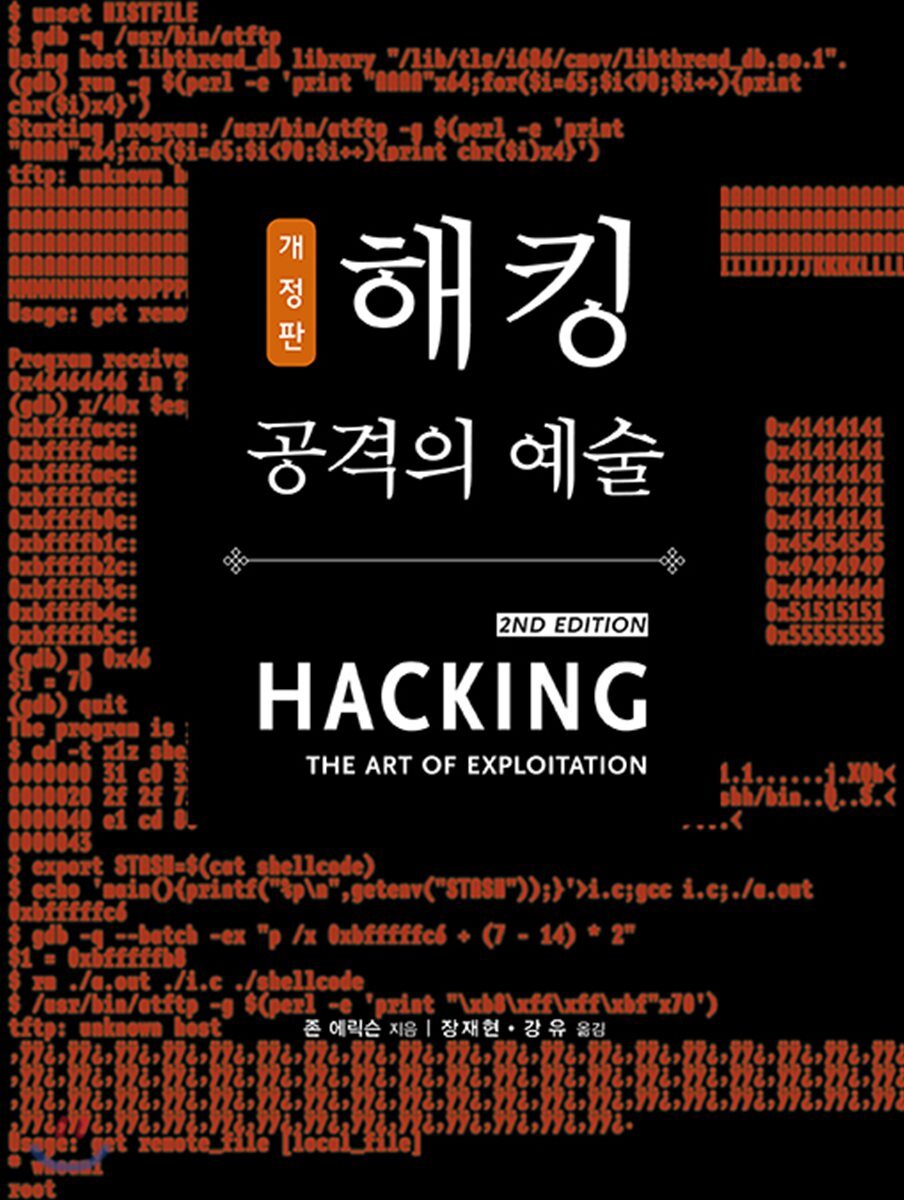
The Art of Hacking Attacks
 |
Description
Book Introduction
Key Skills for True Hacking
Hacking is the art of creative problem solving, such as finding new solutions to difficult problems or finding security vulnerabilities in crude programs.
Many people think they're hackers, but few have the core skills needed to become a top hacker.
In this book, author John Erickson goes beyond simply demonstrating the execution of existing attack techniques to explain how secret hacking techniques actually work.
To share the art and science of hacking with everyone, Hacking: The Art of Attack (Revised Edition) introduces the core of C programming from a hacker's perspective.
The live ISO image provided in the book provides a fully equipped Linux programming and debugging environment.
It can be used without modifying or changing the operating system you are using.
You can make the hacking techniques your own by following the examples in the live ISO image.
You can debug code yourself, exploit buffer overflows, hijack network communications, bypass protections, exploit cryptographic vulnerabilities, or even develop new attack techniques.
Hackers must always move forward, investigate the unknown, and evolve their art.
Even if you don't know much about programming, "Hacking: The Art of Exploitation" (Revised Edition) will teach you current hacking techniques, including understanding programming, machine architecture, and network communication.
You can try out what you learned in the book in a Linux environment using a live ISO image.
Now, all you need is creativity.
Hacking is the art of creative problem solving, such as finding new solutions to difficult problems or finding security vulnerabilities in crude programs.
Many people think they're hackers, but few have the core skills needed to become a top hacker.
In this book, author John Erickson goes beyond simply demonstrating the execution of existing attack techniques to explain how secret hacking techniques actually work.
To share the art and science of hacking with everyone, Hacking: The Art of Attack (Revised Edition) introduces the core of C programming from a hacker's perspective.
The live ISO image provided in the book provides a fully equipped Linux programming and debugging environment.
It can be used without modifying or changing the operating system you are using.
You can make the hacking techniques your own by following the examples in the live ISO image.
You can debug code yourself, exploit buffer overflows, hijack network communications, bypass protections, exploit cryptographic vulnerabilities, or even develop new attack techniques.
Hackers must always move forward, investigate the unknown, and evolve their art.
Even if you don't know much about programming, "Hacking: The Art of Exploitation" (Revised Edition) will teach you current hacking techniques, including understanding programming, machine architecture, and network communication.
You can try out what you learned in the book in a Linux environment using a live ISO image.
Now, all you need is creativity.
index
Entering 0x100 sheets
0x200 programming
What is 0x210 programming?
0x220 virtual code
0x230 control structure
0x231 If-Then-Else
0x232 While/Until Loop
0x233 For loop
0x240 Basic Programming Concepts
0x241 variable
0x242 arithmetic operator
0x243 comparison operator
0x244 function
0x250 Try it yourself
0x251 Understanding the Big Picture
0x252 x86 processor
0x253 assembly language
0x260 Back to default
0x261 string
0x262 Signed, Unsigned, Long, Short
0x263 pointer
0x264 format string
0x265 format conversion
0x266 command line argument
0x267 variable range
0x270 memory segment
Memory segment at 0x271 C
Using the 0x272 heap
malloc() error 0x273
0x280 Building the Foundation
0x281 File Access
0x282 file permissions
0x283 User ID
0x284 structure
0x285 function pointer
0x286 virtual random number
0x287 probability game
0x300 sheet attack
0x310 General attack technique
0x320 Buffer Overflow
0x321 Stack-based buffer overflow vulnerability
Hacking with the 0x330 BASH shell
Using the 0x331 environment variable
0x340 Other segment overflow
0x341 Heap-based overflow
0x342 Function Pointer Overflow
0x350 format string
0x351 format argument
0x352 format string vulnerability
0x353 Read from random memory address
0x354 Write to random memory address
Direct access to argument 0x355
0x356 short write technique
Bypass using the 0x357 destructor
0x358 Vulnerability in Note Search Program
0x359 Overwrite global offset table
0x400 Chapter Networking
0x410 OSI model
0x420 socket
0x421 socket function
0x422 socket address
0x423 network byte order
0x424 Internet Address Translation
0x425 Simple Server Example
0x426 Web Client Example
0x427 small web server
0x430 Sublayer Dissection
0x431 Data Link Layer
0x432 network layer
0x433 transport layer
0x440 Network Sniffing
Socket sniffer with 0x441
0x442 libpcap sniffer
Decrypting layer 0x443
0x444 Active Sniffing
0x450 Denial of Service
0x451 SYN flood
0x452 Death Ping
0x453 Teardrop
0x454 Ping Flood
0x455 amplification attack
0x456 Distributed DoS Flood
0x460 TCP/IP Hijacking
0x461 RST Hijacking
0x462 Persistent hijacking
0x470 port scanning
0x471 Stealth SYN Scan
0x472 FIN, X-mas, Null Scan
0x473 Using fake scan packets
0x474 Idle Scanning
0x475 Pre-defense (cover)
Hacking across the 0x480 network
0x481 Analyzing with GDB
0x482 Try attacking tinyweb
0x483 port binding shellcode
0x500 shellcode
0x510 Assembly and C
0x511 Assembly Linux System Call
The path to 0x520 shellcode
Assembly instructions using the 0x521 stack
0x522 Investigation with GDB
Remove 0x523 null bytes
Shellcode that creates a 0x530 shell
0x531 Permissions Issue
Making the 0x532 shellcode smaller
0x540 port binding shellcode
0x541 Standard file descriptor duplication
0x542 branch control structure
0x550 Connect Back Shellcode
Countermeasures for 0x600 sheets
0x610 Detection Countermeasures
0x620 System Daemon
0x621 signal
0x622 tinyweb daemon
0x630 Main Tools
0x631 tinywebd attack tool
0x640 log file
0x641 Hide in the crowd
0x650 Passing by without seeing
0x651 one at a time
0x652 Restore to original state
0x653 Calling a child process
0x660 Advanced Camouflage
IP address spoofing in log 0x661
0x662 Logless Attack
0x670 Full Base System
0x671 Socket reuse
0x680 Payload Hide
0x681 string encoding
0x682 How to hide a sled
0x690 buffer limit
0x691 Polymorphic printable ASCII shellcode
0x6a0 countermeasure reinforcement
0x6b0 Non-executable stack
0x6b1 ret2libc
Returns 0x6b2 to system()
0x6c0 random stack space
0x6c1 Investigating with BASH and GDB
0x6c2 linux-gate usage
0x6c3 Applied Knowledge
0x6c4 First attempt
0x6c5 Gamble
0x700 Chapter Cryptography
0x710 Information Theory
0x711 Absolute Security
0x712 One-Time Pad
0x713 Quantum Key Distribution
0x714 Unable to compute security
0x720 algorithm execution time
0x721 asymptotic notation
0x730 symmetric encryption method
0x731 Love Grover's Quantum Search Algorithm
0x740 asymmetric encryption
0x741 RSA
0x742 Peter Shor's quantum factorization algorithm
0x750 mixed cipher
0x751 Man in the Middle Attack
0x752 Use SSH protocol host fingerprint version
0x753 Fuzzy Fingerprint
0x760 Password Cracking
0x761 dictionary attack
0x762 Full Investigation Attack
0x763 hash lookup table
0x764 password probability matrix
0x770 Wireless 802.11b Encryption
0x771 WEP
0x772 RC4 stream cipher
0x780 WEP attack
0x781 Offline full investigation attack
0x782 Keystream reuse
0x783 IV-based decryption dictionary table
0x784 IP redirection
0x785 Fluhrer, Mantin, Shamir attack
Chapter 0x800 Conclusion
0x810 References
0x820 source code
0x200 programming
What is 0x210 programming?
0x220 virtual code
0x230 control structure
0x231 If-Then-Else
0x232 While/Until Loop
0x233 For loop
0x240 Basic Programming Concepts
0x241 variable
0x242 arithmetic operator
0x243 comparison operator
0x244 function
0x250 Try it yourself
0x251 Understanding the Big Picture
0x252 x86 processor
0x253 assembly language
0x260 Back to default
0x261 string
0x262 Signed, Unsigned, Long, Short
0x263 pointer
0x264 format string
0x265 format conversion
0x266 command line argument
0x267 variable range
0x270 memory segment
Memory segment at 0x271 C
Using the 0x272 heap
malloc() error 0x273
0x280 Building the Foundation
0x281 File Access
0x282 file permissions
0x283 User ID
0x284 structure
0x285 function pointer
0x286 virtual random number
0x287 probability game
0x300 sheet attack
0x310 General attack technique
0x320 Buffer Overflow
0x321 Stack-based buffer overflow vulnerability
Hacking with the 0x330 BASH shell
Using the 0x331 environment variable
0x340 Other segment overflow
0x341 Heap-based overflow
0x342 Function Pointer Overflow
0x350 format string
0x351 format argument
0x352 format string vulnerability
0x353 Read from random memory address
0x354 Write to random memory address
Direct access to argument 0x355
0x356 short write technique
Bypass using the 0x357 destructor
0x358 Vulnerability in Note Search Program
0x359 Overwrite global offset table
0x400 Chapter Networking
0x410 OSI model
0x420 socket
0x421 socket function
0x422 socket address
0x423 network byte order
0x424 Internet Address Translation
0x425 Simple Server Example
0x426 Web Client Example
0x427 small web server
0x430 Sublayer Dissection
0x431 Data Link Layer
0x432 network layer
0x433 transport layer
0x440 Network Sniffing
Socket sniffer with 0x441
0x442 libpcap sniffer
Decrypting layer 0x443
0x444 Active Sniffing
0x450 Denial of Service
0x451 SYN flood
0x452 Death Ping
0x453 Teardrop
0x454 Ping Flood
0x455 amplification attack
0x456 Distributed DoS Flood
0x460 TCP/IP Hijacking
0x461 RST Hijacking
0x462 Persistent hijacking
0x470 port scanning
0x471 Stealth SYN Scan
0x472 FIN, X-mas, Null Scan
0x473 Using fake scan packets
0x474 Idle Scanning
0x475 Pre-defense (cover)
Hacking across the 0x480 network
0x481 Analyzing with GDB
0x482 Try attacking tinyweb
0x483 port binding shellcode
0x500 shellcode
0x510 Assembly and C
0x511 Assembly Linux System Call
The path to 0x520 shellcode
Assembly instructions using the 0x521 stack
0x522 Investigation with GDB
Remove 0x523 null bytes
Shellcode that creates a 0x530 shell
0x531 Permissions Issue
Making the 0x532 shellcode smaller
0x540 port binding shellcode
0x541 Standard file descriptor duplication
0x542 branch control structure
0x550 Connect Back Shellcode
Countermeasures for 0x600 sheets
0x610 Detection Countermeasures
0x620 System Daemon
0x621 signal
0x622 tinyweb daemon
0x630 Main Tools
0x631 tinywebd attack tool
0x640 log file
0x641 Hide in the crowd
0x650 Passing by without seeing
0x651 one at a time
0x652 Restore to original state
0x653 Calling a child process
0x660 Advanced Camouflage
IP address spoofing in log 0x661
0x662 Logless Attack
0x670 Full Base System
0x671 Socket reuse
0x680 Payload Hide
0x681 string encoding
0x682 How to hide a sled
0x690 buffer limit
0x691 Polymorphic printable ASCII shellcode
0x6a0 countermeasure reinforcement
0x6b0 Non-executable stack
0x6b1 ret2libc
Returns 0x6b2 to system()
0x6c0 random stack space
0x6c1 Investigating with BASH and GDB
0x6c2 linux-gate usage
0x6c3 Applied Knowledge
0x6c4 First attempt
0x6c5 Gamble
0x700 Chapter Cryptography
0x710 Information Theory
0x711 Absolute Security
0x712 One-Time Pad
0x713 Quantum Key Distribution
0x714 Unable to compute security
0x720 algorithm execution time
0x721 asymptotic notation
0x730 symmetric encryption method
0x731 Love Grover's Quantum Search Algorithm
0x740 asymmetric encryption
0x741 RSA
0x742 Peter Shor's quantum factorization algorithm
0x750 mixed cipher
0x751 Man in the Middle Attack
0x752 Use SSH protocol host fingerprint version
0x753 Fuzzy Fingerprint
0x760 Password Cracking
0x761 dictionary attack
0x762 Full Investigation Attack
0x763 hash lookup table
0x764 password probability matrix
0x770 Wireless 802.11b Encryption
0x771 WEP
0x772 RC4 stream cipher
0x780 WEP attack
0x781 Offline full investigation attack
0x782 Keystream reuse
0x783 IV-based decryption dictionary table
0x784 IP redirection
0x785 Fluhrer, Mantin, Shamir attack
Chapter 0x800 Conclusion
0x810 References
0x820 source code
Into the book
The goal of this book is to share the aesthetics of hacking with as many people as possible.
Hacking requires broad and deep knowledge, so understanding hacking techniques is quite difficult.
Most hacking books are difficult and complicated because they don't cover the prerequisite knowledge required for hacking.
So, in 『(Revised Edition) Hacking: The Art of Attack』, we've made the world of hacking easier to understand by covering everything you need to know about hacking, from programming to exploitable machine code.
And as an appendix, we have included a bootable live CD based on Ubuntu Linux.
It can be used on any x86 processor without modifying the existing operating system installed on the computer.
This CD contains all the source code in the book and provides a development environment that allows you to follow the examples and experiments in the book.
--- From the 'Author's Preface'
These days, you can hear the term "hacking" thrown around a lot.
The term "hacking" is used in various contexts, including Twitter account hacking, smartphone hacking, internet banking hacking, and online game money hacking.
Even if you're not a computer expert, you've probably heard of hacking at least once.
That's why so many people are interested in hacking.
But as in the example I just mentioned, the term hacking has negative connotations in society.
That is, the words crime and exploitation come to mind.
But as the text of this book explains, hacking is not necessarily a bad 'crime'.
Although it is now socially associated with a negative connotation, 'hacking' was born from the pure passion of computer enthusiasts who wanted to know more about computers.
In this book, John Erickson artistically explains various hacking techniques and technologies while conveying to readers his pure passion for them.
As hacking and security are discussed throughout society, many people are becoming interested in hacking and security and want to learn hacking.
There are many 'superficial hacking' tools that they can use by simply following them, but there is a lack of tools or materials that teach the true essence of hacking.
This book covers a wide range of hacking topics, from basic C programming to basic attack techniques, network attacks, shellcode attacks, and countermeasures.
It covers the topic in depth, but is relatively easy to understand with sufficient examples.
And, since a live CD that makes it easy to set up a hacking environment is included as an appendix, you can study hacking even more easily.
This book will teach the essence of hacking to readers who want to learn hacking but don't know where to start.
Compared to the first edition, many parts have been added, and the 0x200 programming section, which explains the basics of C programming for readers without programming background, has been strengthened.
And the section on writing and using shellcode was reinforced and separated into a separate 0x500 shellcode chapter.
Additionally, the 0x600 countermeasure covers defense methods against hacking.
Since it's nearly twice as long as the first edition, you'll be able to get more information about hacking.
Hacking requires broad and deep knowledge, so understanding hacking techniques is quite difficult.
Most hacking books are difficult and complicated because they don't cover the prerequisite knowledge required for hacking.
So, in 『(Revised Edition) Hacking: The Art of Attack』, we've made the world of hacking easier to understand by covering everything you need to know about hacking, from programming to exploitable machine code.
And as an appendix, we have included a bootable live CD based on Ubuntu Linux.
It can be used on any x86 processor without modifying the existing operating system installed on the computer.
This CD contains all the source code in the book and provides a development environment that allows you to follow the examples and experiments in the book.
--- From the 'Author's Preface'
These days, you can hear the term "hacking" thrown around a lot.
The term "hacking" is used in various contexts, including Twitter account hacking, smartphone hacking, internet banking hacking, and online game money hacking.
Even if you're not a computer expert, you've probably heard of hacking at least once.
That's why so many people are interested in hacking.
But as in the example I just mentioned, the term hacking has negative connotations in society.
That is, the words crime and exploitation come to mind.
But as the text of this book explains, hacking is not necessarily a bad 'crime'.
Although it is now socially associated with a negative connotation, 'hacking' was born from the pure passion of computer enthusiasts who wanted to know more about computers.
In this book, John Erickson artistically explains various hacking techniques and technologies while conveying to readers his pure passion for them.
As hacking and security are discussed throughout society, many people are becoming interested in hacking and security and want to learn hacking.
There are many 'superficial hacking' tools that they can use by simply following them, but there is a lack of tools or materials that teach the true essence of hacking.
This book covers a wide range of hacking topics, from basic C programming to basic attack techniques, network attacks, shellcode attacks, and countermeasures.
It covers the topic in depth, but is relatively easy to understand with sufficient examples.
And, since a live CD that makes it easy to set up a hacking environment is included as an appendix, you can study hacking even more easily.
This book will teach the essence of hacking to readers who want to learn hacking but don't know where to start.
Compared to the first edition, many parts have been added, and the 0x200 programming section, which explains the basics of C programming for readers without programming background, has been strengthened.
And the section on writing and using shellcode was reinforced and separated into a separate 0x500 shellcode chapter.
Additionally, the 0x600 countermeasure covers defense methods against hacking.
Since it's nearly twice as long as the first edition, you'll be able to get more information about hacking.
--- From the 'Translator's Note'
Publisher's Review
★ What this book covers ★
■ Programming using C, assembly, and shell scripts
■ System memory attack to execute arbitrary code using buffer overflow and format string
■ Examining processor registers and system memory using a debugger to understand actual operation
■ Smart security measures such as inoperable stacks and intrusion detection systems
■ Access remote servers using port binding or connectback shell code, and hide traces by changing server logs.
■ Redirecting network traffic, hiding open ports, and hijacking TCP connections
■ Cracking encrypted wireless traffic with FMS attack, rapid exhaustive search attack using password probability matrix
★ Author's Preface ★
The goal of this book is to share the aesthetics of hacking with as many people as possible.
Hacking requires broad and deep knowledge, so understanding hacking techniques is quite difficult.
Most hacking books are difficult and complicated because they don't cover the prerequisite knowledge required for hacking.
So, in 『(Revised Edition) Hacking: The Art of Attack』, we've made the world of hacking easier to understand by covering everything you need to know about hacking, from programming to exploitable machine code.
And this book provides a bootable live ISO file based on Ubuntu Linux.
If you run this ISO image file on a virtual machine such as VirtualBox, you can use it on any computer.
This live ISO file contains all the source code in the book, providing a development environment that allows you to follow the examples and experiments in the book.
More details about the live ISO image file can be found later.
★ Translator's Note ★
These days, you can hear the term "hacking" thrown around a lot.
The term "hacking" is used in various contexts, including Twitter account hacking, smartphone hacking, internet banking hacking, and online game money hacking.
Even if you're not a computer expert, you've probably heard of hacking at least once.
That's why so many people are interested in hacking.
But as in the example I just mentioned, the term hacking has negative connotations in society.
That is, the words crime and exploitation come to mind.
But as the text of this book explains, hacking is not necessarily a bad 'crime'.
Although it is now socially associated with a negative connotation, 'hacking' was born from the pure passion of computer enthusiasts who wanted to know more about computers.
In this book, John Erickson artistically explains various hacking techniques and technologies while conveying to readers his pure passion for them.
As hacking and security are discussed throughout society, many people are becoming interested in hacking and security and want to learn hacking.
There are many 'superficial hacking' tools that they can use by simply following them, but there is a lack of tools or materials that teach the true essence of hacking.
This book covers a wide range of hacking topics, from basic C programming to basic attack techniques, network attacks, shellcode attacks, and countermeasures.
It covers the topic in depth, but is relatively easy to understand with sufficient examples.
And it provides a live ISO image that makes it easy to build a hacking environment, making it easier to study hacking.
This book will teach the essence of hacking to readers who want to learn hacking but don't know where to start.
Compared to the first edition, many parts have been added, and the 0x200 programming section, which explains the basics of C programming for readers without programming background, has been strengthened.
And the section on writing and using shellcode was reinforced and separated into a separate 0x500 shellcode chapter.
Additionally, the 0x600 countermeasure covers defense methods against hacking.
Since it's nearly twice as long as the first edition, you'll be able to get more information about hacking.
■ Programming using C, assembly, and shell scripts
■ System memory attack to execute arbitrary code using buffer overflow and format string
■ Examining processor registers and system memory using a debugger to understand actual operation
■ Smart security measures such as inoperable stacks and intrusion detection systems
■ Access remote servers using port binding or connectback shell code, and hide traces by changing server logs.
■ Redirecting network traffic, hiding open ports, and hijacking TCP connections
■ Cracking encrypted wireless traffic with FMS attack, rapid exhaustive search attack using password probability matrix
★ Author's Preface ★
The goal of this book is to share the aesthetics of hacking with as many people as possible.
Hacking requires broad and deep knowledge, so understanding hacking techniques is quite difficult.
Most hacking books are difficult and complicated because they don't cover the prerequisite knowledge required for hacking.
So, in 『(Revised Edition) Hacking: The Art of Attack』, we've made the world of hacking easier to understand by covering everything you need to know about hacking, from programming to exploitable machine code.
And this book provides a bootable live ISO file based on Ubuntu Linux.
If you run this ISO image file on a virtual machine such as VirtualBox, you can use it on any computer.
This live ISO file contains all the source code in the book, providing a development environment that allows you to follow the examples and experiments in the book.
More details about the live ISO image file can be found later.
★ Translator's Note ★
These days, you can hear the term "hacking" thrown around a lot.
The term "hacking" is used in various contexts, including Twitter account hacking, smartphone hacking, internet banking hacking, and online game money hacking.
Even if you're not a computer expert, you've probably heard of hacking at least once.
That's why so many people are interested in hacking.
But as in the example I just mentioned, the term hacking has negative connotations in society.
That is, the words crime and exploitation come to mind.
But as the text of this book explains, hacking is not necessarily a bad 'crime'.
Although it is now socially associated with a negative connotation, 'hacking' was born from the pure passion of computer enthusiasts who wanted to know more about computers.
In this book, John Erickson artistically explains various hacking techniques and technologies while conveying to readers his pure passion for them.
As hacking and security are discussed throughout society, many people are becoming interested in hacking and security and want to learn hacking.
There are many 'superficial hacking' tools that they can use by simply following them, but there is a lack of tools or materials that teach the true essence of hacking.
This book covers a wide range of hacking topics, from basic C programming to basic attack techniques, network attacks, shellcode attacks, and countermeasures.
It covers the topic in depth, but is relatively easy to understand with sufficient examples.
And it provides a live ISO image that makes it easy to build a hacking environment, making it easier to study hacking.
This book will teach the essence of hacking to readers who want to learn hacking but don't know where to start.
Compared to the first edition, many parts have been added, and the 0x200 programming section, which explains the basics of C programming for readers without programming background, has been strengthened.
And the section on writing and using shellcode was reinforced and separated into a separate 0x500 shellcode chapter.
Additionally, the 0x600 countermeasure covers defense methods against hacking.
Since it's nearly twice as long as the first edition, you'll be able to get more information about hacking.
GOODS SPECIFICS
- Date of publication: March 19, 2010
- Page count, weight, size: 672 pages | 185*245*35mm
- ISBN13: 9788960771260
- ISBN10: 8960771260
You may also like
카테고리
korean


korean

![GQ KOREA Mark (Monthly): December [2025]](http://librairie.coreenne.fr/cdn/shop/files/8ef265dbbfbf186523ed75ba7319009d.jpg?v=1765340328&width=3840)


