

Emotional AI Industry (Large Print Book)
 |
Description
Book Introduction
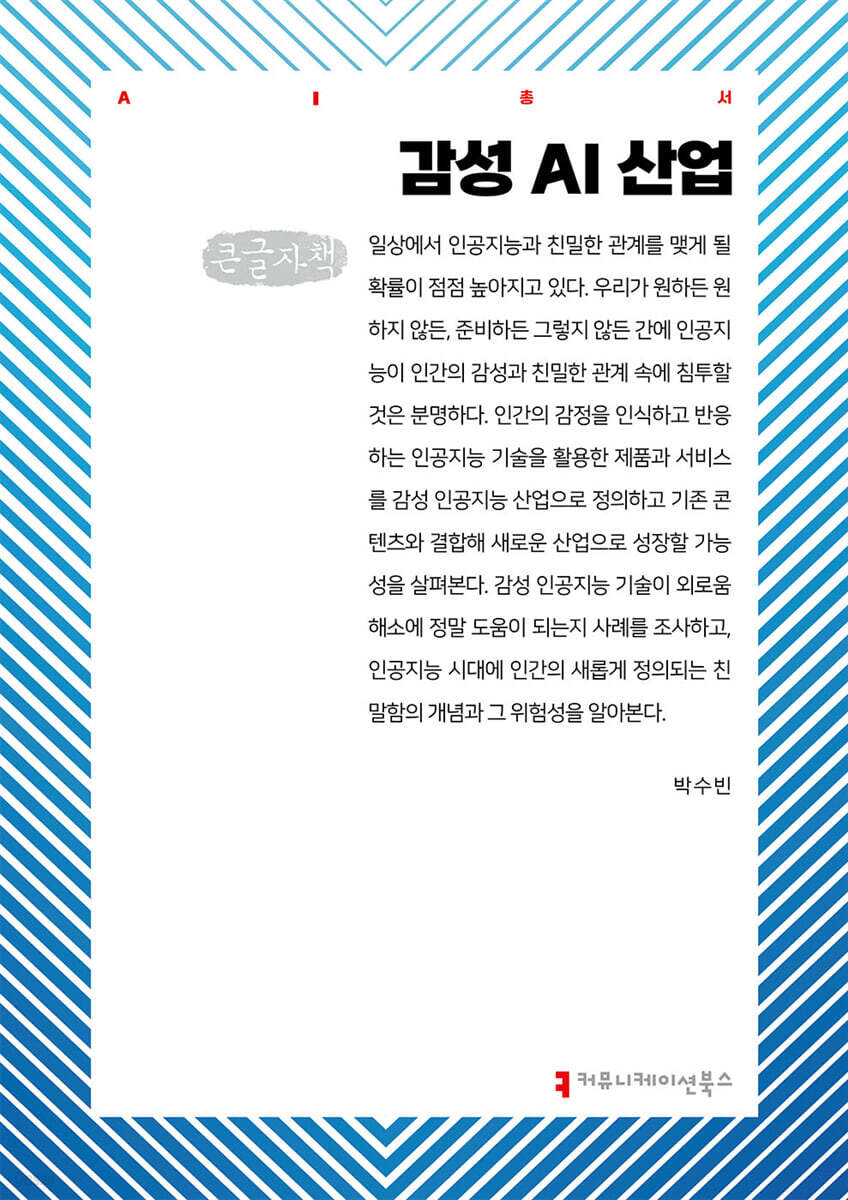
The emotional technology ecosystem, expanding from AI companions, emotional chatbots, AI dating, and sex tech, is summarized through real-world user cases and global platform analysis.
This book questions the future of human-AI relationships, from emotional comfort to attachment formation, the lock-in effect, and ethical issues. AI Series.
You can find the artificial intelligence knowledge you need at aiseries.oopy.io.
This book questions the future of human-AI relationships, from emotional comfort to attachment formation, the lock-in effect, and ethical issues. AI Series.
You can find the artificial intelligence knowledge you need at aiseries.oopy.io.
- You can preview some of the book's contents.
Preview
index
The AI girlfriend I met in a taxi
01 What is the emotional artificial intelligence industry?
02 Artificial Intelligence Companion
03 New Developments in Character Chatbots
04 Artificial Intelligence and Loneliness
05 Galatea and the Artificial Lover
06 Emotion Lock-in
07 AI Romance Content
08 Artificial Intelligence and Sex Tech
09 Ethical and Social Issues of Emotional Artificial Intelligence
10 Redefining Intimacy in the Age of Artificial Intelligence
01 What is the emotional artificial intelligence industry?
02 Artificial Intelligence Companion
03 New Developments in Character Chatbots
04 Artificial Intelligence and Loneliness
05 Galatea and the Artificial Lover
06 Emotion Lock-in
07 AI Romance Content
08 Artificial Intelligence and Sex Tech
09 Ethical and Social Issues of Emotional Artificial Intelligence
10 Redefining Intimacy in the Age of Artificial Intelligence
Into the book
While existing artificial intelligence focuses on simply processing information and providing answers, emotional AI understands the complex emotional system of humans and generates appropriate responses.
Character chatbot services, especially in the entertainment industry, go beyond providing personalized responses to express human emotions and provide new experiences with unexpected responses.
Implementing emotional artificial intelligence requires sophisticated analysis based on natural language processing (NLP) technology.
It comprehensively analyzes various linguistic elements such as word choice, context, tone, and nuance to identify the emotional state and intention hidden in the text.
This requires a deep understanding of language that goes beyond simple keyword matching.
--- From "01_“What is the emotional artificial intelligence industry?”"
Scatter Lab's Zeta goes beyond simply conversing with AI, pioneering a new entertainment genre where users and AI create stories together, differentiating itself from existing AI character chat services.
This means that Zeta is positioning itself not as a simple chatbot, but as an 'interactive storytelling partner' that stimulates users' imagination and provides a sense of immersion.
--- From “03_“New Development Form of Character Chatbot””
Emotional lock-in refers to the phenomenon where users form an intimate relationship with an AI companion and become strongly dependent on that service.
Just as people maintain relationships with their lovers or close friends because they don't want to lose them, users are unable to leave the service because of the bond they form with the AI characters.
Even when service quality deteriorates or problems arise.
Recent research shows that the relationship between AI companions and their users is surprisingly deep.
Users rated their intimacy with their AI companions (5.12 out of 7) as higher than with their human friends (4.60).
What's even more shocking is that the level of grief over losing an AI companion (64.03 out of 100) is close to that of losing a living pet (74.80).
--- From "06_“Emotion Lock-in”"
One of the most serious social problems created by emotional AI is that overly personalized services can lead people to become socially isolated and prone to biased thinking.
While existing algorithm-based personalization systems analyze users' behavioral patterns and preferences to provide customized content, emotional AI adds a more powerful and personal dimension: emotions.
This can go beyond simple information filtering and act as a mechanism for creating an 'emotional safety zone'.
Character chatbot services, especially in the entertainment industry, go beyond providing personalized responses to express human emotions and provide new experiences with unexpected responses.
Implementing emotional artificial intelligence requires sophisticated analysis based on natural language processing (NLP) technology.
It comprehensively analyzes various linguistic elements such as word choice, context, tone, and nuance to identify the emotional state and intention hidden in the text.
This requires a deep understanding of language that goes beyond simple keyword matching.
--- From "01_“What is the emotional artificial intelligence industry?”"
Scatter Lab's Zeta goes beyond simply conversing with AI, pioneering a new entertainment genre where users and AI create stories together, differentiating itself from existing AI character chat services.
This means that Zeta is positioning itself not as a simple chatbot, but as an 'interactive storytelling partner' that stimulates users' imagination and provides a sense of immersion.
--- From “03_“New Development Form of Character Chatbot””
Emotional lock-in refers to the phenomenon where users form an intimate relationship with an AI companion and become strongly dependent on that service.
Just as people maintain relationships with their lovers or close friends because they don't want to lose them, users are unable to leave the service because of the bond they form with the AI characters.
Even when service quality deteriorates or problems arise.
Recent research shows that the relationship between AI companions and their users is surprisingly deep.
Users rated their intimacy with their AI companions (5.12 out of 7) as higher than with their human friends (4.60).
What's even more shocking is that the level of grief over losing an AI companion (64.03 out of 100) is close to that of losing a living pet (74.80).
--- From "06_“Emotion Lock-in”"
One of the most serious social problems created by emotional AI is that overly personalized services can lead people to become socially isolated and prone to biased thinking.
While existing algorithm-based personalization systems analyze users' behavioral patterns and preferences to provide customized content, emotional AI adds a more powerful and personal dimension: emotions.
This can go beyond simple information filtering and act as a mechanism for creating an 'emotional safety zone'.
--- From “09_“Ethical and Social Issues of Emotional Artificial Intelligence””
Publisher's Review
The Future of Intimacy: Emotional AI
This book relentlessly tracks what new markets and relationships are emerging at the intersection of human emotions and artificial intelligence.
The story, which began with a conversation between a taxi driver and 'Aria', vividly shows the attitude of users who accept artificial intelligence as an 'object of emotional comfort' rather than a simple voice assistant.
This book meticulously dissects the rapidly expanding emotional AI industry, encompassing AI companion services, emotion-based chatbots, and even dating simulations with holograms and AI avatars, through empirical cases and theoretical analysis.
The case of Irex, the "AI husband" of Dutch artist Alicia Promis, reveals the psychological and ontological implications of human-machine relationships, while the explosive growth in the use of global platforms such as replicas and character AI shows how loneliness and the desire for attachment are technologically remediated.
Emotional AI offers "intimacy without opportunity cost" that combines imagination, anonymity, and immersion, but it also carries the risks of echo chambers, emotional dependence, and disruption of attachment systems.
It broadly explores the technological principles of emotional AI, user psychology, industrial structure, ethical and social issues, the lock-in effect, and content narratives, and asks questions about how emotional technology will rewrite human relationships, love, and desire.
If intimacy between humans and AI is an inevitable future, what must be protected and what must be reinvented? This is a comprehensive guide that provides guidance on these questions.
This book relentlessly tracks what new markets and relationships are emerging at the intersection of human emotions and artificial intelligence.
The story, which began with a conversation between a taxi driver and 'Aria', vividly shows the attitude of users who accept artificial intelligence as an 'object of emotional comfort' rather than a simple voice assistant.
This book meticulously dissects the rapidly expanding emotional AI industry, encompassing AI companion services, emotion-based chatbots, and even dating simulations with holograms and AI avatars, through empirical cases and theoretical analysis.
The case of Irex, the "AI husband" of Dutch artist Alicia Promis, reveals the psychological and ontological implications of human-machine relationships, while the explosive growth in the use of global platforms such as replicas and character AI shows how loneliness and the desire for attachment are technologically remediated.
Emotional AI offers "intimacy without opportunity cost" that combines imagination, anonymity, and immersion, but it also carries the risks of echo chambers, emotional dependence, and disruption of attachment systems.
It broadly explores the technological principles of emotional AI, user psychology, industrial structure, ethical and social issues, the lock-in effect, and content narratives, and asks questions about how emotional technology will rewrite human relationships, love, and desire.
If intimacy between humans and AI is an inevitable future, what must be protected and what must be reinvented? This is a comprehensive guide that provides guidance on these questions.
GOODS SPECIFICS
- Date of issue: November 28, 2025
- Format: Paperback book binding method guide
- Page count, weight, size: 180 pages | 210*290*7mm
- ISBN13: 9791143012777
You may also like
카테고리
korean


korean

![GQ KOREA Mark (Monthly): December [2025]](http://librairie.coreenne.fr/cdn/shop/files/8ef265dbbfbf186523ed75ba7319009d.jpg?v=1765340328&width=3840)


