

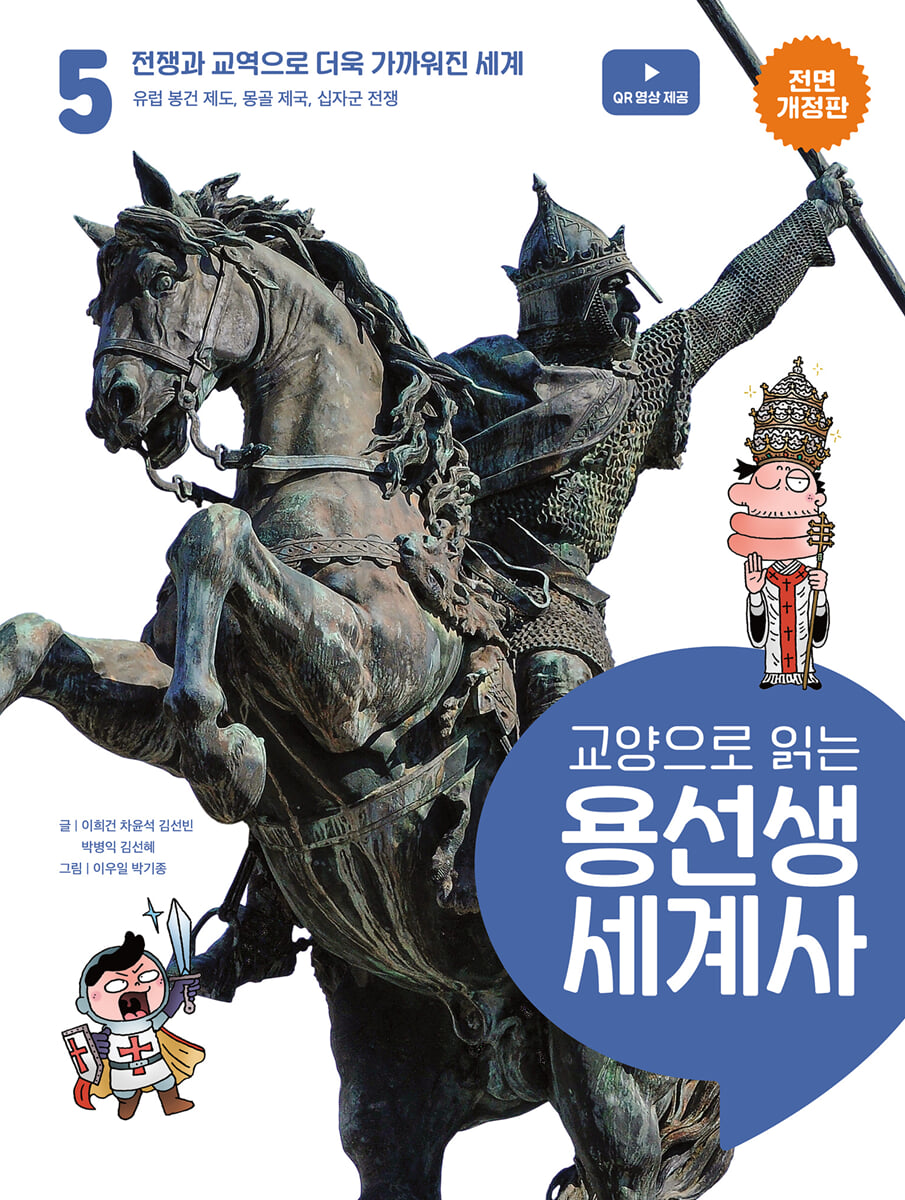
Reading World History with Yongseonsaeng as a Liberal Arts Course 5
 |
Description
Book Introduction
A completely revised edition of "Reading World History with Yongseonsaeng as a Liberal Arts Course" has been published.
The "Mr. Yong" series, which became the standard for studying world history.
Now you can discover the world's cultural heritage through QR videos!
A comprehensively revised edition of "Yongseonsaeng World History: A Cultured Guide," a consistent bestseller in the children's and youth world history category since its publication in 2017, has been released.
《Reading World History with Mr. Yong as a Liberal Arts》 is a series that follows the unwavering Korean history bestseller 《Mr. Yong's Bustling Korean History》, and is the world history book most recommended among parents of elementary and middle school students.
Children who find studying world history daunting, children who find memorization uninteresting, and children who are just beginning to take an interest in history.
And I highly recommend it to everyone, including parents who want to study with their children.
Why is it necessary to study world history?
World history is an essential knowledge for living in modern society.
The news reports on events from around the world every day.
From the conflict between the United States and China, the war between Russia and Ukraine, the long-running conflict between Israel and Arab states, to the global climate crisis, all these events are deeply intertwined with world history.
Only by knowing world history can we truly understand today's world.
The importance of world history in schools is growing.
Under the revised curriculum, children will learn world history before Korean history in middle school.
Because there is no world history course in elementary school, children are suddenly exposed to material they have never encountered before.
Because you have to memorize unfamiliar place names, people, events, and years to take the test, it's easy to get the impression that it's stiff and boring.
It is perhaps natural that world history, which begins without background knowledge, may seem difficult for children.
Why is it that when studying world history, we must read “Yongseonsaeng World History as a Liberal Arts”?
Studying world history, like studying Korean history, requires storytelling.
A story with context and flow is not easily forgotten over time.
It also naturally connects with knowledge from other subjects.
This is why children need good storytelling content, not just books for simple memorization.
"Reading World History with Mr. Yong as a Liberal Arts" is a series that explains the major trends of world history from the evolution of mankind to modern society with the question, "Why?"
When Mr. Yong raises a topic from each era, the history class students constantly ask, "Why?"
Mr. Yong naturally explains the context and flow of history while answering children's questions.
The Greco-Persian Wars, the Peloponnesian War, and Alexander the Great, which we had memorized in fragments, are connected as one story.
The study keywords you need to memorize will soon become fun old stories.
To write a book that is both easy to read and profound, the authors, Mr. Yong, consulted not only middle and high school world history textbooks, but also various world history books from Korea and abroad, foreign textbooks from the United States, Germany, and other countries, as well as domestic and international academic papers.
Mr. Yong's greatest strength is delivering balanced and in-depth content at the children's eye level.
The upper elementary grades are the most appropriate time to begin studying world history, both in terms of developmental stage and curriculum.
For children who want to study world history by connecting context and meaning through storytelling, "Reading World History with Yongseonsaeng as Liberal Arts" is the optimal solution.
The "Mr. Yong" series, which became the standard for studying world history.
Now you can discover the world's cultural heritage through QR videos!
A comprehensively revised edition of "Yongseonsaeng World History: A Cultured Guide," a consistent bestseller in the children's and youth world history category since its publication in 2017, has been released.
《Reading World History with Mr. Yong as a Liberal Arts》 is a series that follows the unwavering Korean history bestseller 《Mr. Yong's Bustling Korean History》, and is the world history book most recommended among parents of elementary and middle school students.
Children who find studying world history daunting, children who find memorization uninteresting, and children who are just beginning to take an interest in history.
And I highly recommend it to everyone, including parents who want to study with their children.
Why is it necessary to study world history?
World history is an essential knowledge for living in modern society.
The news reports on events from around the world every day.
From the conflict between the United States and China, the war between Russia and Ukraine, the long-running conflict between Israel and Arab states, to the global climate crisis, all these events are deeply intertwined with world history.
Only by knowing world history can we truly understand today's world.
The importance of world history in schools is growing.
Under the revised curriculum, children will learn world history before Korean history in middle school.
Because there is no world history course in elementary school, children are suddenly exposed to material they have never encountered before.
Because you have to memorize unfamiliar place names, people, events, and years to take the test, it's easy to get the impression that it's stiff and boring.
It is perhaps natural that world history, which begins without background knowledge, may seem difficult for children.
Why is it that when studying world history, we must read “Yongseonsaeng World History as a Liberal Arts”?
Studying world history, like studying Korean history, requires storytelling.
A story with context and flow is not easily forgotten over time.
It also naturally connects with knowledge from other subjects.
This is why children need good storytelling content, not just books for simple memorization.
"Reading World History with Mr. Yong as a Liberal Arts" is a series that explains the major trends of world history from the evolution of mankind to modern society with the question, "Why?"
When Mr. Yong raises a topic from each era, the history class students constantly ask, "Why?"
Mr. Yong naturally explains the context and flow of history while answering children's questions.
The Greco-Persian Wars, the Peloponnesian War, and Alexander the Great, which we had memorized in fragments, are connected as one story.
The study keywords you need to memorize will soon become fun old stories.
To write a book that is both easy to read and profound, the authors, Mr. Yong, consulted not only middle and high school world history textbooks, but also various world history books from Korea and abroad, foreign textbooks from the United States, Germany, and other countries, as well as domestic and international academic papers.
Mr. Yong's greatest strength is delivering balanced and in-depth content at the children's eye level.
The upper elementary grades are the most appropriate time to begin studying world history, both in terms of developmental stage and curriculum.
For children who want to study world history by connecting context and meaning through storytelling, "Reading World History with Yongseonsaeng as Liberal Arts" is the optimal solution.
- You can preview some of the book's contents.
Preview
index
Volume 5: A World Closer Through War and Trade
European feudalism, the Mongol Empire, and the Crusades
1st Period: The Establishment of Feudal Society and the Growth of Europe
Visit the Czech Republic, the heart of Central Europe
European feudalism?
Europeans who lived self-sufficiently, centered around the estate
The Capetian dynasty was established in France, and Duke William ascended to the English throne.
The Holy Roman Empire is born
Europe regains stability and vitality
Holy Roman Emperor kneels before the Pope
2nd period Song Dynasty, a country of commoners and nobles
Visit Hangzhou, the capital of the Southern Song Dynasty
Zhao Guangyin founded the Song Dynasty and adopted civil administration.
Song Dynasty, the world's greatest commercial nation
Song Dynasty's internal diseases and Wang Anshi's reforms
The End of Peace Bought with Money
3rd Period: The Mongol Empire, Embracing the Eurasian Continent
How do the descendants of Genghis Khan live?
Genghis Khan unifies the Mongolian steppe
Genghis Khan's wars of conquest
Russia and the Islamic world bow to the Mongols
Why was the Mongol Empire so powerful?
Kublai Khan conquers the Southern Song Dynasty and establishes the Yuan Dynasty.
The Mongol Empire ushered in the era of the global village.
4th Period Japan, the Land of the Warriors
Visit Kyoto, the thousand-year-old capital city that still retains its charm from the past.
The appearance of the warrior
A samurai becomes the most powerful person in Japan
The shogunate era begins
The shogunate regime shaken by endless chaos
Commerce flourished and Japanese pirates became rampant.
5th Period: The Shaking Islamic World
Going to Turkmenistan, the country of the Turks
Division of the Abbasid Dynasty
Turks embrace Islam
The Seljuks take over the Islamic world in West Asia.
A war with knights who suddenly appeared in Western Europe
The Mongol Empire shook the Islamic world.
6th Period: Islam Settling in India and the Thriving Indian Ocean Trade
Pakistan, the descendants of Muslims who settled in India
Invaders who came with Islam
The Delhi Sultanate, which established Islam in India
The Birth of Indo-Islamic Culture
The Chola Kingdom of South India Dominates Indian Ocean Trade
The Hindu kingdom of Vijayanagar wages war against Muslim forces.
Period 7: The Crusades and the Black Death Shake Europe
Key cities of the Hanseatic League today
The Crusades begin
The growth of crafts and merchant power
The authority of the Holy Roman Emperor falls to the ground
The Black Death that shook Europe to its core
The French king seized power and undermined the authority of the church.
European feudalism, the Mongol Empire, and the Crusades
1st Period: The Establishment of Feudal Society and the Growth of Europe
Visit the Czech Republic, the heart of Central Europe
European feudalism?
Europeans who lived self-sufficiently, centered around the estate
The Capetian dynasty was established in France, and Duke William ascended to the English throne.
The Holy Roman Empire is born
Europe regains stability and vitality
Holy Roman Emperor kneels before the Pope
2nd period Song Dynasty, a country of commoners and nobles
Visit Hangzhou, the capital of the Southern Song Dynasty
Zhao Guangyin founded the Song Dynasty and adopted civil administration.
Song Dynasty, the world's greatest commercial nation
Song Dynasty's internal diseases and Wang Anshi's reforms
The End of Peace Bought with Money
3rd Period: The Mongol Empire, Embracing the Eurasian Continent
How do the descendants of Genghis Khan live?
Genghis Khan unifies the Mongolian steppe
Genghis Khan's wars of conquest
Russia and the Islamic world bow to the Mongols
Why was the Mongol Empire so powerful?
Kublai Khan conquers the Southern Song Dynasty and establishes the Yuan Dynasty.
The Mongol Empire ushered in the era of the global village.
4th Period Japan, the Land of the Warriors
Visit Kyoto, the thousand-year-old capital city that still retains its charm from the past.
The appearance of the warrior
A samurai becomes the most powerful person in Japan
The shogunate era begins
The shogunate regime shaken by endless chaos
Commerce flourished and Japanese pirates became rampant.
5th Period: The Shaking Islamic World
Going to Turkmenistan, the country of the Turks
Division of the Abbasid Dynasty
Turks embrace Islam
The Seljuks take over the Islamic world in West Asia.
A war with knights who suddenly appeared in Western Europe
The Mongol Empire shook the Islamic world.
6th Period: Islam Settling in India and the Thriving Indian Ocean Trade
Pakistan, the descendants of Muslims who settled in India
Invaders who came with Islam
The Delhi Sultanate, which established Islam in India
The Birth of Indo-Islamic Culture
The Chola Kingdom of South India Dominates Indian Ocean Trade
The Hindu kingdom of Vijayanagar wages war against Muslim forces.
Period 7: The Crusades and the Black Death Shake Europe
Key cities of the Hanseatic League today
The Crusades begin
The growth of crafts and merchant power
The authority of the Holy Roman Emperor falls to the ground
The Black Death that shook Europe to its core
The French king seized power and undermined the authority of the church.
Detailed image

Publisher's Review
Bestselling World History Books for Children and Young Adults
Completely Revised Edition of "Reading World History with Yongseonsaeng as a Liberal Arts Course"
What has changed?
■A world history book that is easy to read with easy descriptions!
The greatest strength of “Reading World History with Yongseonsaeng as a Liberal Arts Course” is its Yongseonsaeng-style narrative that explains difficult content in an easy-to-understand manner.
World history unfolds in a unique narrative style that captures the lively discussion-style classes of Mr. Yong and his five children, known as the "Yong History Class."
Difficult topics such as the development of Greek democracy, the background of Christianity, Buddhism, and Islam becoming world religions, and the reasons why feudal lords of China's Warring States period pursued policies to enrich their country and strengthen their military are all addressed through easy-to-understand conversational narratives and Professor Yong's witty explanations, gradually unraveling the threads of history.
In this fully revised edition, the narrative has been enhanced and refined to make it easier and more readable.
A more friendly narrative makes world history much more interesting.
■A vivid cultural heritage lecture with over 100 QR videos!
The most regrettable thing about studying world history is that it is difficult to go and see it in person.
To complement this, the fully revised edition adds QR videos that vividly convey artifacts, sites, events, and people from around the world.
A total of 100 videos are presented, each with a different theme, and each episode unfolds into an interesting story.
It consists of vivid photographs of relics and sites necessary for studying world history, AI restorations and imaginations created through meticulous research, and fun animations directed by Mr. Yong and children, allowing you to go beyond the limitations of paper books and enjoy an interesting experience of relics and sites from around the world, as well as episodes of major world historical events and figures.
■Linked to the revised middle and high school curriculum!
The fully revised edition aligns with the middle and high school curriculum.
You can check the connection between each lesson and the textbook unit in the table of contents of each volume.
World history terminology has also been unified to the terminology used in textbooks.
Additionally, summary notes and key problem pages were created with a focus on curriculum linkage.
[Na Seon-ae's Summary Note] allows you to systematically organize what you've read, focusing on essential key words from textbooks. [Find a World History Expert!] includes actual school exam questions to enhance your learning effectiveness.
To ensure alignment with the curriculum, we hired a current history teacher as a reviewer to include voices from the educational field.
■Over 5,500 photos and illustrations, 600 real-life maps
Mr. Yong conveys historical content not only through text but also through images.
For children learning world history for the first time, visual aids can be a great help.
Photographs and paintings vividly convey the atmosphere of the time and are also effective in fostering historical imagination.
That is why, in “Reading World History with Yongseonsaeng as a Liberal Arts Course,” we inserted an overwhelming amount of image materials.
In the 'Completely Revised Edition', we've upgraded the design specifications to provide clearer image data.
In addition, Lee Woo-il's drawings, which hit the nail on the head, and the restored drawings and explanatory illustrations that faithfully recreate scenes of past life vividly show historical facts while also being both entertaining and informative.
To study world history, it is important to develop a sense of geography.
To achieve this, we have inserted as many high-level maps as possible.
Using a total of 600 real-life maps, you can instantly understand the locations where historical events took place as well as the natural environment there.
■ "Where is the site of history now?": connecting past history with present life
《Reading World History with Mr. Yong as a Liberal Arts》 also has a corner designed to connect the past and present.
Before each lesson in the book begins, you will read "Where is the Site of History Now?", which provides an overview of the current state of historical sites.
Children who did not know that the Mesopotamian civilization arose in what is now Iraq are imagining various things, connecting the past and present.
Additionally, this comprehensively revised edition faithfully reflects the changing times by updating human geography information, including figures and events from around the world.
■ Thorough review by 16 experts from different regions and eras
《Reading World History with Mr. Yong as a Liberal Arts》 is a book that cost 3 billion won to produce and involved a development team of around 40 people.
The Social Criticism and History Research Institute has invited experts to give lectures on approximately 100 occasions, and has enriched its content by drawing on hundreds of domestic and international references and research materials.
Furthermore, through consultation with 16 historical experts representing various regions and eras around the world and thorough review, the historical narrative of each lesson was composed in a more balanced manner.
Volume 5 covers in detail the feudal system in Europe, the samurai nation of Japan, and the turbulent times in West Asia and India due to the spread of Islam.
We also explore the impact of the Mongol Empire on world history and how the medieval European world was transformed by the Crusades.
Completely Revised Edition of "Reading World History with Yongseonsaeng as a Liberal Arts Course"
What has changed?
■A world history book that is easy to read with easy descriptions!
The greatest strength of “Reading World History with Yongseonsaeng as a Liberal Arts Course” is its Yongseonsaeng-style narrative that explains difficult content in an easy-to-understand manner.
World history unfolds in a unique narrative style that captures the lively discussion-style classes of Mr. Yong and his five children, known as the "Yong History Class."
Difficult topics such as the development of Greek democracy, the background of Christianity, Buddhism, and Islam becoming world religions, and the reasons why feudal lords of China's Warring States period pursued policies to enrich their country and strengthen their military are all addressed through easy-to-understand conversational narratives and Professor Yong's witty explanations, gradually unraveling the threads of history.
In this fully revised edition, the narrative has been enhanced and refined to make it easier and more readable.
A more friendly narrative makes world history much more interesting.
■A vivid cultural heritage lecture with over 100 QR videos!
The most regrettable thing about studying world history is that it is difficult to go and see it in person.
To complement this, the fully revised edition adds QR videos that vividly convey artifacts, sites, events, and people from around the world.
A total of 100 videos are presented, each with a different theme, and each episode unfolds into an interesting story.
It consists of vivid photographs of relics and sites necessary for studying world history, AI restorations and imaginations created through meticulous research, and fun animations directed by Mr. Yong and children, allowing you to go beyond the limitations of paper books and enjoy an interesting experience of relics and sites from around the world, as well as episodes of major world historical events and figures.
■Linked to the revised middle and high school curriculum!
The fully revised edition aligns with the middle and high school curriculum.
You can check the connection between each lesson and the textbook unit in the table of contents of each volume.
World history terminology has also been unified to the terminology used in textbooks.
Additionally, summary notes and key problem pages were created with a focus on curriculum linkage.
[Na Seon-ae's Summary Note] allows you to systematically organize what you've read, focusing on essential key words from textbooks. [Find a World History Expert!] includes actual school exam questions to enhance your learning effectiveness.
To ensure alignment with the curriculum, we hired a current history teacher as a reviewer to include voices from the educational field.
■Over 5,500 photos and illustrations, 600 real-life maps
Mr. Yong conveys historical content not only through text but also through images.
For children learning world history for the first time, visual aids can be a great help.
Photographs and paintings vividly convey the atmosphere of the time and are also effective in fostering historical imagination.
That is why, in “Reading World History with Yongseonsaeng as a Liberal Arts Course,” we inserted an overwhelming amount of image materials.
In the 'Completely Revised Edition', we've upgraded the design specifications to provide clearer image data.
In addition, Lee Woo-il's drawings, which hit the nail on the head, and the restored drawings and explanatory illustrations that faithfully recreate scenes of past life vividly show historical facts while also being both entertaining and informative.
To study world history, it is important to develop a sense of geography.
To achieve this, we have inserted as many high-level maps as possible.
Using a total of 600 real-life maps, you can instantly understand the locations where historical events took place as well as the natural environment there.
■ "Where is the site of history now?": connecting past history with present life
《Reading World History with Mr. Yong as a Liberal Arts》 also has a corner designed to connect the past and present.
Before each lesson in the book begins, you will read "Where is the Site of History Now?", which provides an overview of the current state of historical sites.
Children who did not know that the Mesopotamian civilization arose in what is now Iraq are imagining various things, connecting the past and present.
Additionally, this comprehensively revised edition faithfully reflects the changing times by updating human geography information, including figures and events from around the world.
■ Thorough review by 16 experts from different regions and eras
《Reading World History with Mr. Yong as a Liberal Arts》 is a book that cost 3 billion won to produce and involved a development team of around 40 people.
The Social Criticism and History Research Institute has invited experts to give lectures on approximately 100 occasions, and has enriched its content by drawing on hundreds of domestic and international references and research materials.
Furthermore, through consultation with 16 historical experts representing various regions and eras around the world and thorough review, the historical narrative of each lesson was composed in a more balanced manner.
Volume 5 covers in detail the feudal system in Europe, the samurai nation of Japan, and the turbulent times in West Asia and India due to the spread of Islam.
We also explore the impact of the Mongol Empire on world history and how the medieval European world was transformed by the Crusades.
GOODS SPECIFICS
- Date of issue: July 23, 2025
- Format: Hardcover book binding method guide
- Page count, weight, size: 376 pages | 897g | 190*250*30mm
- ISBN13: 9791162733646
- ISBN10: 1162733640
- KC Certification: Certification Type: Conformity Confirmation
You may also like
카테고리
korean


korean

![GQ KOREA Mark (Monthly): December [2025]](http://librairie.coreenne.fr/cdn/shop/files/8ef265dbbfbf186523ed75ba7319009d.jpg?v=1765340328&width=3840)


