

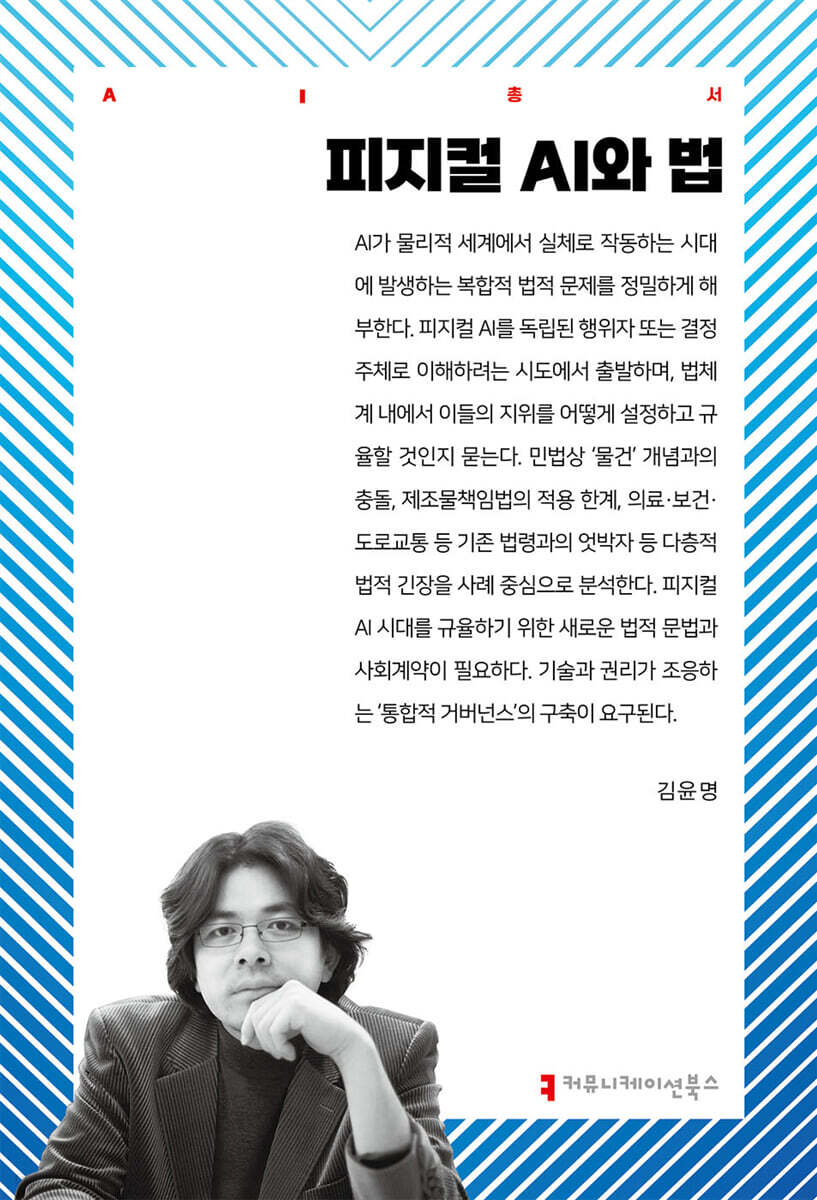
Physical AI and the Law
 |
Description
Book Introduction
Physical AI is now a reality.
Self-driving cars, care robots, and drones will move society alongside humans.
But the law still fails to define these beings.
"Physical AI and the Law" dissects the legal vacuum created by technology and raises the need to redesign responsibilities, rights, and governance.
Rather than suggesting how to control technology, we propose how to coexist with technology.
Artificial Intelligence Encyclopedia.
You can find the artificial intelligence knowledge you need at aiseries.oopy.io.
Self-driving cars, care robots, and drones will move society alongside humans.
But the law still fails to define these beings.
"Physical AI and the Law" dissects the legal vacuum created by technology and raises the need to redesign responsibilities, rights, and governance.
Rather than suggesting how to control technology, we propose how to coexist with technology.
Artificial Intelligence Encyclopedia.
You can find the artificial intelligence knowledge you need at aiseries.oopy.io.
- You can preview some of the book's contents.
Preview
index
Another Side of Robots: Physical AI
01 What is Physical AI?
02 Legal Liability for Autonomous Vehicle Accidents
03 Legal Issues Concerning AI for Vulnerable Populations, Including Care Robots and Medical Robots
04 Public Use of Delivery Robots and Drones and Safety Regulations
05 Scope of Application of Physical AI and Product Liability Law
06 Legal Subjectivity of Physical AI: Discussing the Introduction of "Electronic Personhood"
07 Design of insurance and compensation systems related to physical AI
08 Safety Certification and Licensing System for Physical AI
09 Privacy Infringement Issues Caused by Physical AI
10 Physical AI Regulatory Governance
01 What is Physical AI?
02 Legal Liability for Autonomous Vehicle Accidents
03 Legal Issues Concerning AI for Vulnerable Populations, Including Care Robots and Medical Robots
04 Public Use of Delivery Robots and Drones and Safety Regulations
05 Scope of Application of Physical AI and Product Liability Law
06 Legal Subjectivity of Physical AI: Discussing the Introduction of "Electronic Personhood"
07 Design of insurance and compensation systems related to physical AI
08 Safety Certification and Licensing System for Physical AI
09 Privacy Infringement Issues Caused by Physical AI
10 Physical AI Regulatory Governance
Into the book
Physical AI refers to a system in which artificial intelligence technology goes beyond simple information processing or decision support, and moves and acts autonomously in a physical environment.
This is implemented in the form of artificial intelligence combined with physical devices such as robotic arms, self-driving cars, drones, and delivery robots, and has the ability to interact with the world in a human-like manner.
While general AI produces results such as text, images, and data analysis in virtual spaces, physical AI exists as an 'acting machine' that causes physical results through direct actions in the real world.
--- From "01_“What is Physical AI?”"
The concept of 'electronic personhood' began to attract global attention when it was officially mentioned in a 2017 European Parliament report.
This concept seeks to establish a legal framework for attribution of responsibility for damages or consequences caused by highly autonomous AI systems, particularly physical AI systems that perform physical actions.
The existing legal system assumes that humans or corporations are legal subjects, but the gap between AI's autonomy and impersonality raises problems that cannot be explained by a dualistic system.
--- From "06_“Legal Subjectivity of Physical AI: Discussion on the Introduction of ‘Electronic Personality’”
Currently, most physical AI devices in Korea are subject to general certification under existing laws, such as industrial machinery, medical devices, and electronic communication devices. However, these laws do not sufficiently reflect AI's unique judgment structure, update capabilities, and autonomy.
For example, care robots may not be subject to the Medical Devices Act, and delivery robots exist within the loopholes of the Road Traffic Act.
Therefore, an 'AI device-specific certification system' that takes into account the unique operating structure and risk characteristics of AI must be established, and this can be designed in parallel with the existing certification system.
New criteria are needed, including the ability to make autonomous decisions, the strength of interaction, and the ability to respond to unexpected scenarios.
This is implemented in the form of artificial intelligence combined with physical devices such as robotic arms, self-driving cars, drones, and delivery robots, and has the ability to interact with the world in a human-like manner.
While general AI produces results such as text, images, and data analysis in virtual spaces, physical AI exists as an 'acting machine' that causes physical results through direct actions in the real world.
--- From "01_“What is Physical AI?”"
The concept of 'electronic personhood' began to attract global attention when it was officially mentioned in a 2017 European Parliament report.
This concept seeks to establish a legal framework for attribution of responsibility for damages or consequences caused by highly autonomous AI systems, particularly physical AI systems that perform physical actions.
The existing legal system assumes that humans or corporations are legal subjects, but the gap between AI's autonomy and impersonality raises problems that cannot be explained by a dualistic system.
--- From "06_“Legal Subjectivity of Physical AI: Discussion on the Introduction of ‘Electronic Personality’”
Currently, most physical AI devices in Korea are subject to general certification under existing laws, such as industrial machinery, medical devices, and electronic communication devices. However, these laws do not sufficiently reflect AI's unique judgment structure, update capabilities, and autonomy.
For example, care robots may not be subject to the Medical Devices Act, and delivery robots exist within the loopholes of the Road Traffic Act.
Therefore, an 'AI device-specific certification system' that takes into account the unique operating structure and risk characteristics of AI must be established, and this can be designed in parallel with the existing certification system.
New criteria are needed, including the ability to make autonomous decisions, the strength of interaction, and the ability to respond to unexpected scenarios.
--- From “08_“Physical AI Safety Certification and Permit System””
Publisher's Review
Machines Start Walking Alongside Humans: Rewriting the Law in the Age of Physical AI
AI is no longer a being in code.
From self-driving cars on the road, delivery robots navigating alleyways, to caregiver robots caring for the elderly, physical AI is coexisting with humans in physical space, creating a new social order.
But the law still remains stuck in the language of the past.
Who is responsible when an accident occurs? What are my rights if my face is captured in a video captured by a robot? This book confronts these legal and ethical vacuums head-on.
Physical AI is not simply a technology; it is becoming a legal entity that blurs the lines between objects and people, acting as an "acting entity."
Existing product liability laws, personal information protection laws, medical device laws, and road traffic laws clash and become powerless in the face of this new entity.
This book analyzes the limitations of the current legal system, focusing on each technology case, and presents a new response framework.
This is an institutional design that ensures that the law does not suppress or lag behind technology, but rather evolves alongside it in response to change.
Instead of criticizing law for failing to keep pace with technology, Physical AI and the Law argues that law must redesign the structure of technological society.
In an age where machines walk like humans, we must rewrite the law to ensure we live on the same path and by the same rules.
AI is no longer a being in code.
From self-driving cars on the road, delivery robots navigating alleyways, to caregiver robots caring for the elderly, physical AI is coexisting with humans in physical space, creating a new social order.
But the law still remains stuck in the language of the past.
Who is responsible when an accident occurs? What are my rights if my face is captured in a video captured by a robot? This book confronts these legal and ethical vacuums head-on.
Physical AI is not simply a technology; it is becoming a legal entity that blurs the lines between objects and people, acting as an "acting entity."
Existing product liability laws, personal information protection laws, medical device laws, and road traffic laws clash and become powerless in the face of this new entity.
This book analyzes the limitations of the current legal system, focusing on each technology case, and presents a new response framework.
This is an institutional design that ensures that the law does not suppress or lag behind technology, but rather evolves alongside it in response to change.
Instead of criticizing law for failing to keep pace with technology, Physical AI and the Law argues that law must redesign the structure of technological society.
In an age where machines walk like humans, we must rewrite the law to ensure we live on the same path and by the same rules.
GOODS SPECIFICS
- Date of issue: November 21, 2025
- Page count, weight, size: 146 pages | 128*188*7mm
- ISBN13: 9791143010704
You may also like
카테고리
korean


korean

![GQ KOREA Mark (Monthly): December [2025]](http://librairie.coreenne.fr/cdn/shop/files/8ef265dbbfbf186523ed75ba7319009d.jpg?v=1765340328&width=3840)


