

The Power of Homework
 |
Description
Book Introduction
Amidst all the tests, learning standards, homework, and media overload, parents and children are losing sight of what really matters.
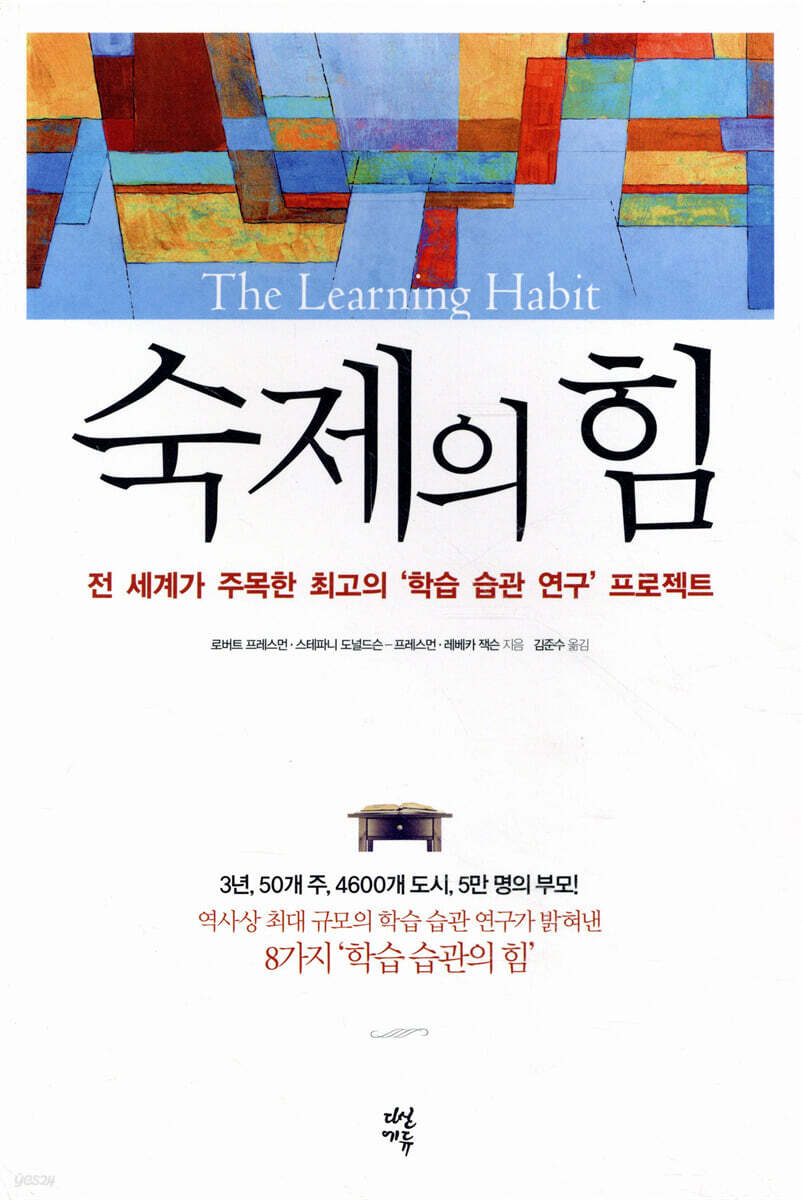
How can parents help their children develop the study habits necessary for true life success, beyond simply excelling on tests? This book presents a new solution based on the largest-ever three-year study, "The Learning Habit Studies," which examined the lifestyles of 50,000 families across 4,600 cities and all 50 states in the United States.
It offers a blueprint for understanding schoolwork, media use, and everyday stress, and offers solutions to help children develop eight key habits they need to thrive in the future.
How can parents help their children develop the study habits necessary for true life success, beyond simply excelling on tests? This book presents a new solution based on the largest-ever three-year study, "The Learning Habit Studies," which examined the lifestyles of 50,000 families across 4,600 cities and all 50 states in the United States.
It offers a blueprint for understanding schoolwork, media use, and everyday stress, and offers solutions to help children develop eight key habits they need to thrive in the future.
- You can preview some of the book's contents.
Preview
index
introduction
PART 1: Lifelong learning begins at home.
Uncover the secrets behind success
Self-directed parenting is the beginning of learning habits.
PART 2: 8 Learning Habits for Successful Children
Chapter 1.
Media Usage Habits: How You Use Your Computer and Smartphone
Chapter 2.
Homework Habits: How to Develop Regular Homework Habits
Chapter 3.
Time Management Habits: How to Manage Your Time Effectively
Chapter 4.
Goal Setting Habits: How to Set Goals Effectively
Chapter 5.
Effective Conversation Habits: How to Express What You Want
Chapter 6.
The Habit of Taking Responsibility: How to Take Responsibility for Your Choices
Chapter 7.
The Habit of Focus: How to Resist the Marshmallow in Front of You
Chapter 8.
The Habit of Self-Reliance: How to Develop the Courage to Be Self-Reliant
PART 3: 21 Play Challenges for Successful Kids
Learn through play
Acknowledgements
annotation
PART 1: Lifelong learning begins at home.
Uncover the secrets behind success
Self-directed parenting is the beginning of learning habits.
PART 2: 8 Learning Habits for Successful Children
Chapter 1.
Media Usage Habits: How You Use Your Computer and Smartphone
Chapter 2.
Homework Habits: How to Develop Regular Homework Habits
Chapter 3.
Time Management Habits: How to Manage Your Time Effectively
Chapter 4.
Goal Setting Habits: How to Set Goals Effectively
Chapter 5.
Effective Conversation Habits: How to Express What You Want
Chapter 6.
The Habit of Taking Responsibility: How to Take Responsibility for Your Choices
Chapter 7.
The Habit of Focus: How to Resist the Marshmallow in Front of You
Chapter 8.
The Habit of Self-Reliance: How to Develop the Courage to Be Self-Reliant
PART 3: 21 Play Challenges for Successful Kids
Learn through play
Acknowledgements
annotation
Into the book
We learned from the Study Habits Study, the foundation of this book and the largest study ever conducted on family life, that homework habits, goal setting, and self-esteem are far better predictors of a child's success.
What our children lack is not intellectual ability.
Kids simply haven't developed the habits necessary to successfully handle the pressures, demands, and relative freedom of college.
---From "PART 1: Find the Secret Behind Success"
According to the results of the 'Learning Habits Study', choosing 'autonomous parenting' as a parenting method means that as parents, you want your children to develop the habit of fostering independence and self-reliance.
Permissive parenting (also known as traditional parenting or authoritarian parenting) is at the complete opposite end.
Autonomous parenting provides opportunities to experience the importance of one's own actions, to make choices within reasonable limits, to take responsibility for their choices because parents do not, to reflect on choices, their significance, and the consequences and impacts of those choices, and to develop habits that will enable them to achieve their goals.
---From "PART 1: Autonomous parenting is the beginning of learning habits"
Children who connect with others through social media fall into the illusion that they are forming real human relationships.
Here's a rule that applies without exception, as our research and teachers have shown:
'When media consumption becomes excessive (our research shows that it exceeds eight hours a day), communication skills decline.'
As children become more immersed in social media, they feel less need for communication skills and spend less time engaging in social activities.
Children who do not know how to express their feelings and needs feel more like losers and feel anxious and angry.
---「Chapter 1.
From “How to Use Computers and Smartphones”
It teaches us that homework is a preparatory process for creating a better world and realizing our dreams.
Autonomy helps children realize that they have the ability to solve problems on their own.
Even if it's difficult, the child can do it on his own.
Don't step aside and do it for them, and don't lose patience.
Highlight the fun aspects of self-management homework and emphasize that studying can help cognitive development.
Help children understand that the grades they receive are a reward for their learning and effort.
---「Chapter 2.
From “How to develop regular homework habits”
Research on learning habits shows that children who don't manage their schedules, don't do chores, don't organize their belongings, don't participate in regular extracurricular activities, and don't have established productive habits generally don't develop good time management habits.
---「Chapter 3.
From “How to Manage Time Efficiently”
There was a time when scientists relied solely on IQ to predict a child's academic success.
Research on learning habits has shown that setting academic goals can help children achieve 25 percent more of their potential.
Academic goals are one of the most important factors in a child's academic success.
---「Chapter 4.
From “How to Set Goals Effectively”
Anything about humans can be stated, and anything that can be stated can be processed.
When we talk about our feelings, we feel less pressure, less anger, and less fear.
Sharing important facts with a believer can help reduce feelings of isolation.
---「Chapter 5.
From "How to Express What You Want"
The most successful children are those who learn to take responsibility only for what they can do and let go of everything else.
And the opposite applies to parents.
The most helpful parents are those who don't take responsibility for things their children can control.
---「Chapter 6.
From “How to Take Responsibility for Your Choices”
Self-management skills are most effectively learned when stressors are removed. This is where the adage "there are no winners or losers" holds true.
Children who are constantly stressed and exposed to criticism and correction develop habits that interfere with their social functioning.
Blaming others, interfering, blaming others for their mistakes, boasting, and making excuses for poor performance.
This can be improved by allowing students to do their homework autonomously.
---「Chapter 7.
From "How to resist the marshmallow right in front of you"
Parents think that children who receive scholarships through sports or academics in college are naturally gifted.
But if we go back to when those children were six or ten years old, we can't find anything special or talented about them.
You can see that the secret is that the child simply repeats the same thing, practices it, and doesn't quit.
It's not a special ability, nor is it magic.
It was all thanks to sheer tenacity.
In high school, it is natural that students who are obsessed with something, give it their all, and don't give up will slowly rise to the front of the pack.
---「Chapter 8.
From “How to cultivate the courage to be independent”
Your children can become successful learners by developing the eight essential habits discussed above.
Through 21 practical play tasks, the whole family can learn to understand each other better, be more orderly, and have more fun while arguing less.
By completing each step, your family will have completed the 21-day learning challenge!
What our children lack is not intellectual ability.
Kids simply haven't developed the habits necessary to successfully handle the pressures, demands, and relative freedom of college.
---From "PART 1: Find the Secret Behind Success"
According to the results of the 'Learning Habits Study', choosing 'autonomous parenting' as a parenting method means that as parents, you want your children to develop the habit of fostering independence and self-reliance.
Permissive parenting (also known as traditional parenting or authoritarian parenting) is at the complete opposite end.
Autonomous parenting provides opportunities to experience the importance of one's own actions, to make choices within reasonable limits, to take responsibility for their choices because parents do not, to reflect on choices, their significance, and the consequences and impacts of those choices, and to develop habits that will enable them to achieve their goals.
---From "PART 1: Autonomous parenting is the beginning of learning habits"
Children who connect with others through social media fall into the illusion that they are forming real human relationships.
Here's a rule that applies without exception, as our research and teachers have shown:
'When media consumption becomes excessive (our research shows that it exceeds eight hours a day), communication skills decline.'
As children become more immersed in social media, they feel less need for communication skills and spend less time engaging in social activities.
Children who do not know how to express their feelings and needs feel more like losers and feel anxious and angry.
---「Chapter 1.
From “How to Use Computers and Smartphones”
It teaches us that homework is a preparatory process for creating a better world and realizing our dreams.
Autonomy helps children realize that they have the ability to solve problems on their own.
Even if it's difficult, the child can do it on his own.
Don't step aside and do it for them, and don't lose patience.
Highlight the fun aspects of self-management homework and emphasize that studying can help cognitive development.
Help children understand that the grades they receive are a reward for their learning and effort.
---「Chapter 2.
From “How to develop regular homework habits”
Research on learning habits shows that children who don't manage their schedules, don't do chores, don't organize their belongings, don't participate in regular extracurricular activities, and don't have established productive habits generally don't develop good time management habits.
---「Chapter 3.
From “How to Manage Time Efficiently”
There was a time when scientists relied solely on IQ to predict a child's academic success.
Research on learning habits has shown that setting academic goals can help children achieve 25 percent more of their potential.
Academic goals are one of the most important factors in a child's academic success.
---「Chapter 4.
From “How to Set Goals Effectively”
Anything about humans can be stated, and anything that can be stated can be processed.
When we talk about our feelings, we feel less pressure, less anger, and less fear.
Sharing important facts with a believer can help reduce feelings of isolation.
---「Chapter 5.
From "How to Express What You Want"
The most successful children are those who learn to take responsibility only for what they can do and let go of everything else.
And the opposite applies to parents.
The most helpful parents are those who don't take responsibility for things their children can control.
---「Chapter 6.
From “How to Take Responsibility for Your Choices”
Self-management skills are most effectively learned when stressors are removed. This is where the adage "there are no winners or losers" holds true.
Children who are constantly stressed and exposed to criticism and correction develop habits that interfere with their social functioning.
Blaming others, interfering, blaming others for their mistakes, boasting, and making excuses for poor performance.
This can be improved by allowing students to do their homework autonomously.
---「Chapter 7.
From "How to resist the marshmallow right in front of you"
Parents think that children who receive scholarships through sports or academics in college are naturally gifted.
But if we go back to when those children were six or ten years old, we can't find anything special or talented about them.
You can see that the secret is that the child simply repeats the same thing, practices it, and doesn't quit.
It's not a special ability, nor is it magic.
It was all thanks to sheer tenacity.
In high school, it is natural that students who are obsessed with something, give it their all, and don't give up will slowly rise to the front of the pack.
---「Chapter 8.
From “How to cultivate the courage to be independent”
Your children can become successful learners by developing the eight essential habits discussed above.
Through 21 practical play tasks, the whole family can learn to understand each other better, be more orderly, and have more fun while arguing less.
By completing each step, your family will have completed the 21-day learning challenge!
---「PART3.
From "Learning through Play"
From "Learning through Play"
Publisher's Review
The Laws of Learning Habits That Shape the Future, Revealed by the Largest Study in History
Small changes in study habits can completely change a child's life!
Habit 1 - Media creation, media consumption, and media communication habits create successful children.
Second habit - Regular homework habits foster self-control, autonomy, and independence.
Third Habit - The habit of managing time efficiently creates a balanced daily life.
The fourth habit is to set grand goals that excite children and make their dreams come true.
The fifth habit: The habit of communicating with respect by listening to emotions changes children.
Habit Six: Taking responsibility for what you can control creates mature children.
The seventh habit - The habit of focusing with strong mental power determines a child's achievement.
Habit 8: The habit of being self-reliant in adversity makes a difference in a child's life.
The largest study of learning habits in history, with 50 states, 4,600 cities, and 50,000 parents participating.
The educational environment has changed rapidly over the past few years.
Beyond academic stress, children and parents face issues such as bullying, school violence, and media addiction.
Amid rapid technological advancements, social instability, and educational changes, parents are anxious about how to educate their children in the future.
Dr. Robert Pressman, Stephanie Donaldson-Pressman, and Rebecca Jackson, authors of the book "The Power of Homework" and experts on family issues, studied families who raised their children to be excellent talents even in such an environment, and sought to find the most fundamental and core educational methods.
The Learning Habit Studies, the largest-ever study of family life in history, began with these questions: How can children succeed academically? How can we foster the social skills to communicate clearly in children? What can parents do to foster a healthy mind and self-confidence even in resource-constrained environments?
This study, conducted over three years across 50 states, 4,600 cities, and 50,000 people in the U.S., aimed to clearly identify the learning habits that determine children's educational success and failure, with a particular focus on 'homework habits.'
Researchers, including the three authors, followed the life trajectories of families who successfully raised their children, using traditional academic research, clinical experience, online surveys, and comprehensive interviews with parents, teachers, and children.
As a result, we discovered what kind of educational guidance parents of successful children imparted during crucial turning points in their children's lives.
Based on this, we define eight laws of learning habits commonly found in families of children who have experienced academic, emotional, and social success.
In particular, the results of all these study habits studies are presented with numerous vivid and specific real-life examples, making them even more relatable.
Authors including Dr. Robert Pressman say, “Learning habits are the processes by which children acquire the skills essential for academic, social, and emotional success.
“This book offers clear answers to parents in modern society who know the importance of habits but don’t know how to apply them to their children’s education, about learning habits that will change their children’s lives,” he said.
Eight "Laws of Learning Habits" Revealed by a World-Reaching Research Project
Dr. Robert Pressman said in his book, "The Power of Homework," "What's learned in the cradle is carried to the grave."
The habits our children are developing now will stay with them for the rest of their lives.
So, if you want your child to be truly successful, you have to develop the right habits,” he said, citing habit formation as the core of child education.
Part 1, "All Lifelong Learning Begins at Home," explains "autonomous parenting," which drives all these habit changes.
Autonomy parenting, as the name suggests, is about giving children choices over their own behavior and giving them control over the direction of their lives.
This stands in stark contrast to 'permissive parenting', where children do as they are told, and is a powerful force in developing children's ability to sustain learning.
This suggests that it starts with how parents interact with their children every day.
Part 2, “The 8 Laws of Learning Habits for a Child Who Will Succeed Throughout His Life,” presents the 8 laws of habits that have a decisive impact on a child’s life.
The first is media usage habits. Media creation, media consumption, and media communication habits create successful children.
The second is homework habits. A regular '10-minute homework rule' fosters self-control, autonomy, and independence.
The third is time management habits. The habit of managing time efficiently creates a balanced daily life.
The fourth is the habit of setting goals. Setting grand goals that excite children will help them achieve their dreams.
The fifth is the habit of effective communication. The habit of 'respectful communication', which involves listening to emotions and communicating, changes the child.
The sixth habit is taking responsibility. Choosing to take responsibility for things you can control creates a mature child.
The seventh is the habit of concentration, and the habit of concentrating with strong mental power determines a child's achievement.
The eighth is the habit of self-reliance. The habit of self-reliance within limited resources makes a difference in a child's life.
Part 3, "21 Play Challenges for Successful Kids," presents practical 24-hour family games to help children and the entire family develop eight learning habits.
Through these fun games, children can experience change for themselves and lay the foundation for developing learning habits.
In a media society, children who do their homework well succeed!
Today's elementary, middle, and high school students are called 'Generation M2' because they have a much deeper relationship with media than the millennial generation or 'Generation M', which refers to the media generation.
The M2 generation's use of media through the Internet, smartphones, and various games is explosive.
The combination of technology and homework through online class tools and textbooks has also made the homework process more complex.
In this process, the boundary between whether the purpose of media consumption is education or hobby has become very blurred.
"The Power of Homework" warns that, amidst the overflow of media, children lack the essential social skills, conversational skills, and study habits.
Kids who play video games for hours can't read a book for more than 10 minutes.
Kids who know how to text and tweet can't focus on math problems or read more than a few lines of a history book.
This is understandable given the instant gratification we get from video games, the internet, and social media.
This book, which highlights the importance of study habits, encourages us to look at "homework" from a completely new perspective amidst the advancements in media and technology.
Because independently performing homework is the only habit that improves children's quality of life by fostering self-regulation, autonomy, intrinsic motivation, and self-efficacy.
Like it or not, in this age of media proliferation and technology-driven homework, regular homework habits are key to helping children grow into academically, socially, and emotionally mature adults.
The learning habits a child develops in childhood last a lifetime.
When you lose sight of your goals, struggle to manage your time, and feel like you're losing your ability to be independent, it's a source of strength to set your course and overcome.
Learning habits help you make choices that are consistent with your thinking at various decision moments you will face throughout your life.
This book, "The Power of Homework," will be a gift that will give children the power of learning habits that will last a lifetime.
Small changes in study habits can completely change a child's life!
Habit 1 - Media creation, media consumption, and media communication habits create successful children.
Second habit - Regular homework habits foster self-control, autonomy, and independence.
Third Habit - The habit of managing time efficiently creates a balanced daily life.
The fourth habit is to set grand goals that excite children and make their dreams come true.
The fifth habit: The habit of communicating with respect by listening to emotions changes children.
Habit Six: Taking responsibility for what you can control creates mature children.
The seventh habit - The habit of focusing with strong mental power determines a child's achievement.
Habit 8: The habit of being self-reliant in adversity makes a difference in a child's life.
The largest study of learning habits in history, with 50 states, 4,600 cities, and 50,000 parents participating.
The educational environment has changed rapidly over the past few years.
Beyond academic stress, children and parents face issues such as bullying, school violence, and media addiction.
Amid rapid technological advancements, social instability, and educational changes, parents are anxious about how to educate their children in the future.
Dr. Robert Pressman, Stephanie Donaldson-Pressman, and Rebecca Jackson, authors of the book "The Power of Homework" and experts on family issues, studied families who raised their children to be excellent talents even in such an environment, and sought to find the most fundamental and core educational methods.
The Learning Habit Studies, the largest-ever study of family life in history, began with these questions: How can children succeed academically? How can we foster the social skills to communicate clearly in children? What can parents do to foster a healthy mind and self-confidence even in resource-constrained environments?
This study, conducted over three years across 50 states, 4,600 cities, and 50,000 people in the U.S., aimed to clearly identify the learning habits that determine children's educational success and failure, with a particular focus on 'homework habits.'
Researchers, including the three authors, followed the life trajectories of families who successfully raised their children, using traditional academic research, clinical experience, online surveys, and comprehensive interviews with parents, teachers, and children.
As a result, we discovered what kind of educational guidance parents of successful children imparted during crucial turning points in their children's lives.
Based on this, we define eight laws of learning habits commonly found in families of children who have experienced academic, emotional, and social success.
In particular, the results of all these study habits studies are presented with numerous vivid and specific real-life examples, making them even more relatable.
Authors including Dr. Robert Pressman say, “Learning habits are the processes by which children acquire the skills essential for academic, social, and emotional success.
“This book offers clear answers to parents in modern society who know the importance of habits but don’t know how to apply them to their children’s education, about learning habits that will change their children’s lives,” he said.
Eight "Laws of Learning Habits" Revealed by a World-Reaching Research Project
Dr. Robert Pressman said in his book, "The Power of Homework," "What's learned in the cradle is carried to the grave."
The habits our children are developing now will stay with them for the rest of their lives.
So, if you want your child to be truly successful, you have to develop the right habits,” he said, citing habit formation as the core of child education.
Part 1, "All Lifelong Learning Begins at Home," explains "autonomous parenting," which drives all these habit changes.
Autonomy parenting, as the name suggests, is about giving children choices over their own behavior and giving them control over the direction of their lives.
This stands in stark contrast to 'permissive parenting', where children do as they are told, and is a powerful force in developing children's ability to sustain learning.
This suggests that it starts with how parents interact with their children every day.
Part 2, “The 8 Laws of Learning Habits for a Child Who Will Succeed Throughout His Life,” presents the 8 laws of habits that have a decisive impact on a child’s life.
The first is media usage habits. Media creation, media consumption, and media communication habits create successful children.
The second is homework habits. A regular '10-minute homework rule' fosters self-control, autonomy, and independence.
The third is time management habits. The habit of managing time efficiently creates a balanced daily life.
The fourth is the habit of setting goals. Setting grand goals that excite children will help them achieve their dreams.
The fifth is the habit of effective communication. The habit of 'respectful communication', which involves listening to emotions and communicating, changes the child.
The sixth habit is taking responsibility. Choosing to take responsibility for things you can control creates a mature child.
The seventh is the habit of concentration, and the habit of concentrating with strong mental power determines a child's achievement.
The eighth is the habit of self-reliance. The habit of self-reliance within limited resources makes a difference in a child's life.
Part 3, "21 Play Challenges for Successful Kids," presents practical 24-hour family games to help children and the entire family develop eight learning habits.
Through these fun games, children can experience change for themselves and lay the foundation for developing learning habits.
In a media society, children who do their homework well succeed!
Today's elementary, middle, and high school students are called 'Generation M2' because they have a much deeper relationship with media than the millennial generation or 'Generation M', which refers to the media generation.
The M2 generation's use of media through the Internet, smartphones, and various games is explosive.
The combination of technology and homework through online class tools and textbooks has also made the homework process more complex.
In this process, the boundary between whether the purpose of media consumption is education or hobby has become very blurred.
"The Power of Homework" warns that, amidst the overflow of media, children lack the essential social skills, conversational skills, and study habits.
Kids who play video games for hours can't read a book for more than 10 minutes.
Kids who know how to text and tweet can't focus on math problems or read more than a few lines of a history book.
This is understandable given the instant gratification we get from video games, the internet, and social media.
This book, which highlights the importance of study habits, encourages us to look at "homework" from a completely new perspective amidst the advancements in media and technology.
Because independently performing homework is the only habit that improves children's quality of life by fostering self-regulation, autonomy, intrinsic motivation, and self-efficacy.
Like it or not, in this age of media proliferation and technology-driven homework, regular homework habits are key to helping children grow into academically, socially, and emotionally mature adults.
The learning habits a child develops in childhood last a lifetime.
When you lose sight of your goals, struggle to manage your time, and feel like you're losing your ability to be independent, it's a source of strength to set your course and overcome.
Learning habits help you make choices that are consistent with your thinking at various decision moments you will face throughout your life.
This book, "The Power of Homework," will be a gift that will give children the power of learning habits that will last a lifetime.
GOODS SPECIFICS
- Date of publication: March 16, 2015
- Page count, weight, size: 356 pages | 601g | 150*220*21mm
- ISBN13: 9791130604848
- ISBN10: 1130604845
You may also like
카테고리
korean


korean

![GQ KOREA Mark (Monthly): December [2025]](http://librairie.coreenne.fr/cdn/shop/files/8ef265dbbfbf186523ed75ba7319009d.jpg?v=1765340328&width=3840)


