

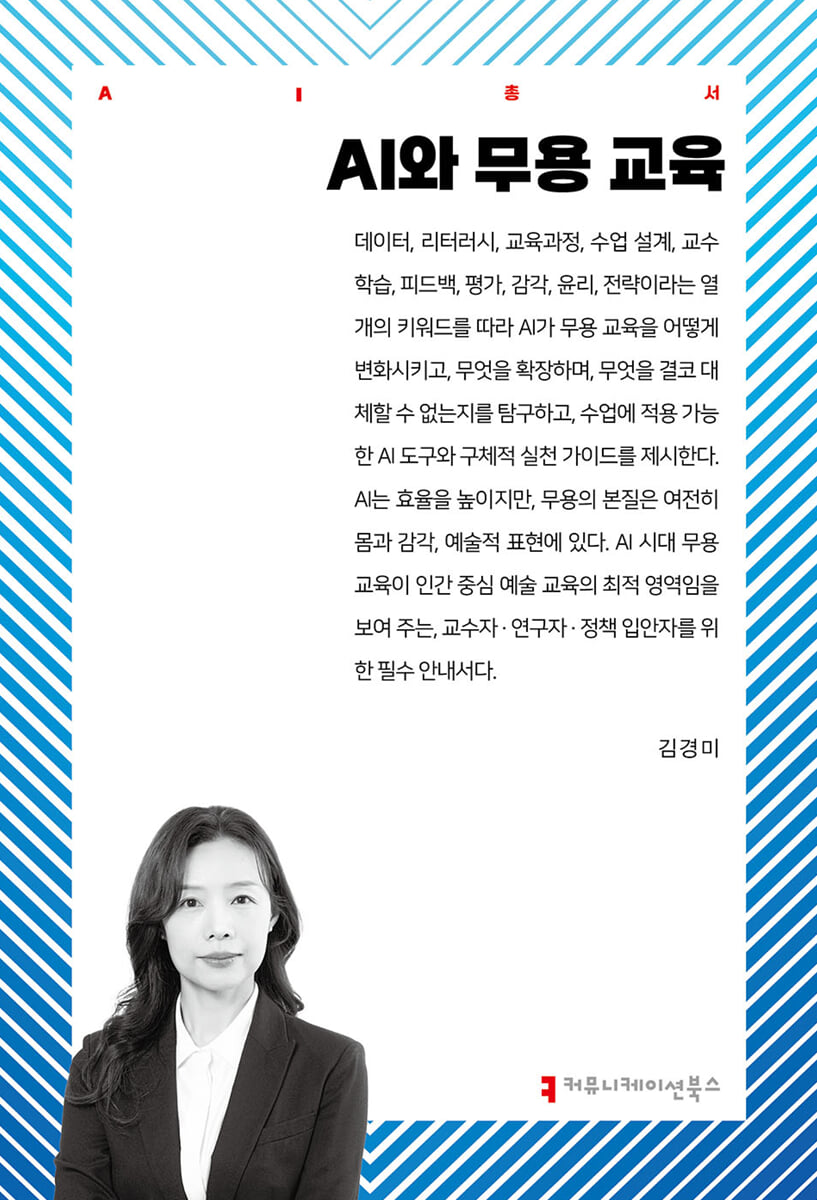
AI and Dance Education
 |
Description
Book Introduction
AI is a tool and assistant in dance education.
Technology analyzes movements, but the emotions of art are created only by humans.
As bodies and algorithms meet, dance education returns to the art of learning human senses. AI Encyclopedia.
You can find the artificial intelligence knowledge you need at aiseries.oopy.io.
Technology analyzes movements, but the emotions of art are created only by humans.
As bodies and algorithms meet, dance education returns to the art of learning human senses. AI Encyclopedia.
You can find the artificial intelligence knowledge you need at aiseries.oopy.io.
- You can preview some of the book's contents.
Preview
index
AI and the Transformation of Dance Education
01 Dance Dataset for AI-Based Dance Education
02 AI Literacy for Collaborating with AI
03 Changes in AI-based dance curriculum
04 AI-based dance class design
05 AI-powered dance teaching and learning methods
06 AI-based personalized learning and feedback
07 Evaluation of AI-based dance movements
08 The Boundaries of Sensory-Based Dance Education and AI Technology
09 AI Ethics Issues in Dance Education
10 AI-Powered Strategies for Dance Education
01 Dance Dataset for AI-Based Dance Education
02 AI Literacy for Collaborating with AI
03 Changes in AI-based dance curriculum
04 AI-based dance class design
05 AI-powered dance teaching and learning methods
06 AI-based personalized learning and feedback
07 Evaluation of AI-based dance movements
08 The Boundaries of Sensory-Based Dance Education and AI Technology
09 AI Ethics Issues in Dance Education
10 AI-Powered Strategies for Dance Education
Into the book
For AI to understand dance, it needs to convert movements into data.
The digitalization of dance is the first language connecting AI and dance education, and a starting point for opening up new possibilities.
However, dance movements are intertwined with elements that are difficult to quantify, such as the human body, emotions, rhythm, and improvisation, and there are inherent limitations in converting them into data that AI can learn from.
The body is not simply a coordinate system, but a subject that encounters the world and creates meaning, and sensory immersion and emotional exchange are difficult to reduce to data.
Therefore, the collection and utilization of dance datasets requires a balance that preserves the artistic essence.
--- From “01_“Dance Dataset for AI-Based Dance Education””
Dance curriculum is being forced to undergo a comprehensive restructuring as it meets the new challenges of AI.
The method of analyzing learners' physical data in real time and reflecting it in their individual learning paths transforms the existing uniform class structure.
AI-based feedback systems can quantify and standardize assessments, but they also risk undermining creativity and individuality.
Therefore, rather than emphasizing the efficiency of technology, AI-based curricula should be an opportunity to reexamine the values and essence of what education should pursue.
--- From “03_“Changes in AI-based Dance Curriculum””
The core of personalized learning design is to provide learning paths that reflect the characteristics and goals of individual learners.
In the past, dance classes were often conducted based on group averages, making tasks too easy or too difficult for some learners. AI can track learners' movement error patterns, fatigue, and recovery speeds to provide personalized tasks.
Moreover, custom design should lead to creative exploration rather than simple technical correction.
As learners explore and transform their own movements based on AI data, learning expands beyond technical training to a process of creation and reflection.
--- From “06_“AI-based personalized learning and feedback””
The first issue faced when utilizing AI technology in dance education is the protection of learners' body data. Utilizing AI means converting the body and movements into data.
However, physical data is not just an indicator; it is sensitive information that contains the learner's identity, senses, and cultural background.
In the case of dance, movement data includes the entire body, including joint angles, speed and rhythm of movement, facial expressions, and breathing, and is also an expression of artistic autonomy that reveals an individual's habits and emotions.
The digitalization of dance is the first language connecting AI and dance education, and a starting point for opening up new possibilities.
However, dance movements are intertwined with elements that are difficult to quantify, such as the human body, emotions, rhythm, and improvisation, and there are inherent limitations in converting them into data that AI can learn from.
The body is not simply a coordinate system, but a subject that encounters the world and creates meaning, and sensory immersion and emotional exchange are difficult to reduce to data.
Therefore, the collection and utilization of dance datasets requires a balance that preserves the artistic essence.
--- From “01_“Dance Dataset for AI-Based Dance Education””
Dance curriculum is being forced to undergo a comprehensive restructuring as it meets the new challenges of AI.
The method of analyzing learners' physical data in real time and reflecting it in their individual learning paths transforms the existing uniform class structure.
AI-based feedback systems can quantify and standardize assessments, but they also risk undermining creativity and individuality.
Therefore, rather than emphasizing the efficiency of technology, AI-based curricula should be an opportunity to reexamine the values and essence of what education should pursue.
--- From “03_“Changes in AI-based Dance Curriculum””
The core of personalized learning design is to provide learning paths that reflect the characteristics and goals of individual learners.
In the past, dance classes were often conducted based on group averages, making tasks too easy or too difficult for some learners. AI can track learners' movement error patterns, fatigue, and recovery speeds to provide personalized tasks.
Moreover, custom design should lead to creative exploration rather than simple technical correction.
As learners explore and transform their own movements based on AI data, learning expands beyond technical training to a process of creation and reflection.
--- From “06_“AI-based personalized learning and feedback””
The first issue faced when utilizing AI technology in dance education is the protection of learners' body data. Utilizing AI means converting the body and movements into data.
However, physical data is not just an indicator; it is sensitive information that contains the learner's identity, senses, and cultural background.
In the case of dance, movement data includes the entire body, including joint angles, speed and rhythm of movement, facial expressions, and breathing, and is also an expression of artistic autonomy that reveals an individual's habits and emotions.
--- From "09_“AI Ethical Issues in Dance Education”"
Publisher's Review
Coexistence of Body and Algorithm: Reconstructing Dance Education
AI has now entered the dance world.
Technologies that analyze movement, suggest choreography, and recognize a learner's body in real time are fundamentally changing the way dance is taught.
However, the essence of change lies not in technology, but in the human body. AI offers efficiency and precision, but it cannot replace the artistic dimension of sensation, emotion, improvisation, and empathy. AI is not a replacement, but a mirror that reflects human sensibility.
Dance education is now expanding beyond physical training into a new field of learning where technique and emotion coexist.
As a guide who interprets data and as an artistic facilitator, the instructor must teach learners both the language of technology and the language of the senses.
The essence of dance remains in the body, emotions, and sensory reflection on the world. When dancing with AI, dance education transcends the language of efficiency and restores human artistic dignity.
AI has now entered the dance world.
Technologies that analyze movement, suggest choreography, and recognize a learner's body in real time are fundamentally changing the way dance is taught.
However, the essence of change lies not in technology, but in the human body. AI offers efficiency and precision, but it cannot replace the artistic dimension of sensation, emotion, improvisation, and empathy. AI is not a replacement, but a mirror that reflects human sensibility.
Dance education is now expanding beyond physical training into a new field of learning where technique and emotion coexist.
As a guide who interprets data and as an artistic facilitator, the instructor must teach learners both the language of technology and the language of the senses.
The essence of dance remains in the body, emotions, and sensory reflection on the world. When dancing with AI, dance education transcends the language of efficiency and restores human artistic dignity.
GOODS SPECIFICS
- Date of issue: November 18, 2025
- Page count, weight, size: 137 pages | 128*188*20mm
- ISBN13: 9791143014511
- ISBN10: 1143014510
You may also like
카테고리
korean


korean

![GQ KOREA Mark (Monthly): December [2025]](http://librairie.coreenne.fr/cdn/shop/files/8ef265dbbfbf186523ed75ba7319009d.jpg?v=1765340328&width=3840)


