

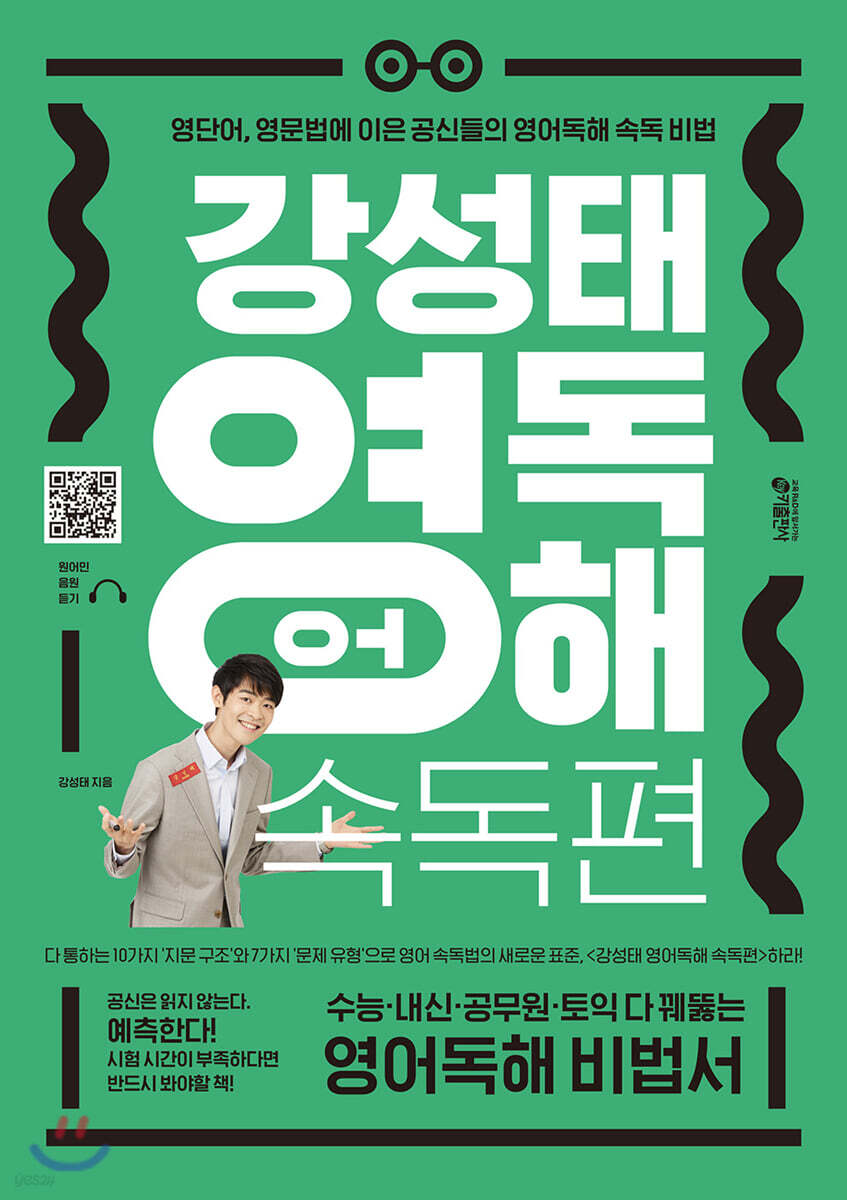
Kang Sung-tae's English Reading Speed Reading
 |
Description
Book Introduction
The officials don't read. Predict! 『Kang Seong-tae's English Reading Speed Reading』 that covers the college entrance exam, school report card, civil service exam, and TOEIC With 10 different 'question structures' and 7 different 'question types,' you can now take the English test with confidence! The officials do not read them one by one. Read quickly. This is a speed reading secret book that contains all the speed reading methods that have been proven so far, called 'Speed Reading Methods You Can Use Right Away on Tests.' The officials just don't read. Predict every moment. Get the 10 fingerprint structures in your head and predict what will happen next before you even finish reading. Read the text by predicting its development from the first sentence through the 'First Sentence Keyword' corner. This book is a secret book for reading English. The secrets to reading comprehension from public officials are fully included in the ‘Strategy’, ‘Feeling’, and ‘Tip’ corners. Arm yourself with the secret! The public officials repeat it again and again. Repeat again and again with various supplementary materials such as speed reading maps, mini books, speed reading filters (cellophane), 5-time reading study tables, and native speaker MP3 files. In this process, the learning effect is maximized. |
- You can preview some of the book's contents.
Preview
index
[Kang Sung-tae's English Reading Speed Reading]
ORIENTATION: Speed reading techniques that can be used immediately on exams
[PART 1 Fingerprint Structure]
UNIT 01.
Topic Sentence - Example 1 - Example 2
Strategy 1) The topic sentence contains a definitive expression.
Strategy 2) Examples usually follow the topic sentence.
Strategy 3) The topic sentence should be general, and the examples should be specific.
Strategy 4) The position of the topic sentence is not fixed.
UNIT 02.
Introduction - Topic Sentence - Example - Conclusion
Strategy 1) Once the introductory sentence is found, the topic sentence follows it.
Strategy 2) The topic of the article is what is repeatedly explained.
Strategy 3) If an example appears after the introduction, the topic sentence is at the end.
Strategy 4) Reconfirm the topic in the conclusion.
UNIT 03.
Common Sense - Refutation
Strategy 1) Anticipate the rebuttal when a common expression appears.
Strategy 2) The topic is revealed after the rebuttal.
Strategy 3) You must confirm the conclusion that follows the rebuttal.
Strategy 4) If there is no adversarial conjunction, determine the rebuttal from the context.
UNIT 04.
Description 1 - Description 2 - Summary
Strategy 1) The repeated subject is the material of the explanatory text.
Strategy 2) There are many list-like structures without clear topic sentences.
Strategy 3) First, check the hint words indicated by stars.
Strategy 4) The more complex the explanation, the more likely it is that a summary sentence will appear later.
UNIT 05.
Phenomenon - Problem Statement - Solution
Strategy 1) The topic of 'Phenomena-Problem Raising' is the problem.
Strategy 2) If a solution follows a problem, the solution becomes the topic.
Strategy 3) When a negative tone is used, recognize that it is a problem.
Strategy 4) Multiple problems or solutions can be mentioned.
UNIT 06.
Cause - Effect
Strategy 1) There is a clear expression indicating cause and effect.
Strategy 2) Cause and effect are directly reflected in the topic/title search answer.
Strategy 3) The order of cause and effect can be changed at any time.
Strategy 4) If the author's argument follows the 'cause-effect', that is the topic.
UNIT 07.
Research Contents - Research Results - Conclusion
Strategy 1) There are keywords that are bound to appear in research papers.
Strategy 2) The topic is the author's own words rephrasing the research results.
Strategy 3) The research results that follow the topic must be consistent with the topic.
Strategy 4) Identify differences between experimental subjects.
UNIT 08.
Compare/Contrast
Strategy 1) When two objects are mentioned in the first sentence, they are usually compared/contrasted.
Strategy 2) If a comparative expression appears in the first sentence, it is likely to be a topic sentence.
Strategy 3) Pay attention to texts that mention both similarities and differences.
Strategy 4) The vocabulary that appears most frequently in the comparison/contrast text is fixed.
UNIT 09.
Questions and Answers
Strategy 1) The answer to the question becomes the topic of the essay.
Strategy 2) Understand the Intention of the Question ① - Find a Solution
Strategy 3) Understand the Intention of the Question ② - Explain the Principle/Concept
Strategy 4) Understand the intention behind the question ③ - Arouse interest
UNIT 10.
Introduction - Development - Conclusion (Chronological order)
Strategy 1) The story's protagonist appears in the introduction.
Strategy 2) Use time information to understand the flow of the story.
Strategy 3) The answer is in the last sentence of the chronological text.
Strategy 4) The theme of the story is almost always moral.
[PART 2 Problem Types]
UNIT 11.
Identify the topic
Strategy 1) [Finding the Topic] Choose the option that contains the key vocabulary in the topic sentence.
Strategy 2) [Finding a Title] Learn the five types of title options.
Strategy 3) [Finding the main point] The main point is the author's subjective opinion.
Strategy 4) [Finding a Purpose] The purpose is specifically presented after the middle part.
UNIT 12.
Get the context
Strategy 1) [Nominative Inference] Find objects of the same gender and number as the underlined pronoun.
Strategy 2) [Referential Inference] The answer appears when you substitute the referent for the pronoun.
Strategy 3) [Grab the Atmosphere] There are set expressions to express the atmosphere.
Strategy 4) [Understanding the state of mind] Expressions that express the state of mind are bound to appear.
UNIT 13.
See through the logical flow
Strategy 1) [Find an unrelated sentence] The answer is a sentence that contradicts the topic or contains new material.
Strategy 2) [Insert the given sentence] Pay attention to the conjunctions and nouns in the given sentence.
Strategy 3) [Arrange the order of the text] Determine the order by looking at the first sentence of (A), (B), and (C).
Strategy 4) [Arrangement of the text order] Predictive reading using the text structure signals of (A), (B), and (C)
UNIT 14.
Infer accurately
Strategy 1) [Blank Inference] The blank in the beginning is usually the topic sentence.
Strategy 2) [Blank Inference] Pay special attention to the sentences before and after the middle blank.
Strategy 3) [Blank Inference] The blank in the latter half is often a summary of the entire text.
Strategy 4) [Connective Inference] The logical relationship between the preceding and following sentences determines the connective.
Strategy 5) [Complete the Summary] Divide the text into two or three parts and summarize the key points.
UNIT 15.
Find out the details
Strategy 1) [Understand the details] Read the options first and understand the subject of the explanation.
Strategy 2) [Understanding the details] Just read the text based on its structure.
Strategy 3) [Inferring Vocabulary in Context] Use the topic and text structure to determine vocabulary types.
Strategy 4) [Inferring Vocabulary from Context] Inferring unfamiliar antonyms and confusing words from their etymology.
UNIT 16.
Analyze the data keenly
Strategy 1) [Practical Text] You can understand the flow of practical text by reading only the choices.
Strategy 2) [Practical Text] The components of practical text are fixed.
Strategy 3) [Diagram] In diagram text, the answer is usually an increase or decrease.
Strategy 4) [Chart] The trap is hidden in the numerical comparison expression.
UNIT 17.
Hold the long text
Strategy 1) [General Long Text] Read the problem first and apply the appropriate solution strategy.
Strategy 2) [General Long Text] Use Speed Reading and In-Depth Reading When Appropriate
Strategy 3) [Long text with sequence arrangement] The options for the detailed content problem are no different from the answer sheet.
Strategy 4) [Long text in sequence] Read with a focus on the story's development.
66-Day English Reading Habit Calendar
Answer and explanation
ORIENTATION: Speed reading techniques that can be used immediately on exams
[PART 1 Fingerprint Structure]
UNIT 01.
Topic Sentence - Example 1 - Example 2
Strategy 1) The topic sentence contains a definitive expression.
Strategy 2) Examples usually follow the topic sentence.
Strategy 3) The topic sentence should be general, and the examples should be specific.
Strategy 4) The position of the topic sentence is not fixed.
UNIT 02.
Introduction - Topic Sentence - Example - Conclusion
Strategy 1) Once the introductory sentence is found, the topic sentence follows it.
Strategy 2) The topic of the article is what is repeatedly explained.
Strategy 3) If an example appears after the introduction, the topic sentence is at the end.
Strategy 4) Reconfirm the topic in the conclusion.
UNIT 03.
Common Sense - Refutation
Strategy 1) Anticipate the rebuttal when a common expression appears.
Strategy 2) The topic is revealed after the rebuttal.
Strategy 3) You must confirm the conclusion that follows the rebuttal.
Strategy 4) If there is no adversarial conjunction, determine the rebuttal from the context.
UNIT 04.
Description 1 - Description 2 - Summary
Strategy 1) The repeated subject is the material of the explanatory text.
Strategy 2) There are many list-like structures without clear topic sentences.
Strategy 3) First, check the hint words indicated by stars.
Strategy 4) The more complex the explanation, the more likely it is that a summary sentence will appear later.
UNIT 05.
Phenomenon - Problem Statement - Solution
Strategy 1) The topic of 'Phenomena-Problem Raising' is the problem.
Strategy 2) If a solution follows a problem, the solution becomes the topic.
Strategy 3) When a negative tone is used, recognize that it is a problem.
Strategy 4) Multiple problems or solutions can be mentioned.
UNIT 06.
Cause - Effect
Strategy 1) There is a clear expression indicating cause and effect.
Strategy 2) Cause and effect are directly reflected in the topic/title search answer.
Strategy 3) The order of cause and effect can be changed at any time.
Strategy 4) If the author's argument follows the 'cause-effect', that is the topic.
UNIT 07.
Research Contents - Research Results - Conclusion
Strategy 1) There are keywords that are bound to appear in research papers.
Strategy 2) The topic is the author's own words rephrasing the research results.
Strategy 3) The research results that follow the topic must be consistent with the topic.
Strategy 4) Identify differences between experimental subjects.
UNIT 08.
Compare/Contrast
Strategy 1) When two objects are mentioned in the first sentence, they are usually compared/contrasted.
Strategy 2) If a comparative expression appears in the first sentence, it is likely to be a topic sentence.
Strategy 3) Pay attention to texts that mention both similarities and differences.
Strategy 4) The vocabulary that appears most frequently in the comparison/contrast text is fixed.
UNIT 09.
Questions and Answers
Strategy 1) The answer to the question becomes the topic of the essay.
Strategy 2) Understand the Intention of the Question ① - Find a Solution
Strategy 3) Understand the Intention of the Question ② - Explain the Principle/Concept
Strategy 4) Understand the intention behind the question ③ - Arouse interest
UNIT 10.
Introduction - Development - Conclusion (Chronological order)
Strategy 1) The story's protagonist appears in the introduction.
Strategy 2) Use time information to understand the flow of the story.
Strategy 3) The answer is in the last sentence of the chronological text.
Strategy 4) The theme of the story is almost always moral.
[PART 2 Problem Types]
UNIT 11.
Identify the topic
Strategy 1) [Finding the Topic] Choose the option that contains the key vocabulary in the topic sentence.
Strategy 2) [Finding a Title] Learn the five types of title options.
Strategy 3) [Finding the main point] The main point is the author's subjective opinion.
Strategy 4) [Finding a Purpose] The purpose is specifically presented after the middle part.
UNIT 12.
Get the context
Strategy 1) [Nominative Inference] Find objects of the same gender and number as the underlined pronoun.
Strategy 2) [Referential Inference] The answer appears when you substitute the referent for the pronoun.
Strategy 3) [Grab the Atmosphere] There are set expressions to express the atmosphere.
Strategy 4) [Understanding the state of mind] Expressions that express the state of mind are bound to appear.
UNIT 13.
See through the logical flow
Strategy 1) [Find an unrelated sentence] The answer is a sentence that contradicts the topic or contains new material.
Strategy 2) [Insert the given sentence] Pay attention to the conjunctions and nouns in the given sentence.
Strategy 3) [Arrange the order of the text] Determine the order by looking at the first sentence of (A), (B), and (C).
Strategy 4) [Arrangement of the text order] Predictive reading using the text structure signals of (A), (B), and (C)
UNIT 14.
Infer accurately
Strategy 1) [Blank Inference] The blank in the beginning is usually the topic sentence.
Strategy 2) [Blank Inference] Pay special attention to the sentences before and after the middle blank.
Strategy 3) [Blank Inference] The blank in the latter half is often a summary of the entire text.
Strategy 4) [Connective Inference] The logical relationship between the preceding and following sentences determines the connective.
Strategy 5) [Complete the Summary] Divide the text into two or three parts and summarize the key points.
UNIT 15.
Find out the details
Strategy 1) [Understand the details] Read the options first and understand the subject of the explanation.
Strategy 2) [Understanding the details] Just read the text based on its structure.
Strategy 3) [Inferring Vocabulary in Context] Use the topic and text structure to determine vocabulary types.
Strategy 4) [Inferring Vocabulary from Context] Inferring unfamiliar antonyms and confusing words from their etymology.
UNIT 16.
Analyze the data keenly
Strategy 1) [Practical Text] You can understand the flow of practical text by reading only the choices.
Strategy 2) [Practical Text] The components of practical text are fixed.
Strategy 3) [Diagram] In diagram text, the answer is usually an increase or decrease.
Strategy 4) [Chart] The trap is hidden in the numerical comparison expression.
UNIT 17.
Hold the long text
Strategy 1) [General Long Text] Read the problem first and apply the appropriate solution strategy.
Strategy 2) [General Long Text] Use Speed Reading and In-Depth Reading When Appropriate
Strategy 3) [Long text with sequence arrangement] The options for the detailed content problem are no different from the answer sheet.
Strategy 4) [Long text in sequence] Read with a focus on the story's development.
66-Day English Reading Habit Calendar
Answer and explanation
Detailed image

Publisher's Review
#KangSungTae surpasses 1 million YouTube subscribers and 210 million views.
#Following 『Kang Seong-tae's English Vocabulary Etymology』 and 『Kang Seong-tae's Essential English Grammar』
『Kang Seong-tae's English Reading Speed Reading』 is finally out!
A well-written book can change a person's life.
A book has to be that effective.
I am sure.
This book will be able to change many people's reading skills, English, and even their lives.
This book was created to completely change the way reading is studied in Korea.
As you can see from the title, this is not your typical English reading book.
It's a speed reading book.
Anyone who has ever taken an English test in South Korea will know.
The English test we take is more of an English 'speed reading' test than an English test.
Whether it's the CSAT, the civil service exam, the TOEIC or TOEFL, or even the English midterm and final exams in middle school, you have to solve all the reading comprehension questions in a very short amount of time.
You can't just read and understand.
You have to read 'very quickly', that is, speed read.
It would be more appropriate to rename the test as the English 'Speed Reading' Test rather than the English Reading Comprehension Test.
Reading slowly is reading, but you will never get good grades if you do it that way.
Even if you can interpret every sentence correctly, it's a total failure if you don't have enough time.
(Omitted) I am a person who knows all too well how difficult it is for students in Korea.
We need to create a book that saves even just one second of time and makes studying just one percent more efficient.
So, I tested and applied every method I knew of for fast reading that had been proven so far.
I dare say that if you study with this book, you will no longer need to worry about how to increase your reading speed.
- From the prologue of "Kang Seong-tae's English Reading Speed Reading" -
#Following 『Kang Seong-tae's English Vocabulary Etymology』 and 『Kang Seong-tae's Essential English Grammar』
『Kang Seong-tae's English Reading Speed Reading』 is finally out!
A well-written book can change a person's life.
A book has to be that effective.
I am sure.
This book will be able to change many people's reading skills, English, and even their lives.
This book was created to completely change the way reading is studied in Korea.
As you can see from the title, this is not your typical English reading book.
It's a speed reading book.
Anyone who has ever taken an English test in South Korea will know.
The English test we take is more of an English 'speed reading' test than an English test.
Whether it's the CSAT, the civil service exam, the TOEIC or TOEFL, or even the English midterm and final exams in middle school, you have to solve all the reading comprehension questions in a very short amount of time.
You can't just read and understand.
You have to read 'very quickly', that is, speed read.
It would be more appropriate to rename the test as the English 'Speed Reading' Test rather than the English Reading Comprehension Test.
Reading slowly is reading, but you will never get good grades if you do it that way.
Even if you can interpret every sentence correctly, it's a total failure if you don't have enough time.
(Omitted) I am a person who knows all too well how difficult it is for students in Korea.
We need to create a book that saves even just one second of time and makes studying just one percent more efficient.
So, I tested and applied every method I knew of for fast reading that had been proven so far.
I dare say that if you study with this book, you will no longer need to worry about how to increase your reading speed.
- From the prologue of "Kang Seong-tae's English Reading Speed Reading" -
GOODS SPECIFICS
- Publication date: December 27, 2019
- Page count, weight, size: 408 pages | 1,014g | 210*297*17mm
- ISBN13: 9791189719050
- ISBN10: 1189719053
- Reference book for use in grades: High school common
- Reference book usage semester: Common semester
- Reference book difficulty: Medium Reference book difficulty guide
You may also like
카테고리
korean


korean

![GQ KOREA Mark (Monthly): December [2025]](http://librairie.coreenne.fr/cdn/shop/files/8ef265dbbfbf186523ed75ba7319009d.jpg?v=1765340328&width=3840)


