

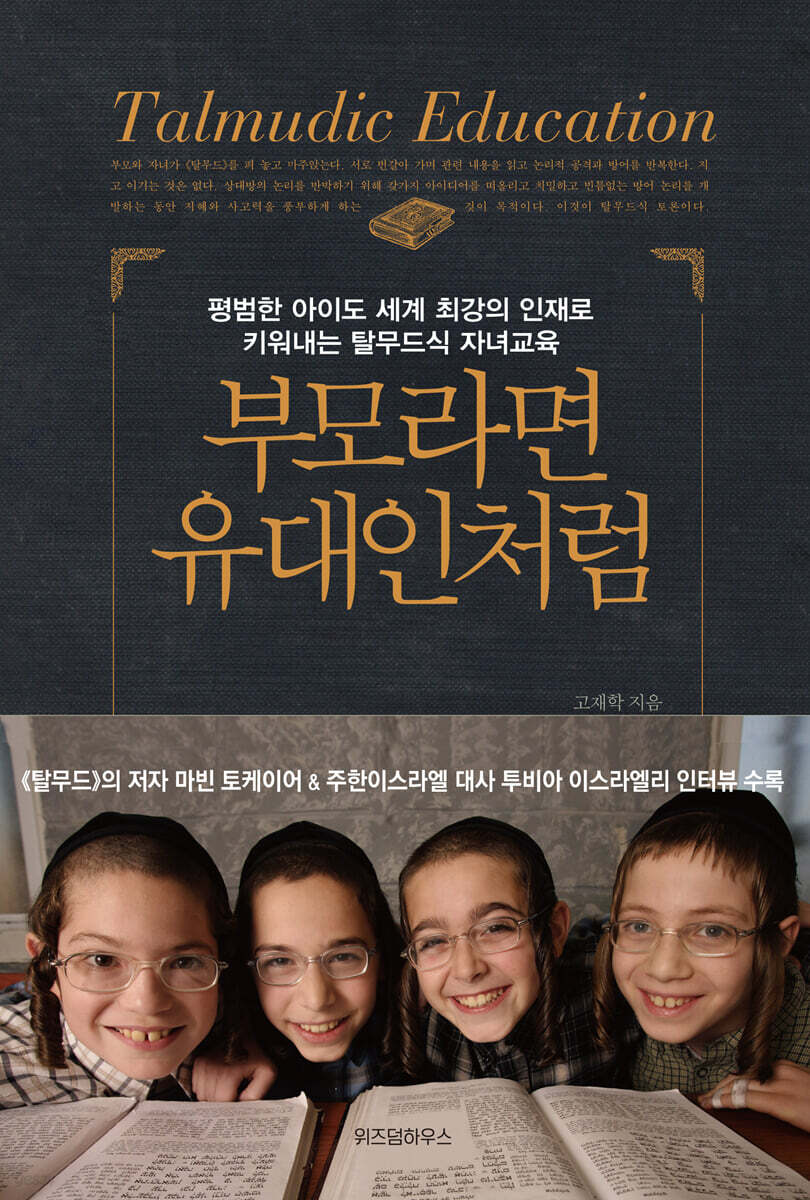
If you are a parent, be like a Jew
 |
Description
Book Introduction
Includes interviews with Marvin Tokayer, author of "Talmud," and Tuvia Israeli, Israeli Ambassador to Korea.
This book clearly explains the Jewish education system, which balances knowledge and character education, by finding the secret to the success of the Jews, who are driving the world of 6 billion people, in 'education.'
We introduce a Talmudic educational method that fosters foreign language skills, social networks, and economic capabilities without relying on textbooks or private tutoring, and find a way for both parents and children to be happy.
- You can preview some of the book's contents.
Preview
index
Prologue _ What Makes Them Super Talented?
Hear from Talmud author Marvin Tokayer: Questioning and discussion are at the heart of Jewish education.
Hear from Israeli Ambassador to Korea Tuvia Israeli: If books are fish, then debate is the fishing method.
home education
Strong roots lead to strong fruit - The root of child education is family education.
It tells us that the wise man is the richest man.
Put a bookshelf in the living room instead of a television.
Mother is the soul of the family
Prepare a chair for your father
Don't miss out on table manners education
Punish with your right hand and hug with your left.
The husband respects and cares for his wife.
It shows a couple caring for and loving each other.
Prenatal care begins before pregnancy
Seong conveys only the facts honestly and concisely.
learning ability
The wisdom of the mind is a weapon for survival _ Parents are responsible for their children's brain development.
The alphabet written with honey, words learned through riddles
Use the magic of 15 minutes of pillow reading
Developing foreign language skills through 'bilingual education'
Parents are their children's debate sparring partners.
Humor training
Wake up your brain with breakfast every morning
In Talmudic dialogue, questions are asked rather than answers.
Focus more on encouraging the process than praising the results.
Develop the right brain, the core of creativity, through ample play.
Studying is a marathon, parents are the pacemakers.
It conveys anticipation, but not expectations.
Creativity
Creativity is the seed of success - drawing out your child's questions as much as possible.
Be patient and join your child's question relay.
Encourage them to do things differently rather than just do things well like everyone else.
"If you get bored while studying, it's okay to stand up."
A creative child is bound to be a square peg.
The 'yellow voice' is the secret to memorization.
Knowledge can only fly if it has one wing called 'art'.
The future is the era of integrated talent, broadening their scope of interest.
character education
The warp of society and the weft of history - teaching community consciousness!
Deciding on a "family classic" that's better than the Talmud
Helps you find role models
The 13-Year-Old Coming-of-Age Ceremony Prepares for Early Independence
It teaches us to appreciate our ancestors and traditions.
Wisdom comes before knowledge
Help people understand and practice the value of donation.
The sooner you start economic education, the better.
Find good friends and learn deep friendships.
The first rivals, siblings, teach brotherhood.
It tells us that honesty is the best weapon.
Develop the habit of always being grateful
It makes you realize the value of today (time)
It shows that a frugal life is beautiful.
Maintain a balanced attitude toward life in all things
It fosters social skills, such as the ability to compromise and apologize.
If you fail, encourage them; if you repeat the same failure, scold them.
Listen carefully and think carefully to avoid making mistakes in speech.
Don't make promises carelessly, and if you make a promise, make sure to keep it.
Teaches order and manners
Future hopes
A life that flows as you dream _ Letting you dream in reality
If you don't lose hope, adversity is often the greatest opportunity.
It teaches us that to dream bigger, we must first acknowledge reality.
Let's go down a path that others don't take
Encourage early exposure to and familiarization with cultural diversity.
It highlights the importance of a friendly network.
Hear from Talmud author Marvin Tokayer: Questioning and discussion are at the heart of Jewish education.
Hear from Israeli Ambassador to Korea Tuvia Israeli: If books are fish, then debate is the fishing method.
home education
Strong roots lead to strong fruit - The root of child education is family education.
It tells us that the wise man is the richest man.
Put a bookshelf in the living room instead of a television.
Mother is the soul of the family
Prepare a chair for your father
Don't miss out on table manners education
Punish with your right hand and hug with your left.
The husband respects and cares for his wife.
It shows a couple caring for and loving each other.
Prenatal care begins before pregnancy
Seong conveys only the facts honestly and concisely.
learning ability
The wisdom of the mind is a weapon for survival _ Parents are responsible for their children's brain development.
The alphabet written with honey, words learned through riddles
Use the magic of 15 minutes of pillow reading
Developing foreign language skills through 'bilingual education'
Parents are their children's debate sparring partners.
Humor training
Wake up your brain with breakfast every morning
In Talmudic dialogue, questions are asked rather than answers.
Focus more on encouraging the process than praising the results.
Develop the right brain, the core of creativity, through ample play.
Studying is a marathon, parents are the pacemakers.
It conveys anticipation, but not expectations.
Creativity
Creativity is the seed of success - drawing out your child's questions as much as possible.
Be patient and join your child's question relay.
Encourage them to do things differently rather than just do things well like everyone else.
"If you get bored while studying, it's okay to stand up."
A creative child is bound to be a square peg.
The 'yellow voice' is the secret to memorization.
Knowledge can only fly if it has one wing called 'art'.
The future is the era of integrated talent, broadening their scope of interest.
character education
The warp of society and the weft of history - teaching community consciousness!
Deciding on a "family classic" that's better than the Talmud
Helps you find role models
The 13-Year-Old Coming-of-Age Ceremony Prepares for Early Independence
It teaches us to appreciate our ancestors and traditions.
Wisdom comes before knowledge
Help people understand and practice the value of donation.
The sooner you start economic education, the better.
Find good friends and learn deep friendships.
The first rivals, siblings, teach brotherhood.
It tells us that honesty is the best weapon.
Develop the habit of always being grateful
It makes you realize the value of today (time)
It shows that a frugal life is beautiful.
Maintain a balanced attitude toward life in all things
It fosters social skills, such as the ability to compromise and apologize.
If you fail, encourage them; if you repeat the same failure, scold them.
Listen carefully and think carefully to avoid making mistakes in speech.
Don't make promises carelessly, and if you make a promise, make sure to keep it.
Teaches order and manners
Future hopes
A life that flows as you dream _ Letting you dream in reality
If you don't lose hope, adversity is often the greatest opportunity.
It teaches us that to dream bigger, we must first acknowledge reality.
Let's go down a path that others don't take
Encourage early exposure to and familiarization with cultural diversity.
It highlights the importance of a friendly network.
Into the book
Jewish parents prioritize 'questions and discussions' over their children's grades.
They are extremely wary of the habit of just listening silently and encourage people to “ask questions whenever they have questions.”
Never yell at someone to “just stay still and stop bothering me with questions!”
This is because the learning attitude of finding questions and finding answers on your own is an ability absolutely necessary for success.
---From the "Prologue"
Lawrence Harvey Zeiger, born to a poor Russian Jewish immigrant family in Brooklyn, New York, spent his childhood working as a newspaper deliveryman and postal worker due to his family's difficult circumstances.
His parents (his father died of heart disease when he was nine) were poor and could not afford to provide him with nice clothes or a comfortable life, but they never gave up on their son's education.
They actively utilized the best education that could be easily obtained without money, 'table education'.
While eating, I constantly stimulated my son's intellectual curiosity and encouraged him to actively ask questions about the world.
As a result, Zaiger always knew how to ask special questions.
He is Larry King, CNN's star and considered one of the best interviewers in history.
--- From "The Root of Child Education is Family Education"
Jewish parents have long considered riddles and jokes to be "a whetstone that sharpens the mind," and have actively utilized them in education.
Most of the wisdom expressed in riddles in their scripture, the Talmud.
“The human eye is made up of a white part and a black part, so why can we only see things through the black part?” “Because life requires looking into the light through the dark.” Life is a long journey of joy, sorrow, and pleasure.
As we live, darkness and light coexist.
Life inevitably has dark sides, such as crises and failures, and we must recognize them and face them head on.
Children come to understand the profound truths of life through the fun riddles their parents ask them.
---From "Children's brain development is the parents' responsibility"
Thomas Friedman, a Jewish columnist for the New York Times, explains the importance of imagination:
“In today’s world, interconnected like a spider’s web through the Internet, the most important economic competition is no longer between nations or companies.
The individual and his imagination are the most important competitive factors.
These days, when kids imagine something, they can do it faster and cheaper than they could have ever imagined before.
In today's world where everything is becoming commodified, the one thing that is not easily obtained is imagination." This Jewish imagination is connected to meaningful memories of learning and even affects the ability to memorize and recall.
Early education, which involves learning a lot of knowledge in advance, destroys this imagination.
--- From "Getting the most out of your child's questions"
Statistics show that 45 percent of donations in the United States come from Jews.
The 'Giving Pledge' movement, in which American billionaires pledged to donate half of their wealth, was organized by Jewish billionaire David Rockefeller, and was attended by New York Mayor Michael Bloomberg, who is also Jewish, and George Soros, chairman of the Soros Fund, who is Jewish.
In Jewish schools, 'donation' and 'community service' are also important criteria for selecting students.
Learning to donate from a young age will help you become a warm-hearted person who helps and cares for others throughout your life.
Only by fostering a sense of community and living together like this can we lay the groundwork for great success.
--- From "Teaching Community Awareness"
Ralph Lauren, the Russian-Jewish designer famous for the Polo brand, was born the son of a painter.
Lauren inherited a natural sense of color from her father, and had a knack for dressing up even cheap clothes.
He dropped out of college because he couldn't afford the tuition, and got a job as a clerk at a glove company, where he learned design through the sidelines.
He presented fashion that reflected the lifestyles of various people based on a thoroughly American inspiration.
The elite group of Ivy Leaguers in the eastern United States, the pioneers of the western frontier, the uniforms of baseball players… “While making clothes for my wife, women’s clothing was born. While making clothes for my three sons, children’s clothing was born. While decorating my house, the home collection was created.”
They are extremely wary of the habit of just listening silently and encourage people to “ask questions whenever they have questions.”
Never yell at someone to “just stay still and stop bothering me with questions!”
This is because the learning attitude of finding questions and finding answers on your own is an ability absolutely necessary for success.
---From the "Prologue"
Lawrence Harvey Zeiger, born to a poor Russian Jewish immigrant family in Brooklyn, New York, spent his childhood working as a newspaper deliveryman and postal worker due to his family's difficult circumstances.
His parents (his father died of heart disease when he was nine) were poor and could not afford to provide him with nice clothes or a comfortable life, but they never gave up on their son's education.
They actively utilized the best education that could be easily obtained without money, 'table education'.
While eating, I constantly stimulated my son's intellectual curiosity and encouraged him to actively ask questions about the world.
As a result, Zaiger always knew how to ask special questions.
He is Larry King, CNN's star and considered one of the best interviewers in history.
--- From "The Root of Child Education is Family Education"
Jewish parents have long considered riddles and jokes to be "a whetstone that sharpens the mind," and have actively utilized them in education.
Most of the wisdom expressed in riddles in their scripture, the Talmud.
“The human eye is made up of a white part and a black part, so why can we only see things through the black part?” “Because life requires looking into the light through the dark.” Life is a long journey of joy, sorrow, and pleasure.
As we live, darkness and light coexist.
Life inevitably has dark sides, such as crises and failures, and we must recognize them and face them head on.
Children come to understand the profound truths of life through the fun riddles their parents ask them.
---From "Children's brain development is the parents' responsibility"
Thomas Friedman, a Jewish columnist for the New York Times, explains the importance of imagination:
“In today’s world, interconnected like a spider’s web through the Internet, the most important economic competition is no longer between nations or companies.
The individual and his imagination are the most important competitive factors.
These days, when kids imagine something, they can do it faster and cheaper than they could have ever imagined before.
In today's world where everything is becoming commodified, the one thing that is not easily obtained is imagination." This Jewish imagination is connected to meaningful memories of learning and even affects the ability to memorize and recall.
Early education, which involves learning a lot of knowledge in advance, destroys this imagination.
--- From "Getting the most out of your child's questions"
Statistics show that 45 percent of donations in the United States come from Jews.
The 'Giving Pledge' movement, in which American billionaires pledged to donate half of their wealth, was organized by Jewish billionaire David Rockefeller, and was attended by New York Mayor Michael Bloomberg, who is also Jewish, and George Soros, chairman of the Soros Fund, who is Jewish.
In Jewish schools, 'donation' and 'community service' are also important criteria for selecting students.
Learning to donate from a young age will help you become a warm-hearted person who helps and cares for others throughout your life.
Only by fostering a sense of community and living together like this can we lay the groundwork for great success.
--- From "Teaching Community Awareness"
Ralph Lauren, the Russian-Jewish designer famous for the Polo brand, was born the son of a painter.
Lauren inherited a natural sense of color from her father, and had a knack for dressing up even cheap clothes.
He dropped out of college because he couldn't afford the tuition, and got a job as a clerk at a glove company, where he learned design through the sidelines.
He presented fashion that reflected the lifestyles of various people based on a thoroughly American inspiration.
The elite group of Ivy Leaguers in the eastern United States, the pioneers of the western frontier, the uniforms of baseball players… “While making clothes for my wife, women’s clothing was born. While making clothes for my three sons, children’s clothing was born. While decorating my house, the home collection was created.”
--- From "Making Dreams in Reality"
Publisher's Review
Why, despite the same educational fervor, does Korea show its limitations early on, while Jews continue to develop?
Pay attention to Jewish education! To cultivate global talent, raise them according to the Talmudic method!
We live in an age of overeducation.
Even though parents go into debt to pay for expensive private tutoring for their children and even risk their lives as a single-parent family, the university entrance gates are narrowing, and even after graduation, they have to watch their children wander around unemployed and unemployed.
Due to the fierce competition in college entrance exam education that has been criticized as “killing creativity,” Korea is falling behind emerging powers such as China in terms of academic achievement of middle and high school students, which was once considered to be the best in the world.
The age for early education was lowered to the point where it was practically impossible to lower it, and sleep time was split up to the point where it was poured into private tutoring.
Now is the time to do something right, not just do something more.
Rather than chasing one or two educational methods that claim to improve learning ability, it is time to return to the fundamentals of education.
In this respect, the educational methods of Jewish parents, who show a high level of educational enthusiasm that rivals that of Koreans and the world's top two, but show a significant difference in achievement, provide a good comparison.
Einstein, Freud, Marx, Picasso, Rothschild, Pulitzer, Rockefeller, George Soros, Alan Greenspan, Larry King, Chaplin, Steven Spielberg, Sergey Brin & Larry Page (Google), Howard Schultz (Starbucks), Andrew Grove (Intel), Milton Hershey (Hershey Chocolate), William Rosenberg (Dunkin' Donuts), Irvine Robbins (Baskin-Robbins), Calvin Klein, Paul Marciano (Guess)… …
From New York's Wall Street to the cutting-edge IT kingdom of Silicon Valley, major financial, media, and cultural and artistic circles can be said to be dominated by Jews, who have consistently produced success stories from the past to the present.
With an average IQ of 26th in the world (the average Jewish IQ is 95.
The average IQ of Koreans is 106, the second highest in the world) and there are only about 17 million people (the number of Jews in the world).
What is the source of the enormous influence and success of a nation with only about 7.1 million Israelis, which moves a world of 6 billion people? Why, with the same fervor for education, do Koreans show their limitations early on, while Jews develop more and more? (According to one survey, among mid-level executives at Fortune 500 companies, Koreans accounted for 0.3%, while Jews accounted for 41.5%.)
In "Parents, Be Like Jews," the Jewish principles of child education, which raise even ordinary children into the world's greatest talents, are meticulously introduced in 52 keywords.
Their educational principles, which confidently state that the development of children's intelligence, creativity, and sociality is the responsibility of parents, are examined in five areas (home education, intelligence development, creativity, character education, and career counseling), and we will explain how to apply them to our own families.
We also seriously reflect on the problems of Korean education, as advised by Marvin Tokayer, author of Talmud, and Tuvia Israeli, Israeli Ambassador to Korea, who said, “Stop endless competitive learning and start questioning education that fosters true creativity.”
If we follow their teaching methods, which foster early education, self-directed learning, foreign language skills, social networks, and even economic activity without relying on short-term alternatives like textbooks or private tutoring, Korea will now be able to achieve a happy and successful education for both parents and children.
From Einstein to Larry Page (Google), the ongoing myth of Talmudic parenting!
The author of the Talmud himself reveals the secret of education: "Questioning and Discussion."
The Talmud is a collection of commentaries by Jewish scholars on Jewish rules, traditions, and wisdom that have been passed down from ancient times, and is a book that all Jews use as a standard for their lives.
It is a 'textbook of life' that I first encountered through my parents' pillow reading when I was a child, and that I read, reflected on, and contemplated throughout my life.
Because it was a collection of oral traditions, the volume was vast, but in the 1970s, Rabbi Marvin Tokayer, who was active in the United States and Japan, compiled it into books such as “The Wisdom of the Talmud,” “The Art of Living in the Talmud,” and “The Laughter of the Talmud,” making it popular around the world.
Most of the Talmud-related books currently introduced in our country also refer to Marvin Tokayer's book.
The core of Talmudic education, as Marvin Tokayer explains, is 'questioning and discussion.'
For example, Jewish children engage in something called 'Talmudic debate' from a young age, and the trick is as follows:
Parents and children set aside time to be together, such as at the dining table or in the living room, and sit down with the Talmud spread out.
After reading a passage from the Talmud in the form of a short story, each person makes a logical attack or defense based on their own thoughts.
Children who engage in these debates daily from a young age are increasingly able to demonstrate a strong sense of curiosity and creativity, as they develop various ideas to refute their opponent's arguments and develop a well-structured and flawless defense. This is because their true critical thinking and reasoning skills are developed.
Marvin Tokayer advises Korean parents that it is most important to break away from the short-sighted, competitive education focused on memorization and sex, and to cultivate the "ability to ask questions on one's own."
“Jewish parents never ask their children when they come home from school, ‘What did you learn today?’ They always ask, ‘What questions did you ask your teacher today?’
Knowing a lot just by listening is no different from raising a parrot.
“Students who don’t know how to ask their own questions cannot progress.”
“Give him a fish, and he will eat a meal.
“Teach a man to fish and he will eat for a lifetime.”
This is the most frequently cited expression when describing Talmudic child education.
Our education system up until now has only thrown out the fish needed at the time and only produced smart-aleck students with good grades.
Now we need to pay attention to the Talmudic way of teaching children how to fish.
Even if it may seem slow and clumsy for a while, it is the only way to raise our children to become global talents like Einstein or Larry Page, breaking free from the trap of being frogs in a well.
Core Principles of Talmudic Child Education
1. Fill all four walls with books from the child's eye level! : A child who loses the intense concentration of childhood to television will never be able to keep up with a child who reads books.
2. After reading, always have a "Talmudic discussion": Rather than memorizing or reading extensively to organize what you've read, a discussion that seeks out different opinions from the book fosters creativity.
3. Don't ask what they've learned, ask what they're curious about: The habit of making it a point to find the "question of the day" is a key driving force for lifelong, self-directed growth.
4. Teach community rules and etiquette strictly: Children who are well-mannered will be loved and will be able to become the center of social networks when they grow up.
5. Teach your children the value of money through early economic education: Teach them that they need money to achieve their dreams, and encourage them to save from a young age.
An example of Talmudic child education
“What question did you ask the teacher today?”
Because my mom would ask me questions every time I came home from school, I had to make up questions on purpose even on days when I didn't have any.
_Rom Brafman, author of the international bestseller "Sway"
“Dad (Mom) thinks this way, what do you think?”
Because of the heated discussions that took place at every mealtime, I was constantly forced to read, think, and imagine. - Larry Page, founder of Google
“Don’t be tied down by money, and don’t ignore it either.”
The allowance and children's fund my father gave me fostered my savings habits, investment acumen, patience, and determination. - Alan Greenspan, 'America's Economic President'
“You have a talent that is different from others!”
Even though I was more interested in other things than my studies and only had wild imaginations, my parents always listened to my stories and encouraged me, saying that they were fun.
_ World-renowned film director, Steven Spielberg
“The biggest failure is not learning from it.”
Thanks to my parents who understood my failures despite my best efforts, I wasn't afraid to take on challenges even in the high-risk world of business.
_ Paul Marciano, founder of GUESS
Pay attention to Jewish education! To cultivate global talent, raise them according to the Talmudic method!
We live in an age of overeducation.
Even though parents go into debt to pay for expensive private tutoring for their children and even risk their lives as a single-parent family, the university entrance gates are narrowing, and even after graduation, they have to watch their children wander around unemployed and unemployed.
Due to the fierce competition in college entrance exam education that has been criticized as “killing creativity,” Korea is falling behind emerging powers such as China in terms of academic achievement of middle and high school students, which was once considered to be the best in the world.
The age for early education was lowered to the point where it was practically impossible to lower it, and sleep time was split up to the point where it was poured into private tutoring.
Now is the time to do something right, not just do something more.
Rather than chasing one or two educational methods that claim to improve learning ability, it is time to return to the fundamentals of education.
In this respect, the educational methods of Jewish parents, who show a high level of educational enthusiasm that rivals that of Koreans and the world's top two, but show a significant difference in achievement, provide a good comparison.
Einstein, Freud, Marx, Picasso, Rothschild, Pulitzer, Rockefeller, George Soros, Alan Greenspan, Larry King, Chaplin, Steven Spielberg, Sergey Brin & Larry Page (Google), Howard Schultz (Starbucks), Andrew Grove (Intel), Milton Hershey (Hershey Chocolate), William Rosenberg (Dunkin' Donuts), Irvine Robbins (Baskin-Robbins), Calvin Klein, Paul Marciano (Guess)… …
From New York's Wall Street to the cutting-edge IT kingdom of Silicon Valley, major financial, media, and cultural and artistic circles can be said to be dominated by Jews, who have consistently produced success stories from the past to the present.
With an average IQ of 26th in the world (the average Jewish IQ is 95.
The average IQ of Koreans is 106, the second highest in the world) and there are only about 17 million people (the number of Jews in the world).
What is the source of the enormous influence and success of a nation with only about 7.1 million Israelis, which moves a world of 6 billion people? Why, with the same fervor for education, do Koreans show their limitations early on, while Jews develop more and more? (According to one survey, among mid-level executives at Fortune 500 companies, Koreans accounted for 0.3%, while Jews accounted for 41.5%.)
In "Parents, Be Like Jews," the Jewish principles of child education, which raise even ordinary children into the world's greatest talents, are meticulously introduced in 52 keywords.
Their educational principles, which confidently state that the development of children's intelligence, creativity, and sociality is the responsibility of parents, are examined in five areas (home education, intelligence development, creativity, character education, and career counseling), and we will explain how to apply them to our own families.
We also seriously reflect on the problems of Korean education, as advised by Marvin Tokayer, author of Talmud, and Tuvia Israeli, Israeli Ambassador to Korea, who said, “Stop endless competitive learning and start questioning education that fosters true creativity.”
If we follow their teaching methods, which foster early education, self-directed learning, foreign language skills, social networks, and even economic activity without relying on short-term alternatives like textbooks or private tutoring, Korea will now be able to achieve a happy and successful education for both parents and children.
From Einstein to Larry Page (Google), the ongoing myth of Talmudic parenting!
The author of the Talmud himself reveals the secret of education: "Questioning and Discussion."
The Talmud is a collection of commentaries by Jewish scholars on Jewish rules, traditions, and wisdom that have been passed down from ancient times, and is a book that all Jews use as a standard for their lives.
It is a 'textbook of life' that I first encountered through my parents' pillow reading when I was a child, and that I read, reflected on, and contemplated throughout my life.
Because it was a collection of oral traditions, the volume was vast, but in the 1970s, Rabbi Marvin Tokayer, who was active in the United States and Japan, compiled it into books such as “The Wisdom of the Talmud,” “The Art of Living in the Talmud,” and “The Laughter of the Talmud,” making it popular around the world.
Most of the Talmud-related books currently introduced in our country also refer to Marvin Tokayer's book.
The core of Talmudic education, as Marvin Tokayer explains, is 'questioning and discussion.'
For example, Jewish children engage in something called 'Talmudic debate' from a young age, and the trick is as follows:
Parents and children set aside time to be together, such as at the dining table or in the living room, and sit down with the Talmud spread out.
After reading a passage from the Talmud in the form of a short story, each person makes a logical attack or defense based on their own thoughts.
Children who engage in these debates daily from a young age are increasingly able to demonstrate a strong sense of curiosity and creativity, as they develop various ideas to refute their opponent's arguments and develop a well-structured and flawless defense. This is because their true critical thinking and reasoning skills are developed.
Marvin Tokayer advises Korean parents that it is most important to break away from the short-sighted, competitive education focused on memorization and sex, and to cultivate the "ability to ask questions on one's own."
“Jewish parents never ask their children when they come home from school, ‘What did you learn today?’ They always ask, ‘What questions did you ask your teacher today?’
Knowing a lot just by listening is no different from raising a parrot.
“Students who don’t know how to ask their own questions cannot progress.”
“Give him a fish, and he will eat a meal.
“Teach a man to fish and he will eat for a lifetime.”
This is the most frequently cited expression when describing Talmudic child education.
Our education system up until now has only thrown out the fish needed at the time and only produced smart-aleck students with good grades.
Now we need to pay attention to the Talmudic way of teaching children how to fish.
Even if it may seem slow and clumsy for a while, it is the only way to raise our children to become global talents like Einstein or Larry Page, breaking free from the trap of being frogs in a well.
Core Principles of Talmudic Child Education
1. Fill all four walls with books from the child's eye level! : A child who loses the intense concentration of childhood to television will never be able to keep up with a child who reads books.
2. After reading, always have a "Talmudic discussion": Rather than memorizing or reading extensively to organize what you've read, a discussion that seeks out different opinions from the book fosters creativity.
3. Don't ask what they've learned, ask what they're curious about: The habit of making it a point to find the "question of the day" is a key driving force for lifelong, self-directed growth.
4. Teach community rules and etiquette strictly: Children who are well-mannered will be loved and will be able to become the center of social networks when they grow up.
5. Teach your children the value of money through early economic education: Teach them that they need money to achieve their dreams, and encourage them to save from a young age.
An example of Talmudic child education
“What question did you ask the teacher today?”
Because my mom would ask me questions every time I came home from school, I had to make up questions on purpose even on days when I didn't have any.
_Rom Brafman, author of the international bestseller "Sway"
“Dad (Mom) thinks this way, what do you think?”
Because of the heated discussions that took place at every mealtime, I was constantly forced to read, think, and imagine. - Larry Page, founder of Google
“Don’t be tied down by money, and don’t ignore it either.”
The allowance and children's fund my father gave me fostered my savings habits, investment acumen, patience, and determination. - Alan Greenspan, 'America's Economic President'
“You have a talent that is different from others!”
Even though I was more interested in other things than my studies and only had wild imaginations, my parents always listened to my stories and encouraged me, saying that they were fun.
_ World-renowned film director, Steven Spielberg
“The biggest failure is not learning from it.”
Thanks to my parents who understood my failures despite my best efforts, I wasn't afraid to take on challenges even in the high-risk world of business.
_ Paul Marciano, founder of GUESS
GOODS SPECIFICS
- Date of issue: December 15, 2010
- Page count, weight, size: 320 pages | 538g | 150*225*20mm
- ISBN13: 9788991731493
- ISBN10: 899173149X
You may also like
카테고리
korean


korean

![GQ KOREA Mark (Monthly): December [2025]](http://librairie.coreenne.fr/cdn/shop/files/8ef265dbbfbf186523ed75ba7319009d.jpg?v=1765340328&width=3840)


