

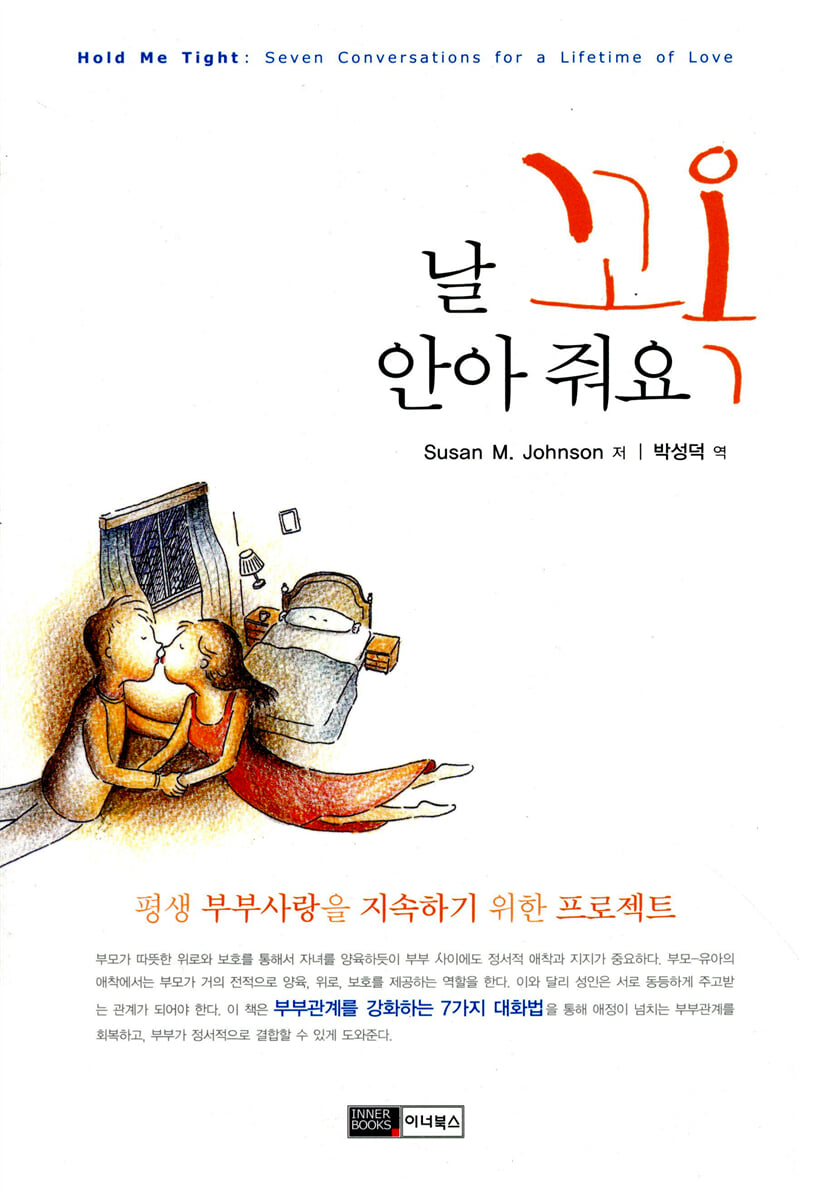
Hug me tight
 |
Description
Book Introduction
A book painstakingly written by Professor Susan Johnson, who developed the emotion-centered couples therapy model, based on solid theoretical background and therapeutic experience.
It presents scientific evidence for love and ways to maintain a couple's union.
It also helps restore loving marital relationships and helps couples bond emotionally.
Through this, couples will understand each other's position and respond actively.
Part 1 answers the question, "What is love?" and includes the results of various studies on intimacy. Part 2 presents the latest research on emotion-focused couples therapy and describes seven communication methods for restoring marital relationships.
The final third part focuses on the influence of love.
This book can be applied to all couples, including young couples, older couples, married couples, engaged couples, cohabiting couples, happy couples, discordant couples, and homosexual couples who want to maintain their love for a lifetime.
It presents scientific evidence for love and ways to maintain a couple's union.
It also helps restore loving marital relationships and helps couples bond emotionally.
Through this, couples will understand each other's position and respond actively.
Part 1 answers the question, "What is love?" and includes the results of various studies on intimacy. Part 2 presents the latest research on emotion-focused couples therapy and describes seven communication methods for restoring marital relationships.
The final third part focuses on the influence of love.
This book can be applied to all couples, including young couples, older couples, married couples, engaged couples, cohabiting couples, happy couples, discordant couples, and homosexual couples who want to maintain their love for a lifetime.
index
Part 1: A New Look at Love
An Evolutionary Perspective on Love
A New Understanding of Attachment / Adult Love / The Diverse Evidence of Love
Loss of Bond: Where Has Our Love Gone?
Primal fear / Negative communication style / The moment when attachment is formed and separation occurs
Emotional Responsiveness: The Key to Maintaining Love
The Birth of Emotionally Focused Couples Therapy / Emotional Access, Response, and Empathy (ARE) / Seven Conversational Methods
Part 2: 7 Conversation Techniques to Strengthen Your Relationship
Conversation Technique #1: Identifying - Identifying Negative Conversational Patterns
Negative Communication Style 1: Finding the Bad Guy / Negative Communication Style 2: Complaining / Negative Communication Style 3: Apathy and Avoidance
Conversation 2: Finding the Roots - Finding the Original Wound
Recognize the moment the original wound was stimulated / Share it with your spouse
The Third Dialogue: Going Back - Going Back to the Beginning of the Conflict
Reducing Distance / Recognizing the Impact on Your Spouse / Recognizing the Impact of Fear on Your Spouse
Conversation Technique 4: Making a Request
Ask for a hug / A couple in distress / What I fear most / Practice / What I want most / A neuroscientific approach to harmony
Conversation 5: Forgiveness
Forgive the Hurt / Small Incidents, Big Consequences / 6 Steps to Forgiveness
The Sixth Conversation: Making Contact
Physical contact / Sensual sex / Emotional sex / Harmonious sex / Solving sexual problems
Conversation Technique 7: Maintaining
Keeping Love Alive / Navigating Crisis Situations / Celebrating Moments of Connection / Ritualizing Moments of Separation and Connection / Prioritizing Safety / Creating a Story of Relationship Recovery / Creating a Story of Future Love / Maintaining Positive Change: Creating a New Framework for Love
Healing from Trauma: The Power of Love
Blocking Out Emotions / Returning to a Loved One / The Effects of Psychological Trauma
The Fundamental Bond: Love, the Last Hope
What Love Does / The Great Wave / Love Between Lovers and Family / Human Society / Remaining in Isolation / The Greatest Obstacle
An Evolutionary Perspective on Love
A New Understanding of Attachment / Adult Love / The Diverse Evidence of Love
Loss of Bond: Where Has Our Love Gone?
Primal fear / Negative communication style / The moment when attachment is formed and separation occurs
Emotional Responsiveness: The Key to Maintaining Love
The Birth of Emotionally Focused Couples Therapy / Emotional Access, Response, and Empathy (ARE) / Seven Conversational Methods
Part 2: 7 Conversation Techniques to Strengthen Your Relationship
Conversation Technique #1: Identifying - Identifying Negative Conversational Patterns
Negative Communication Style 1: Finding the Bad Guy / Negative Communication Style 2: Complaining / Negative Communication Style 3: Apathy and Avoidance
Conversation 2: Finding the Roots - Finding the Original Wound
Recognize the moment the original wound was stimulated / Share it with your spouse
The Third Dialogue: Going Back - Going Back to the Beginning of the Conflict
Reducing Distance / Recognizing the Impact on Your Spouse / Recognizing the Impact of Fear on Your Spouse
Conversation Technique 4: Making a Request
Ask for a hug / A couple in distress / What I fear most / Practice / What I want most / A neuroscientific approach to harmony
Conversation 5: Forgiveness
Forgive the Hurt / Small Incidents, Big Consequences / 6 Steps to Forgiveness
The Sixth Conversation: Making Contact
Physical contact / Sensual sex / Emotional sex / Harmonious sex / Solving sexual problems
Conversation Technique 7: Maintaining
Keeping Love Alive / Navigating Crisis Situations / Celebrating Moments of Connection / Ritualizing Moments of Separation and Connection / Prioritizing Safety / Creating a Story of Relationship Recovery / Creating a Story of Future Love / Maintaining Positive Change: Creating a New Framework for Love
Healing from Trauma: The Power of Love
Blocking Out Emotions / Returning to a Loved One / The Effects of Psychological Trauma
The Fundamental Bond: Love, the Last Hope
What Love Does / The Great Wave / Love Between Lovers and Family / Human Society / Remaining in Isolation / The Greatest Obstacle
Into the book
# A colleague blurted out to me, “If a couple’s love isn’t just a transaction, then what is it?”
At that time, I was answering calmly.
“It’s an emotional bond.
Humans have a desire to be emotionally securely connected to someone.
“British psychiatrist Bowlby has already explained this through the parent-child relationship in his attachment theory, and similar things are happening to adults as well.”
Only after we engaged in more lively debate did we discover the sharp logic behind the couple's discontent and desperate behavior.
I came to realize what couples truly wanted and how they could transform their relationships through emotion-focused couples therapy.
Romantic love is an act of attachment and an emotional bond.
Adult love is the inner need to lean on someone and be emotionally connected and comforted.
But when I tried to express this view, my colleagues opposed it.
The first reason they opposed it was that adults should be able to control their emotions.
In fact, excessive emotions can cause marital problems.
Therefore, I thought that emotions should be controlled and that there was no need to understand them deeply.
But the biggest reason my colleagues opposed it was the idea that a healthy adult should have self-sufficiency.
People who depend on others have a lot of problems.
These people were described as overly attached, overly dependent, lacking in subjectivity, and fused.
In short, he is a confused and ugly person.
I was thinking that a person who is dependent on their spouse is ruining their marriage.
Colleagues agreed that the therapist's role is to encourage couples to become independent.
# Emotionally focused couples therapy does not emphasize assertiveness, analyzing one's past, romantic attitudes, or developing new sexual positions.
Instead, it emphasizes the importance of emotional attachment and support between couples, just as parents raise their children through warm comfort and protection.
In parent-infant attachment, parents play almost exclusively the role of providing nurturing, comfort, and protection.
In contrast, adult attachment should be a reciprocal, equal give-and-take relationship, with less emphasis on physical contact.
Above all, what adult and parent-infant attachment have in common is that emotional bonding is important.
Emotionally focused couples therapy helps couples restore loving relationships and connect emotionally.
Through this, couples understand each other's position and respond actively.
# Finding an attachment figure that we can ask to 'hold me tight' is a basic human need that is already ingrained in our genes.
The need for attachment figures is one of the basic needs for human survival, health, and happiness, just like the needs for food, shelter, and sex.
Humans need emotional attachment figures to survive physically and mentally.
# When couples argued fiercely and showed contempt for each other, their stress hormone levels were higher and their immunity was weakened.
These results persisted for 24 hours after the couple's fight ended.
And when they artificially created small blisters on the back of the wife's hand and then had her fight with the husband, the results were even more surprising.
The more severe the fight between the couple, the longer it took for the blisters to heal.
It is very important to be recognized by your loved ones.
Researchers say marital discord can increase the risk of developing depression by more than 10 times.
But it's not all sad news.
Numerous studies have shown that positive relationships can reduce stress and help us overcome challenging situations and psychological trauma.
Contact with loved ones served to alleviate shock, stress, and pain.
# We need to dive deep into the water and see the root problem.
Emotional disconnection and lack of emotional security in the marital relationship are at the heart of marital problems.
Emotionally disconnected couples tend to protest to their spouses.
Couples and therapists often overlook the fact that protest behavior is the essence of marital conflict.
A closer look at marital discord reveals that couples constantly ask their spouses the following questions:
Can I approach you and rely on you? Will you always be there for me? Will you respond when I call when I need you? Am I important to you? Am I worthy and worthy of your approval? Sincerely appealing to you through anger, criticism, and demands can move your spouse, emotionally connect with them, and help restore the secure bond between you.
# If the couple's desire for bonding and fear of loss are not addressed, standard treatments like teaching problem-solving and communication skills, reflecting on past hurts, or taking time-outs will be ineffective.
Conventional treatment models do not address couples' desires and fears to be emotionally connected.
And it doesn't teach couples how to bond and maintain a lasting relationship.
At best, it teaches you techniques to stop fighting, but in the meantime, your relationship ends up being seriously damaged.
Eventually, when a couple grows apart and tries to reunite, the fear of rejection and abandonment only grows.
# Sometimes couples take relationship trauma lightly, thinking it is a simple incident that can happen on a daily basis.
But the relationship gradually cools down and becomes severely strained.
Defensively downplaying your own hurt may help temporarily.
But trauma can always come back.
Larry couldn't understand Susan's words because it had been 17 years since he moved out of that house.
But she couldn't forget what happened in the past.
At the time, she was suffering from depression, struggling with the aftereffects of a car accident, and struggling with raising three children.
One day, when Larry came home from work, he found Susan crying alone in the kitchen.
She expected her husband to come and comfort her, even if he didn't say anything.
But Larry left her with a long phone call with someone, telling her to come to her senses.
Susan said.
“I cried all afternoon that day.
And I promised myself I would never seek your comfort again.
Since then, I have relied on my sister more than you.
You have never comforted me in the past years.
But now you suddenly ask me to hug you, saying you need me. Does that make sense?”
# I feel a little troubled when I hear that consideration and comfort have disappeared between couples.
It's concerning when a couple says they don't have sex.
But when a couple says that contact has disappeared, you know that there is serious discord between them.
An adult's skin is a huge sensory organ.
Gentle touching and light stroking, and the emotions they evoke, strengthen love.
Touch satisfies sexual desire along with two other instinctual needs: the need for recognition and affection.
A healthy sex life is possible when couples bond and their relationship is stable through approach, response, sympathetic conversation, and gentle touch.
Sex therapists say that healthy sex requires "getting pleasure without being demanding."
So I often prescribe couples to abstain from sex altogether for a few weeks.
Limiting sexual intercourse helps to eliminate sexual anxiety and disappointment, and encourages contact using different senses.
As couples increase their gentle physical contact with each other, their bonds become stronger and they begin to positively evaluate their partner's actions and efforts.
# Let's take a closer look at how bonding and connection work together in a marital relationship.
Sexual passion itself does not last long.
Desires can become stronger or weaker for a thousand reasons, including special events, seasons, and health conditions.
However, problems arise when couples do not express these changes in desire to each other.
Many couples can tolerate less frequent sex.
But when they feel like their spouse is rejecting them, they find it hard to bear.
In this case, it is very difficult to open up to each other's emotions.
Even securely bonded couples struggle.
# Most couples fail to express gratitude for their spouse's everyday conversations or gestures that touch their hearts, or for the small but special acts that build intimacy.
People don't easily forget the moment when they were overcome with feelings of love.
Moments when people approach, respond, and connect with each other remain in people's minds for a long time.
And it is very important for a couple to share those memories together to keep their love alive.
Just as a family takes commemorative photos, couples need to recognize, look back on, and treasure precious moments in order to maintain the vitality of their love.
Through this, couples can deeply understand the value and intimacy of their relationship.
Being considerate like this can change your spouse's world.
# Parents habitually kiss their children when they leave the house and hug and welcome them when they return.
There is no reason why we cannot do these things with our loved ones as adults.
Small rituals that regularly convey the message, “You mean something to me,” keep relationships strong and vibrant.
Couples are often unaware of the rituals they are engaging in when they separate and reunite.
When I asked Joel what rituals his couple currently practices, he gave a blank look and said,
“When the puppy came running to me and greeted me happily, I sat next to it for a while and petted it.
But that wasn't the case with Emma.
“No matter how hard I try to think about it, I can’t remember what we did every day to maintain our relationship.” Emma chuckled and chimed in as he scratched his head.
“Honey! I’m not like a pet dog.
You always came into the kitchen and said so gently, 'Oh! My sunshine, how are you feeling today?'
And he patted me on the back.
“I was so happy and glad at that time.” Joel’s expression relaxed.
“Ah! That’s right! I can keep patting and kissing you from now on.
“I’ll do that to you, not the puppy.”
# Emotionally avoidant spouses sometimes say the following during counseling:
“I did everything I could to be considerate.
I mowed the lawn, paid my salary on time, solved problems when they arose, and worked tirelessly.
"But are my efforts completely unimportant? All that matters to my wife is that I avoid her feelings and refuse to embrace her." So I told them.
“Until now, the two of you have lived your lives thinking that was the best way to do it.
But you definitely need someone who will genuinely play with you, hug you, come close and respond emotionally, share your emotions, and connect with you.
This is more precious than anything in this world.
You two need someone like that too.
“Have you been neglecting it?”
# But is attachment and bonding everything? Adult love requires sex and attention.
On top of attachment, several other elements are needed.
When securely connected, couples can have the most satisfying sexual relationships.
Sexual curiosity is aroused when you approach your partner with an open attitude rather than seeking out a different sensual experience.
# When a couple forms an attachment, they perform their parental role positively and become a safe base and refuge for their children.
Then, your child will easily learn how to deal with emotions positively and connect with others.
It is already scientifically proven that children who are securely connected are happier, better socially adaptable, and more easily overcome stress.
The greatest gift you can give your children is a good relationship with your spouse.
This is not just a sentimental thought, but a statement based on scientific evidence.
Children who grew up with warm and supportive parents were also warm and supportive of their spouses and had happy marital relationships.
When we love our spouses deeply, we provide our children and their spouses with a positive blueprint for a loving relationship.
A happy marriage contributes greatly to society.
If the relationship between a couple is good, the family atmosphere will naturally become positive.
At that time, I was answering calmly.
“It’s an emotional bond.
Humans have a desire to be emotionally securely connected to someone.
“British psychiatrist Bowlby has already explained this through the parent-child relationship in his attachment theory, and similar things are happening to adults as well.”
Only after we engaged in more lively debate did we discover the sharp logic behind the couple's discontent and desperate behavior.
I came to realize what couples truly wanted and how they could transform their relationships through emotion-focused couples therapy.
Romantic love is an act of attachment and an emotional bond.
Adult love is the inner need to lean on someone and be emotionally connected and comforted.
But when I tried to express this view, my colleagues opposed it.
The first reason they opposed it was that adults should be able to control their emotions.
In fact, excessive emotions can cause marital problems.
Therefore, I thought that emotions should be controlled and that there was no need to understand them deeply.
But the biggest reason my colleagues opposed it was the idea that a healthy adult should have self-sufficiency.
People who depend on others have a lot of problems.
These people were described as overly attached, overly dependent, lacking in subjectivity, and fused.
In short, he is a confused and ugly person.
I was thinking that a person who is dependent on their spouse is ruining their marriage.
Colleagues agreed that the therapist's role is to encourage couples to become independent.
# Emotionally focused couples therapy does not emphasize assertiveness, analyzing one's past, romantic attitudes, or developing new sexual positions.
Instead, it emphasizes the importance of emotional attachment and support between couples, just as parents raise their children through warm comfort and protection.
In parent-infant attachment, parents play almost exclusively the role of providing nurturing, comfort, and protection.
In contrast, adult attachment should be a reciprocal, equal give-and-take relationship, with less emphasis on physical contact.
Above all, what adult and parent-infant attachment have in common is that emotional bonding is important.
Emotionally focused couples therapy helps couples restore loving relationships and connect emotionally.
Through this, couples understand each other's position and respond actively.
# Finding an attachment figure that we can ask to 'hold me tight' is a basic human need that is already ingrained in our genes.
The need for attachment figures is one of the basic needs for human survival, health, and happiness, just like the needs for food, shelter, and sex.
Humans need emotional attachment figures to survive physically and mentally.
# When couples argued fiercely and showed contempt for each other, their stress hormone levels were higher and their immunity was weakened.
These results persisted for 24 hours after the couple's fight ended.
And when they artificially created small blisters on the back of the wife's hand and then had her fight with the husband, the results were even more surprising.
The more severe the fight between the couple, the longer it took for the blisters to heal.
It is very important to be recognized by your loved ones.
Researchers say marital discord can increase the risk of developing depression by more than 10 times.
But it's not all sad news.
Numerous studies have shown that positive relationships can reduce stress and help us overcome challenging situations and psychological trauma.
Contact with loved ones served to alleviate shock, stress, and pain.
# We need to dive deep into the water and see the root problem.
Emotional disconnection and lack of emotional security in the marital relationship are at the heart of marital problems.
Emotionally disconnected couples tend to protest to their spouses.
Couples and therapists often overlook the fact that protest behavior is the essence of marital conflict.
A closer look at marital discord reveals that couples constantly ask their spouses the following questions:
Can I approach you and rely on you? Will you always be there for me? Will you respond when I call when I need you? Am I important to you? Am I worthy and worthy of your approval? Sincerely appealing to you through anger, criticism, and demands can move your spouse, emotionally connect with them, and help restore the secure bond between you.
# If the couple's desire for bonding and fear of loss are not addressed, standard treatments like teaching problem-solving and communication skills, reflecting on past hurts, or taking time-outs will be ineffective.
Conventional treatment models do not address couples' desires and fears to be emotionally connected.
And it doesn't teach couples how to bond and maintain a lasting relationship.
At best, it teaches you techniques to stop fighting, but in the meantime, your relationship ends up being seriously damaged.
Eventually, when a couple grows apart and tries to reunite, the fear of rejection and abandonment only grows.
# Sometimes couples take relationship trauma lightly, thinking it is a simple incident that can happen on a daily basis.
But the relationship gradually cools down and becomes severely strained.
Defensively downplaying your own hurt may help temporarily.
But trauma can always come back.
Larry couldn't understand Susan's words because it had been 17 years since he moved out of that house.
But she couldn't forget what happened in the past.
At the time, she was suffering from depression, struggling with the aftereffects of a car accident, and struggling with raising three children.
One day, when Larry came home from work, he found Susan crying alone in the kitchen.
She expected her husband to come and comfort her, even if he didn't say anything.
But Larry left her with a long phone call with someone, telling her to come to her senses.
Susan said.
“I cried all afternoon that day.
And I promised myself I would never seek your comfort again.
Since then, I have relied on my sister more than you.
You have never comforted me in the past years.
But now you suddenly ask me to hug you, saying you need me. Does that make sense?”
# I feel a little troubled when I hear that consideration and comfort have disappeared between couples.
It's concerning when a couple says they don't have sex.
But when a couple says that contact has disappeared, you know that there is serious discord between them.
An adult's skin is a huge sensory organ.
Gentle touching and light stroking, and the emotions they evoke, strengthen love.
Touch satisfies sexual desire along with two other instinctual needs: the need for recognition and affection.
A healthy sex life is possible when couples bond and their relationship is stable through approach, response, sympathetic conversation, and gentle touch.
Sex therapists say that healthy sex requires "getting pleasure without being demanding."
So I often prescribe couples to abstain from sex altogether for a few weeks.
Limiting sexual intercourse helps to eliminate sexual anxiety and disappointment, and encourages contact using different senses.
As couples increase their gentle physical contact with each other, their bonds become stronger and they begin to positively evaluate their partner's actions and efforts.
# Let's take a closer look at how bonding and connection work together in a marital relationship.
Sexual passion itself does not last long.
Desires can become stronger or weaker for a thousand reasons, including special events, seasons, and health conditions.
However, problems arise when couples do not express these changes in desire to each other.
Many couples can tolerate less frequent sex.
But when they feel like their spouse is rejecting them, they find it hard to bear.
In this case, it is very difficult to open up to each other's emotions.
Even securely bonded couples struggle.
# Most couples fail to express gratitude for their spouse's everyday conversations or gestures that touch their hearts, or for the small but special acts that build intimacy.
People don't easily forget the moment when they were overcome with feelings of love.
Moments when people approach, respond, and connect with each other remain in people's minds for a long time.
And it is very important for a couple to share those memories together to keep their love alive.
Just as a family takes commemorative photos, couples need to recognize, look back on, and treasure precious moments in order to maintain the vitality of their love.
Through this, couples can deeply understand the value and intimacy of their relationship.
Being considerate like this can change your spouse's world.
# Parents habitually kiss their children when they leave the house and hug and welcome them when they return.
There is no reason why we cannot do these things with our loved ones as adults.
Small rituals that regularly convey the message, “You mean something to me,” keep relationships strong and vibrant.
Couples are often unaware of the rituals they are engaging in when they separate and reunite.
When I asked Joel what rituals his couple currently practices, he gave a blank look and said,
“When the puppy came running to me and greeted me happily, I sat next to it for a while and petted it.
But that wasn't the case with Emma.
“No matter how hard I try to think about it, I can’t remember what we did every day to maintain our relationship.” Emma chuckled and chimed in as he scratched his head.
“Honey! I’m not like a pet dog.
You always came into the kitchen and said so gently, 'Oh! My sunshine, how are you feeling today?'
And he patted me on the back.
“I was so happy and glad at that time.” Joel’s expression relaxed.
“Ah! That’s right! I can keep patting and kissing you from now on.
“I’ll do that to you, not the puppy.”
# Emotionally avoidant spouses sometimes say the following during counseling:
“I did everything I could to be considerate.
I mowed the lawn, paid my salary on time, solved problems when they arose, and worked tirelessly.
"But are my efforts completely unimportant? All that matters to my wife is that I avoid her feelings and refuse to embrace her." So I told them.
“Until now, the two of you have lived your lives thinking that was the best way to do it.
But you definitely need someone who will genuinely play with you, hug you, come close and respond emotionally, share your emotions, and connect with you.
This is more precious than anything in this world.
You two need someone like that too.
“Have you been neglecting it?”
# But is attachment and bonding everything? Adult love requires sex and attention.
On top of attachment, several other elements are needed.
When securely connected, couples can have the most satisfying sexual relationships.
Sexual curiosity is aroused when you approach your partner with an open attitude rather than seeking out a different sensual experience.
# When a couple forms an attachment, they perform their parental role positively and become a safe base and refuge for their children.
Then, your child will easily learn how to deal with emotions positively and connect with others.
It is already scientifically proven that children who are securely connected are happier, better socially adaptable, and more easily overcome stress.
The greatest gift you can give your children is a good relationship with your spouse.
This is not just a sentimental thought, but a statement based on scientific evidence.
Children who grew up with warm and supportive parents were also warm and supportive of their spouses and had happy marital relationships.
When we love our spouses deeply, we provide our children and their spouses with a positive blueprint for a loving relationship.
A happy marriage contributes greatly to society.
If the relationship between a couple is good, the family atmosphere will naturally become positive.
--- From the text
Publisher's Review
A project to sustain lifelong marital love
7 Conversational Techniques to Get to the Core of Marital Conflict and Provide Direction
Even now, if we look around us, there are many couples living each day in conflict, and many of them are seeking change and recovery to overcome their discord.
However, some couples refuse treatment, and there are not enough places to refer couples for therapy, so couples in conflict are missing out on opportunities for recovery.
Couples therapy is a process of healing both the individual and the relationship.
In other words, the emotional experiences of each husband and wife as well as the influence they have on each other must be considered together.
Just as parents raise their children with warm comfort and protection, emotional attachment and support are also important between couples.
In parent-infant attachment, parents play almost exclusively the role of providing nurturing, comfort, and protection.
In contrast, adults should have a reciprocal, equal relationship of giving and receiving.
Emotionally focused couples therapy, which aims to strengthen the emotional bond between couples, is a model developed from the beginning to treat discordant couples.
This book was painstakingly written by Professor Susan Johnson, who developed the emotion-centered couples therapy model, based on solid theoretical background and therapeutic experience.
Until now, it has not been easy for the average person to restore a marital relationship without the help of a therapist, and most books on marital recovery have only taught and advised communication methods, negotiation skills, and compromise and concessions.
However, "Hold Me Tight" delves into the core of marital relationships and discord, the process of recovery, and describes it in a way that readers can easily apply, showing couples how to love in a better way.
In particular, the seven communication methods introduced in this book can serve as excellent guidelines for couples to understand their relationship and overcome conflict.
This book presents scientific evidence for love and ways to maintain a couple's union.
It also helps restore loving marital relationships and helps couples bond emotionally.
Through this, couples will understand each other's position and respond actively.
This book can be applied to all couples: young couples, older couples, married couples, engaged couples, cohabiting couples, happy couples, discordant couples, and homosexual couples.
Simply put, this is a book for any couple who wants to maintain their love for life.
It can be used by people of all ages and genders, and across various cultures.
Because all humans have a desire for connection.
However, this book is not recommended for people who are severely abusive, at risk for violence, have serious drug addictions, or have long-term affairs.
Because they are unwilling to participate positively in treatment.
* Structure of this book
This book is divided into three parts.
Part 1 presents an answer to the question, "What is love?" and includes the results of various studies on intimacy.
It provides scientific evidence on intimate relationships and reveals how couples' communication and behavior patterns are linked to their individual fears and desires, and how they influence the formation and destruction of bonds.
Part 2 presents recent research on emotion-focused couples therapy and describes seven communication strategies for restoring marital relationships.
Through this, couples can learn how to maintain a stable union and train in emotion-centered couples therapy through the cases and practices presented in each conversation method.
Part 3 focuses on the influence of love.
Love has the power to heal wounds and connect us with the wider world.
A loving response is the foundation of a compassionate and civilized society.
To help readers understand, important terms are defined at the end.
* Seven conversation techniques to strengthen your relationship
# Emotional Approach, Response, and Empathy (ARE)
Emotional responses are very important for a couple to maintain their love.
Seven conversation techniques designed to enhance emotional responsiveness form the foundation of emotion-focused couples therapy.
There are three elements necessary for a couple to bond emotionally.
Accessibility: Can I approach you?
Approach means keeping an open mind with your spouse when doubts and insecurities arise.
It also shows your willingness to understand it accurately so that you don't get overwhelmed by your emotions.
At this time, you can break free from your state of disconnection and become attuned to the attachment signals of your loved one.
Responsiveness: Can I expect an emotional response from you?
The response is to focus on your spouse and show them that his or her attachment needs and fears are affecting you.
It means that you are receptive to and cherish your spouse's signals, and that you show them clear comfort and attention when they ask for it.
When you are sensitive to attachment signals, you always experience emotional excitement and physical comfort.
Engagement: Can I sense that you respect me and want to be with me?
The dictionary definition of sympathy is 'to be sucked in, to be captivated, to be attracted, to be enchanted, to pledge, to be absorbed'.
Emotional connection is a very special and exclusive attention shown only to a loved one.
It's about looking at each other for a long time and making physical contact.
Empathy refers to showing your feelings to your spouse through actions.
The three elements above are 'ARE
It is good to remember it as a ‘conversation’.
# Seven Conversational Skills
The first four communication techniques can help couples transform their relationships.
You will learn about the properties of love and conversation techniques that can restore love.
The first method of dialogue is 'Recognizing the Demon Dialogues', which uncovers the couple's negative communication patterns.
It clearly identifies the negative interactions that plague the couple, when they started, and the conflicts within the couple.
When couples recognize negative interactions, they can begin to realize the true meaning behind the destructive expressions.
Through the second dialogue method, "Finding the Raw Spot," couples can understand each other's reactions and learn that these reactions are connected to emotional attachment.
Couples come to realize that in the process of interacting, they can stimulate their spouse's raw spots.
So couples need to know what the original wound is and express it in a way that their spouse can approach.
The third dialogue, "Revisiting Rocky Moment," helps couples understand their relationship style and emotions by reenacting a situation where they are stuck in a negative cycle of attack and defense.
The couple is controlling the problem through negative relationship methods.
The three conversation styles above are a preparatory step for the next conversation method that will ease tension and strengthen the couple's bond.
The fourth dialogue, “Hold Me Tight,” brings about a qualitative change in the marital relationship.
Couples approach each other, respond emotionally, and develop a deep connection.
The last five, six, and seven conversation methods are 'Forgiving Injury', 'Bong Through Sex and Touch', and 'Keeping Your Love Alive'.
These three conversational skills form the foundation for forming an intimate bond.
When couples learn the Fourth Conversation Method, they can overcome the pain they experience because of love, break free from the severance of their relationship, and significantly improve negative relationships.
In the process, a strong emotional bond is formed.
This is a new experience that cannot be felt even in the early days of love when hormones were at work and the love was full of passion.
The joy felt in the parent-child relationship can be re-experienced in the marital relationship.
Through this type of conversation, you will come to understand yourself and your spouse from a different perspective than before.
The couple experiences new feelings for each other and reacts differently than before.
Couples muster up the courage to approach each other and build intimacy.
7 Conversational Techniques to Get to the Core of Marital Conflict and Provide Direction
Even now, if we look around us, there are many couples living each day in conflict, and many of them are seeking change and recovery to overcome their discord.
However, some couples refuse treatment, and there are not enough places to refer couples for therapy, so couples in conflict are missing out on opportunities for recovery.
Couples therapy is a process of healing both the individual and the relationship.
In other words, the emotional experiences of each husband and wife as well as the influence they have on each other must be considered together.
Just as parents raise their children with warm comfort and protection, emotional attachment and support are also important between couples.
In parent-infant attachment, parents play almost exclusively the role of providing nurturing, comfort, and protection.
In contrast, adults should have a reciprocal, equal relationship of giving and receiving.
Emotionally focused couples therapy, which aims to strengthen the emotional bond between couples, is a model developed from the beginning to treat discordant couples.
This book was painstakingly written by Professor Susan Johnson, who developed the emotion-centered couples therapy model, based on solid theoretical background and therapeutic experience.
Until now, it has not been easy for the average person to restore a marital relationship without the help of a therapist, and most books on marital recovery have only taught and advised communication methods, negotiation skills, and compromise and concessions.
However, "Hold Me Tight" delves into the core of marital relationships and discord, the process of recovery, and describes it in a way that readers can easily apply, showing couples how to love in a better way.
In particular, the seven communication methods introduced in this book can serve as excellent guidelines for couples to understand their relationship and overcome conflict.
This book presents scientific evidence for love and ways to maintain a couple's union.
It also helps restore loving marital relationships and helps couples bond emotionally.
Through this, couples will understand each other's position and respond actively.
This book can be applied to all couples: young couples, older couples, married couples, engaged couples, cohabiting couples, happy couples, discordant couples, and homosexual couples.
Simply put, this is a book for any couple who wants to maintain their love for life.
It can be used by people of all ages and genders, and across various cultures.
Because all humans have a desire for connection.
However, this book is not recommended for people who are severely abusive, at risk for violence, have serious drug addictions, or have long-term affairs.
Because they are unwilling to participate positively in treatment.
* Structure of this book
This book is divided into three parts.
Part 1 presents an answer to the question, "What is love?" and includes the results of various studies on intimacy.
It provides scientific evidence on intimate relationships and reveals how couples' communication and behavior patterns are linked to their individual fears and desires, and how they influence the formation and destruction of bonds.
Part 2 presents recent research on emotion-focused couples therapy and describes seven communication strategies for restoring marital relationships.
Through this, couples can learn how to maintain a stable union and train in emotion-centered couples therapy through the cases and practices presented in each conversation method.
Part 3 focuses on the influence of love.
Love has the power to heal wounds and connect us with the wider world.
A loving response is the foundation of a compassionate and civilized society.
To help readers understand, important terms are defined at the end.
* Seven conversation techniques to strengthen your relationship
# Emotional Approach, Response, and Empathy (ARE)
Emotional responses are very important for a couple to maintain their love.
Seven conversation techniques designed to enhance emotional responsiveness form the foundation of emotion-focused couples therapy.
There are three elements necessary for a couple to bond emotionally.
Accessibility: Can I approach you?
Approach means keeping an open mind with your spouse when doubts and insecurities arise.
It also shows your willingness to understand it accurately so that you don't get overwhelmed by your emotions.
At this time, you can break free from your state of disconnection and become attuned to the attachment signals of your loved one.
Responsiveness: Can I expect an emotional response from you?
The response is to focus on your spouse and show them that his or her attachment needs and fears are affecting you.
It means that you are receptive to and cherish your spouse's signals, and that you show them clear comfort and attention when they ask for it.
When you are sensitive to attachment signals, you always experience emotional excitement and physical comfort.
Engagement: Can I sense that you respect me and want to be with me?
The dictionary definition of sympathy is 'to be sucked in, to be captivated, to be attracted, to be enchanted, to pledge, to be absorbed'.
Emotional connection is a very special and exclusive attention shown only to a loved one.
It's about looking at each other for a long time and making physical contact.
Empathy refers to showing your feelings to your spouse through actions.
The three elements above are 'ARE
It is good to remember it as a ‘conversation’.
# Seven Conversational Skills
The first four communication techniques can help couples transform their relationships.
You will learn about the properties of love and conversation techniques that can restore love.
The first method of dialogue is 'Recognizing the Demon Dialogues', which uncovers the couple's negative communication patterns.
It clearly identifies the negative interactions that plague the couple, when they started, and the conflicts within the couple.
When couples recognize negative interactions, they can begin to realize the true meaning behind the destructive expressions.
Through the second dialogue method, "Finding the Raw Spot," couples can understand each other's reactions and learn that these reactions are connected to emotional attachment.
Couples come to realize that in the process of interacting, they can stimulate their spouse's raw spots.
So couples need to know what the original wound is and express it in a way that their spouse can approach.
The third dialogue, "Revisiting Rocky Moment," helps couples understand their relationship style and emotions by reenacting a situation where they are stuck in a negative cycle of attack and defense.
The couple is controlling the problem through negative relationship methods.
The three conversation styles above are a preparatory step for the next conversation method that will ease tension and strengthen the couple's bond.
The fourth dialogue, “Hold Me Tight,” brings about a qualitative change in the marital relationship.
Couples approach each other, respond emotionally, and develop a deep connection.
The last five, six, and seven conversation methods are 'Forgiving Injury', 'Bong Through Sex and Touch', and 'Keeping Your Love Alive'.
These three conversational skills form the foundation for forming an intimate bond.
When couples learn the Fourth Conversation Method, they can overcome the pain they experience because of love, break free from the severance of their relationship, and significantly improve negative relationships.
In the process, a strong emotional bond is formed.
This is a new experience that cannot be felt even in the early days of love when hormones were at work and the love was full of passion.
The joy felt in the parent-child relationship can be re-experienced in the marital relationship.
Through this type of conversation, you will come to understand yourself and your spouse from a different perspective than before.
The couple experiences new feelings for each other and reacts differently than before.
Couples muster up the courage to approach each other and build intimacy.
GOODS SPECIFICS
- Date of issue: September 15, 2010
- Page count, weight, size: 400 pages | 590g | 153*224*30mm
- ISBN13: 9788992654371
- ISBN 10: 8992654375
You may also like
카테고리
korean


korean

![ELLE 엘르 스페셜 에디션 A형 : 12월 [2025]](http://librairie.coreenne.fr/cdn/shop/files/b8e27a3de6c9538896439686c6b0e8fb.jpg?v=1766436872&width=3840)


