

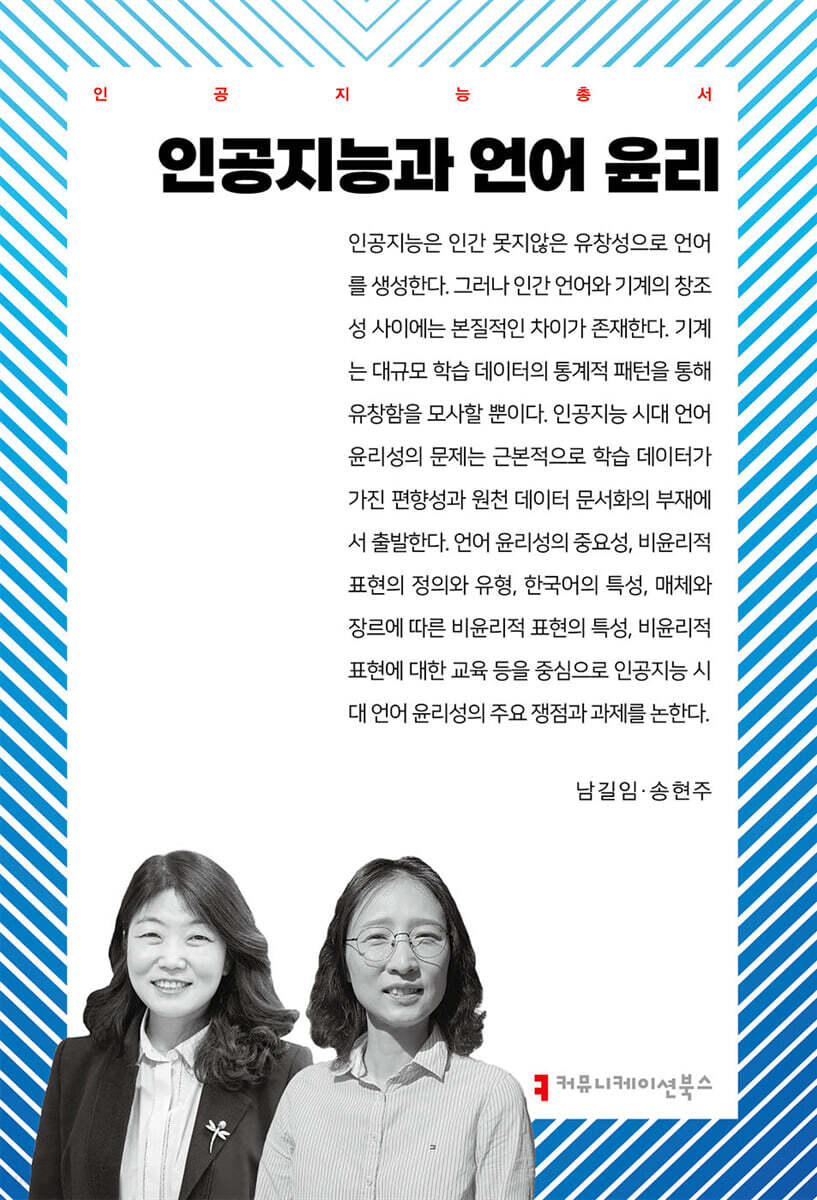
Artificial Intelligence and Language Ethics
 |
Description
Book Introduction
In an era where artificial intelligence demonstrates linguistic abilities comparable to those of humans, we must now re-examine the ethics of language.
"Artificial Intelligence and Language Ethics" addresses ethical issues in AI language stemming from data bias and lack of documentation. It also explores the definition and types of unethical expressions, contextual characteristics of the Korean language, media-specific case studies, and educational challenges, proposing new directions for language ethics.
"Artificial Intelligence and Language Ethics" addresses ethical issues in AI language stemming from data bias and lack of documentation. It also explores the definition and types of unethical expressions, contextual characteristics of the Korean language, media-specific case studies, and educational challenges, proposing new directions for language ethics.
- You can preview some of the book's contents.
Preview
index
Language in the Age of Artificial Intelligence
01 Why is language ethics important in the age of artificial intelligence?
02 What is unethical speech?
03 Types of Unethical Expression
04 Unethical Expression and Reader Artificial Intelligence
05 Context-dependence and subjectivity of unethical expressions
06 Issues in Units and Identification of Unethical Expressions
07 Unethical expressions of messengers
08 Unethical expressions in broadcasting
09 Unethical Expressions and Dictionary
10 How to teach about unethical expressions?
01 Why is language ethics important in the age of artificial intelligence?
02 What is unethical speech?
03 Types of Unethical Expression
04 Unethical Expression and Reader Artificial Intelligence
05 Context-dependence and subjectivity of unethical expressions
06 Issues in Units and Identification of Unethical Expressions
07 Unethical expressions of messengers
08 Unethical expressions in broadcasting
09 Unethical Expressions and Dictionary
10 How to teach about unethical expressions?
Into the book
In short, machine-created language has inherent problems with the "learning data" itself, which is directly related to the properties of large-scale data.
These limitations arise from the fact that the entire process of building data—who speaks, what is collected, and how it is filtered—cannot go through transparent procedures and stages.
Unlike the creativity of human language, mechanical creativity has no intention, context, or ethical awareness, and is highly productive anytime, anywhere.
Therefore, the ripple effect of text or voice data created by artificial intelligence goes beyond what we can expect.
In the age of artificial intelligence, we must consider and prepare for the possibility that this mechanical creativity could bias a particular worldview and reproduce unethical practices and discrimination.
--- From "01_“Why is language ethics important in the age of artificial intelligence?”
There has never been a time in language studies when there has been more interest in 'unethical expression' than there is today.
Concerns about profanity, vulgarity, and discriminatory and hate speech, which had previously remained on the periphery of linguistic research, have emerged as key issues across the humanities, including linguistics, with the spread of artificial intelligence.
The essence of the problem is related to how to prevent and respond to the problems of language ethics that exist behind the linguistic creativity of machines.
--- From “02_“What is unethical expression?”
As artificial intelligence becomes more commonplace, accountability for the results generated, the accuracy and verifiability of the results generated, and transparency regarding their use are emerging as key issues internationally.
Establishing a classification system for unethical expressions and standards for detection and de-identification that reflect the linguistic characteristics and socio-cultural context of the Korean language are ethical factors that must be considered in the development of artificial intelligence.
Beyond simply technical measures to exclude profanity and vulgarity, we need language policy design based on lexicographic and sociolinguistic analyses of the ethical nature of language to enable AI to internalize social diversity and equality values.
The linguistic ethics of artificial intelligence will also become an essential task in securing the social acceptability and public nature of artificial intelligence in the near future.
These limitations arise from the fact that the entire process of building data—who speaks, what is collected, and how it is filtered—cannot go through transparent procedures and stages.
Unlike the creativity of human language, mechanical creativity has no intention, context, or ethical awareness, and is highly productive anytime, anywhere.
Therefore, the ripple effect of text or voice data created by artificial intelligence goes beyond what we can expect.
In the age of artificial intelligence, we must consider and prepare for the possibility that this mechanical creativity could bias a particular worldview and reproduce unethical practices and discrimination.
--- From "01_“Why is language ethics important in the age of artificial intelligence?”
There has never been a time in language studies when there has been more interest in 'unethical expression' than there is today.
Concerns about profanity, vulgarity, and discriminatory and hate speech, which had previously remained on the periphery of linguistic research, have emerged as key issues across the humanities, including linguistics, with the spread of artificial intelligence.
The essence of the problem is related to how to prevent and respond to the problems of language ethics that exist behind the linguistic creativity of machines.
--- From “02_“What is unethical expression?”
As artificial intelligence becomes more commonplace, accountability for the results generated, the accuracy and verifiability of the results generated, and transparency regarding their use are emerging as key issues internationally.
Establishing a classification system for unethical expressions and standards for detection and de-identification that reflect the linguistic characteristics and socio-cultural context of the Korean language are ethical factors that must be considered in the development of artificial intelligence.
Beyond simply technical measures to exclude profanity and vulgarity, we need language policy design based on lexicographic and sociolinguistic analyses of the ethical nature of language to enable AI to internalize social diversity and equality values.
The linguistic ethics of artificial intelligence will also become an essential task in securing the social acceptability and public nature of artificial intelligence in the near future.
--- From "04_“Unethical Expression and Reader Artificial Intelligence”"
Publisher's Review
The boundary between human language creativity and machine language
Can AI mimic human linguistic creativity? "AI and Language Ethics" explores the boundaries between inherently human linguistic abilities and the language-generating capabilities of AI, based on large-scale data learning.
Through case studies, we critically examine the process by which AI reproduces unethical language from training data, demonstrating that AI's use of language is not free from ethical issues.
Furthermore, it analyzes how unethical expressions such as profanity, hate speech, and discrimination are transformed and spread according to social context, and raises the need for standards for ethical language use and educational approaches.
Language Change and the Ethical Challenges of Artificial Intelligence
Language is constantly changing, and hate speech in particular evolves rapidly along with social change.
This book addresses the problems that arise when artificial intelligence fails to reflect these linguistic changes, and emphasizes the need for "linguistic ethics assessment" that takes into account linguistic variability over time and sociocultural context.
Unethical Language in the Korean Context
This book addresses the characteristics and challenges of identifying unethical expressions in the cultural context of the Korean language.
This paper provides a case-based explanation of why high-context language usage, such as metaphors, jokes, and regional expressions, is misclassified by AI detection models, and suggests directions for building language resources that reflect Korean sensibilities.
The Future of Artificial Intelligence Through the Eyes of a Linguist
Consisting of 10 chapters, it discusses artificial intelligence language ethics from various perspectives, including linguistics, language engineering, and education.
As artificial intelligence becomes a dominant force in everyday language behavior, this book suggests a path toward a more ethical and inclusive language culture in an era where humans and artificial intelligence coexist.
Can AI mimic human linguistic creativity? "AI and Language Ethics" explores the boundaries between inherently human linguistic abilities and the language-generating capabilities of AI, based on large-scale data learning.
Through case studies, we critically examine the process by which AI reproduces unethical language from training data, demonstrating that AI's use of language is not free from ethical issues.
Furthermore, it analyzes how unethical expressions such as profanity, hate speech, and discrimination are transformed and spread according to social context, and raises the need for standards for ethical language use and educational approaches.
Language Change and the Ethical Challenges of Artificial Intelligence
Language is constantly changing, and hate speech in particular evolves rapidly along with social change.
This book addresses the problems that arise when artificial intelligence fails to reflect these linguistic changes, and emphasizes the need for "linguistic ethics assessment" that takes into account linguistic variability over time and sociocultural context.
Unethical Language in the Korean Context
This book addresses the characteristics and challenges of identifying unethical expressions in the cultural context of the Korean language.
This paper provides a case-based explanation of why high-context language usage, such as metaphors, jokes, and regional expressions, is misclassified by AI detection models, and suggests directions for building language resources that reflect Korean sensibilities.
The Future of Artificial Intelligence Through the Eyes of a Linguist
Consisting of 10 chapters, it discusses artificial intelligence language ethics from various perspectives, including linguistics, language engineering, and education.
As artificial intelligence becomes a dominant force in everyday language behavior, this book suggests a path toward a more ethical and inclusive language culture in an era where humans and artificial intelligence coexist.
GOODS SPECIFICS
- Date of issue: November 5, 2025
- Page count, weight, size: 117 pages | 128*188*7mm
- ISBN13: 9791143012944
You may also like
카테고리
korean


korean

![GQ KOREA Mark (Monthly): December [2025]](http://librairie.coreenne.fr/cdn/shop/files/8ef265dbbfbf186523ed75ba7319009d.jpg?v=1765340328&width=3840)


