

Dr. Choi Seong-ae's Happiness Class
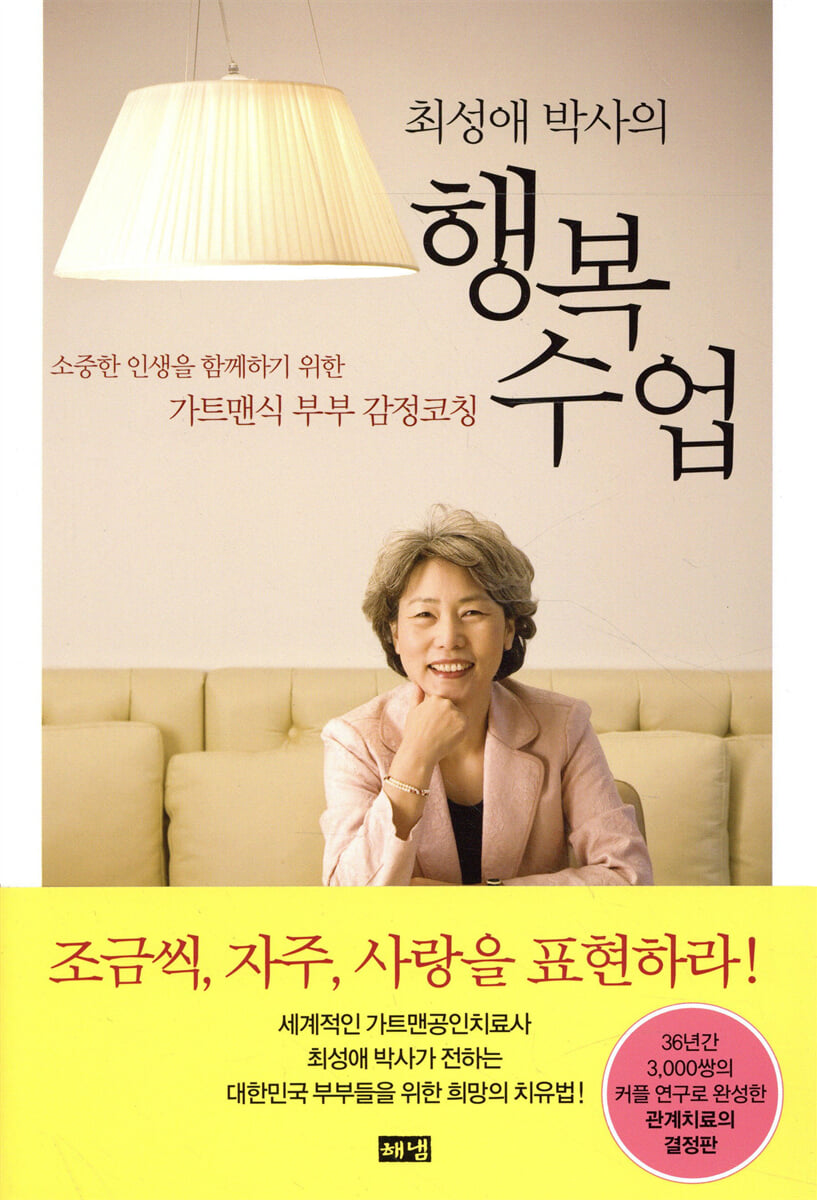 |
Description
Book Introduction
This book is based on the author's experience with Gottman couples therapy workshops and various healing activities, and is an easy-to-understand compilation of knowledge in psychology, child development, sociology, and brain science accumulated over 30 years.
Gottman Couples Therapy is a relationship therapy systematized by Dr. John Gottman, the director of the Gottman Institute and a distinguished professor of psychology at the University of Washington, through various scientific research and experimental methods on 3,000 couples over 36 years.
This book is divided into three parts. Part 1 explains the basic theory and characteristics of Gottman couples therapy in an easy-to-understand way. Part 2 teaches the love skills that couples need to cultivate in their daily lives to create a happy relationship. Part 3 contains practical methods for wisely resolving marital conflicts.
The author emphasizes that the root cause of marital conflict and divorce lies not in differences in personality, but in the way relationships are structured and communicated.
Gottman Couples Therapy is a relationship therapy systematized by Dr. John Gottman, the director of the Gottman Institute and a distinguished professor of psychology at the University of Washington, through various scientific research and experimental methods on 3,000 couples over 36 years.
This book is divided into three parts. Part 1 explains the basic theory and characteristics of Gottman couples therapy in an easy-to-understand way. Part 2 teaches the love skills that couples need to cultivate in their daily lives to create a happy relationship. Part 3 contains practical methods for wisely resolving marital conflicts.
The author emphasizes that the root cause of marital conflict and divorce lies not in differences in personality, but in the way relationships are structured and communicated.
- You can preview some of the book's contents.
Preview
index
preface
Part 1: The Style of Your Relationship Determines Your Couple's Happiness
Chapter 01 The Science of Marriage: Gottman Couples Therapy
Chapter 02 Relationship Master vs. Relationship Bomb
Chapter 03 Happy Couple vs. Unhappy Couple
Chapter 04 Four Shortcuts to Ruining Relationships
Part 2: Express Your Love Little by Little Every Day
Chapter 05 Drawing a Map of Love
Chapter 06 Building mutual affection and respect
Chapter 07: Talking to Your Heart
Chapter 08 Bringing in positive emotions
Part 3: Happy Couples Coexist Wisely
Chapter 09 Dealing with Unresolved Issues Between Couples
Chapter 10: Untangling the Tangled Conflict
Chapter 11: Managing the Emotional Flood
Chapter 12: Sharing Each Other's Dreams and Values
Conclusion
Part 1: The Style of Your Relationship Determines Your Couple's Happiness
Chapter 01 The Science of Marriage: Gottman Couples Therapy
Chapter 02 Relationship Master vs. Relationship Bomb
Chapter 03 Happy Couple vs. Unhappy Couple
Chapter 04 Four Shortcuts to Ruining Relationships
Part 2: Express Your Love Little by Little Every Day
Chapter 05 Drawing a Map of Love
Chapter 06 Building mutual affection and respect
Chapter 07: Talking to Your Heart
Chapter 08 Bringing in positive emotions
Part 3: Happy Couples Coexist Wisely
Chapter 09 Dealing with Unresolved Issues Between Couples
Chapter 10: Untangling the Tangled Conflict
Chapter 11: Managing the Emotional Flood
Chapter 12: Sharing Each Other's Dreams and Values
Conclusion
Into the book
“Just as you brush your teeth every day and sweep your room every day, practice small acts of love.”
Even so-called "experts" who know a lot can easily get hurt by such small things, so I can sympathize with how painful it must be for ordinary people who have never learned how to have healthy relationships at home or school to have these things happen over and over again without knowing why the relationship is painful or how to fix it.
It is also understandable that people who are having a hard time in their marriage and want to get divorced are not terribly lacking, wrong, or bad people.
Just like a dentist who studies a lot about teeth and treats other people's cavities can still have bad breath and cavities in just one day if he doesn't brush his teeth well.
I want to emphasize again from my experience that no matter how good a relationship you have or how many good treatments you know, if you don't put them into practice properly, your relationship will deteriorate.
At the same time, I want to give you hope that relationships can be restored if you know the right method and practice it consistently.
Even so-called "experts" who know a lot can easily get hurt by such small things, so I can sympathize with how painful it must be for ordinary people who have never learned how to have healthy relationships at home or school to have these things happen over and over again without knowing why the relationship is painful or how to fix it.
It is also understandable that people who are having a hard time in their marriage and want to get divorced are not terribly lacking, wrong, or bad people.
Just like a dentist who studies a lot about teeth and treats other people's cavities can still have bad breath and cavities in just one day if he doesn't brush his teeth well.
I want to emphasize again from my experience that no matter how good a relationship you have or how many good treatments you know, if you don't put them into practice properly, your relationship will deteriorate.
At the same time, I want to give you hope that relationships can be restored if you know the right method and practice it consistently.
--- From the preface
The ultimate happiness manual for couples: a must-have for every Korean home.
Neuroscientist John Medina worries about the future of America, citing statistics such as 77 percent of U.S. health care spending on stress-related illnesses, 67 percent of workers experiencing burnout, and parental discord being the biggest factor in students' academic underachievement.
When the Gottman method was applied to couples as a solution, it is said that even their children's health, learning, and happiness indices all improved.
They found that they laughed more, were able to cope with stress better, had higher emotional intelligence, and had better concentration.
What does this have to do with our country? We have the highest divorce rate in the world and the lowest birth rate.
And a quarter of elementary school students are diagnosed with emotional problems, and our youth suicide rate is the highest among OECD countries.
I believe that in Korea, in such a crisis, the Gottman method will serve as more than just a gold mine.
--- From 'Chapter 01 The Science of Marriage, Gottman Couples Therapy'
To become a relationship master, you must simultaneously change your thoughts to positive ones and frequently practice the actions that arise from those positive thoughts in your daily life.
Do small things often.
This is the core of Gottman couples therapy.
Dr. Gottman compared the effectiveness of positivity in a variety of ways, including quantity and quality, time and frequency, and content and format.
They say that the effect of positivity depends on how often you do it (frequency), not on how much money you spend or how new and grandiose it is.
Rather than showing little interest in your spouse on a regular basis and then dining out at an expensive restaurant on their birthday or going on a $20,000 cruise for your 30th wedding anniversary, it's much better to do small things with them often.
Giving a 5-carat diamond ring is as long-lasting as giving a warm kiss.
The frequency and number of times you show affection and interest is important. --- From 'Chapter 02 Relationship Master vs. Relationship Bomb'
An emotional bank account refers to the goodwill, warmth, and consideration built up between a couple.
Happy couples have ample emotional savings.
Dr. Gottman said, “If you want change, first like the other person as they are.
“When people believe that they are loved and accepted, even with their flaws, they are motivated to change,” he said.
In order to build up your emotional bank account, it is important to have an attitude of accepting the other person's basic tendencies and personality as they are.
Fritz Perls, the founder of Gestalt therapy, called this the “paradox of change.”
The difference between happy couples and unhappy couples is whether they have problems or not, and whether they fight or not.
Rather, it is a difference in how you look at a problem and how you solve it when there is a problem.
no see.
In other words, it is not important what the problem is, but how you think about it and express it that determines whether you can maintain happiness or become unhappy. --- From 'Chapter 03 Happy Couple vs. Unhappy Couple'
In the UK, researchers found that when parents raised their voices and argued in front of their babies, babies as young as six months old had higher levels of stress hormones in their urine.
And recently, the Gottman Institute published a study showing that simply looking at the concentration of stress hormones in a child's urine can predict whether or not their parents will divorce.
Children feel tremendous anxiety and fear when they witness their parents fighting.
My heart is pounding so fast that I can't breathe, my head is spinning, and I feel at a loss.
They also feel guilty, wondering if they did something wrong, and feel intense shame when their parents fight in front of others.
If things don't get better no matter what you do, you feel helpless and hopeless.
As a result, they feel less self-efficacy and control, which leads them to become discouraged or act recklessly. --- From 'Chapter 04 Four Shortcuts to Ruining Relationships'
Discovering positive traits or strengths in your spouse is crucial to maintaining a healthy relationship.
There are advantages, but whether you see them or not depends on your efforts.
Just like you need to exercise consistently to lose weight.
Dr. Gottman said that in order to build goodwill and respect between couples and enrich their emotional accounts, they should change their way of talking and thinking from 'me-ness' of 'I am like this and like that' and 'you are like this and like that' to 'we-ness' of 'what if we were like this?'
It's about changing the subject from 'I, you' to 'we'.
Then, you can create a sense of sharing and an atmosphere of cooperation.
If you say things like 'You, you, you', it's easy to criticize the other person, and if you say 'I, my, me', it's easy to only assert yourself.
If you do that, you may become distant from the other person.
--- From 'Chapter 06 Building mutual affection and respect'
69 percent of marital problems are unresolvable.
That is, every couple in this world has topics of perpetual conflict.
Sometimes, deep wounds are inherent, and even though we fight tirelessly, there is no sign of resolution.
Whenever this issue is brought up, I feel criticized, rejected, and misunderstood, which makes me feel wronged, offended, sad, and angry.
If either of you feels that way, it's a perpetual conflict.
Dan Wile, a close friend of Dr. Gottman and a leading figure in couples therapy, said, “When you choose a spouse, you choose a whole set of problems with them.”
In other words, marrying someone you love means marrying all the problems they have.
That person's good
It's not just about the good things that happen with that person, but also about accepting the problems that that person has had for a long time.
Of course, those problems will include many topics of persistent conflict. --- From 'Chapter 09 Dealing with Unresolved Issues Between Couples'
Dr. Rapoport, who is also a friend of Dr. Gottman, is said to have made this suggestion to Dr. Gottman:
There are formulas for peaceful resolutions to conflicts between nations and peoples, and formulas for ending in tragedy. I wondered if we could apply these principles to conflicts between couples.
So, I tried applying it, and indeed, it led to a peaceful resolution of many couples who had been unable to compromise and ended up in ruin.
The answer here is, 'To resolve conflict and dispute, you must first give up the will to resolve it.'
So what should we do? This is the core of the Rapoport formula.
Before you speak, listen to the other person's feelings first.
The bridge that crosses to the other side's position is what leads to 'dialogue'.
If compromise or emotional understanding cannot be reached on any issue, it is because the symbolic meaning behind each position has not been reached.
Beyond anger and fear, we need to ask what the other person's position means to them.
The ultimate happiness manual for couples: a must-have for every Korean home.
Neuroscientist John Medina worries about the future of America, citing statistics such as 77 percent of U.S. health care spending on stress-related illnesses, 67 percent of workers experiencing burnout, and parental discord being the biggest factor in students' academic underachievement.
When the Gottman method was applied to couples as a solution, it is said that even their children's health, learning, and happiness indices all improved.
They found that they laughed more, were able to cope with stress better, had higher emotional intelligence, and had better concentration.
What does this have to do with our country? We have the highest divorce rate in the world and the lowest birth rate.
And a quarter of elementary school students are diagnosed with emotional problems, and our youth suicide rate is the highest among OECD countries.
I believe that in Korea, in such a crisis, the Gottman method will serve as more than just a gold mine.
--- From 'Chapter 01 The Science of Marriage, Gottman Couples Therapy'
To become a relationship master, you must simultaneously change your thoughts to positive ones and frequently practice the actions that arise from those positive thoughts in your daily life.
Do small things often.
This is the core of Gottman couples therapy.
Dr. Gottman compared the effectiveness of positivity in a variety of ways, including quantity and quality, time and frequency, and content and format.
They say that the effect of positivity depends on how often you do it (frequency), not on how much money you spend or how new and grandiose it is.
Rather than showing little interest in your spouse on a regular basis and then dining out at an expensive restaurant on their birthday or going on a $20,000 cruise for your 30th wedding anniversary, it's much better to do small things with them often.
Giving a 5-carat diamond ring is as long-lasting as giving a warm kiss.
The frequency and number of times you show affection and interest is important. --- From 'Chapter 02 Relationship Master vs. Relationship Bomb'
An emotional bank account refers to the goodwill, warmth, and consideration built up between a couple.
Happy couples have ample emotional savings.
Dr. Gottman said, “If you want change, first like the other person as they are.
“When people believe that they are loved and accepted, even with their flaws, they are motivated to change,” he said.
In order to build up your emotional bank account, it is important to have an attitude of accepting the other person's basic tendencies and personality as they are.
Fritz Perls, the founder of Gestalt therapy, called this the “paradox of change.”
The difference between happy couples and unhappy couples is whether they have problems or not, and whether they fight or not.
Rather, it is a difference in how you look at a problem and how you solve it when there is a problem.
no see.
In other words, it is not important what the problem is, but how you think about it and express it that determines whether you can maintain happiness or become unhappy. --- From 'Chapter 03 Happy Couple vs. Unhappy Couple'
In the UK, researchers found that when parents raised their voices and argued in front of their babies, babies as young as six months old had higher levels of stress hormones in their urine.
And recently, the Gottman Institute published a study showing that simply looking at the concentration of stress hormones in a child's urine can predict whether or not their parents will divorce.
Children feel tremendous anxiety and fear when they witness their parents fighting.
My heart is pounding so fast that I can't breathe, my head is spinning, and I feel at a loss.
They also feel guilty, wondering if they did something wrong, and feel intense shame when their parents fight in front of others.
If things don't get better no matter what you do, you feel helpless and hopeless.
As a result, they feel less self-efficacy and control, which leads them to become discouraged or act recklessly. --- From 'Chapter 04 Four Shortcuts to Ruining Relationships'
Discovering positive traits or strengths in your spouse is crucial to maintaining a healthy relationship.
There are advantages, but whether you see them or not depends on your efforts.
Just like you need to exercise consistently to lose weight.
Dr. Gottman said that in order to build goodwill and respect between couples and enrich their emotional accounts, they should change their way of talking and thinking from 'me-ness' of 'I am like this and like that' and 'you are like this and like that' to 'we-ness' of 'what if we were like this?'
It's about changing the subject from 'I, you' to 'we'.
Then, you can create a sense of sharing and an atmosphere of cooperation.
If you say things like 'You, you, you', it's easy to criticize the other person, and if you say 'I, my, me', it's easy to only assert yourself.
If you do that, you may become distant from the other person.
--- From 'Chapter 06 Building mutual affection and respect'
69 percent of marital problems are unresolvable.
That is, every couple in this world has topics of perpetual conflict.
Sometimes, deep wounds are inherent, and even though we fight tirelessly, there is no sign of resolution.
Whenever this issue is brought up, I feel criticized, rejected, and misunderstood, which makes me feel wronged, offended, sad, and angry.
If either of you feels that way, it's a perpetual conflict.
Dan Wile, a close friend of Dr. Gottman and a leading figure in couples therapy, said, “When you choose a spouse, you choose a whole set of problems with them.”
In other words, marrying someone you love means marrying all the problems they have.
That person's good
It's not just about the good things that happen with that person, but also about accepting the problems that that person has had for a long time.
Of course, those problems will include many topics of persistent conflict. --- From 'Chapter 09 Dealing with Unresolved Issues Between Couples'
Dr. Rapoport, who is also a friend of Dr. Gottman, is said to have made this suggestion to Dr. Gottman:
There are formulas for peaceful resolutions to conflicts between nations and peoples, and formulas for ending in tragedy. I wondered if we could apply these principles to conflicts between couples.
So, I tried applying it, and indeed, it led to a peaceful resolution of many couples who had been unable to compromise and ended up in ruin.
The answer here is, 'To resolve conflict and dispute, you must first give up the will to resolve it.'
So what should we do? This is the core of the Rapoport formula.
Before you speak, listen to the other person's feelings first.
The bridge that crosses to the other side's position is what leads to 'dialogue'.
If compromise or emotional understanding cannot be reached on any issue, it is because the symbolic meaning behind each position has not been reached.
Beyond anger and fear, we need to ask what the other person's position means to them.
Neuroscientist John Medina worries about the future of America, citing statistics such as 77 percent of U.S. health care spending on stress-related illnesses, 67 percent of workers experiencing burnout, and parental discord being the biggest factor in students' academic underachievement.
When the Gottman method was applied to couples as a solution, it is said that even their children's health, learning, and happiness indices all improved.
They found that they laughed more, were able to cope with stress better, had higher emotional intelligence, and had better concentration.
What does this have to do with our country? We have the highest divorce rate in the world and the lowest birth rate.
And a quarter of elementary school students are diagnosed with emotional problems, and our youth suicide rate is the highest among OECD countries.
I believe that in Korea, in such a crisis, the Gottman method will serve as more than just a gold mine.
--- From 'Chapter 01 The Science of Marriage, Gottman Couples Therapy'
To become a relationship master, you must simultaneously change your thoughts to positive ones and frequently practice the actions that arise from those positive thoughts in your daily life.
Do small things often.
This is the core of Gottman couples therapy.
Dr. Gottman compared the effectiveness of positivity in a variety of ways, including quantity and quality, time and frequency, and content and format.
They say that the effect of positivity depends on how often you do it (frequency), not on how much money you spend or how new and grandiose it is.
Rather than showing little interest in your spouse on a regular basis and then dining out at an expensive restaurant on their birthday or going on a $20,000 cruise for your 30th wedding anniversary, it's much better to do small things with them often.
Giving a 5-carat diamond ring is as long-lasting as giving a warm kiss.
The frequency and number of times you show affection and interest is important. --- From 'Chapter 02 Relationship Master vs. Relationship Bomb'
An emotional bank account refers to the goodwill, warmth, and consideration built up between a couple.
Happy couples have ample emotional savings.
Dr. Gottman said, “If you want change, first like the other person as they are.
“When people believe that they are loved and accepted, even with their flaws, they are motivated to change,” he said.
In order to build up your emotional bank account, it is important to have an attitude of accepting the other person's basic tendencies and personality as they are.
Fritz Perls, the founder of Gestalt therapy, called this the “paradox of change.”
The difference between happy couples and unhappy couples is whether they have problems or not, and whether they fight or not.
Rather, it is a difference in how you look at a problem and how you solve it when there is a problem.
no see.
In other words, it is not important what the problem is, but how you think about it and express it that determines whether you can maintain happiness or become unhappy. --- From 'Chapter 03 Happy Couple vs. Unhappy Couple'
In the UK, researchers found that when parents raised their voices and argued in front of their babies, babies as young as six months old had higher levels of stress hormones in their urine.
And recently, the Gottman Institute published a study showing that simply looking at the concentration of stress hormones in a child's urine can predict whether or not their parents will divorce.
Children feel tremendous anxiety and fear when they witness their parents fighting.
My heart is pounding so fast that I can't breathe, my head is spinning, and I feel at a loss.
They also feel guilty, wondering if they did something wrong, and feel intense shame when their parents fight in front of others.
If things don't get better no matter what you do, you feel helpless and hopeless.
As a result, they feel less self-efficacy and control, which leads them to become discouraged or act recklessly. --- From 'Chapter 04 Four Shortcuts to Ruining Relationships'
Discovering positive traits or strengths in your spouse is crucial to maintaining a healthy relationship.
There are advantages, but whether you see them or not depends on your efforts.
Just like you need to exercise consistently to lose weight.
Dr. Gottman said that in order to build goodwill and respect between couples and enrich their emotional accounts, they should change their way of talking and thinking from 'me-ness' of 'I am like this and like that' and 'you are like this and like that' to 'we-ness' of 'what if we were like this?'
It's about changing the subject from 'I, you' to 'we'.
Then, you can create a sense of sharing and an atmosphere of cooperation.
If you say things like 'You, you, you', it's easy to criticize the other person, and if you say 'I, my, me', it's easy to only assert yourself.
If you do that, you may become distant from the other person.
--- From 'Chapter 06 Building mutual affection and respect'
69 percent of marital problems are unresolvable.
That is, every couple in this world has topics of perpetual conflict.
Sometimes, deep wounds are inherent, and even though we fight tirelessly, there is no sign of resolution.
Whenever this issue is brought up, I feel criticized, rejected, and misunderstood, which makes me feel wronged, offended, sad, and angry.
If either of you feels that way, it's a perpetual conflict.
Dan Wile, a close friend of Dr. Gottman and a leading figure in couples therapy, said, “When you choose a spouse, you choose a whole set of problems with them.”
In other words, marrying someone you love means marrying all the problems they have.
That person's good
It's not just about the good things that happen with that person, but also about accepting the problems that that person has had for a long time.
Of course, those problems will include many topics of persistent conflict. --- From 'Chapter 09 Dealing with Unresolved Issues Between Couples'
Dr. Rapoport, who is also a friend of Dr. Gottman, is said to have made this suggestion to Dr. Gottman:
There are formulas for peaceful resolutions to conflicts between nations and peoples, and formulas for ending in tragedy. I wondered if we could apply these principles to conflicts between couples.
So, I tried applying it, and indeed, it led to a peaceful resolution of many couples who had been unable to compromise and ended up in ruin.
The answer here is, 'To resolve conflict and dispute, you must first give up the will to resolve it.'
So what should we do? This is the core of the Rapoport formula.
Before you speak, listen to the other person's feelings first.
The bridge that crosses to the other side's position is what leads to 'dialogue'.
If compromise or emotional understanding cannot be reached on any issue, it is because the symbolic meaning behind each position has not been reached.
Beyond anger and fear, we need to ask what the other person's position means to them.
The ultimate happiness manual for couples: a must-have for every Korean home.
Neuroscientist John Medina worries about the future of America, citing statistics such as 77 percent of U.S. health care spending on stress-related illnesses, 67 percent of workers experiencing burnout, and parental discord being the biggest factor in students' academic underachievement.
When the Gottman method was applied to couples as a solution, it is said that even their children's health, learning, and happiness indices all improved.
They found that they laughed more, were able to cope with stress better, had higher emotional intelligence, and had better concentration.
What does this have to do with our country? We have the highest divorce rate in the world and the lowest birth rate.
And a quarter of elementary school students are diagnosed with emotional problems, and our youth suicide rate is the highest among OECD countries.
I believe that in Korea, in such a crisis, the Gottman method will serve as more than just a gold mine.
--- From 'Chapter 01 The Science of Marriage, Gottman Couples Therapy'
To become a relationship master, you must simultaneously change your thoughts to positive ones and frequently practice the actions that arise from those positive thoughts in your daily life.
Do small things often.
This is the core of Gottman couples therapy.
Dr. Gottman compared the effectiveness of positivity in a variety of ways, including quantity and quality, time and frequency, and content and format.
They say that the effect of positivity depends on how often you do it (frequency), not on how much money you spend or how new and grandiose it is.
Rather than showing little interest in your spouse on a regular basis and then dining out at an expensive restaurant on their birthday or going on a $20,000 cruise for your 30th wedding anniversary, it's much better to do small things with them often.
Giving a 5-carat diamond ring is as long-lasting as giving a warm kiss.
The frequency and number of times you show affection and interest is important. --- From 'Chapter 02 Relationship Master vs. Relationship Bomb'
An emotional bank account refers to the goodwill, warmth, and consideration built up between a couple.
Happy couples have ample emotional savings.
Dr. Gottman said, “If you want change, first like the other person as they are.
“When people believe that they are loved and accepted, even with their flaws, they are motivated to change,” he said.
In order to build up your emotional bank account, it is important to have an attitude of accepting the other person's basic tendencies and personality as they are.
Fritz Perls, the founder of Gestalt therapy, called this the “paradox of change.”
The difference between happy couples and unhappy couples is whether they have problems or not, and whether they fight or not.
Rather, it is a difference in how you look at a problem and how you solve it when there is a problem.
no see.
In other words, it is not important what the problem is, but how you think about it and express it that determines whether you can maintain happiness or become unhappy. --- From 'Chapter 03 Happy Couple vs. Unhappy Couple'
In the UK, researchers found that when parents raised their voices and argued in front of their babies, babies as young as six months old had higher levels of stress hormones in their urine.
And recently, the Gottman Institute published a study showing that simply looking at the concentration of stress hormones in a child's urine can predict whether or not their parents will divorce.
Children feel tremendous anxiety and fear when they witness their parents fighting.
My heart is pounding so fast that I can't breathe, my head is spinning, and I feel at a loss.
They also feel guilty, wondering if they did something wrong, and feel intense shame when their parents fight in front of others.
If things don't get better no matter what you do, you feel helpless and hopeless.
As a result, they feel less self-efficacy and control, which leads them to become discouraged or act recklessly. --- From 'Chapter 04 Four Shortcuts to Ruining Relationships'
Discovering positive traits or strengths in your spouse is crucial to maintaining a healthy relationship.
There are advantages, but whether you see them or not depends on your efforts.
Just like you need to exercise consistently to lose weight.
Dr. Gottman said that in order to build goodwill and respect between couples and enrich their emotional accounts, they should change their way of talking and thinking from 'me-ness' of 'I am like this and like that' and 'you are like this and like that' to 'we-ness' of 'what if we were like this?'
It's about changing the subject from 'I, you' to 'we'.
Then, you can create a sense of sharing and an atmosphere of cooperation.
If you say things like 'You, you, you', it's easy to criticize the other person, and if you say 'I, my, me', it's easy to only assert yourself.
If you do that, you may become distant from the other person.
--- From 'Chapter 06 Building mutual affection and respect'
69 percent of marital problems are unresolvable.
That is, every couple in this world has topics of perpetual conflict.
Sometimes, deep wounds are inherent, and even though we fight tirelessly, there is no sign of resolution.
Whenever this issue is brought up, I feel criticized, rejected, and misunderstood, which makes me feel wronged, offended, sad, and angry.
If either of you feels that way, it's a perpetual conflict.
Dan Wile, a close friend of Dr. Gottman and a leading figure in couples therapy, said, “When you choose a spouse, you choose a whole set of problems with them.”
In other words, marrying someone you love means marrying all the problems they have.
That person's good
It's not just about the good things that happen with that person, but also about accepting the problems that that person has had for a long time.
Of course, those problems will include many topics of persistent conflict. --- From 'Chapter 09 Dealing with Unresolved Issues Between Couples'
Dr. Rapoport, who is also a friend of Dr. Gottman, is said to have made this suggestion to Dr. Gottman:
There are formulas for peaceful resolutions to conflicts between nations and peoples, and formulas for ending in tragedy. I wondered if we could apply these principles to conflicts between couples.
So, I tried applying it, and indeed, it led to a peaceful resolution of many couples who had been unable to compromise and ended up in ruin.
The answer here is, 'To resolve conflict and dispute, you must first give up the will to resolve it.'
So what should we do? This is the core of the Rapoport formula.
Before you speak, listen to the other person's feelings first.
The bridge that crosses to the other side's position is what leads to 'dialogue'.
If compromise or emotional understanding cannot be reached on any issue, it is because the symbolic meaning behind each position has not been reached.
Beyond anger and fear, we need to ask what the other person's position means to them.
--- From 'Chapter 12 Sharing Each Other's Dreams and Values'
Publisher's Review
Dr. Choi Seong-ae, a leading family therapy expert
The vivid relationship skills learned through laughter and tears with couples in this land.
A hopeful solution for the happy coexistence of our couples and families!
The highest divorce rate in Asia, the "birth strike" of couples in their 30s and 40s, the rise in children at risk due to broken families... South Korea's families are in utter chaos.
The adverse effects of marital conflict and divorce, which have now become a reality before our eyes, are not just a problem for individual families, but are expanding into a problem for the entire society.
Accordingly, Dr. Choi Seong-ae, director of the HD Mind Brain Science Training Center, who has been at the forefront of finding hope for families in Korea with the belief that happy families create a happy society, presents a solution of hope for couples and families in this country in her new book, “Dr. Choi Seong-ae’s Happiness Class.”
This book was written based on Dr. Choi Seong-ae's experience conducting Gottman couples therapy workshops and various healing activities for hundreds of couples over the past five years, and it incorporates her knowledge of psychology, child development, sociology, and brain science accumulated over the past 30 years into an easily understandable text.
Gottman Couples Therapy is a relationship therapy method that was systematized through various scientific research and experimental methods on 3,000 couples over 36 years by Dr. John Gottman, the director of the Gottman Institute in the United States and a distinguished professor of psychology at the University of Washington. It is evaluated as having “raised marriage to the realm of science” and is a relationship therapy method that has already been verified for its effectiveness and stability worldwide.
Dr. Choi Seong-ae, the only certified Gottman therapist in Asia among only about 100 in the world, has adapted the Gottman method to our reality in this book so that Korean couples can follow along easily as if they were participating in an actual workshop.
Above all, there are abundant examples of domestic couples that support various theoretical explanations.
This book is divided into three parts. Part 1 explains the basic theory and characteristics of Gottman couples therapy in an easy-to-understand way. Part 2 teaches the love skills that couples need to cultivate in their daily lives to create a happy relationship. Part 3 contains practical methods for wisely resolving marital conflicts.
Dr. Choi Seong-ae emphasizes that the root cause of marital conflict and divorce lies not in personality differences, but in the way relationships are structured and communicated.
In other words, the more fundamental cause is not the ‘content’ of the conflict, but the ‘method of resolving’ the conflict.
In particular, the difference between happy and unhappy couples is not determined by external factors such as education, wealth, status, or race, but by the friendliness and positivity they share in their daily lives.
A relationship can only recover from conflict if positivity is at least five times greater than negativity.
To build this positivity, I say, “Small things often!” every day.
Additionally, it is advised that 69% of problems between couples are unresolved issues, that is, persistent conflicts, and that couples should consider each other's existential meaning and dreams latent within them, and focus on managing them rather than solving them.
Above all, Dr. Choi Seong-ae, who is working on healing at-risk youth in the field, emphasizes that a healthy marital relationship creates happy children.
This is because the marital relationship is a role model for children and a 'garden' where they form their emotions.
This is an important issue that we must reflect on in a reality where children's education is often not considered a marital issue.
Why is the Gottman Method so essential for Korean families today? The Gottman Method is a scientific, comprehensive diagnostic and treatment method proven in the United States, a showcase of racial diversity and a "divorce powerhouse," with individuals from diverse cultural backgrounds.
Above all, the core of the modern Gottman method, which emphasizes gentle and polite conversation and positivity, is also in line with Korean sentiments and traditions.
Furthermore, with the high divorce rate, the number of families experiencing discord and conflict is increasing, but in reality, there is an absolute shortage of experts to help improve their relationships and heal, so practical methods that anyone can easily implement are needed.
The foundation of society is the family, and the center of that family is the couple.
This is precisely why individuals seeking happiness and societies dreaming of growth must consider the challenges of couples. "Dr. Choi Sung-ae's Happiness Class" offers a warm guide, based on clear and easy-to-practice methods, enabling anyone to become a "relationship master" and build a more fulfilling and happy marital relationship and family.
Gottman Couples Therapy
Dr. Gottman predicts the likelihood of divorce with 90% accuracy by watching just the first three minutes of a couple's fight.
He is the best expert at predicting.
―Malcolm Gladwell, from Blink
Since the 1970s, Dr. John Gottman has been conducting scientific and academic experiments and analyses in a space called the Love Lab at the University of Washington, including videotaping and observing couples' interactions and measuring their stress levels with heart rate monitors and biofeedback equipment.
Through this attempt, the success of a marriage was predicted with a nearly 94% accuracy rate with just 15 minutes of conversation listening, thereby breaking the existing research reality that treatment effects could not be objectively predicted, and suggesting a new direction for the restoration of marital relationships.
By collecting and analyzing long-term data on 3,000 couples over 36 years, we were able to identify which interactions make couples happy and which make them unhappy.
This process was also featured prominently in the best-selling book Blink as “thin slicing.”
John Gottman identified four threats to marriage: blame, contempt, defensiveness, and stonewalling. Through the concept of "emotional bankbook," he discovered that the cause of marital conflict lies not in personality differences but in the way relationships are structured, including fighting.
Based on these insights, the author's various proposed treatments have become established worldwide as methods for improving marital relationships and preventing divorce.
The vivid relationship skills learned through laughter and tears with couples in this land.
A hopeful solution for the happy coexistence of our couples and families!
The highest divorce rate in Asia, the "birth strike" of couples in their 30s and 40s, the rise in children at risk due to broken families... South Korea's families are in utter chaos.
The adverse effects of marital conflict and divorce, which have now become a reality before our eyes, are not just a problem for individual families, but are expanding into a problem for the entire society.
Accordingly, Dr. Choi Seong-ae, director of the HD Mind Brain Science Training Center, who has been at the forefront of finding hope for families in Korea with the belief that happy families create a happy society, presents a solution of hope for couples and families in this country in her new book, “Dr. Choi Seong-ae’s Happiness Class.”
This book was written based on Dr. Choi Seong-ae's experience conducting Gottman couples therapy workshops and various healing activities for hundreds of couples over the past five years, and it incorporates her knowledge of psychology, child development, sociology, and brain science accumulated over the past 30 years into an easily understandable text.
Gottman Couples Therapy is a relationship therapy method that was systematized through various scientific research and experimental methods on 3,000 couples over 36 years by Dr. John Gottman, the director of the Gottman Institute in the United States and a distinguished professor of psychology at the University of Washington. It is evaluated as having “raised marriage to the realm of science” and is a relationship therapy method that has already been verified for its effectiveness and stability worldwide.
Dr. Choi Seong-ae, the only certified Gottman therapist in Asia among only about 100 in the world, has adapted the Gottman method to our reality in this book so that Korean couples can follow along easily as if they were participating in an actual workshop.
Above all, there are abundant examples of domestic couples that support various theoretical explanations.
This book is divided into three parts. Part 1 explains the basic theory and characteristics of Gottman couples therapy in an easy-to-understand way. Part 2 teaches the love skills that couples need to cultivate in their daily lives to create a happy relationship. Part 3 contains practical methods for wisely resolving marital conflicts.
Dr. Choi Seong-ae emphasizes that the root cause of marital conflict and divorce lies not in personality differences, but in the way relationships are structured and communicated.
In other words, the more fundamental cause is not the ‘content’ of the conflict, but the ‘method of resolving’ the conflict.
In particular, the difference between happy and unhappy couples is not determined by external factors such as education, wealth, status, or race, but by the friendliness and positivity they share in their daily lives.
A relationship can only recover from conflict if positivity is at least five times greater than negativity.
To build this positivity, I say, “Small things often!” every day.
Additionally, it is advised that 69% of problems between couples are unresolved issues, that is, persistent conflicts, and that couples should consider each other's existential meaning and dreams latent within them, and focus on managing them rather than solving them.
Above all, Dr. Choi Seong-ae, who is working on healing at-risk youth in the field, emphasizes that a healthy marital relationship creates happy children.
This is because the marital relationship is a role model for children and a 'garden' where they form their emotions.
This is an important issue that we must reflect on in a reality where children's education is often not considered a marital issue.
Why is the Gottman Method so essential for Korean families today? The Gottman Method is a scientific, comprehensive diagnostic and treatment method proven in the United States, a showcase of racial diversity and a "divorce powerhouse," with individuals from diverse cultural backgrounds.
Above all, the core of the modern Gottman method, which emphasizes gentle and polite conversation and positivity, is also in line with Korean sentiments and traditions.
Furthermore, with the high divorce rate, the number of families experiencing discord and conflict is increasing, but in reality, there is an absolute shortage of experts to help improve their relationships and heal, so practical methods that anyone can easily implement are needed.
The foundation of society is the family, and the center of that family is the couple.
This is precisely why individuals seeking happiness and societies dreaming of growth must consider the challenges of couples. "Dr. Choi Sung-ae's Happiness Class" offers a warm guide, based on clear and easy-to-practice methods, enabling anyone to become a "relationship master" and build a more fulfilling and happy marital relationship and family.
Gottman Couples Therapy
Dr. Gottman predicts the likelihood of divorce with 90% accuracy by watching just the first three minutes of a couple's fight.
He is the best expert at predicting.
―Malcolm Gladwell, from Blink
Since the 1970s, Dr. John Gottman has been conducting scientific and academic experiments and analyses in a space called the Love Lab at the University of Washington, including videotaping and observing couples' interactions and measuring their stress levels with heart rate monitors and biofeedback equipment.
Through this attempt, the success of a marriage was predicted with a nearly 94% accuracy rate with just 15 minutes of conversation listening, thereby breaking the existing research reality that treatment effects could not be objectively predicted, and suggesting a new direction for the restoration of marital relationships.
By collecting and analyzing long-term data on 3,000 couples over 36 years, we were able to identify which interactions make couples happy and which make them unhappy.
This process was also featured prominently in the best-selling book Blink as “thin slicing.”
John Gottman identified four threats to marriage: blame, contempt, defensiveness, and stonewalling. Through the concept of "emotional bankbook," he discovered that the cause of marital conflict lies not in personality differences but in the way relationships are structured, including fighting.
Based on these insights, the author's various proposed treatments have become established worldwide as methods for improving marital relationships and preventing divorce.
GOODS SPECIFICS
- Date of issue: April 10, 2010
- Page count, weight, size: 264 pages | 438g | 152*225*20mm
- ISBN13: 9788973370092
- ISBN10: 897337009X
You may also like
카테고리
korean


korean

![GQ KOREA Mark (Monthly): December [2025]](http://librairie.coreenne.fr/cdn/shop/files/8ef265dbbfbf186523ed75ba7319009d.jpg?v=1765340328&width=3840)


