

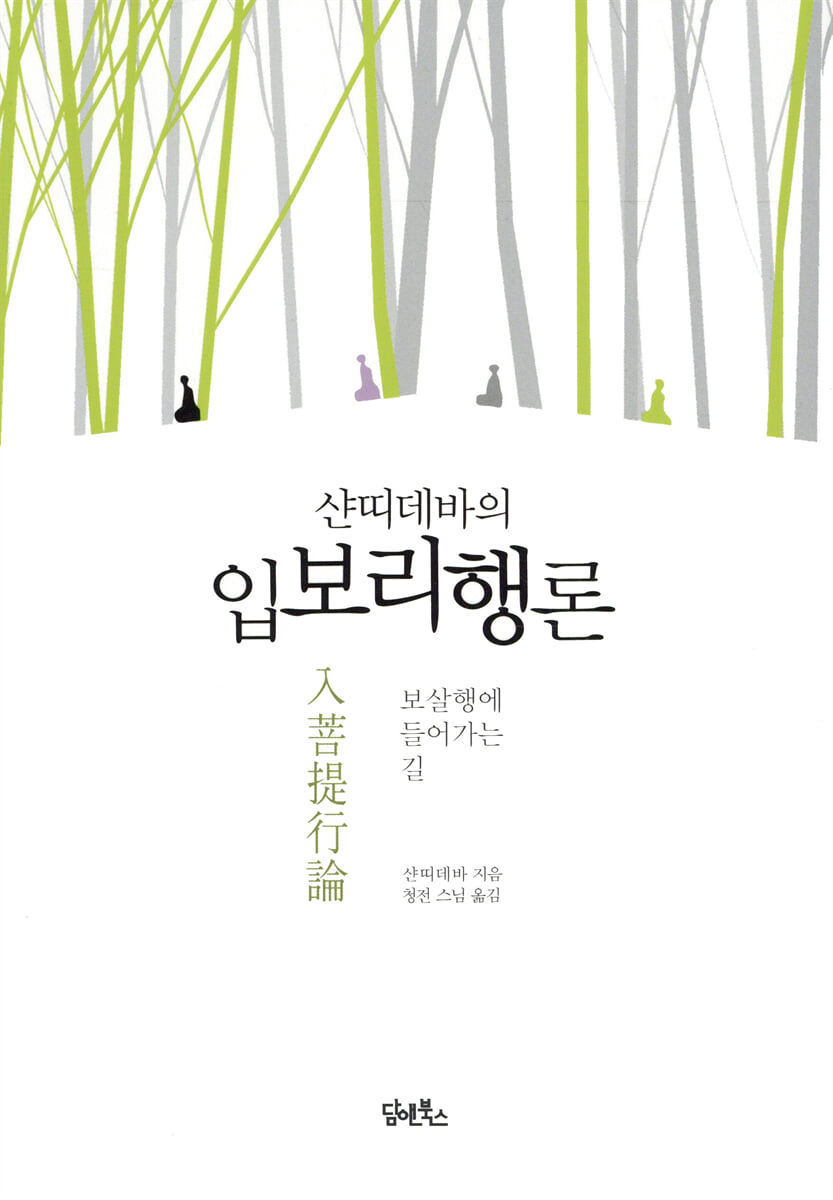
Shantideva's Treatise on the Path to Bodhicitta
 |
Description
Book Introduction
The Path to Entering the Bodhisattva Path
The 『Entry into the Bodhi Path』 written by Shantideva, a 7th-century Indian Buddhist scholar.
The Dalai Lama said of this book, “There is no better treatise on Bodhicitta (the mind to awaken for the sake of all sentient beings) than this one.”
To that extent, 『Theory of the Beginning of Bodhicitta』 is evaluated as having the most detailed and extensive discussion of Bodhicitta among the numerous Buddhist treatises.
For this reason, since this book was first introduced in Korea, it has become the most quoted and read scripture among the general public, following the Dhammapada and the Suttanipata.
The 『Entry into the Bodhi Path』 written by Shantideva, a 7th-century Indian Buddhist scholar.
The Dalai Lama said of this book, “There is no better treatise on Bodhicitta (the mind to awaken for the sake of all sentient beings) than this one.”
To that extent, 『Theory of the Beginning of Bodhicitta』 is evaluated as having the most detailed and extensive discussion of Bodhicitta among the numerous Buddhist treatises.
For this reason, since this book was first introduced in Korea, it has become the most quoted and read scripture among the general public, following the Dhammapada and the Suttanipata.
- You can preview some of the book's contents.
Preview
index
Preface to the Revised Edition_ 4
Release_ 7
Note_ 10
Chapter 1... Praise for the Merits of the Bodhicitta_ 13
Chapter 2... ...Repentance for Sins_ 23
Chapter 3 … … Bodhicitta Jeonjipum_ 39
Chapter 4 … … The Bodhicitta’s Unwavering Purity_ 49
Chapter 5 … … Hogyejeongjipum_ 61
Chapter 6 … … Insults_ 87
Chapter 7 … …Jeongjinpum_ 117
Chapter 8 … … Selections_ 135
Chapter 9 … … Wisdom Items_ 175
Chapter 10 … … Incense_ 211
Release_ 7
Note_ 10
Chapter 1... Praise for the Merits of the Bodhicitta_ 13
Chapter 2... ...Repentance for Sins_ 23
Chapter 3 … … Bodhicitta Jeonjipum_ 39
Chapter 4 … … The Bodhicitta’s Unwavering Purity_ 49
Chapter 5 … … Hogyejeongjipum_ 61
Chapter 6 … … Insults_ 87
Chapter 7 … …Jeongjinpum_ 117
Chapter 8 … … Selections_ 135
Chapter 9 … … Wisdom Items_ 175
Chapter 10 … … Incense_ 211
Publisher's Review
'The most outstanding treatise on Bodhicitta'
The place that values the 『Entry to the Bodhi Path』 the most is Tibet, which places the Bodhi mind at the forefront of practice.
Korean Buddhism emphasizes humility (hasim) not only for practitioners but also for the general public, so the Bodhicitta, which goes one step further and seeks enlightenment for the sake of all sentient beings, may seem unfamiliar.
However, in Southern Buddhism, including Tibet, Myanmar, and Sri Lanka, it is a practice that is more emphasized than lowering one's mind.
In the case of Tibet, since the translation of the "Entry into the Bodhi Path" in the 11th century, there have been more than eight commentaries on the Tibetan Tripitaka, and over 130 commentaries are in circulation.
Those who study Tibetan Buddhism believe that this book initiated the flourishing of a wide range of scholarship on the ideology and practice of Tibetan Mahayana Buddhism, and that this book also gave rise to a new practice unique to Tibetan Buddhism called Lojong, or "changing the mind."
On the other hand, in Chinese or Korean Buddhism, the 『Entry into the Bodhi Path』 was not that popular among practitioners and lay believers.
However, interest in the book has grown, with the Jogye Order adopting 『Theory of the Beginning of the Bodhi Path』 as an official textbook for its graduate school of Buddhist studies since 2013.
The pinnacle of Buddhist literature - a powerful and beautifully moving sentence
This book is a treatise consisting of 917 verses in 10 chapters.
The order of each chapter is like a flowing stream of contents that are designed to arouse the mind of Bodhicitta → prevent the mind of Bodhicitta from disappearing → and further increase the mind of Bodhicitta.
Chapter 1, “Praise of the Merits of the Bodhicitta,” Chapter 2, “Repentance of Sins,” and Chapter 3, “The Evolution of the Bodhicitta,” are about arousing the Bodhicitta. Chapter 4, “Avoiding the Bodhicitta’s Aversion to Arrogance,” Chapter 5, “Stopping the Precepts,” and Chapter 6, “Desires,” are about preventing the Bodhicitta from disappearing and always maintaining it.
And Chapter 7, “The Chapter on Diligence,” Chapter 8, “The Chapter on Selection,” and Chapter 9, “The Chapter on Wisdom,” are chapters for further developing the Bodhicitta.
The last part ends with “Hwanhyangpum.”
In particular, the best parts of this book are Chapter 2, Song 1, and Chapter 3, Song 22.
This section begins with repentance of one’s sins, such as “In the cycle of reincarnation without beginning or end / In this life and another life / The wrongdoings I committed without knowing / And the sins I caused to be committed (Chapter 2, Chapter 2, Chapter on Repentance of Sins, 28 verses)” and ends with the expression of Bodhicitta, “Until I reach the end of the void / In all the various realms of sentient beings / Until they are all free from suffering / May I become the source of their lives” (Chapter 3, Chapter on the Preservation of Bodhicitta, 22 verses). This section touches the hearts of readers with every verse.
For this reason, when the Dalama Lama held a Buddhist ceremony for Koreans in Dharamsala, India in 2004, he encouraged all participants to recite this passage together, and it is said that everyone who participated shed tears as they read it.
But there is something that makes the content shine even brighter than this heart-wrenching content.
This song is said to be composed of such beautiful verses that it is said to be the best among existing Buddhist literature.
Therefore, many documents and dictionaries that introduce Shantideva introduce him as a Buddhist scholar, but always write him as a ‘poet.’
The first complete Sanskrit-Tibetan translation
The Tibetan version of 『Theory of the Beginning of the Bodhi Path』 was first introduced to Korea in 2004 through the book's translator, Venerable Cheongjeon.
Of course, it exists in the Korean translation and the Hangul Tripitaka Koreana under the name of 『Bodhi Haenggyeong (菩提行經)』, but in both the Korean translation and Hangul versions, the content of chapter 2 out of 10 is abbreviated, and chapters 3 and 4 are completely missing.
So, many people used the English version to read 『Ipborihaengron』, and over time, books that translated the English version into Korean were published.
However, the translation of the Sanskrit and Tibetan versions by monk Cheongjeon was the first to compare the Sanskrit and Tibetan versions through the 『Entry into the Bodhi Path』.
In 2013, to commemorate the 10th anniversary of the publication of 『Theory of the Beginning of the Bodhi Path』 translated by Monk Cheongjeon, some of the translations and annotations were revised to match Sanskrit, and a revised edition was published with sentences deleted or added that were difficult to understand or prone to mistranslation. This time (2022), a second revised edition was published with some of the content revised and the translation of Chapter 9 supplemented.
The place that values the 『Entry to the Bodhi Path』 the most is Tibet, which places the Bodhi mind at the forefront of practice.
Korean Buddhism emphasizes humility (hasim) not only for practitioners but also for the general public, so the Bodhicitta, which goes one step further and seeks enlightenment for the sake of all sentient beings, may seem unfamiliar.
However, in Southern Buddhism, including Tibet, Myanmar, and Sri Lanka, it is a practice that is more emphasized than lowering one's mind.
In the case of Tibet, since the translation of the "Entry into the Bodhi Path" in the 11th century, there have been more than eight commentaries on the Tibetan Tripitaka, and over 130 commentaries are in circulation.
Those who study Tibetan Buddhism believe that this book initiated the flourishing of a wide range of scholarship on the ideology and practice of Tibetan Mahayana Buddhism, and that this book also gave rise to a new practice unique to Tibetan Buddhism called Lojong, or "changing the mind."
On the other hand, in Chinese or Korean Buddhism, the 『Entry into the Bodhi Path』 was not that popular among practitioners and lay believers.
However, interest in the book has grown, with the Jogye Order adopting 『Theory of the Beginning of the Bodhi Path』 as an official textbook for its graduate school of Buddhist studies since 2013.
The pinnacle of Buddhist literature - a powerful and beautifully moving sentence
This book is a treatise consisting of 917 verses in 10 chapters.
The order of each chapter is like a flowing stream of contents that are designed to arouse the mind of Bodhicitta → prevent the mind of Bodhicitta from disappearing → and further increase the mind of Bodhicitta.
Chapter 1, “Praise of the Merits of the Bodhicitta,” Chapter 2, “Repentance of Sins,” and Chapter 3, “The Evolution of the Bodhicitta,” are about arousing the Bodhicitta. Chapter 4, “Avoiding the Bodhicitta’s Aversion to Arrogance,” Chapter 5, “Stopping the Precepts,” and Chapter 6, “Desires,” are about preventing the Bodhicitta from disappearing and always maintaining it.
And Chapter 7, “The Chapter on Diligence,” Chapter 8, “The Chapter on Selection,” and Chapter 9, “The Chapter on Wisdom,” are chapters for further developing the Bodhicitta.
The last part ends with “Hwanhyangpum.”
In particular, the best parts of this book are Chapter 2, Song 1, and Chapter 3, Song 22.
This section begins with repentance of one’s sins, such as “In the cycle of reincarnation without beginning or end / In this life and another life / The wrongdoings I committed without knowing / And the sins I caused to be committed (Chapter 2, Chapter 2, Chapter on Repentance of Sins, 28 verses)” and ends with the expression of Bodhicitta, “Until I reach the end of the void / In all the various realms of sentient beings / Until they are all free from suffering / May I become the source of their lives” (Chapter 3, Chapter on the Preservation of Bodhicitta, 22 verses). This section touches the hearts of readers with every verse.
For this reason, when the Dalama Lama held a Buddhist ceremony for Koreans in Dharamsala, India in 2004, he encouraged all participants to recite this passage together, and it is said that everyone who participated shed tears as they read it.
But there is something that makes the content shine even brighter than this heart-wrenching content.
This song is said to be composed of such beautiful verses that it is said to be the best among existing Buddhist literature.
Therefore, many documents and dictionaries that introduce Shantideva introduce him as a Buddhist scholar, but always write him as a ‘poet.’
The first complete Sanskrit-Tibetan translation
The Tibetan version of 『Theory of the Beginning of the Bodhi Path』 was first introduced to Korea in 2004 through the book's translator, Venerable Cheongjeon.
Of course, it exists in the Korean translation and the Hangul Tripitaka Koreana under the name of 『Bodhi Haenggyeong (菩提行經)』, but in both the Korean translation and Hangul versions, the content of chapter 2 out of 10 is abbreviated, and chapters 3 and 4 are completely missing.
So, many people used the English version to read 『Ipborihaengron』, and over time, books that translated the English version into Korean were published.
However, the translation of the Sanskrit and Tibetan versions by monk Cheongjeon was the first to compare the Sanskrit and Tibetan versions through the 『Entry into the Bodhi Path』.
In 2013, to commemorate the 10th anniversary of the publication of 『Theory of the Beginning of the Bodhi Path』 translated by Monk Cheongjeon, some of the translations and annotations were revised to match Sanskrit, and a revised edition was published with sentences deleted or added that were difficult to understand or prone to mistranslation. This time (2022), a second revised edition was published with some of the content revised and the translation of Chapter 9 supplemented.
GOODS SPECIFICS
- Date of issue: July 1, 2022
- Page count, weight, size: 224 pages | 408g | 150*215*15mm
- ISBN13: 9791162010549
- ISBN10: 1162010541
You may also like
카테고리
korean


korean

![GQ KOREA Mark (Monthly): December [2025]](http://librairie.coreenne.fr/cdn/shop/files/8ef265dbbfbf186523ed75ba7319009d.jpg?v=1765340328&width=3840)


