

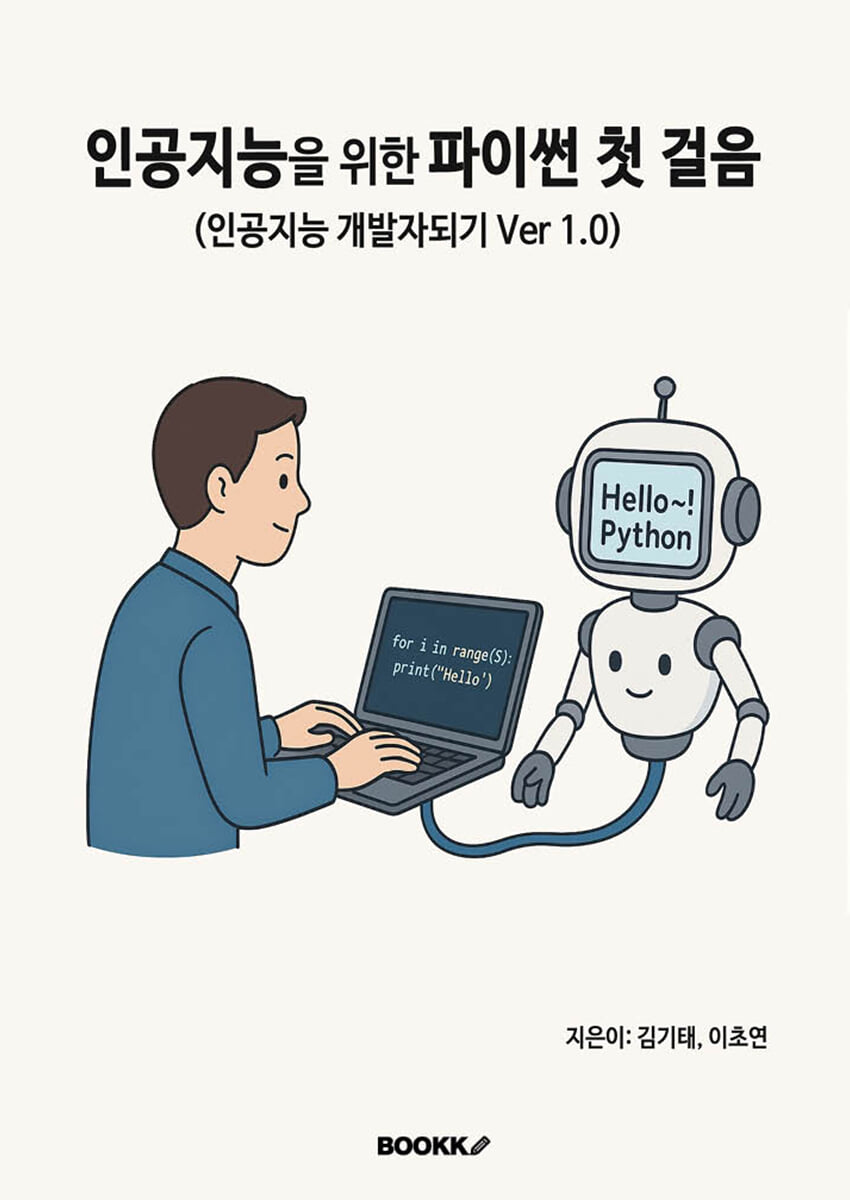
First Steps in Python for AI
 |
Description
Book Introduction
This textbook is designed to cover a wide range of topics, from beginners to data analysis and artificial intelligence applications.
Chapter 1 introduces the features and advantages of Python, and covers download and installation methods, VS Code environment setup, and package management to help learners fully prepare for development.
Chapter 2 explains basic data concepts such as variables, numbers, logical values, strings, input and output, and lays the foundation for writing actual programs.
Chapter 3 develops efficient data management and algorithm implementation skills through data structures such as lists, tuples, sets, and dictionaries, and collections such as stacks, queues, and decks.
In Chapter 4, you will learn conditional statements, loops, nested statements, and frequently used algorithms to develop logical problem-solving skills.
In Chapter 5, you will learn about modularization, built-in functions, and how to use libraries, focusing on the concepts of functions and classes, and experience Python-style programming.
Chapter 6 covers exception handling and how to process text, Excel, pickle, and JSON files, designed to help you learn data input/output techniques frequently needed in practice.
In Chapter 7, you will learn the basics of data analysis and visualization by practicing with representative external libraries such as Numpy, Pandas, Matplotlib, Seaborn, and OpenCV.
Chapter 8 guides you through the natural language processing unit, covering text preprocessing, tokenization, stopword removal, stem and title extraction, part-of-speech tagging, vectorization, embedding techniques, and even the latest transformer model, helping you expand into the field of artificial intelligence.
Finally, the appendix provides comprehensive materials that students can immediately apply in practice, including basic Python grammar, useful libraries, and cheat sheets for web frameworks such as Django, Flask, and FastAPI.
This book offers a systematic, connected learning journey from basics to practical training and cutting-edge applications, making it an ideal guide for developing diverse Python programming projects and data-driven problem-solving skills.
Chapter 1 introduces the features and advantages of Python, and covers download and installation methods, VS Code environment setup, and package management to help learners fully prepare for development.
Chapter 2 explains basic data concepts such as variables, numbers, logical values, strings, input and output, and lays the foundation for writing actual programs.
Chapter 3 develops efficient data management and algorithm implementation skills through data structures such as lists, tuples, sets, and dictionaries, and collections such as stacks, queues, and decks.
In Chapter 4, you will learn conditional statements, loops, nested statements, and frequently used algorithms to develop logical problem-solving skills.
In Chapter 5, you will learn about modularization, built-in functions, and how to use libraries, focusing on the concepts of functions and classes, and experience Python-style programming.
Chapter 6 covers exception handling and how to process text, Excel, pickle, and JSON files, designed to help you learn data input/output techniques frequently needed in practice.
In Chapter 7, you will learn the basics of data analysis and visualization by practicing with representative external libraries such as Numpy, Pandas, Matplotlib, Seaborn, and OpenCV.
Chapter 8 guides you through the natural language processing unit, covering text preprocessing, tokenization, stopword removal, stem and title extraction, part-of-speech tagging, vectorization, embedding techniques, and even the latest transformer model, helping you expand into the field of artificial intelligence.
Finally, the appendix provides comprehensive materials that students can immediately apply in practice, including basic Python grammar, useful libraries, and cheat sheets for web frameworks such as Django, Flask, and FastAPI.
This book offers a systematic, connected learning journey from basics to practical training and cutting-edge applications, making it an ideal guide for developing diverse Python programming projects and data-driven problem-solving skills.
index
Chapter 1: Python Overview and Development Environment Setup
1.1 Python Overview 7
1.2 Download and install Python 12
1.3 Download and install VS Code 16
1.4 Setting up the VS Code Python Development Environment 21
1.5 Package Management and Application Running 25
Chapter 2 Variables and Data
2.1 Meaning and Concept of Variables + 33
2.2 Handling Numbers 39
2.3 Handling Logical Values 45
2.4 Handling Strings 49
2.5 Handling Output Statements 55
2.6 Handling Input Statements 60
Chapter 3 Data Structures (Collection Framework)
3.1 List 69
3.2 Tuple 76
3.3 Set 82
3.4 Dictionary 88
3.5 Stack, Queue, and Deque 95
Chapter 4 Control Statements
4.1 Other Operations 107
4.2 Conditional Statements 111
4.3 Loop 120
4.4 Inner sentence 129
4.5 Key Algorithms 136
Chapter 5 Functions and Classes
5.1 Function 149
5.2 Class 154
5.3 Modularization 161
5.4 Using Built-in Functions 168
5.5 Using Built-in Libraries 177
Chapter 6 Exception Handling and File Handling
6.1 Exception Handling 189
6.2 Text File Processing 194
6.3 Excel File Processing 199
6.4 Pickle File Processing 205
6.5 JSON File Processing 211
Chapter 7 External Libraries
7.1 Numpy 221
7.2 Pandas 226
7.3 Matplotlib 235
7.4 Seaborn 247
7.5 OpenCV 257
Chapter 8 Artificial Intelligence Natural Language Processing
8.1 Preprocessing Text Data 267
8.2 Tokenization 273
8.3 Stopword Removal 279
8.4 Stemming and Lemmatization 285
8.5 POS Tagging 291
8.6 Text Vectorization 299
8.7 Word Embedding (Word2Vec, FastText, GloVe) 304
8.8 Advanced Natural Language Processing (BERT, GPT, Transformers) 309
supplement.
Cheat Sheet Collection
Appendix A.
Python Cheat Sheet 320
Appendix B.
Python Web Framework Cheat Sheet 322
1.1 Python Overview 7
1.2 Download and install Python 12
1.3 Download and install VS Code 16
1.4 Setting up the VS Code Python Development Environment 21
1.5 Package Management and Application Running 25
Chapter 2 Variables and Data
2.1 Meaning and Concept of Variables + 33
2.2 Handling Numbers 39
2.3 Handling Logical Values 45
2.4 Handling Strings 49
2.5 Handling Output Statements 55
2.6 Handling Input Statements 60
Chapter 3 Data Structures (Collection Framework)
3.1 List 69
3.2 Tuple 76
3.3 Set 82
3.4 Dictionary 88
3.5 Stack, Queue, and Deque 95
Chapter 4 Control Statements
4.1 Other Operations 107
4.2 Conditional Statements 111
4.3 Loop 120
4.4 Inner sentence 129
4.5 Key Algorithms 136
Chapter 5 Functions and Classes
5.1 Function 149
5.2 Class 154
5.3 Modularization 161
5.4 Using Built-in Functions 168
5.5 Using Built-in Libraries 177
Chapter 6 Exception Handling and File Handling
6.1 Exception Handling 189
6.2 Text File Processing 194
6.3 Excel File Processing 199
6.4 Pickle File Processing 205
6.5 JSON File Processing 211
Chapter 7 External Libraries
7.1 Numpy 221
7.2 Pandas 226
7.3 Matplotlib 235
7.4 Seaborn 247
7.5 OpenCV 257
Chapter 8 Artificial Intelligence Natural Language Processing
8.1 Preprocessing Text Data 267
8.2 Tokenization 273
8.3 Stopword Removal 279
8.4 Stemming and Lemmatization 285
8.5 POS Tagging 291
8.6 Text Vectorization 299
8.7 Word Embedding (Word2Vec, FastText, GloVe) 304
8.8 Advanced Natural Language Processing (BERT, GPT, Transformers) 309
supplement.
Cheat Sheet Collection
Appendix A.
Python Cheat Sheet 320
Appendix B.
Python Web Framework Cheat Sheet 322
GOODS SPECIFICS
- Date of issue: October 13, 2025
- Page count, weight, size: 324 pages | 182*257*30mm
- ISBN13: 9791112070982
You may also like
카테고리
korean


korean

![GQ KOREA Mark (Monthly): December [2025]](http://librairie.coreenne.fr/cdn/shop/files/8ef265dbbfbf186523ed75ba7319009d.jpg?v=1765340328&width=3840)


