

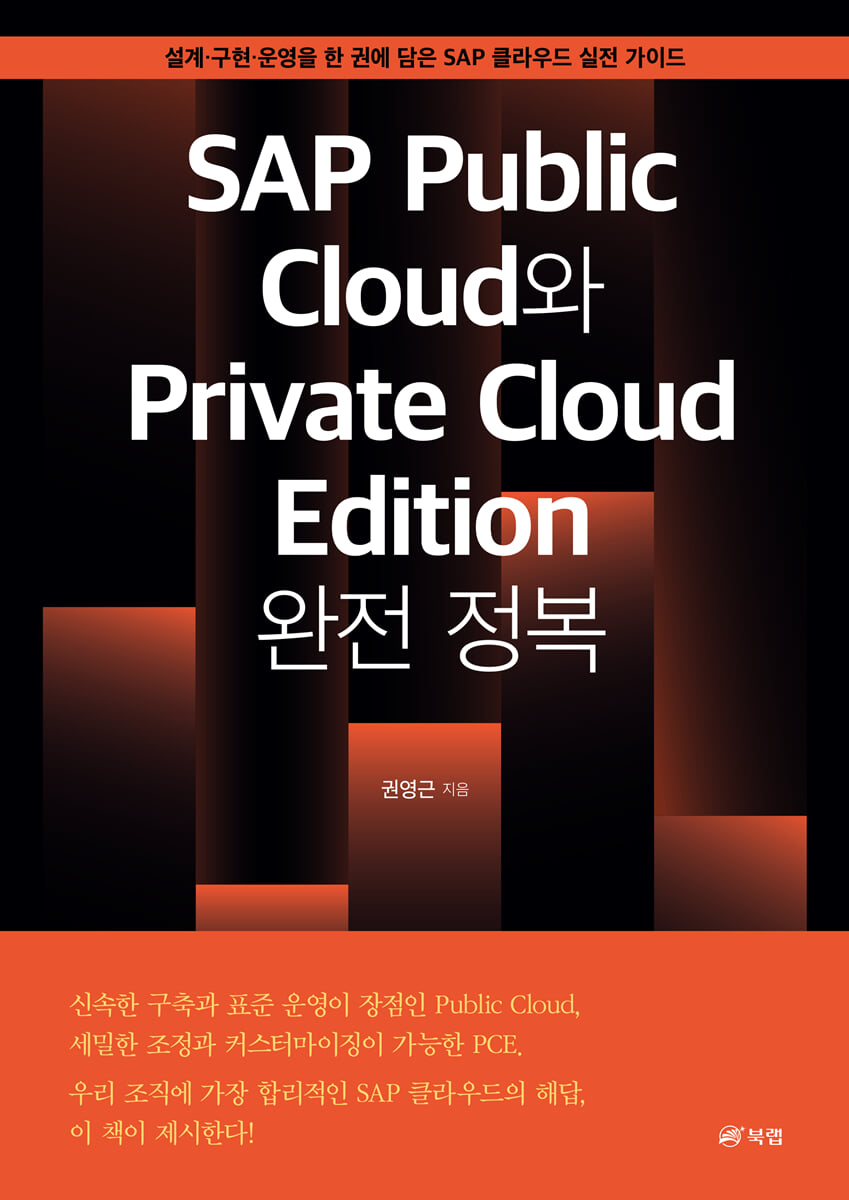
Mastering SAP Public Cloud and Private Cloud Editions
 |
Description
Book Introduction
Public Cloud, which has the advantage of rapid construction and standard operation.
PCE with fine tuning and customization.
The most reasonable SAP Cloud solution for our organization,
This book presents!
Public or Private: Which Cloud is Right for Your Business?
Cloud transformation isn't about technology; it's about redesigning your business!
A suggestion for companies that are lost in the face of SAP cloud transformation
Standards for fail-safe selection and execution
For decades, SAP ERP has served as the core operating system for global enterprises, setting the standard for corporate operations. Evolving from the era of SAP R/3 and ECC to the in-memory database HANA and today's S/4HANA cloud, SAP has gone beyond technological innovation to transform business paradigms.
Cloud migration is no longer simply a change in IT infrastructure; it is a strategic turning point that redefines a company's business model and sustainability.
PCE with fine tuning and customization.
The most reasonable SAP Cloud solution for our organization,
This book presents!
Public or Private: Which Cloud is Right for Your Business?
Cloud transformation isn't about technology; it's about redesigning your business!
A suggestion for companies that are lost in the face of SAP cloud transformation
Standards for fail-safe selection and execution
For decades, SAP ERP has served as the core operating system for global enterprises, setting the standard for corporate operations. Evolving from the era of SAP R/3 and ECC to the in-memory database HANA and today's S/4HANA cloud, SAP has gone beyond technological innovation to transform business paradigms.
Cloud migration is no longer simply a change in IT infrastructure; it is a strategic turning point that redefines a company's business model and sustainability.
- You can preview some of the book's contents.
Preview
index
preface
Chapter 1. The History and Technological Evolution of SAP ERP
1.1 R/2 era
1.2 The emergence of R/3
1.3 ECC Era (2004–2015)
1.4 HANA and S/4HANA Era
1.5 Cloud Transition in the 2000s
Chapter 2. SAP Global Roadmap
2.1 Business Model Transformation
2.2 Technological Innovation
2.3 Sustainability Roadmap
SAP Global Roadmap Appendix A & B: Decision-Making Checklist and Comparative Analysis
[Appendix A] Decision-Making Checklist
- Business Model: Choosing RISE vs. GROW
- Industrial Strategy: Suitability of Industry Cloud and BTP-based expansion
- Technology Selection: Joule, Integration Suite, Event Mesh Application Priority
- Sustainability: Timing of Green Ledger and SCT adoption and compliance enforcement
[Appendix B] Sample Comparison Table
- Contract Model: RISE vs GROW
Industry Expansion: Industry Cloud vs. Traditional Custom Development
Technology Strategy: Joule/AI vs. API-first/EDA
ESG Management: Green Ledger vs. SCT + CSRD Response
Chapter 3.
Comparing Public Cloud and PCE
3.1 Architecture
3.2 Distribution and Implementation Methods
3.3 Upgrade Policy
3.4 Scalability
3.5 Functional Scope
3.6 Operations and Costs
3.7 Security and Compliance
3.8 Performance and System Scalability
3.9 Implementation Approach
3.10 Selection Considerations and Targets
Chapter 4.
Migration Strategy
4.1 Greenfield
4.2 Brownfield
4.3 Selective Data Transition
4.4 Data Migration
4.5 Testing Strategy
4.6 Fit-to-Standard Workshop Procedure
Chapter 5.
Advanced Technology Topics
5.1. CDS View and ABAP RESTful
5.2.
Event Integration with Event Mesh
5.3. BTP Integration Suite
5.4. SAP Build Governance
5.5.
Test Automation Strategy
5.6. HANA Performance Tuning
References
Chapter 1. The History and Technological Evolution of SAP ERP
1.1 R/2 era
1.2 The emergence of R/3
1.3 ECC Era (2004–2015)
1.4 HANA and S/4HANA Era
1.5 Cloud Transition in the 2000s
Chapter 2. SAP Global Roadmap
2.1 Business Model Transformation
2.2 Technological Innovation
2.3 Sustainability Roadmap
SAP Global Roadmap Appendix A & B: Decision-Making Checklist and Comparative Analysis
[Appendix A] Decision-Making Checklist
- Business Model: Choosing RISE vs. GROW
- Industrial Strategy: Suitability of Industry Cloud and BTP-based expansion
- Technology Selection: Joule, Integration Suite, Event Mesh Application Priority
- Sustainability: Timing of Green Ledger and SCT adoption and compliance enforcement
[Appendix B] Sample Comparison Table
- Contract Model: RISE vs GROW
Industry Expansion: Industry Cloud vs. Traditional Custom Development
Technology Strategy: Joule/AI vs. API-first/EDA
ESG Management: Green Ledger vs. SCT + CSRD Response
Chapter 3.
Comparing Public Cloud and PCE
3.1 Architecture
3.2 Distribution and Implementation Methods
3.3 Upgrade Policy
3.4 Scalability
3.5 Functional Scope
3.6 Operations and Costs
3.7 Security and Compliance
3.8 Performance and System Scalability
3.9 Implementation Approach
3.10 Selection Considerations and Targets
Chapter 4.
Migration Strategy
4.1 Greenfield
4.2 Brownfield
4.3 Selective Data Transition
4.4 Data Migration
4.5 Testing Strategy
4.6 Fit-to-Standard Workshop Procedure
Chapter 5.
Advanced Technology Topics
5.1. CDS View and ABAP RESTful
5.2.
Event Integration with Event Mesh
5.3. BTP Integration Suite
5.4. SAP Build Governance
5.5.
Test Automation Strategy
5.6. HANA Performance Tuning
References
Into the book
Public Cloud Edition (S/4HANA Cloud): S/4HANA is a multi-tenant SaaS model operated by SAP.
Although instances or tenants are separate for each customer, they basically use the same codeline, and SAP applies new feature updates to all customers on a quarterly basis.
The public cloud version has a somewhat limited functional scope compared to the on-premises version (especially industry-specific functions), and expansion is also limited to in-app.
However, because it's available on a subscription basis and SAP manages infrastructure and backups, customers can use ERP with a small initial investment and simple operation. SAP recommends the public cloud to mid-sized companies and those with a high adoption rate of standardized processes.
As part of its future strategy, SAP plans to prioritize the deployment of the latest innovations in the public cloud and rapidly deliver AI scenarios and business network integration.
--- p.150
Meanwhile, the EU Carbon Border Adjustment (CBAM) has emerged as a prime example of trade regulations aimed at combating climate change. CBAM is a mechanism that imposes a carbon cost equivalent to the EU's domestic carbon cost on certain carbon-intensive products produced outside the EU and exported to the EU.
The CBAM regulation, which came into effect in October 2023, aligns with the EU Emissions Trading Scheme (ETS) and puts a price on greenhouse gas emissions produced during the production of imported goods from carbon-intensive sectors such as cement, steel, aluminum, fertilizer, power, and hydrogen.
This is intended to prevent so-called carbon leakage – the phenomenon of shifting production to areas without strict carbon regulations, thereby reducing the overall global emissions reduction effect – and to create a “level playing field” between EU and non-EU companies. CBAM will be a transitional period from 2023 to 2025, during which importers will only submit quarterly reports on the carbon emissions of imported goods (at no actual cost). From 2026, they will have to purchase and submit CBAM certificates corresponding to the reported emissions, thereby bearing the actual cost.
--- p.300
Security vulnerabilities are likely to arise during hybrid integration or external linkages.
For example, if you test an API in a development environment without authentication and forget to apply it to production, there is a high risk of exposure.
Additionally, multiple system accounts (ID/PW) may be leaked if stored in plain text within iFlow.
To prevent this, create a security inspection checklist and ensure that authentication/authorization is applied, confidential information is encrypted/masked, and unnecessary endpoints are blocked before deployment.
If an interface with weak security is already in operation, first set up firewall rules or IP restrictions at the gateway level and quickly improve the interface.
For example, add token authentication to exposed APIs and move credentials to a Secure Store and encrypt them.
Although instances or tenants are separate for each customer, they basically use the same codeline, and SAP applies new feature updates to all customers on a quarterly basis.
The public cloud version has a somewhat limited functional scope compared to the on-premises version (especially industry-specific functions), and expansion is also limited to in-app.
However, because it's available on a subscription basis and SAP manages infrastructure and backups, customers can use ERP with a small initial investment and simple operation. SAP recommends the public cloud to mid-sized companies and those with a high adoption rate of standardized processes.
As part of its future strategy, SAP plans to prioritize the deployment of the latest innovations in the public cloud and rapidly deliver AI scenarios and business network integration.
--- p.150
Meanwhile, the EU Carbon Border Adjustment (CBAM) has emerged as a prime example of trade regulations aimed at combating climate change. CBAM is a mechanism that imposes a carbon cost equivalent to the EU's domestic carbon cost on certain carbon-intensive products produced outside the EU and exported to the EU.
The CBAM regulation, which came into effect in October 2023, aligns with the EU Emissions Trading Scheme (ETS) and puts a price on greenhouse gas emissions produced during the production of imported goods from carbon-intensive sectors such as cement, steel, aluminum, fertilizer, power, and hydrogen.
This is intended to prevent so-called carbon leakage – the phenomenon of shifting production to areas without strict carbon regulations, thereby reducing the overall global emissions reduction effect – and to create a “level playing field” between EU and non-EU companies. CBAM will be a transitional period from 2023 to 2025, during which importers will only submit quarterly reports on the carbon emissions of imported goods (at no actual cost). From 2026, they will have to purchase and submit CBAM certificates corresponding to the reported emissions, thereby bearing the actual cost.
--- p.300
Security vulnerabilities are likely to arise during hybrid integration or external linkages.
For example, if you test an API in a development environment without authentication and forget to apply it to production, there is a high risk of exposure.
Additionally, multiple system accounts (ID/PW) may be leaked if stored in plain text within iFlow.
To prevent this, create a security inspection checklist and ensure that authentication/authorization is applied, confidential information is encrypted/masked, and unnecessary endpoints are blocked before deployment.
If an interface with weak security is already in operation, first set up firewall rules or IP restrictions at the gateway level and quickly improve the interface.
For example, add token authentication to exposed APIs and move credentials to a Secure Store and encrypt them.
--- p.500
Publisher's Review
In "Complete Mastery of SAP Public Cloud and Private Cloud Edition," we provide an in-depth comparison of the architecture, scalability, upgrades, cost structure, and operational strategies of SAP S/4HANA's Public Cloud and Private Cloud Edition (PCE).
By analyzing the standardized agility of Public Cloud and the flexible customization capabilities of P CE, we provide clear criteria for companies to choose a cloud path.
It also covers a wide range of core technologies required for practical applications, including transition strategies such as Greenfield, Brownfield, and Selective Data Transition, as well as data migration, testing, and performance and security management.
In particular, the author presents new possibilities for AI-based business innovation and integrated ESG management through SAP's latest innovations, Joule AI and Green Ledger.
Joule AI will enhance usability and automation with its natural language-based digital assistant, while Green Ledger will gradually expand its scope to integrate financial and environmental data to meet global sustainability reporting standards such as the CSRD.
This book, designed for IT professionals, consultants, and business leaders alike, views SAP Cloud migration as a core strategy for digital transformation and is a comprehensive guide covering the entire process, from strategy development to technology implementation and operations. It is a must-read for anyone seeking to view SAP migration not simply as an IT project but as a core strategy for corporate digital transformation.
By analyzing the standardized agility of Public Cloud and the flexible customization capabilities of P CE, we provide clear criteria for companies to choose a cloud path.
It also covers a wide range of core technologies required for practical applications, including transition strategies such as Greenfield, Brownfield, and Selective Data Transition, as well as data migration, testing, and performance and security management.
In particular, the author presents new possibilities for AI-based business innovation and integrated ESG management through SAP's latest innovations, Joule AI and Green Ledger.
Joule AI will enhance usability and automation with its natural language-based digital assistant, while Green Ledger will gradually expand its scope to integrate financial and environmental data to meet global sustainability reporting standards such as the CSRD.
This book, designed for IT professionals, consultants, and business leaders alike, views SAP Cloud migration as a core strategy for digital transformation and is a comprehensive guide covering the entire process, from strategy development to technology implementation and operations. It is a must-read for anyone seeking to view SAP migration not simply as an IT project but as a core strategy for corporate digital transformation.
GOODS SPECIFICS
- Date of issue: October 20, 2025
- Page count, weight, size: 542 pages | Checking size
- ISBN13: 9791172249250
- ISBN10: 1172249253
You may also like
카테고리
korean


korean

![GQ KOREA Mark (Monthly): December [2025]](http://librairie.coreenne.fr/cdn/shop/files/8ef265dbbfbf186523ed75ba7319009d.jpg?v=1765340328&width=3840)


