

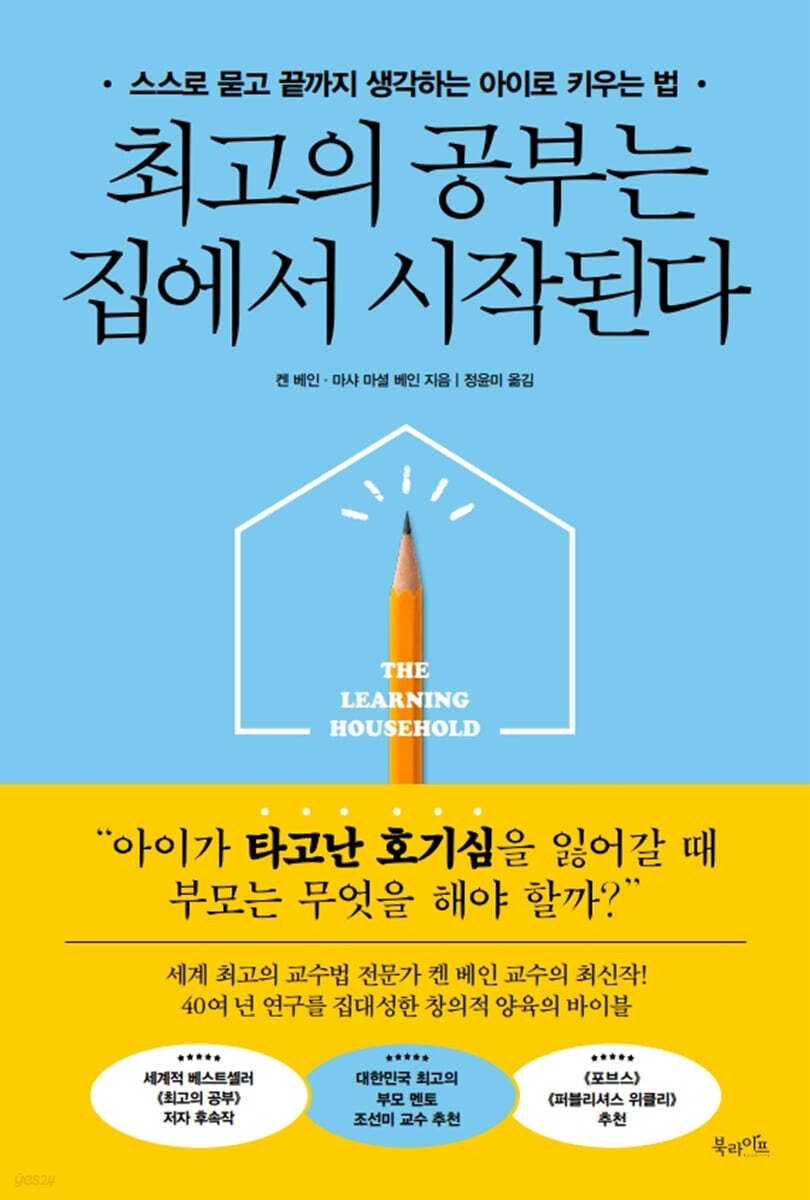
The best learning begins at home.
 |
Description
Book Introduction
“Become a ‘submarine parent’ who watches over your child’s adventures.
“Real learning begins at home!”
Final Insights from Ken Bain, the World's Leading Teaching Expert
Professor Ken Bain, one of the world's leading teaching experts and a professor most respected by professors and students at prestigious universities, has published his latest book, "The Best Learning Begins at Home."
This book is the culmination of his lifelong research journey into the essence of education and learning, and is a heartwarming suggestion to all parents.
Based on hundreds of interviews with parents and educators and the latest learning psychology research, this book offers a variety of parenting solutions that can help children develop a growth mindset and a curiosity-driven, exploratory learning attitude.
Children are 'learners' who learn everything new from the moment they are born and have a constant desire to learn.
However, many children fail to pursue their natural curiosity and passion, and become bored at school or lose interest in learning.
What can parents do to rekindle their children's curiosity for learning? What role can they play in helping their children realize their potential? In this book, the author emphasizes that the best education begins at home and provides specific guidance on how to support children in understanding the world and developing the ability to think independently.
"The Best Study Begins at Home" is not a manual for better teaching of children, but rather a book that guides parents on how to view and help their children.
It will serve as a wise guide for all parents who want to raise children who know the joy of learning through daily conversation and attitude.
“Real learning begins at home!”
Final Insights from Ken Bain, the World's Leading Teaching Expert
Professor Ken Bain, one of the world's leading teaching experts and a professor most respected by professors and students at prestigious universities, has published his latest book, "The Best Learning Begins at Home."
This book is the culmination of his lifelong research journey into the essence of education and learning, and is a heartwarming suggestion to all parents.
Based on hundreds of interviews with parents and educators and the latest learning psychology research, this book offers a variety of parenting solutions that can help children develop a growth mindset and a curiosity-driven, exploratory learning attitude.
Children are 'learners' who learn everything new from the moment they are born and have a constant desire to learn.
However, many children fail to pursue their natural curiosity and passion, and become bored at school or lose interest in learning.
What can parents do to rekindle their children's curiosity for learning? What role can they play in helping their children realize their potential? In this book, the author emphasizes that the best education begins at home and provides specific guidance on how to support children in understanding the world and developing the ability to think independently.
"The Best Study Begins at Home" is not a manual for better teaching of children, but rather a book that guides parents on how to view and help their children.
It will serve as a wise guide for all parents who want to raise children who know the joy of learning through daily conversation and attitude.
- You can preview some of the book's contents.
Preview
index
Recommendation
Praise for this book
Introduction
Chapter 1: How to Get Children Curious Again
The Science of Motivation
-What are basic needs? / How to get them interested again
When it's time to enter school
- Unexpected Problems / How Great Teachers Act / Every Moment Is a Learning Opportunity
How to Arouse Curiosity with Questions
-What more can you learn at school / If your child doesn't step up on his own
◆Think more
Chapter 2: How to Help Children Deal Wisely with Success and Failure
Growth Mindset Approach
-What is a growth mindset? / Things you can't know until you experience them / Children who create their own limitations / Differences in thinking about intelligence
How did the IQ test come about?
How Praise Becomes Poison / The Belief That Children Can Grow Changes Their Attitudes
Innate ability doesn't determine everything.
-Turn failure into a learning opportunity
Learn to learn
How We Understand the World / We All Live in Our Own World / Can Intelligence Be Increased? / Exercises to Change Stereotypes About Intelligence
◆Think more
Chapter 3: Creating a Home Where Learning Grows
The Power of Parents to Discover Their Children's Passions
Passion breeds passion / A child fascinated by conversations about nature / What excessive perfectionism brings / Children's hands-on experience / The joy of learning found in flowers
To have diverse and rich thoughts
How to Think While Having Fun / How Philosophical Thinking Begins / Philosophy for Children with Children / Thinking Training You Can Do at Home / Sandel's Teaching Method That Changed Students' Lives
Chapter 4: Raising a Creative Child
How to Develop a Creative Mindset
-All creation comes from within / Language that fosters creativity / Five pieces to inspire creativity
Creating an environment that fosters creativity
-Every experience becomes a child's path / The more you see, the more you discover
Creative decision-making process
Physical activity improves thinking skills
◆Think more
Chapter 5: To help you do deep learning
Superficial Learning Mindset vs. Deep Learning Mindset
- Distinguishing between superficial and deep learning / The pitfalls of strategic learning / Children who ask questions themselves / The moment when deep learning occurs / How to develop deep learning skills
The Role of Parents in Enabling Deep Learning
Study Methods for In-Depth Study
Connect and connect again / Question and test / Reason freely / Passion is essential / Practice retrieval instead of memorization / Learn over time / Try cross-learning / Use mindfulness
How to apply what we've learned so far to your child's studies
-To introduce project-based learning to schools
◆Think more
Chapter 6: How to Prepare for the Real Difficulties You'll Face at School
Smart Ways to Deal with Perfectionism
Is more time with children always better? / The pandemic's impact on perfectionism / Children can achieve perfection without pressure.
What Parents Should Do When Their Child Is Being Bullied
The Role of Parents and Schools / What Social Psychologists Suggest / The Power of Active Learning / Zero Tolerance Policies Don't Work / The Effects of Gratitude Journals
How to Protect Your Child from Prejudice and Discrimination
Diversity benefits us all / Changing a child's perspective through dialogue and communication
Chapter 7: How to Get a Higher Education That Will Help You in Life
Is STEM the only thing that matters?
Liberal arts education that enriches children's lives
Things not to miss in college
The child always has the initiative to make choices.
How to Choose a Great Professor and Course / How to Judge a Good Class / Everything Must Start with a Question
Grades can be important feedback
-The nightmare created by grades
◆Think more
Acknowledgements
main
Praise for this book
Introduction
Chapter 1: How to Get Children Curious Again
The Science of Motivation
-What are basic needs? / How to get them interested again
When it's time to enter school
- Unexpected Problems / How Great Teachers Act / Every Moment Is a Learning Opportunity
How to Arouse Curiosity with Questions
-What more can you learn at school / If your child doesn't step up on his own
◆Think more
Chapter 2: How to Help Children Deal Wisely with Success and Failure
Growth Mindset Approach
-What is a growth mindset? / Things you can't know until you experience them / Children who create their own limitations / Differences in thinking about intelligence
How did the IQ test come about?
How Praise Becomes Poison / The Belief That Children Can Grow Changes Their Attitudes
Innate ability doesn't determine everything.
-Turn failure into a learning opportunity
Learn to learn
How We Understand the World / We All Live in Our Own World / Can Intelligence Be Increased? / Exercises to Change Stereotypes About Intelligence
◆Think more
Chapter 3: Creating a Home Where Learning Grows
The Power of Parents to Discover Their Children's Passions
Passion breeds passion / A child fascinated by conversations about nature / What excessive perfectionism brings / Children's hands-on experience / The joy of learning found in flowers
To have diverse and rich thoughts
How to Think While Having Fun / How Philosophical Thinking Begins / Philosophy for Children with Children / Thinking Training You Can Do at Home / Sandel's Teaching Method That Changed Students' Lives
Chapter 4: Raising a Creative Child
How to Develop a Creative Mindset
-All creation comes from within / Language that fosters creativity / Five pieces to inspire creativity
Creating an environment that fosters creativity
-Every experience becomes a child's path / The more you see, the more you discover
Creative decision-making process
Physical activity improves thinking skills
◆Think more
Chapter 5: To help you do deep learning
Superficial Learning Mindset vs. Deep Learning Mindset
- Distinguishing between superficial and deep learning / The pitfalls of strategic learning / Children who ask questions themselves / The moment when deep learning occurs / How to develop deep learning skills
The Role of Parents in Enabling Deep Learning
Study Methods for In-Depth Study
Connect and connect again / Question and test / Reason freely / Passion is essential / Practice retrieval instead of memorization / Learn over time / Try cross-learning / Use mindfulness
How to apply what we've learned so far to your child's studies
-To introduce project-based learning to schools
◆Think more
Chapter 6: How to Prepare for the Real Difficulties You'll Face at School
Smart Ways to Deal with Perfectionism
Is more time with children always better? / The pandemic's impact on perfectionism / Children can achieve perfection without pressure.
What Parents Should Do When Their Child Is Being Bullied
The Role of Parents and Schools / What Social Psychologists Suggest / The Power of Active Learning / Zero Tolerance Policies Don't Work / The Effects of Gratitude Journals
How to Protect Your Child from Prejudice and Discrimination
Diversity benefits us all / Changing a child's perspective through dialogue and communication
Chapter 7: How to Get a Higher Education That Will Help You in Life
Is STEM the only thing that matters?
Liberal arts education that enriches children's lives
Things not to miss in college
The child always has the initiative to make choices.
How to Choose a Great Professor and Course / How to Judge a Good Class / Everything Must Start with a Question
Grades can be important feedback
-The nightmare created by grades
◆Think more
Acknowledgements
main
Detailed image

Into the book
When children take charge of their own play and play freely without adult intervention, what they gain is enormous.
Psychologist Peter Gray has studied the positive effects of this type of play.
He argues that:
“Play is the primary means by which children develop their inner interests and capabilities.”
The benefits of play don't end there.
When children gather outdoors and create their own games and set their own rules, they learn to “make decisions, solve problems, develop self-control, and follow rules.”
And while playing freely, they “develop the ability to regulate their emotions, make friends, learn to get along with others equally, and experience pure joy.”
--- p.20, from “Introduction”
Our first suggestion is to not focus solely on grades.
Rather than focusing on grades, you should focus on the joy and excitement of learning new things.
Some excellent schools don't grade students for the first five or six years after admission.
If your child's school doesn't do this, you need to step up and show them that you enjoy learning itself.
Ask your child what interests them, what subjects they like best, or encourage them to discover and explore their own interests.
You can also spark their imagination with questions like, “If you could fly anywhere on a magic carpet, where would you go?”
Talk casually about math or history over dinner, or show enthusiasm and interest in what they're learning in school, and ask why they think that way and what evidence they have.
However, an atmosphere of pressure should not be created, as if questioning a witness.
It's a good idea to make conversations with your parents a fun experience and always conduct them with a smile, as if playing a game or playing a game.
--- p.59, from “Chapter 1: How to Make Children Curious Again”
Everyone has failed at something important at some point, and this experience can not only be frustrating but can also dampen your motivation to try new challenges.
Then, the scope of inquiry in which you can use your intellectual abilities becomes increasingly narrow, and you may end up feeling helpless, overwhelmed by excessive self-doubt and negativity.
Even once-successful students can become overwhelmed by anxiety and become discouraged, and while they may appear confident on the outside, they may harbor self-doubts deep inside.
In this psychological state, it is not easy to do your best in schoolwork.
Dweck isn't arguing that learners should overestimate their intelligence or that positive statements on posters and mugs should motivate them to try harder.
Dweck emphasized that we need to fundamentally change our perspective on how talent and ability develop through experience.
--- p.99~100, from “Chapter 2 How Children Can Wisely Deal with Success and Failure”
Professor Paul Baker, known as an expert in creative education, used to say this during his lectures.
“Understand and become familiar with how your mind and imagination work, the flow of ideas that emerge.
“Think carefully about what time of day you focus best and what tasks or objects motivate you.”
To create a home environment that values learning, you must help your child discover his or her inner potential.
We must boldly discard outdated and outdated ideas and encourage the development or better use of original, beautiful, and useful ones.
And involve your child in household chores.
For example, you can have them help you with tasks such as cooking, grocery shopping, cleaning, meal preparation, dusting, mowing the lawn, gardening, and planting flowers.
--- p.154, from “Chapter 3: Creating a Home Where Learning Grows”
We can all learn from each other.
Every experience can be a source of learning for someone else.
Great ideas emerge and creative development occurs when people share and understand diverse perspectives.
Likewise, individual creativity can grow explosively when we experience diverse perspectives and cultivate them as nourishment for our minds.
That doesn't mean all ideas are equally good.
Rather, it means that making decisions that require careful and deep reflection is very difficult, but everyone can help with that.
--- p.196, from “Chapter 4: Raising a Creative Child”
Unlike superficial learners, deep learners intentionally listen to opinions that contradict their own.
They are very interested in developing their intellectual abilities.
I'm constantly learning new things, and when I come across a good idea or piece of information, I try to figure out how to use it in a new way.
I try to integrate everything I come across and see how different ideas connect and differ from one another.
And they are accustomed to re-examining their thinking, constantly exploring the possibility that they might be wrong.
Psychologist Peter Gray has studied the positive effects of this type of play.
He argues that:
“Play is the primary means by which children develop their inner interests and capabilities.”
The benefits of play don't end there.
When children gather outdoors and create their own games and set their own rules, they learn to “make decisions, solve problems, develop self-control, and follow rules.”
And while playing freely, they “develop the ability to regulate their emotions, make friends, learn to get along with others equally, and experience pure joy.”
--- p.20, from “Introduction”
Our first suggestion is to not focus solely on grades.
Rather than focusing on grades, you should focus on the joy and excitement of learning new things.
Some excellent schools don't grade students for the first five or six years after admission.
If your child's school doesn't do this, you need to step up and show them that you enjoy learning itself.
Ask your child what interests them, what subjects they like best, or encourage them to discover and explore their own interests.
You can also spark their imagination with questions like, “If you could fly anywhere on a magic carpet, where would you go?”
Talk casually about math or history over dinner, or show enthusiasm and interest in what they're learning in school, and ask why they think that way and what evidence they have.
However, an atmosphere of pressure should not be created, as if questioning a witness.
It's a good idea to make conversations with your parents a fun experience and always conduct them with a smile, as if playing a game or playing a game.
--- p.59, from “Chapter 1: How to Make Children Curious Again”
Everyone has failed at something important at some point, and this experience can not only be frustrating but can also dampen your motivation to try new challenges.
Then, the scope of inquiry in which you can use your intellectual abilities becomes increasingly narrow, and you may end up feeling helpless, overwhelmed by excessive self-doubt and negativity.
Even once-successful students can become overwhelmed by anxiety and become discouraged, and while they may appear confident on the outside, they may harbor self-doubts deep inside.
In this psychological state, it is not easy to do your best in schoolwork.
Dweck isn't arguing that learners should overestimate their intelligence or that positive statements on posters and mugs should motivate them to try harder.
Dweck emphasized that we need to fundamentally change our perspective on how talent and ability develop through experience.
--- p.99~100, from “Chapter 2 How Children Can Wisely Deal with Success and Failure”
Professor Paul Baker, known as an expert in creative education, used to say this during his lectures.
“Understand and become familiar with how your mind and imagination work, the flow of ideas that emerge.
“Think carefully about what time of day you focus best and what tasks or objects motivate you.”
To create a home environment that values learning, you must help your child discover his or her inner potential.
We must boldly discard outdated and outdated ideas and encourage the development or better use of original, beautiful, and useful ones.
And involve your child in household chores.
For example, you can have them help you with tasks such as cooking, grocery shopping, cleaning, meal preparation, dusting, mowing the lawn, gardening, and planting flowers.
--- p.154, from “Chapter 3: Creating a Home Where Learning Grows”
We can all learn from each other.
Every experience can be a source of learning for someone else.
Great ideas emerge and creative development occurs when people share and understand diverse perspectives.
Likewise, individual creativity can grow explosively when we experience diverse perspectives and cultivate them as nourishment for our minds.
That doesn't mean all ideas are equally good.
Rather, it means that making decisions that require careful and deep reflection is very difficult, but everyone can help with that.
--- p.196, from “Chapter 4: Raising a Creative Child”
Unlike superficial learners, deep learners intentionally listen to opinions that contradict their own.
They are very interested in developing their intellectual abilities.
I'm constantly learning new things, and when I come across a good idea or piece of information, I try to figure out how to use it in a new way.
I try to integrate everything I come across and see how different ideas connect and differ from one another.
And they are accustomed to re-examining their thinking, constantly exploring the possibility that they might be wrong.
--- p.237, from “Chapter 5: Helping You Learn Deeper”
Publisher's Review
“The moment you become a ‘creator’ rather than a ‘consumer’ of knowledge,
“The child’s world changes completely.”
In the AI era, what should we teach and how should we help them grow?
The world today is changing at a pace that previous generations have never experienced.
In an age where technology replaces the role of storing knowledge and performing calculations, what is needed more than what one knows is an attitude of 'continuous learning and intellectual curiosity.'
The World Economic Forum (WEF) also selected “the ability to redefine problems, creative analysis, and critical thinking” as the core competencies of the future, and Bill Gates answered that “the most important virtue in the AI era” is “finding out what you are good at and having a lifelong learning attitude.”
This shows that the ability to 'ask questions, explore, and expand learning on your own' has become more important than the 'ability to quickly find the right answer'.
The author, Professor Ken Bain, emphasizes that humans are born with a natural curiosity as an innate learner, and that whether this innate drive to learn is suppressed or expanded determines a child's learning attitude and way of thinking throughout his or her life.
This perspective has significant implications for Korean parents, who boast the world's highest level of educational enthusiasm.
Kids these days rarely ask questions in class.
This is because the main educational method was one-sided teaching, rather than learning through questioning, sharing thoughts, and discussing.
However, just memorizing the correct answers cannot develop a child's future capabilities.
To ensure that children's spark of learning is not extinguished, we need to shift our focus from 'what to teach them' to 'where their questions and interests lie.'
The moment a child becomes a 'creator' rather than a consumer of knowledge who simply memorizes and guesses the given answer, the child's world changes completely.
As students move beyond simply consuming information and experience creating their own knowledge, they develop the ability to understand complex concepts and improve their academic performance.
“A child’s self-initiative and independence are determined by his parents.”
The best parenting lessons to help your child grow into a person who knows the joy of learning.
This book is the final culmination of Ken Bain's research journey as an outstanding educator and researcher who has had a profound impact on the global educational community.
While previous studies and books have tried to show what habits "good teachers" and "good students" have, this time the focus is on parents.
How can we prepare our children to navigate the various twists and turns and challenges of life? How can we help them learn more deeply and broadly than we do? The author suggests that parents should be "submarine parents," quietly observing their children, rather than "helicopter parents," who monitor them.
The reality is that many parents are so focused on grades that they fail to foster the creativity, perseverance, and passion for learning that are necessary for survival in a rapidly changing world.
Well-educated children learn to question themselves, explore the basis of their beliefs, and develop their thinking to meet new challenges.
On the other hand, children who focus solely on memorizing answers to improve their grades have difficulty with 'deep learning.'
Having high grades does not necessarily mean you have experienced meaningful learning.
Ultimately, you risk finishing your studies without knowing how to learn new things or without a genuine desire to learn.
The world our children will live in requires people who can adapt to changing environments and solve new problems without set answers.
In the book, the author presents "adaptive talent" who can cope with new situations and solve problems creatively, and says that parents can play a key role in fostering creative thinking.
To achieve this, the book redefines the purpose and value of education by focusing on the individual needs and potential of each child, and provides practical methods to teach children to ask deep questions instead of memorizing answers, to discover their interests and passions without being obsessed with grades, and to take risks without fear of failure.
“Every moment is a learning opportunity.”
What children need now is the power to continue learning.
The book begins by introducing the experiences of children in the Roanoke area of the United States in the 1940s and 1950s, who created their own games, set their own rules, and played without adult interference.
The children of Roanoke learned to make decisions freely, collaborate, solve problems, regulate their emotions, and take responsibility.
Play at that time was not simply a leisure activity, but a place of learning that naturally fostered inner interest, autonomy, problem-solving skills, and self-regulation.
The author argues that half a century later, children's play environments have become more formalized and adult-centered, and the important learning opportunities that play once provided are disappearing.
As a result, many modern children suffer from psychological difficulties such as anxiety, depression, helplessness, egocentrism, and lack of frustration tolerance, and it is pointed out that the more parents today provide their children with high knowledge and information, and more detailed plans, the more they risk depriving their children of the 'opportunity to think' and the 'opportunity to fail'.
He emphasizes that true learning is achieved through experiences, conversations, various attempts, and failures, not through textbooks, and that parents should be 'partners who stimulate children's thinking' rather than 'controllers who provide the right answers.'
“The belief that a child can grow changes his or her attitude.”
How to Give Your Child the Seeds of Learning They Will Carry for a Lifetime
This book, in seven chapters, guides parents on how to support and encourage their children's growth so that they can continue to cultivate their innate curiosity.
First, Chapter 1 covers the principles of motivation to learn on one's own based on a child's innate curiosity.
Attitudes toward learning begin with internal interest rather than external direction or coercion, and are expanded through questions.
Chapter 2 explains the importance of a growth mindset, which views abilities not as fixed but as something that can be developed through effort and experience.
Failure is a key part of learning, and how we deal with it determines our child's growth.
Chapter 3 presents the view that the home should be the foundation for learning.
Parents who strive to create a dynamic environment where their children's learning flourishes naturally incorporate the learning process into every moment of their daily lives.
We talk about how to discover your child's passion with various examples.
Chapter 4 emphasizes that creativity is the ability to connect knowledge, experience, and imagination, and that it can be cultivated through diverse experiences and a wide range of stimuli in everyday life.
Creative? A growth mindset is the foundation for a fulfilling life, not just college entrance exam preparation. Parents' words and attitudes are crucial factors in shaping this mindset.
Chapter 5 emphasizes the need for 'deep learning' that involves sufficient exploration, connection, and self-reconstruction, rather than superficial learning centered on memorization.
To achieve this, parents should support questions and learning habits that encourage deep thinking.
Chapter 6 addresses issues children will face in the future, such as perfectionism and bullying, and suggests ways to foster resilience and social competence in children in various conflict situations.
Finally, Chapter 7 discusses the need for liberal arts education to enrich a child's life and how to lead them to higher education, as well as the importance of judging higher education and career paths based on a child's interests, values, and potential, rather than on grades or career prospects.
Our life is a continuous 'learning journey'.
Children, who are natural learners, grow up with the spark of learning in their first school, the home.
The author says that true learning is the power to live life beyond grades or achievements, and emphasizes that the starting point is always 'home.'
This book will offer parents who want their children to grow up happy and healthy while also being competitive in the future society practical insights and wisdom that will help them alleviate anxiety and reorient their parenting.
“The child’s world changes completely.”
In the AI era, what should we teach and how should we help them grow?
The world today is changing at a pace that previous generations have never experienced.
In an age where technology replaces the role of storing knowledge and performing calculations, what is needed more than what one knows is an attitude of 'continuous learning and intellectual curiosity.'
The World Economic Forum (WEF) also selected “the ability to redefine problems, creative analysis, and critical thinking” as the core competencies of the future, and Bill Gates answered that “the most important virtue in the AI era” is “finding out what you are good at and having a lifelong learning attitude.”
This shows that the ability to 'ask questions, explore, and expand learning on your own' has become more important than the 'ability to quickly find the right answer'.
The author, Professor Ken Bain, emphasizes that humans are born with a natural curiosity as an innate learner, and that whether this innate drive to learn is suppressed or expanded determines a child's learning attitude and way of thinking throughout his or her life.
This perspective has significant implications for Korean parents, who boast the world's highest level of educational enthusiasm.
Kids these days rarely ask questions in class.
This is because the main educational method was one-sided teaching, rather than learning through questioning, sharing thoughts, and discussing.
However, just memorizing the correct answers cannot develop a child's future capabilities.
To ensure that children's spark of learning is not extinguished, we need to shift our focus from 'what to teach them' to 'where their questions and interests lie.'
The moment a child becomes a 'creator' rather than a consumer of knowledge who simply memorizes and guesses the given answer, the child's world changes completely.
As students move beyond simply consuming information and experience creating their own knowledge, they develop the ability to understand complex concepts and improve their academic performance.
“A child’s self-initiative and independence are determined by his parents.”
The best parenting lessons to help your child grow into a person who knows the joy of learning.
This book is the final culmination of Ken Bain's research journey as an outstanding educator and researcher who has had a profound impact on the global educational community.
While previous studies and books have tried to show what habits "good teachers" and "good students" have, this time the focus is on parents.
How can we prepare our children to navigate the various twists and turns and challenges of life? How can we help them learn more deeply and broadly than we do? The author suggests that parents should be "submarine parents," quietly observing their children, rather than "helicopter parents," who monitor them.
The reality is that many parents are so focused on grades that they fail to foster the creativity, perseverance, and passion for learning that are necessary for survival in a rapidly changing world.
Well-educated children learn to question themselves, explore the basis of their beliefs, and develop their thinking to meet new challenges.
On the other hand, children who focus solely on memorizing answers to improve their grades have difficulty with 'deep learning.'
Having high grades does not necessarily mean you have experienced meaningful learning.
Ultimately, you risk finishing your studies without knowing how to learn new things or without a genuine desire to learn.
The world our children will live in requires people who can adapt to changing environments and solve new problems without set answers.
In the book, the author presents "adaptive talent" who can cope with new situations and solve problems creatively, and says that parents can play a key role in fostering creative thinking.
To achieve this, the book redefines the purpose and value of education by focusing on the individual needs and potential of each child, and provides practical methods to teach children to ask deep questions instead of memorizing answers, to discover their interests and passions without being obsessed with grades, and to take risks without fear of failure.
“Every moment is a learning opportunity.”
What children need now is the power to continue learning.
The book begins by introducing the experiences of children in the Roanoke area of the United States in the 1940s and 1950s, who created their own games, set their own rules, and played without adult interference.
The children of Roanoke learned to make decisions freely, collaborate, solve problems, regulate their emotions, and take responsibility.
Play at that time was not simply a leisure activity, but a place of learning that naturally fostered inner interest, autonomy, problem-solving skills, and self-regulation.
The author argues that half a century later, children's play environments have become more formalized and adult-centered, and the important learning opportunities that play once provided are disappearing.
As a result, many modern children suffer from psychological difficulties such as anxiety, depression, helplessness, egocentrism, and lack of frustration tolerance, and it is pointed out that the more parents today provide their children with high knowledge and information, and more detailed plans, the more they risk depriving their children of the 'opportunity to think' and the 'opportunity to fail'.
He emphasizes that true learning is achieved through experiences, conversations, various attempts, and failures, not through textbooks, and that parents should be 'partners who stimulate children's thinking' rather than 'controllers who provide the right answers.'
“The belief that a child can grow changes his or her attitude.”
How to Give Your Child the Seeds of Learning They Will Carry for a Lifetime
This book, in seven chapters, guides parents on how to support and encourage their children's growth so that they can continue to cultivate their innate curiosity.
First, Chapter 1 covers the principles of motivation to learn on one's own based on a child's innate curiosity.
Attitudes toward learning begin with internal interest rather than external direction or coercion, and are expanded through questions.
Chapter 2 explains the importance of a growth mindset, which views abilities not as fixed but as something that can be developed through effort and experience.
Failure is a key part of learning, and how we deal with it determines our child's growth.
Chapter 3 presents the view that the home should be the foundation for learning.
Parents who strive to create a dynamic environment where their children's learning flourishes naturally incorporate the learning process into every moment of their daily lives.
We talk about how to discover your child's passion with various examples.
Chapter 4 emphasizes that creativity is the ability to connect knowledge, experience, and imagination, and that it can be cultivated through diverse experiences and a wide range of stimuli in everyday life.
Creative? A growth mindset is the foundation for a fulfilling life, not just college entrance exam preparation. Parents' words and attitudes are crucial factors in shaping this mindset.
Chapter 5 emphasizes the need for 'deep learning' that involves sufficient exploration, connection, and self-reconstruction, rather than superficial learning centered on memorization.
To achieve this, parents should support questions and learning habits that encourage deep thinking.
Chapter 6 addresses issues children will face in the future, such as perfectionism and bullying, and suggests ways to foster resilience and social competence in children in various conflict situations.
Finally, Chapter 7 discusses the need for liberal arts education to enrich a child's life and how to lead them to higher education, as well as the importance of judging higher education and career paths based on a child's interests, values, and potential, rather than on grades or career prospects.
Our life is a continuous 'learning journey'.
Children, who are natural learners, grow up with the spark of learning in their first school, the home.
The author says that true learning is the power to live life beyond grades or achievements, and emphasizes that the starting point is always 'home.'
This book will offer parents who want their children to grow up happy and healthy while also being competitive in the future society practical insights and wisdom that will help them alleviate anxiety and reorient their parenting.
GOODS SPECIFICS
- Date of issue: November 24, 2025
- Page count, weight, size: 400 pages | 152*225*30mm
- ISBN13: 9791124002018
- ISBN10: 1124002014
You may also like
카테고리
korean


korean

![GQ KOREA Mark (Monthly): December [2025]](http://librairie.coreenne.fr/cdn/shop/files/8ef265dbbfbf186523ed75ba7319009d.jpg?v=1765340328&width=3840)


