

AI music generator, Suno
 |
Description
Book Introduction
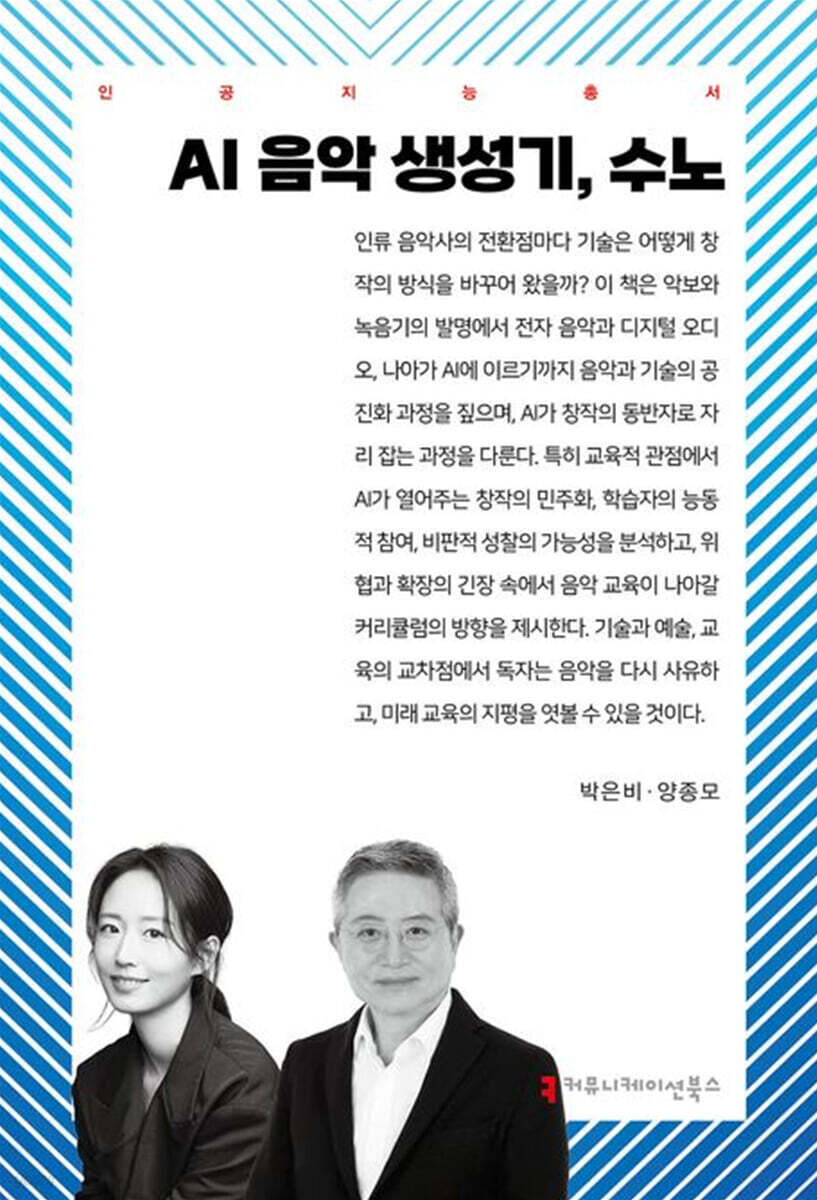
This practical tutorial presents the operating principles of Suno and how to write prompts to quickly create a complete song including vocals.
It enhances the utility of creation, learning, and policy by integrating education, copyright and ethics guidelines, and future development directions.
Artificial Intelligence Encyclopedia.
You can find the artificial intelligence knowledge you need at aiseries.oopy.io.
It enhances the utility of creation, learning, and policy by integrating education, copyright and ethics guidelines, and future development directions.
Artificial Intelligence Encyclopedia.
You can find the artificial intelligence knowledge you need at aiseries.oopy.io.
- You can preview some of the book's contents.
Preview
index
The Age of AI Music Generators
01 The History of Digital Music and the Birth of AI Music
02 Development and Diversity of AI Music Generators
03 Suno, appearance and ripple effect
04 Characteristics of Suno's creative music
05 Making Music with Suno
06 Suno, How to Use It in Education
07 Suno, Integration in the Music Education Curriculum
08 AI Music Generation and Ethics
09 Development Direction and Educational Application of AI Music Generators
10 The Future of AI Music Generators
01 The History of Digital Music and the Birth of AI Music
02 Development and Diversity of AI Music Generators
03 Suno, appearance and ripple effect
04 Characteristics of Suno's creative music
05 Making Music with Suno
06 Suno, How to Use It in Education
07 Suno, Integration in the Music Education Curriculum
08 AI Music Generation and Ethics
09 Development Direction and Educational Application of AI Music Generators
10 The Future of AI Music Generators
Into the book
Human music has been created for a long time using the human body and tools.
Tools such as hands, voices, and instruments have been the primary mediums of music for thousands of years, and composers have conceived music based on hearing and emotion.
However, in the mid-20th century, music encountered technology and underwent unprecedented change.
This is the beginning of electronic and digital music.
The history of digital music begins with changes in the way sound signals are recorded.
Until the mid-20th century, music was stored and played back based on physical media, but after the 1960s and 1970s, with the advent of digital audio technology that converts sound into discrete numerical signals, the way music was recorded and played back began to change.
--- From “01_“The History of Digital Music and the Birth of AI Music””
Suno's outstanding performance is based on cutting-edge AI model architecture and massive data learning.
Suno's core technology is believed to be in its transformer-based model.
It has a structure similar to GPT, a language model, and learns the patterns and structure of music by understanding the context and predicting the next word.
In particular, it is highly likely that Suno adopted an end-to-end method (single system) that directly processes audio data.
This allows for much more natural and high-quality results because it analyzes and generates the actual waveforms of voice and instrument sounds without the process of converting sheet music data (MIDI).
--- From "03_“Suno, Appearance and Ripple Effect”"
Suno generates complete pieces with just a few verbal instructions, providing students with an immediate creative experience.
This significantly shifts the paradigm of music education.
Creation, which previously required extensive training and specialized knowledge, is now open to anyone, and learners are transformed from mere observers or performers to active creators.
Furthermore, the use of Suno helps students understand musical concepts in a real-world context, enables collaborative creative activities, and stimulates critical thinking.
Therefore, in this chapter, we will examine how Suno can be utilized in actual educational settings.
--- From “06_“How to Use Suno in Education””
Traditionally, teachers have been authoritative figures who impart knowledge and guide skills.
But in an era where AI can ‘automatically’ generate music, the teacher’s role shifts to that of a facilitator, helping students analyze and reflect on their output, and discover meaning within it.
Teachers no longer provide the “right” answer, but rather guide students to critically examine AI’s music and connect it to their own experiences.
This provides an opportunity for education to shift from being output-centered to reflective-centered.
Ultimately, the educational application of AI music generators is not simply the introduction of a new technology, but an opportunity to rediscover the essence of music education—the process of expressing oneself, communicating with others, and understanding the world through art.
Tools such as hands, voices, and instruments have been the primary mediums of music for thousands of years, and composers have conceived music based on hearing and emotion.
However, in the mid-20th century, music encountered technology and underwent unprecedented change.
This is the beginning of electronic and digital music.
The history of digital music begins with changes in the way sound signals are recorded.
Until the mid-20th century, music was stored and played back based on physical media, but after the 1960s and 1970s, with the advent of digital audio technology that converts sound into discrete numerical signals, the way music was recorded and played back began to change.
--- From “01_“The History of Digital Music and the Birth of AI Music””
Suno's outstanding performance is based on cutting-edge AI model architecture and massive data learning.
Suno's core technology is believed to be in its transformer-based model.
It has a structure similar to GPT, a language model, and learns the patterns and structure of music by understanding the context and predicting the next word.
In particular, it is highly likely that Suno adopted an end-to-end method (single system) that directly processes audio data.
This allows for much more natural and high-quality results because it analyzes and generates the actual waveforms of voice and instrument sounds without the process of converting sheet music data (MIDI).
--- From "03_“Suno, Appearance and Ripple Effect”"
Suno generates complete pieces with just a few verbal instructions, providing students with an immediate creative experience.
This significantly shifts the paradigm of music education.
Creation, which previously required extensive training and specialized knowledge, is now open to anyone, and learners are transformed from mere observers or performers to active creators.
Furthermore, the use of Suno helps students understand musical concepts in a real-world context, enables collaborative creative activities, and stimulates critical thinking.
Therefore, in this chapter, we will examine how Suno can be utilized in actual educational settings.
--- From “06_“How to Use Suno in Education””
Traditionally, teachers have been authoritative figures who impart knowledge and guide skills.
But in an era where AI can ‘automatically’ generate music, the teacher’s role shifts to that of a facilitator, helping students analyze and reflect on their output, and discover meaning within it.
Teachers no longer provide the “right” answer, but rather guide students to critically examine AI’s music and connect it to their own experiences.
This provides an opportunity for education to shift from being output-centered to reflective-centered.
Ultimately, the educational application of AI music generators is not simply the introduction of a new technology, but an opportunity to rediscover the essence of music education—the process of expressing oneself, communicating with others, and understanding the world through art.
--- From “09_“Development Direction and Educational Application of AI Music Generators””
Publisher's Review
The era of generative music opened by Suno
Building on the evolution of music from analog to digital and then to algorithms, Suno lowers the threshold for creation and maximizes speed and diversity.
This book examines the history and principles of AI music generators, compares them with contemporary tools such as Mobert and Soundrow, and dissects Suno's strengths, including vocal-included song generation and intuitive prompt system.
The tutorial guides you through the actual production process, including custom mode and song creation, and presents a plan for integrating it into the educational field through lesson design and project ideas.
It addresses ethical issues such as copyright, credit notation, and data bias in a balanced manner, and argues that the composer's role does not disappear but expands to encompass planning, direction, and curation.
Through a future roadmap that includes emotion- and context-based generation and multimodal feedback, we envision how AI and human collaboration will reshape the music ecosystem.
It provides practical guidance for creators, teachers, and policy makers alike.
Building on the evolution of music from analog to digital and then to algorithms, Suno lowers the threshold for creation and maximizes speed and diversity.
This book examines the history and principles of AI music generators, compares them with contemporary tools such as Mobert and Soundrow, and dissects Suno's strengths, including vocal-included song generation and intuitive prompt system.
The tutorial guides you through the actual production process, including custom mode and song creation, and presents a plan for integrating it into the educational field through lesson design and project ideas.
It addresses ethical issues such as copyright, credit notation, and data bias in a balanced manner, and argues that the composer's role does not disappear but expands to encompass planning, direction, and curation.
Through a future roadmap that includes emotion- and context-based generation and multimodal feedback, we envision how AI and human collaboration will reshape the music ecosystem.
It provides practical guidance for creators, teachers, and policy makers alike.
GOODS SPECIFICS
- Date of issue: October 23, 2025
- Page count, weight, size: 131 pages | 128*188*20mm
- ISBN13: 9791143014061
- ISBN10: 1143014065
You may also like
카테고리
korean


korean

![GQ KOREA Mark (Monthly): December [2025]](http://librairie.coreenne.fr/cdn/shop/files/8ef265dbbfbf186523ed75ba7319009d.jpg?v=1765340328&width=3840)


