

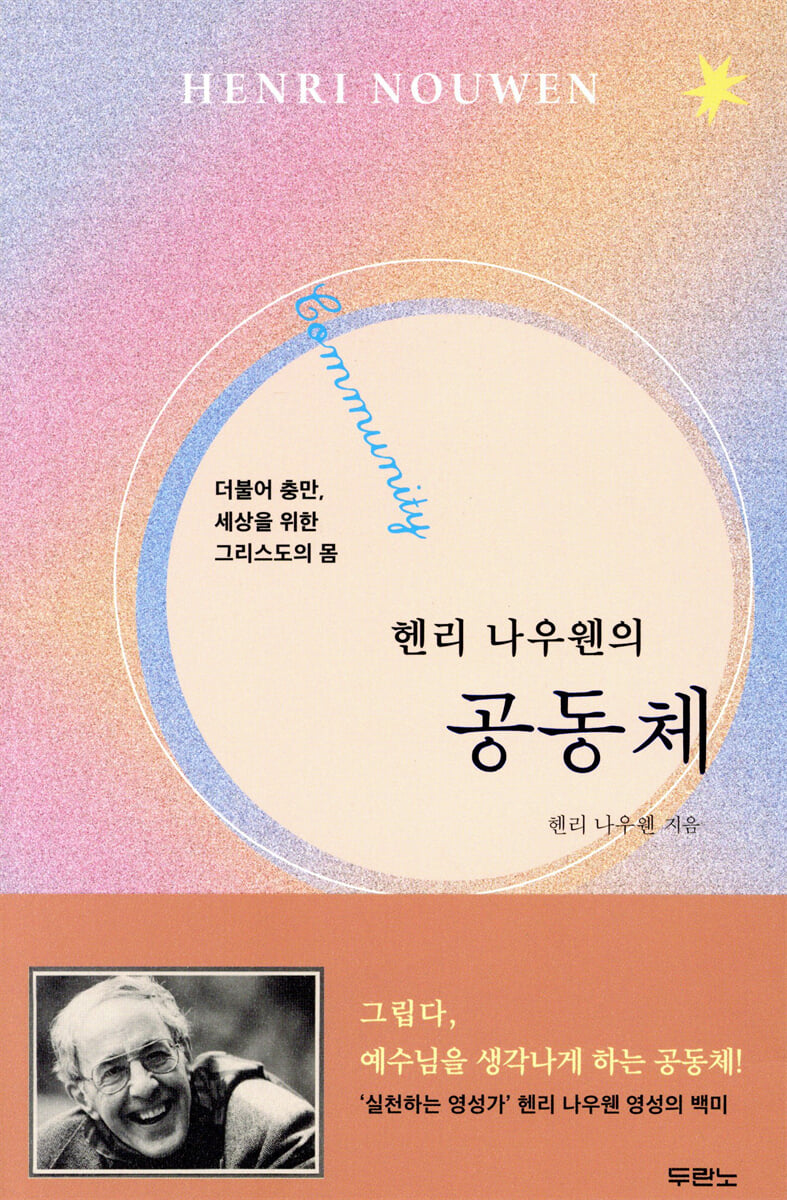
Henri Nouwen's Community
 |
Description
Book Introduction
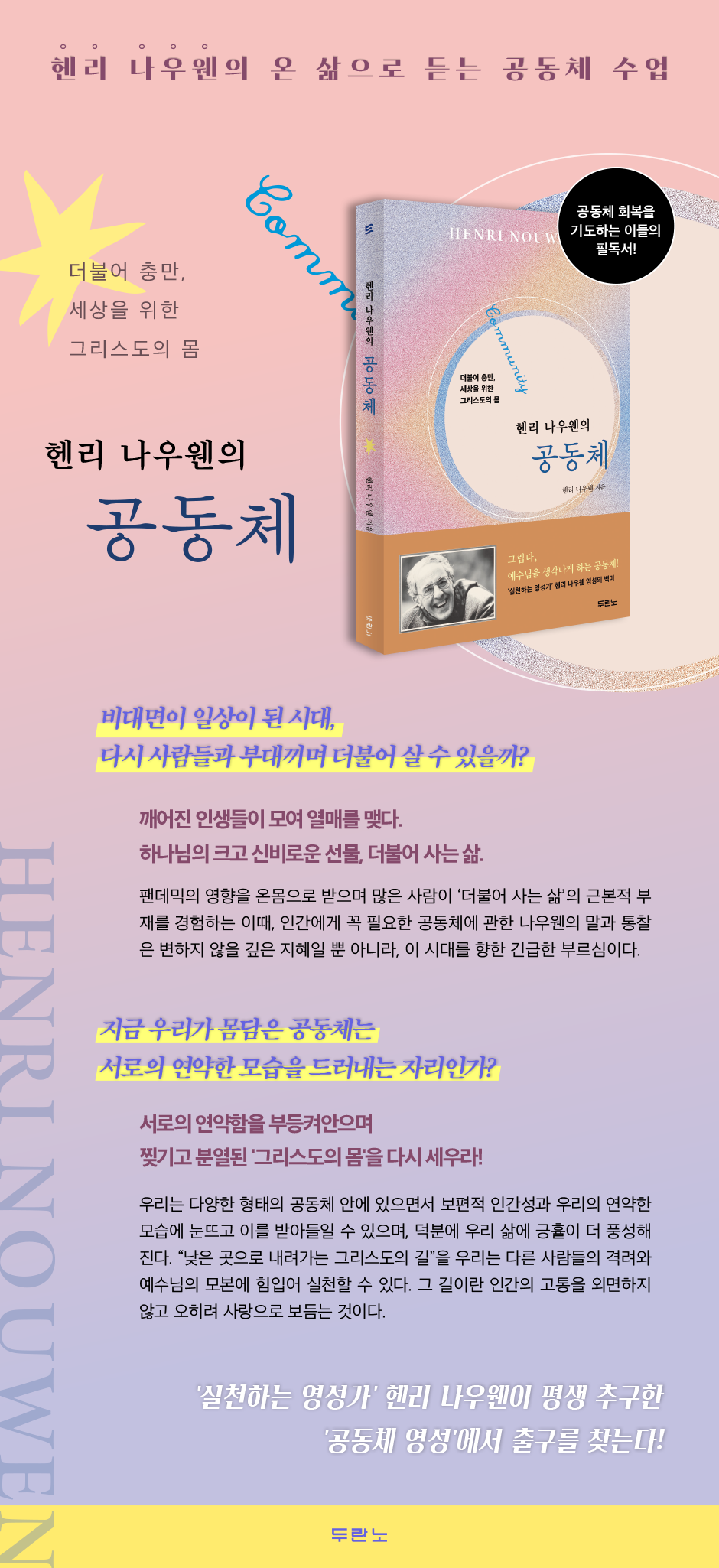
I miss you! A community that reminds me of Jesus!
Henri Nouwen, the "practicing spiritualist," is the pinnacle of spirituality.
Are the diverse communities we inhabit today places where we care for one another and enjoy each other? Are they spaces where we reveal our wounds and weaknesses? Are they safe places where we confess our sins and brokenness? Are they homes of love where we receive and extend forgiveness? In this age, more wracked by division than ever before, we examine the writings and lectures of Henri Nouwen on "community," and reflect on the "community spirituality" that so permeated his mind and heart.
It also includes some lesser-known writings and lectures, and five manuscripts are being published and presented to the world for the first time.
Henri Nouwen, the "practicing spiritualist," is the pinnacle of spirituality.
Are the diverse communities we inhabit today places where we care for one another and enjoy each other? Are they spaces where we reveal our wounds and weaknesses? Are they safe places where we confess our sins and brokenness? Are they homes of love where we receive and extend forgiveness? In this age, more wracked by division than ever before, we examine the writings and lectures of Henri Nouwen on "community," and reflect on the "community spirituality" that so permeated his mind and heart.
It also includes some lesser-known writings and lectures, and five manuscripts are being published and presented to the world for the first time.
- You can preview some of the book's contents.
Preview
index
Publisher's note.
Henri Nouwen's Community Lessons: Listening to Your Whole Life
The editor's writing.
Follow Jesus again, necessarily, into community
Christian Life and Community
1.
No matter how much you run, if there is no fruit in life
Spiritual Development and Community
2.
The mind cannot be cultivated alone.
Burnout and Community
3.
With so many tasks at hand, is solitude a luxury?
The Gospel and Community
4.
There is joy and blessing in sharing poverty.
The Pursuit of Peace and Community
5.
Only the 'living body of Christ' can bring peace to the world.
'Broken World, Broken Self' and Community
6.
When we become each other's broken earth, life sprouts there.
'Calling' and Community
7.
Even if it is small and insignificant, when we move boldly on the way of the cross
Communion with God and Community
8.
Even though I'm surrounded by a lot of people, there are times when loneliness overwhelms me.
Compassion and Community
9.
The strength lies in rejoicing that you and I are 'the same being'
Change and Community
10.
A daily journey from a 'hard heart' to a 'soft heart'
Acknowledgements
Entry
main
Henri Nouwen's Community Lessons: Listening to Your Whole Life
The editor's writing.
Follow Jesus again, necessarily, into community
Christian Life and Community
1.
No matter how much you run, if there is no fruit in life
Spiritual Development and Community
2.
The mind cannot be cultivated alone.
Burnout and Community
3.
With so many tasks at hand, is solitude a luxury?
The Gospel and Community
4.
There is joy and blessing in sharing poverty.
The Pursuit of Peace and Community
5.
Only the 'living body of Christ' can bring peace to the world.
'Broken World, Broken Self' and Community
6.
When we become each other's broken earth, life sprouts there.
'Calling' and Community
7.
Even if it is small and insignificant, when we move boldly on the way of the cross
Communion with God and Community
8.
Even though I'm surrounded by a lot of people, there are times when loneliness overwhelms me.
Compassion and Community
9.
The strength lies in rejoicing that you and I are 'the same being'
Change and Community
10.
A daily journey from a 'hard heart' to a 'soft heart'
Acknowledgements
Entry
main
Detailed image
Into the book
Celebrating each other's gifts means accepting each other's humanity.
In Daybreak, we just see each other as people.
Someone who can smile, someone who can say hello, someone who can eat food, someone who can take a few steps.
To others, they may seem like broken people, but at some point, they suddenly burst with life.
Because through them I discover my own broken self.
What I mean is this:
There are countless people in the world who suffer from the burden of self-deprecation.
'I am useless and worthless.
People don't care about me.
If I didn't have money, no one would talk to me.
If I didn't have a good job, no one would call me.
If I don't have influence, no one will love me.' People who are outwardly successful and praised can still live in fear, feeling inferior.
Community is a place where we reveal our weaknesses to one another.
In that state, we can forgive one another and celebrate the gifts of each other.
--- p.41~42
The reason solitude is essential to community life is because in solitude we become closer to one another.
Even when we step away from direct interaction and spend time alone praying, studying, reading, writing, or simply spending quiet time together, we are actually fully participating in the growth of the community.
If you think that you only become closer when you talk, play, or work together, you are mistaken.
Of course, much growth is achieved through such interpersonal interactions, but just as much growth is possible in solitude.
Because we bring the other person into our solitude, our relationship grows and deepens there.
We find each other in solitude in ways that are difficult or impossible when we are physically together.
The mutual solidarity we realize there does not depend on words, gestures, or actions; it is so deep and strong that we cannot achieve it through our own efforts alone.
--- p.77~78
It is only within community that we begin to see each other's uniqueness.
Community is a place where talents are discovered and brought to fruition.
Herein lies the great paradox of homogeneity and uniqueness.
When we recognize that we are fundamentally the same human beings, and are willing to set aside our outstanding differences and reveal our vulnerabilities, only then can we truly reveal our individual talents.
The talent at this time is the gift of unity instead of division.
Because our brokenness is what we have in common, our gifts can be used for each other.
A most notable characteristic of the Christian community is that it neither promotes uniformity nor suppresses individual gifts.
Conversely, the Christian community fosters an environment where people can observe one another closely and discover hidden talents.
Of course, such talents are used to build community life.
Our self-image does not depend on our individual differences.
Moreover, the foundation of self-esteem is not praise earned through extraordinary skills, but a love that is much deeper than that.
Only when you realize this fact do you begin to see your unique talents as gifts to others.
Furthermore, I realize that my value as a human being is not diminished by sharing gifts, but rather elevated.
--- p.98~99
Prayer is indeed an act of resistance.
It is about resisting the scary and persistent obsession that comes from desire.
First, we must believe that there is a very strong and deep power of love within us that we have not yet realized.
So, in these times when so much is happening and anxiety, anger, and confusion are at their peak, it is incredibly important that you bravely resist it and sit in silence, waiting, and listening.
Listen to the word of God within you.
Meditate on the texts of the Psalms, the Prophets, and the Gospels.
Let the words slowly descend from your head to your heart.
Then you can experience the power of peace within you.
Even when you do go out and do something, it's not because of your own desperate desires, but because you want to share the abundant love you feel.
--- p.105
My call to respond to the realities of Central America with prayer and action seems to be a concrete reaffirmation of the Christian calling.
Our calling is to be in the world but not of the world, to strive for peace and justice but never lose sight of Him who is the source of our identity, to reject and defeat the power of death while remaining truly alive, to act courageously while praying boldly.
The world tries to lure us into hatred, violence, and war, but we stand firm through constant prayer and through actions of love, gratitude, and community.
… … The more we feel the need for resistance and relief work, the more we must balance such work with the solitude of being alone with God.
Without solitude, our actions cease to be expressions of faith and degenerate into jagged attempts to overcome a fatalism born of the devil.
--- p.151~152
I have made many mistakes throughout my life.
He sought out people and sought fellowship with God.
I called it “community,” but mostly what I really asked of them was fellowship with Him.
It felt complete, it felt safe.
But before I knew it, I was hurting people.
Human love is so finite that if we start demanding fellowship with God from humans, we will end up forcibly controlling the other person.
It's because you want so many things.
So, when I go out to seek fellowship with Him, I always come back somewhat disappointed.
Suffering is seen in the multitude of people who thirst for fellowship with God.
They suddenly wake up and are plunged into deep sorrow.
Whenever we go around demanding from humans the fellowship that only God can give, the unfortunate result is sorrow.
Depression comes in waves.
No matter how desperately I want to find it, the absence of such fellowship is keenly felt.
And yet we say, 'Let's try again.
I always live with hope, thinking, 'This time it will work out.'
The world we live in also manipulates our longing for community.
They keep nagging us that we must do this or that to fulfill our deepest longings.
--- p.171~172
The deeper I entered into the light of the community, the more my anger, jealousy, and fear of rejection became apparent.
There were so many longings inside me that I didn't even know I had.
Although I experienced true friendship and love in the community, all the wounds I had been unable to face before came to the surface in this place where we lived together.
Community is a place where I can no longer hide.
You can't fool those who live together in a true community for very long, and you can't fool yourself either.
In a community, everyone has to take off the armor of their successful history.
I have to take it off too.
Even if I don't take it off, someone else will anyway.
They are all literally naked beings.
--- p.175~176
Living in a community makes you realize that you, like anyone else, have a disability.
Even if you can't see it, you too have a disability.
In fact, the longer you live in a community, the more you see your own brokenness and limitations.
So sometimes you have to say this.
“You guys, you have to be patient with me.
Because I won't change completely.
I'll try, but I'll probably explode with anger again." "I know you probably feel the same way about me.
So, I shouldn't force you to change, but rather accept your limitations."
We must truly believe that the community is a 'solidarity of the weak'.
A community is a group of people who are willing to be vulnerable with each other.
If we always forgive and ask for forgiveness for our shortcomings or inability to do better or be stronger, then there is a blessing.
The community trusts it.
When we can forgive each other like that, a beautiful celebration becomes possible.
In Daybreak, we just see each other as people.
Someone who can smile, someone who can say hello, someone who can eat food, someone who can take a few steps.
To others, they may seem like broken people, but at some point, they suddenly burst with life.
Because through them I discover my own broken self.
What I mean is this:
There are countless people in the world who suffer from the burden of self-deprecation.
'I am useless and worthless.
People don't care about me.
If I didn't have money, no one would talk to me.
If I didn't have a good job, no one would call me.
If I don't have influence, no one will love me.' People who are outwardly successful and praised can still live in fear, feeling inferior.
Community is a place where we reveal our weaknesses to one another.
In that state, we can forgive one another and celebrate the gifts of each other.
--- p.41~42
The reason solitude is essential to community life is because in solitude we become closer to one another.
Even when we step away from direct interaction and spend time alone praying, studying, reading, writing, or simply spending quiet time together, we are actually fully participating in the growth of the community.
If you think that you only become closer when you talk, play, or work together, you are mistaken.
Of course, much growth is achieved through such interpersonal interactions, but just as much growth is possible in solitude.
Because we bring the other person into our solitude, our relationship grows and deepens there.
We find each other in solitude in ways that are difficult or impossible when we are physically together.
The mutual solidarity we realize there does not depend on words, gestures, or actions; it is so deep and strong that we cannot achieve it through our own efforts alone.
--- p.77~78
It is only within community that we begin to see each other's uniqueness.
Community is a place where talents are discovered and brought to fruition.
Herein lies the great paradox of homogeneity and uniqueness.
When we recognize that we are fundamentally the same human beings, and are willing to set aside our outstanding differences and reveal our vulnerabilities, only then can we truly reveal our individual talents.
The talent at this time is the gift of unity instead of division.
Because our brokenness is what we have in common, our gifts can be used for each other.
A most notable characteristic of the Christian community is that it neither promotes uniformity nor suppresses individual gifts.
Conversely, the Christian community fosters an environment where people can observe one another closely and discover hidden talents.
Of course, such talents are used to build community life.
Our self-image does not depend on our individual differences.
Moreover, the foundation of self-esteem is not praise earned through extraordinary skills, but a love that is much deeper than that.
Only when you realize this fact do you begin to see your unique talents as gifts to others.
Furthermore, I realize that my value as a human being is not diminished by sharing gifts, but rather elevated.
--- p.98~99
Prayer is indeed an act of resistance.
It is about resisting the scary and persistent obsession that comes from desire.
First, we must believe that there is a very strong and deep power of love within us that we have not yet realized.
So, in these times when so much is happening and anxiety, anger, and confusion are at their peak, it is incredibly important that you bravely resist it and sit in silence, waiting, and listening.
Listen to the word of God within you.
Meditate on the texts of the Psalms, the Prophets, and the Gospels.
Let the words slowly descend from your head to your heart.
Then you can experience the power of peace within you.
Even when you do go out and do something, it's not because of your own desperate desires, but because you want to share the abundant love you feel.
--- p.105
My call to respond to the realities of Central America with prayer and action seems to be a concrete reaffirmation of the Christian calling.
Our calling is to be in the world but not of the world, to strive for peace and justice but never lose sight of Him who is the source of our identity, to reject and defeat the power of death while remaining truly alive, to act courageously while praying boldly.
The world tries to lure us into hatred, violence, and war, but we stand firm through constant prayer and through actions of love, gratitude, and community.
… … The more we feel the need for resistance and relief work, the more we must balance such work with the solitude of being alone with God.
Without solitude, our actions cease to be expressions of faith and degenerate into jagged attempts to overcome a fatalism born of the devil.
--- p.151~152
I have made many mistakes throughout my life.
He sought out people and sought fellowship with God.
I called it “community,” but mostly what I really asked of them was fellowship with Him.
It felt complete, it felt safe.
But before I knew it, I was hurting people.
Human love is so finite that if we start demanding fellowship with God from humans, we will end up forcibly controlling the other person.
It's because you want so many things.
So, when I go out to seek fellowship with Him, I always come back somewhat disappointed.
Suffering is seen in the multitude of people who thirst for fellowship with God.
They suddenly wake up and are plunged into deep sorrow.
Whenever we go around demanding from humans the fellowship that only God can give, the unfortunate result is sorrow.
Depression comes in waves.
No matter how desperately I want to find it, the absence of such fellowship is keenly felt.
And yet we say, 'Let's try again.
I always live with hope, thinking, 'This time it will work out.'
The world we live in also manipulates our longing for community.
They keep nagging us that we must do this or that to fulfill our deepest longings.
--- p.171~172
The deeper I entered into the light of the community, the more my anger, jealousy, and fear of rejection became apparent.
There were so many longings inside me that I didn't even know I had.
Although I experienced true friendship and love in the community, all the wounds I had been unable to face before came to the surface in this place where we lived together.
Community is a place where I can no longer hide.
You can't fool those who live together in a true community for very long, and you can't fool yourself either.
In a community, everyone has to take off the armor of their successful history.
I have to take it off too.
Even if I don't take it off, someone else will anyway.
They are all literally naked beings.
--- p.175~176
Living in a community makes you realize that you, like anyone else, have a disability.
Even if you can't see it, you too have a disability.
In fact, the longer you live in a community, the more you see your own brokenness and limitations.
So sometimes you have to say this.
“You guys, you have to be patient with me.
Because I won't change completely.
I'll try, but I'll probably explode with anger again." "I know you probably feel the same way about me.
So, I shouldn't force you to change, but rather accept your limitations."
We must truly believe that the community is a 'solidarity of the weak'.
A community is a group of people who are willing to be vulnerable with each other.
If we always forgive and ask for forgiveness for our shortcomings or inability to do better or be stronger, then there is a blessing.
The community trusts it.
When we can forgive each other like that, a beautiful celebration becomes possible.
--- p.194~195
Publisher's Review
Jesus' way of living fully in a lonely age
More, community!
Is it a biblical way to live, surrendering ourselves to the increasingly personalized flow of our times and following trends? How should we prepare for the post-COVID era? This book invites us to God's great and mysterious gift: a life of togetherness.
It introduces the amazing scene where broken lives come together to bear fruit, and strongly encourages us to embrace each other's weaknesses and rebuild the torn and divided 'body of Christ.'
The publisher and editor of this book testify in the introduction, “Henry Nouwen was consistently committed to the pursuit of community, and his work increasingly shifted to concrete reality,” and “For him, community was never primarily an abstract concept, a theory, or an option.”
Henri Nouwen experienced a “radical transformation” as a Christian within the community.
It was there, where he was accepted and loved purely for who he was, regardless of his career or the books he had written, that he was finally healed.
Can we live together again?
This book introduces true biblical relationships to a generation accustomed to invisible online relationships and unable to understand how to connect with others.
It will also provide an outlet for those who find life with others uncomfortable, awkward, and difficult, whether at home, at work, or at church, and for those who pray and wait for the restoration of their communities.
As the pandemic reels deeply and many experience the fundamental absence of "living together," Nouwen's words and insights on the community essential to humanity are not only a profound and timeless wisdom, but also an urgent call to action for our times.
More, community!
Is it a biblical way to live, surrendering ourselves to the increasingly personalized flow of our times and following trends? How should we prepare for the post-COVID era? This book invites us to God's great and mysterious gift: a life of togetherness.
It introduces the amazing scene where broken lives come together to bear fruit, and strongly encourages us to embrace each other's weaknesses and rebuild the torn and divided 'body of Christ.'
The publisher and editor of this book testify in the introduction, “Henry Nouwen was consistently committed to the pursuit of community, and his work increasingly shifted to concrete reality,” and “For him, community was never primarily an abstract concept, a theory, or an option.”
Henri Nouwen experienced a “radical transformation” as a Christian within the community.
It was there, where he was accepted and loved purely for who he was, regardless of his career or the books he had written, that he was finally healed.
Can we live together again?
This book introduces true biblical relationships to a generation accustomed to invisible online relationships and unable to understand how to connect with others.
It will also provide an outlet for those who find life with others uncomfortable, awkward, and difficult, whether at home, at work, or at church, and for those who pray and wait for the restoration of their communities.
As the pandemic reels deeply and many experience the fundamental absence of "living together," Nouwen's words and insights on the community essential to humanity are not only a profound and timeless wisdom, but also an urgent call to action for our times.
GOODS SPECIFICS
- Publication date: March 16, 2022
- Page count, weight, size: 248 pages | 268g | 125*190*20mm
- ISBN13: 9788953141551
- ISBN10: 8953141559
You may also like
카테고리
korean


korean

![GQ KOREA Mark (Monthly): December [2025]](http://librairie.coreenne.fr/cdn/shop/files/8ef265dbbfbf186523ed75ba7319009d.jpg?v=1765340328&width=3840)


