

AI Career Map
 |
Description
Book Introduction
AI destroys jobs while creating new opportunities.
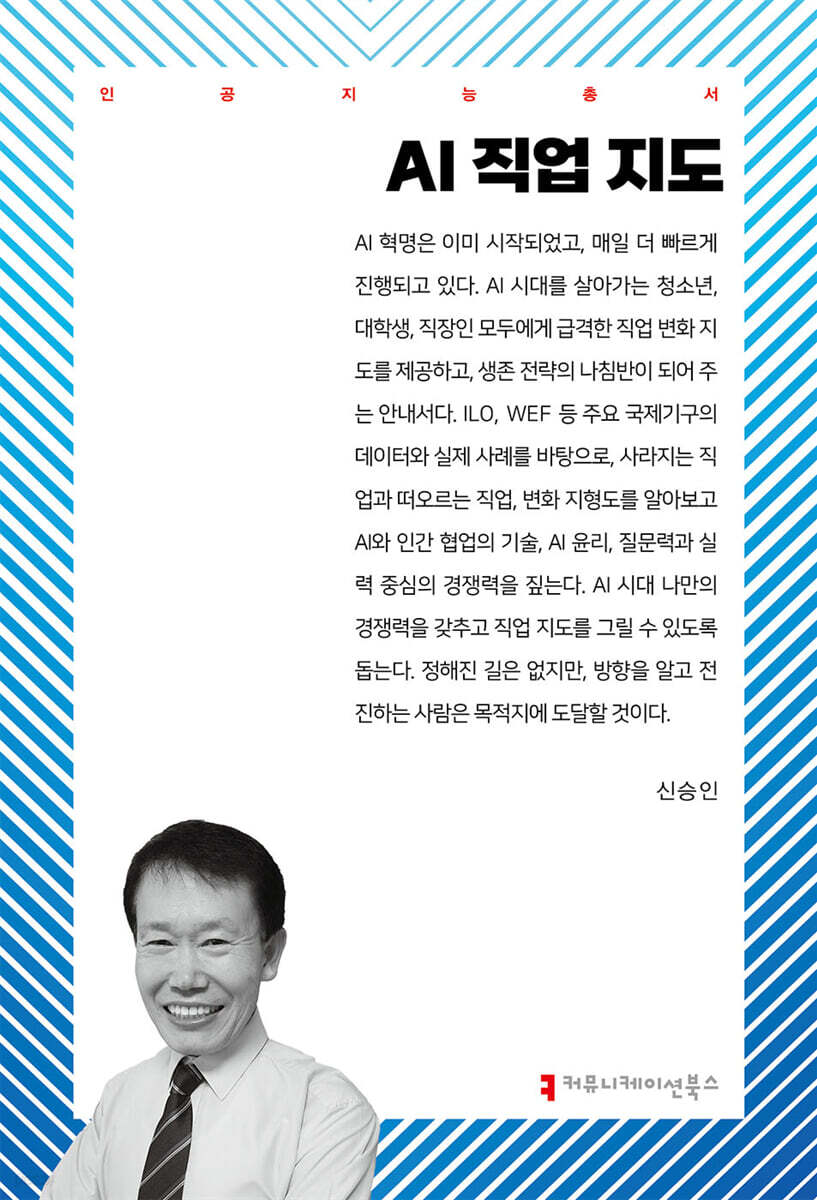
We explore disappearing jobs and emerging skills, guiding both students and professionals to establish their own career compass for survival in the AI era.
Artificial Intelligence Encyclopedia.
You can find the artificial intelligence knowledge you need at aiseries.oopy.io.
We explore disappearing jobs and emerging skills, guiding both students and professionals to establish their own career compass for survival in the AI era.
Artificial Intelligence Encyclopedia.
You can find the artificial intelligence knowledge you need at aiseries.oopy.io.
- You can preview some of the book's contents.
Preview
index
A map, a sword, and survival strategies for navigating the AI era.
01 AI Big Bang Era
02 Conflict map between AI and occupational terrain
03 The future boundaries of occupations
04 Coexistence Route Map
05 Map of Ethical Boundaries
06 The Era of the Skill Economy
07 Core Competencies in the AI Era
08 How to Use AI for Teenagers and College Students
09 Career Reset Roadmap
10. Create Your Own Career Compass
01 AI Big Bang Era
02 Conflict map between AI and occupational terrain
03 The future boundaries of occupations
04 Coexistence Route Map
05 Map of Ethical Boundaries
06 The Era of the Skill Economy
07 Core Competencies in the AI Era
08 How to Use AI for Teenagers and College Students
09 Career Reset Roadmap
10. Create Your Own Career Compass
Into the book
Humanity could move toward the "super-productivity, super-collaboration" society that optimists talk about, or toward the "trust crisis, job collapse, and digital control" society that pessimists warn of.
This is not simply a question of technology, but of what ethical and social compass we have to guide our approach to future technologies.
Now, we have the responsibility to redraw the 'future map of the AI era.'
The map should show the direction of technological innovation along with the path to human dignity, coexistence, and sustainability.
--- From "01_“AI Big Bang Era”"
Survival strategies in the age of AI should be designed around competencies rather than jobs, assuming that jobs can be automated. Careers should be designed around competencies and mindsets.
We need to create a flexible career by structuring modular careers and linking various projects, jobs, and roles rather than just one job.
Furthermore, in order to correctly interpret and utilize the future boundaries of occupations in the age of artificial intelligence, it is important to objectively diagnose your current skill level, values, and preferred work style to understand your position.
--- From “03_“The Future Boundaries of Professions””
In the age of the skills economy driven by artificial intelligence and digital technology, the concept of "job" is no longer fixed, and an individual's career is not perceived as a single path, but rather a "route" that constantly branches out and returns.
Career paths are no longer linear, connected by school, qualifications, and degrees, but rather multi-layered paths that require self-directed redesign and exploration.
--- From "06_“The Age of Skill Economy”"
Now that artificial intelligence has become a part of everyday life for every worker, the difference between those who succeed and those who fall behind is only one thing.
The key is how skillfully you utilize artificial intelligence tools.
The fastest way to reskill and upskill is to learn how to use tools that can be immediately applied in practice, rather than just theoretical knowledge.
This is not simply a question of technology, but of what ethical and social compass we have to guide our approach to future technologies.
Now, we have the responsibility to redraw the 'future map of the AI era.'
The map should show the direction of technological innovation along with the path to human dignity, coexistence, and sustainability.
--- From "01_“AI Big Bang Era”"
Survival strategies in the age of AI should be designed around competencies rather than jobs, assuming that jobs can be automated. Careers should be designed around competencies and mindsets.
We need to create a flexible career by structuring modular careers and linking various projects, jobs, and roles rather than just one job.
Furthermore, in order to correctly interpret and utilize the future boundaries of occupations in the age of artificial intelligence, it is important to objectively diagnose your current skill level, values, and preferred work style to understand your position.
--- From “03_“The Future Boundaries of Professions””
In the age of the skills economy driven by artificial intelligence and digital technology, the concept of "job" is no longer fixed, and an individual's career is not perceived as a single path, but rather a "route" that constantly branches out and returns.
Career paths are no longer linear, connected by school, qualifications, and degrees, but rather multi-layered paths that require self-directed redesign and exploration.
--- From "06_“The Age of Skill Economy”"
Now that artificial intelligence has become a part of everyday life for every worker, the difference between those who succeed and those who fall behind is only one thing.
The key is how skillfully you utilize artificial intelligence tools.
The fastest way to reskill and upskill is to learn how to use tools that can be immediately applied in practice, rather than just theoretical knowledge.
--- From “09_“Career Reset Roadmap””
Publisher's Review
Your Own Career Compass in the AI Era
Artificial intelligence is fundamentally shaking up industrial structures and job landscapes.
The World Economic Forum predicted that 23% of jobs will change or disappear within the next five years, and McKinsey analyzed that 30% of work hours could be automated by 2030.
From simple labor to professional jobs, everything is now under the influence of AI.
But at the same time, a new continent of careers is opening up: AI engineers, data curators, AI ethics managers, and more.
Now, when the shock of change and opportunity intersect, what's needed is not vague fear, but to map out your own career path.
This book comprehensively examines disappearing jobs, emerging new professions, and the collaborative technologies between humans and AI. Topics such as AI ethics, the skill economy, questioning, and competency-based competitiveness are not simply theoretical; they are linked to concrete implementation strategies.
For students, it offers customized career exploration and learning methods, and for working professionals, it offers reskilling, upskilling, and portfolio strategies, providing a compass that enables anyone to become a career navigator in the AI era.
Technology changes the way, but we must set the direction.
Artificial intelligence is fundamentally shaking up industrial structures and job landscapes.
The World Economic Forum predicted that 23% of jobs will change or disappear within the next five years, and McKinsey analyzed that 30% of work hours could be automated by 2030.
From simple labor to professional jobs, everything is now under the influence of AI.
But at the same time, a new continent of careers is opening up: AI engineers, data curators, AI ethics managers, and more.
Now, when the shock of change and opportunity intersect, what's needed is not vague fear, but to map out your own career path.
This book comprehensively examines disappearing jobs, emerging new professions, and the collaborative technologies between humans and AI. Topics such as AI ethics, the skill economy, questioning, and competency-based competitiveness are not simply theoretical; they are linked to concrete implementation strategies.
For students, it offers customized career exploration and learning methods, and for working professionals, it offers reskilling, upskilling, and portfolio strategies, providing a compass that enables anyone to become a career navigator in the AI era.
Technology changes the way, but we must set the direction.
GOODS SPECIFICS
- Date of issue: October 15, 2025
- Page count, weight, size: 135 pages | 128*188*7mm
- ISBN13: 9791143008220
You may also like
카테고리
korean


korean

![GQ KOREA Mark (Monthly): December [2025]](http://librairie.coreenne.fr/cdn/shop/files/8ef265dbbfbf186523ed75ba7319009d.jpg?v=1765340328&width=3840)


