

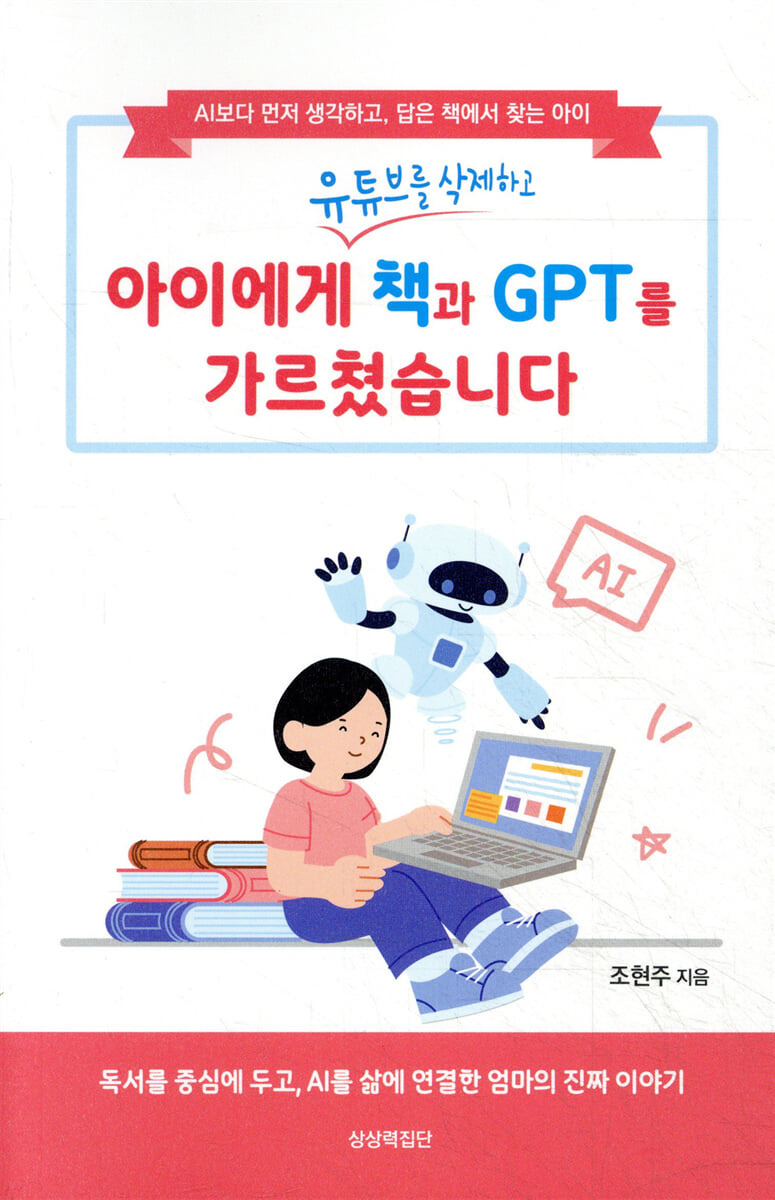
I taught my child books and GPT.
 |
Description
Book Introduction
How should we educate our children in the AI era?
A Mom's Real Education Experiment: YouTube Blocked, But GPT Opened
A must-read for all parents, from those who fear AI to those concerned about their children's education.
A new paradigm for child education in the AI era, written with my middle school daughter.
In our house, "Shall we ask GPT?" has become a daily greeting every morning.
A child who studies by talking to AI instead of going to an academy.
Is this truly the right kind of education? "I Taught My Child Books and GPT" is a record of the remarkable changes an ordinary mother discovered while raising her child with AI.
A Mom's Real Education Experiment: YouTube Blocked, But GPT Opened
A must-read for all parents, from those who fear AI to those concerned about their children's education.
A new paradigm for child education in the AI era, written with my middle school daughter.
In our house, "Shall we ask GPT?" has become a daily greeting every morning.
A child who studies by talking to AI instead of going to an academy.
Is this truly the right kind of education? "I Taught My Child Books and GPT" is a record of the remarkable changes an ordinary mother discovered while raising her child with AI.
index
prolog
Chapter 1: It's My First Time, Mom, Back When AI Was So Scary
YouTube is blocked, but GPT is open.
Will Naver and Google Search Really Be Replaced by AI? (feat. Perplexity)
The text on the notice board, AI digital textbook
The first day I felt like AI was really smart
Chapter 2: Our Child's Story of Growing Up with AI and Books
A child who couldn't write a single line after reading a book is now writing a book report.
Don't worry about the books, Mom will buy them for you.
Create a personalized tutor for your child
AI friend Kant becomes Yesul's philosophy teacher.
Chapter 3: How to Converse, Not What to Teach
More important than studying is practicing expressing your feelings.
Cultivating metacognition - the courage to say you're wrong
Why My Child Suddenly Started Seemingly Creative
The child who asked more questions began to learn on his own.
Chapter 4: Practical Parenting Methods in the AI Era
5 Steps to Raising Your Children with AI
How Parents Should Control Their Children When Using AI (5 Tips)
AI Image Creation: The Most Fun Educational Activity for Children
Please, let mom learn first
Chapter 5: Parents must plan for the future, and their children will follow.
Can a Teenage CEO Be Born? - In an Era Where Studying Isn't the Only Answer
The career education we need now is not 'aptitude' but 'attitude'.
Where and what should we start teaching AI ethics?
If parents change first, children will follow sooner than you think.
Chapter 6: Yesul's Opinion on AI
*Thoughts on AI written by Yesul, a second-year middle school student
How I study with AI
Are you curious about how kids these days play with AI?
My mom gives me a bit of a strange education.
The good thing about my mom's education
I wasn't friendly with AI from the beginning.
Epilogue
Chapter 1: It's My First Time, Mom, Back When AI Was So Scary
YouTube is blocked, but GPT is open.
Will Naver and Google Search Really Be Replaced by AI? (feat. Perplexity)
The text on the notice board, AI digital textbook
The first day I felt like AI was really smart
Chapter 2: Our Child's Story of Growing Up with AI and Books
A child who couldn't write a single line after reading a book is now writing a book report.
Don't worry about the books, Mom will buy them for you.
Create a personalized tutor for your child
AI friend Kant becomes Yesul's philosophy teacher.
Chapter 3: How to Converse, Not What to Teach
More important than studying is practicing expressing your feelings.
Cultivating metacognition - the courage to say you're wrong
Why My Child Suddenly Started Seemingly Creative
The child who asked more questions began to learn on his own.
Chapter 4: Practical Parenting Methods in the AI Era
5 Steps to Raising Your Children with AI
How Parents Should Control Their Children When Using AI (5 Tips)
AI Image Creation: The Most Fun Educational Activity for Children
Please, let mom learn first
Chapter 5: Parents must plan for the future, and their children will follow.
Can a Teenage CEO Be Born? - In an Era Where Studying Isn't the Only Answer
The career education we need now is not 'aptitude' but 'attitude'.
Where and what should we start teaching AI ethics?
If parents change first, children will follow sooner than you think.
Chapter 6: Yesul's Opinion on AI
*Thoughts on AI written by Yesul, a second-year middle school student
How I study with AI
Are you curious about how kids these days play with AI?
My mom gives me a bit of a strange education.
The good thing about my mom's education
I wasn't friendly with AI from the beginning.
Epilogue
Detailed image

Into the book
I wasn't scolded for saying I didn't know, I wasn't ridiculed for asking awkward questions, and most importantly, I could ask questions repeatedly.
Not knowing the answer was always a small, quiet shame to this child.
But AI accepted the state of ‘not knowing’ as it was.
He didn't scold me for being wrong, and he didn't get impatient for being lacking.
All I could do was help the child move forward from where he was, just enough to understand.
--- p.71
The Changing Role of Parents: It's Time to Become "Digital Guardians"
In the AI era, the role of parents has completely changed.
In the past, parents' job was to help their children choose good books and find good academies, but now they have a much more complex responsibility.
--- p.136
As Yesul became more comfortable with AI image generation, we experimented with ways to go beyond simply describing the subject and even manipulate the style and mood of the image.
This provided an opportunity to further develop the child's expressive skills.
I learned that even with the same content, an image with a completely different feel can be created depending on the style in which it is expressed.
For example, I tried out the theme “house in the forest” in various styles.
--- p.161
I want to remain the person who can most closely observe the child's potential, and sometimes the person who is the first to notice the child's fears.
If parents move just a little bit ahead of technology, that one step can be a huge signal to their children.
AI is not scary.
It's just unfamiliar.
If parents show courage first, children will learn by watching them.
In this way, together, we can raise children who will not waver in a changing world.
--- p.196
I can't forget what a principal said.
“Unless we double the number of teachers, it will be difficult for teachers to focus solely on preparing for class.” Realistically, doubling the number of teachers is nearly impossible.
And within these realistic limitations, AI digital textbooks have emerged as a new alternative.
--- p.31
You, who have opened this book now, probably started out like me.
I'm anxious, I'm afraid, I'm afraid of falling behind.
But within it, there is clearly a desire to live in a better world with children. That desire is enough.
I believe so.
So, if you feel like, 'I'm not the only one' while reading this book, then we are already on the same path.
--- p.5
At first, we tried to use AI as a tool.
I hope my grades go up, I hope presentation materials get created quickly, and when I see GPT answering my child's questions, I think, 'This is really useful.'
Not knowing the answer was always a small, quiet shame to this child.
But AI accepted the state of ‘not knowing’ as it was.
He didn't scold me for being wrong, and he didn't get impatient for being lacking.
All I could do was help the child move forward from where he was, just enough to understand.
--- p.71
The Changing Role of Parents: It's Time to Become "Digital Guardians"
In the AI era, the role of parents has completely changed.
In the past, parents' job was to help their children choose good books and find good academies, but now they have a much more complex responsibility.
--- p.136
As Yesul became more comfortable with AI image generation, we experimented with ways to go beyond simply describing the subject and even manipulate the style and mood of the image.
This provided an opportunity to further develop the child's expressive skills.
I learned that even with the same content, an image with a completely different feel can be created depending on the style in which it is expressed.
For example, I tried out the theme “house in the forest” in various styles.
--- p.161
I want to remain the person who can most closely observe the child's potential, and sometimes the person who is the first to notice the child's fears.
If parents move just a little bit ahead of technology, that one step can be a huge signal to their children.
AI is not scary.
It's just unfamiliar.
If parents show courage first, children will learn by watching them.
In this way, together, we can raise children who will not waver in a changing world.
--- p.196
I can't forget what a principal said.
“Unless we double the number of teachers, it will be difficult for teachers to focus solely on preparing for class.” Realistically, doubling the number of teachers is nearly impossible.
And within these realistic limitations, AI digital textbooks have emerged as a new alternative.
--- p.31
You, who have opened this book now, probably started out like me.
I'm anxious, I'm afraid, I'm afraid of falling behind.
But within it, there is clearly a desire to live in a better world with children. That desire is enough.
I believe so.
So, if you feel like, 'I'm not the only one' while reading this book, then we are already on the same path.
--- p.5
At first, we tried to use AI as a tool.
I hope my grades go up, I hope presentation materials get created quickly, and when I see GPT answering my child's questions, I think, 'This is really useful.'
--- p.248
Publisher's Review
The Secret to Raising Children to Ask Their Own Questions Without Nagging Them to "Study"
A mother who broke her child's cell phone at a campsite, a mother who didn't start learning English until the 5th grade.
How would such a mother change after encountering AI? This book candidly captures the journey of imperfect parents, using AI as a tool, to grow alongside their children. It covers creating personalized teachers for each child using GPTs, creative learning methods that connect reading and AI, and even stories of AI utilization shared by actual middle school students.
It contains everything about AI education that has been proven in practice, not just theory.
"Children who ask questions will become the protagonists of the AI era."
AI is not a tool that provides answers, but a catalyst that creates more questions.
Through this book, you too can become a parent who is not afraid of AI and can explore it with your child.
"I blocked YouTube, but did my mom make the right choice to open GPT?"
Will AI threaten our children's future, or will it open up new possibilities? Countless parents struggle with this question.
"I Taught My Child Books and GPT" is one mother's experimental answer to this question.
It contains the surprising changes discovered while exploring AI with my daughter, and the importance of a 'questioning child' realized in the process.
This book is not simply a guidebook on utilizing AI.
This is a coming-of-age story about the meaning of 'real education' discovered through trial and error by an ordinary mother and her child.
Above all, the experience of using AI written by middle school student Yesul herself adds to the authenticity of this book.
Why do we need "Teaching Children Books and GPT" now?
One. AI is not dangerous; ignorance is dangerous: This reassures parents that they must first understand and experience AI to properly guide their children.
two.
A classroom where questions disappeared, curiosity revived by AI: This shows how children, tired of rote learning, rediscover the joy of asking questions and exploring through conversations with AI.
three.
Field-proven AI education methods: We present concrete, immediately applicable methodologies, including creating personalized teachers with GPTs, writing effective prompts, and age-appropriate AI ethics education methods.
four.
Reading Meets AI: This book proposes a new educational model that cultivates critical thinking through books and expands that thinking through AI. This book will serve as a compass for parents who fear AI, those concerned about their children's future educational direction, and all those who already use AI but are unsure of how to use it properly.
In particular, the author's confession, "I thought I was teaching my child, but I learned it myself," offers a new perspective on parenting.
In the AI era, the role of parents is not to ‘teach’ but to ‘learn together’.
What will you choose after reading this book? Will you explore AI with your child starting today, or will you continue to fear it and fall behind?
A mother who broke her child's cell phone at a campsite, a mother who didn't start learning English until the 5th grade.
How would such a mother change after encountering AI? This book candidly captures the journey of imperfect parents, using AI as a tool, to grow alongside their children. It covers creating personalized teachers for each child using GPTs, creative learning methods that connect reading and AI, and even stories of AI utilization shared by actual middle school students.
It contains everything about AI education that has been proven in practice, not just theory.
"Children who ask questions will become the protagonists of the AI era."
AI is not a tool that provides answers, but a catalyst that creates more questions.
Through this book, you too can become a parent who is not afraid of AI and can explore it with your child.
"I blocked YouTube, but did my mom make the right choice to open GPT?"
Will AI threaten our children's future, or will it open up new possibilities? Countless parents struggle with this question.
"I Taught My Child Books and GPT" is one mother's experimental answer to this question.
It contains the surprising changes discovered while exploring AI with my daughter, and the importance of a 'questioning child' realized in the process.
This book is not simply a guidebook on utilizing AI.
This is a coming-of-age story about the meaning of 'real education' discovered through trial and error by an ordinary mother and her child.
Above all, the experience of using AI written by middle school student Yesul herself adds to the authenticity of this book.
Why do we need "Teaching Children Books and GPT" now?
One. AI is not dangerous; ignorance is dangerous: This reassures parents that they must first understand and experience AI to properly guide their children.
two.
A classroom where questions disappeared, curiosity revived by AI: This shows how children, tired of rote learning, rediscover the joy of asking questions and exploring through conversations with AI.
three.
Field-proven AI education methods: We present concrete, immediately applicable methodologies, including creating personalized teachers with GPTs, writing effective prompts, and age-appropriate AI ethics education methods.
four.
Reading Meets AI: This book proposes a new educational model that cultivates critical thinking through books and expands that thinking through AI. This book will serve as a compass for parents who fear AI, those concerned about their children's future educational direction, and all those who already use AI but are unsure of how to use it properly.
In particular, the author's confession, "I thought I was teaching my child, but I learned it myself," offers a new perspective on parenting.
In the AI era, the role of parents is not to ‘teach’ but to ‘learn together’.
What will you choose after reading this book? Will you explore AI with your child starting today, or will you continue to fear it and fall behind?
GOODS SPECIFICS
- Date of issue: July 16, 2025
- Page count, weight, size: 254 pages | 130*200*20mm
- ISBN13: 9791197840067
- ISBN10: 1197840060
You may also like
카테고리
korean


korean

![GQ KOREA Mark (Monthly): December [2025]](http://librairie.coreenne.fr/cdn/shop/files/8ef265dbbfbf186523ed75ba7319009d.jpg?v=1765340328&width=3840)


