

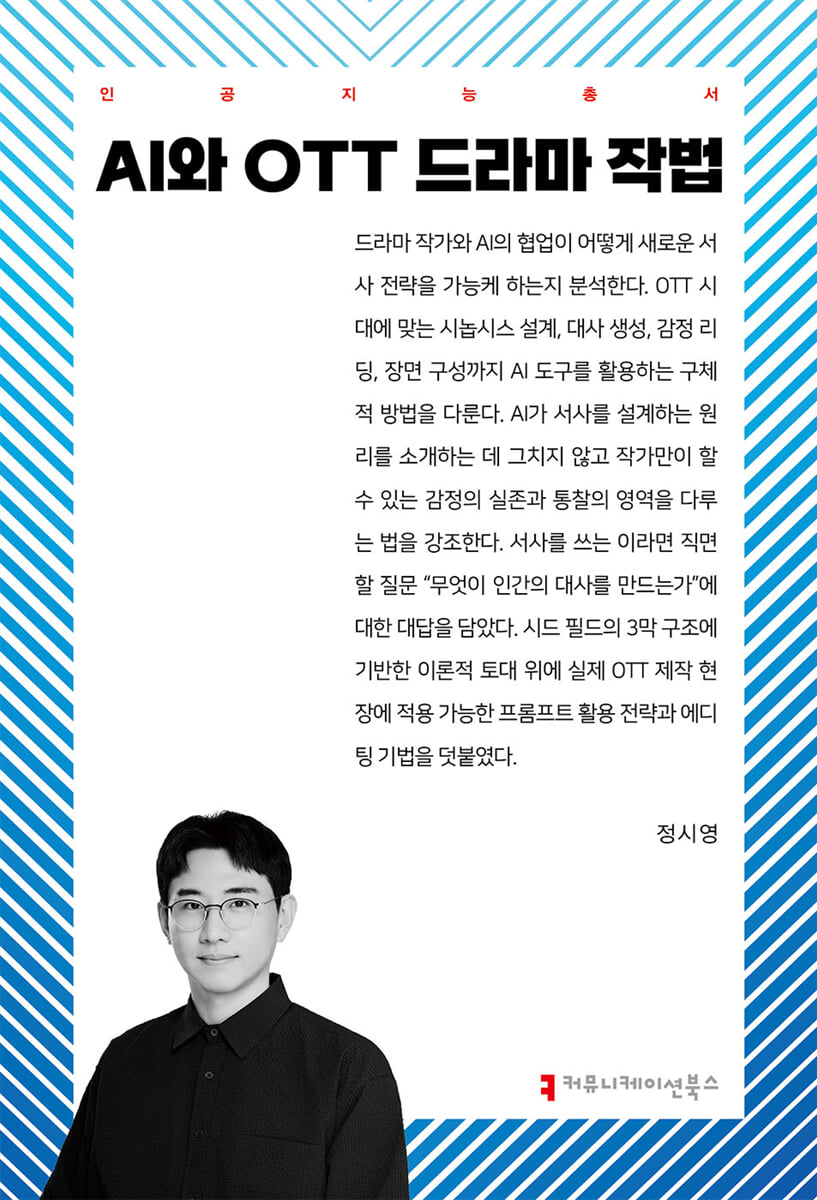
AI and OTT Drama Writing
 |
Description
Book Introduction
We analyze the new production environment created by OTT platforms and generative AI.
In the face of the advent of free-form, data-driven planning, and AI-assisted writing, it emphasizes that the planning and responsibility of human writers remain central.
Artificial Intelligence Encyclopedia.
You can find the artificial intelligence knowledge you need at aiseries.oopy.io.
In the face of the advent of free-form, data-driven planning, and AI-assisted writing, it emphasizes that the planning and responsibility of human writers remain central.
Artificial Intelligence Encyclopedia.
You can find the artificial intelligence knowledge you need at aiseries.oopy.io.
index
The emergence of OTT platforms
01 AI and OTT Drama Writing
02 Integration of AI and Storytelling
03 Drafting a plan
04 Character Development and AI
05 Plot Points of the Drama
06 Write a synopsis
07 Script Writing Using AI
08 AI Reading
09 The Role of the Author and Precautions When Using AI
10 The Future of AI and Drama Production
01 AI and OTT Drama Writing
02 Integration of AI and Storytelling
03 Drafting a plan
04 Character Development and AI
05 Plot Points of the Drama
06 Write a synopsis
07 Script Writing Using AI
08 AI Reading
09 The Role of the Author and Precautions When Using AI
10 The Future of AI and Drama Production
Into the book
The biggest strategy of the season system is to ‘give up intermediate emotions.’
In existing dramas, conflict and resolution are repeated in each episode, and the emotional waves are distributed relatively evenly.
However, the season system operates on a long-term rhythm, such as 'heightening from episode 1 to 4, transition in episode 5, and explosion in episode 6.'
Instead of less emotional ups and downs between episodes, the immersion in the latter half of the season is stronger.
This structure demands patience and focus from the writer in designing emotions.
Because maintaining tension throughout the season is more important than the fun of one episode.
Additionally, the seasonal system requires a structure that divides the character arc.
In Season 1, only the ‘starting point of change’ is shown, and in Season 2, a ‘new self’ is presented.
Any writer writing a coming-of-age story must place a "loss" or "realization" at the end of Season 1.
It must leave a transition of emotions, not a conclusion of emotions, to lead to the next season.
This method is a story structure that presupposes the structure of emotions, and requires much more elaborate emotional planning than a one-shot drama.
--- From “01_“AI and OTT Drama Writing””
AI is also useful for tone experiments.
If you have people express the same event through two different emotions, you can compare which emotion is more persuasive.
The writer does not judge by his senses, but chooses through experimentation with structure and expression.
This process solidifies the plan and ensures that the central emotion of the drama remains unshaken.
The plan is the plan itself, and AI is the engine that repeatedly experiments on it.
The author provides direction and sets the tone, while AI enhances the design.
While drama writers used intuition and experience to design their plans, we now live in an era where they rely on structure and prompts. AI isn't just a substitute for writing, but a companion that enhances the precision of planning.
The narrative structure, emotions, turn points, and even tone are all connected through prompt-based design.
A plan that takes all of this into account from the beginning can convince the platform.
--- From “03_“Writing a Plan””
AI is excellent at rearranging the poles around this hooking point.
Writers can build tension throughout their synopsis by suggesting prompts like “a striking twist that grabs the reader’s attention” or “place conflict and irony at the heart of the narrative.”
Moreover, the hooking point is not limited to just the ‘originality of the material’.
When emotions, themes, and character goals are organically intertwined, hooks lead to real immersion. Having analyzed countless narratives, AI can assess whether these points are clichés or not, suggesting "lesser-known but powerful conflict structures."
--- From "06_“Synopsis Writing”"
AI learns from data.
The data may contain stereotypes about certain cultures, genders, classes, and races.
There are cases where only male characters' lines are repeated for the word 'leader', or only characters of a certain age or appearance appear for the theme of 'love'.
This is not just a statistical result; it also influences the way we structure society through narrative.
Authors must recognize this bias and not uncritically accept AI output. AI provides only one of many possible options, and authors must actively remove or reinterpret ethically questionable expressions, characterizations, and emotional structures.
In particular, if AI-generated settings degrade or ridicule others, the responsibility lies entirely with the author. AI is not responsible.
Only the creators and writers should bear the ethical implications of the results.
In existing dramas, conflict and resolution are repeated in each episode, and the emotional waves are distributed relatively evenly.
However, the season system operates on a long-term rhythm, such as 'heightening from episode 1 to 4, transition in episode 5, and explosion in episode 6.'
Instead of less emotional ups and downs between episodes, the immersion in the latter half of the season is stronger.
This structure demands patience and focus from the writer in designing emotions.
Because maintaining tension throughout the season is more important than the fun of one episode.
Additionally, the seasonal system requires a structure that divides the character arc.
In Season 1, only the ‘starting point of change’ is shown, and in Season 2, a ‘new self’ is presented.
Any writer writing a coming-of-age story must place a "loss" or "realization" at the end of Season 1.
It must leave a transition of emotions, not a conclusion of emotions, to lead to the next season.
This method is a story structure that presupposes the structure of emotions, and requires much more elaborate emotional planning than a one-shot drama.
--- From “01_“AI and OTT Drama Writing””
AI is also useful for tone experiments.
If you have people express the same event through two different emotions, you can compare which emotion is more persuasive.
The writer does not judge by his senses, but chooses through experimentation with structure and expression.
This process solidifies the plan and ensures that the central emotion of the drama remains unshaken.
The plan is the plan itself, and AI is the engine that repeatedly experiments on it.
The author provides direction and sets the tone, while AI enhances the design.
While drama writers used intuition and experience to design their plans, we now live in an era where they rely on structure and prompts. AI isn't just a substitute for writing, but a companion that enhances the precision of planning.
The narrative structure, emotions, turn points, and even tone are all connected through prompt-based design.
A plan that takes all of this into account from the beginning can convince the platform.
--- From “03_“Writing a Plan””
AI is excellent at rearranging the poles around this hooking point.
Writers can build tension throughout their synopsis by suggesting prompts like “a striking twist that grabs the reader’s attention” or “place conflict and irony at the heart of the narrative.”
Moreover, the hooking point is not limited to just the ‘originality of the material’.
When emotions, themes, and character goals are organically intertwined, hooks lead to real immersion. Having analyzed countless narratives, AI can assess whether these points are clichés or not, suggesting "lesser-known but powerful conflict structures."
--- From "06_“Synopsis Writing”"
AI learns from data.
The data may contain stereotypes about certain cultures, genders, classes, and races.
There are cases where only male characters' lines are repeated for the word 'leader', or only characters of a certain age or appearance appear for the theme of 'love'.
This is not just a statistical result; it also influences the way we structure society through narrative.
Authors must recognize this bias and not uncritically accept AI output. AI provides only one of many possible options, and authors must actively remove or reinterpret ethically questionable expressions, characterizations, and emotional structures.
In particular, if AI-generated settings degrade or ridicule others, the responsibility lies entirely with the author. AI is not responsible.
Only the creators and writers should bear the ethical implications of the results.
--- From “09_“The Role of the Author and Precautions When Using AI””
Publisher's Review
AI and OTT Dramas: A New Landscape for Writing
It explores how the rapid rise of OTT platforms and the emergence of generative AI are changing the Korean drama production landscape.
OTT, which has rapidly expanded since the COVID-19 pandemic, has broken down limitations on length and format, and has made seasonal programming, pre-production, and data-driven planning commonplace.
This book closely examines how writers are adapting and reshaping their creative methods amidst these changes.
In particular, the emergence of generative AI is rapidly replacing the role of existing assistant writers, assisting with idea generation, plot composition, and even dialogue drafting.
However, the process of developing AI-generated drafts into works of art still falls to human writers.
Planning, design, judgment, and interpretation are the author's responsibilities, which AI cannot replace, and it is at this point that the author's "authorship" is revealed.
This book introduces a new creative environment where data precisely designs emotional lines and prompts establish structure, while also reminding us that it's always people who bear the ultimate responsibility. In an era disrupted by OTT and AI, the skills required of drama writers are no longer simply creative, but planning and curation skills.
It offers insights and strategies to help writers and creators navigate this wave of change.
It explores how the rapid rise of OTT platforms and the emergence of generative AI are changing the Korean drama production landscape.
OTT, which has rapidly expanded since the COVID-19 pandemic, has broken down limitations on length and format, and has made seasonal programming, pre-production, and data-driven planning commonplace.
This book closely examines how writers are adapting and reshaping their creative methods amidst these changes.
In particular, the emergence of generative AI is rapidly replacing the role of existing assistant writers, assisting with idea generation, plot composition, and even dialogue drafting.
However, the process of developing AI-generated drafts into works of art still falls to human writers.
Planning, design, judgment, and interpretation are the author's responsibilities, which AI cannot replace, and it is at this point that the author's "authorship" is revealed.
This book introduces a new creative environment where data precisely designs emotional lines and prompts establish structure, while also reminding us that it's always people who bear the ultimate responsibility. In an era disrupted by OTT and AI, the skills required of drama writers are no longer simply creative, but planning and curation skills.
It offers insights and strategies to help writers and creators navigate this wave of change.
GOODS SPECIFICS
- Date of issue: September 19, 2025
- Page count, weight, size: 124 pages | 128*188*8mm
- ISBN13: 9791143008763
You may also like
카테고리
korean


korean

![GQ KOREA Mark (Monthly): December [2025]](http://librairie.coreenne.fr/cdn/shop/files/8ef265dbbfbf186523ed75ba7319009d.jpg?v=1765340328&width=3840)


