

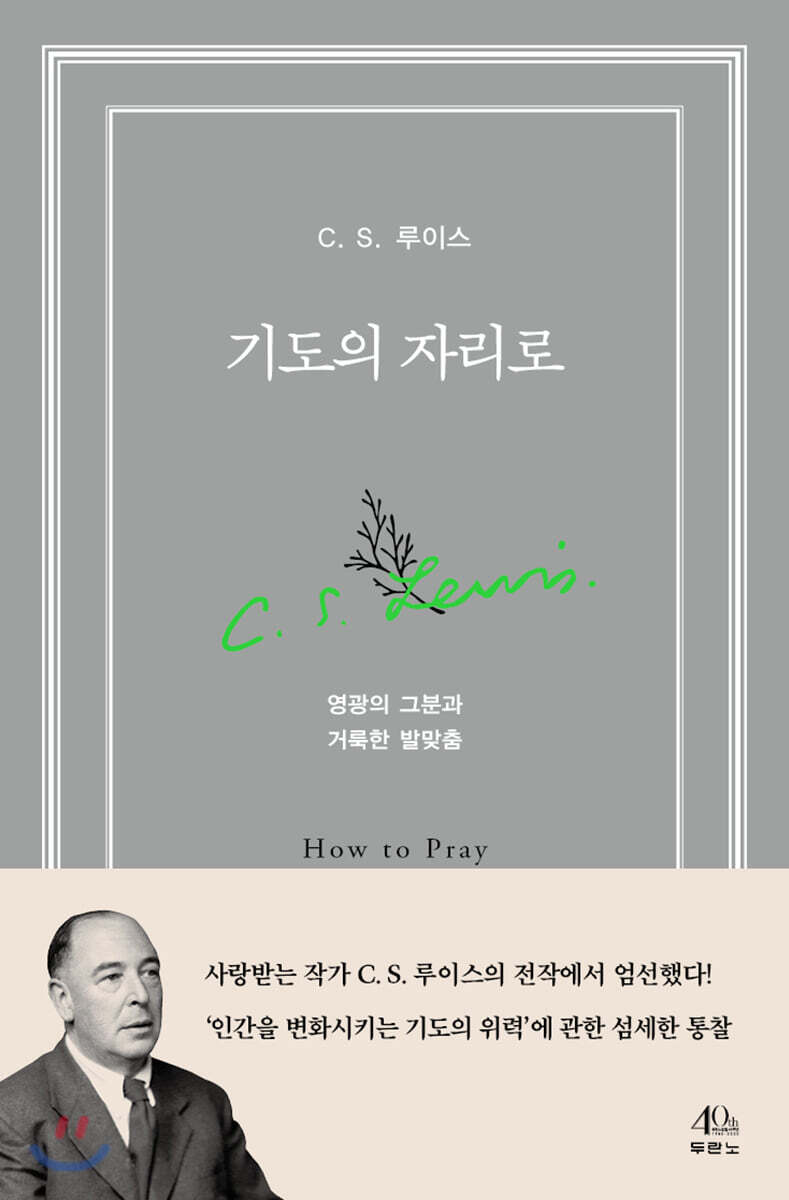
To the place of prayer
 |
Description
Book Introduction
In these turbulent times, for those who have nowhere to put their hearts
C.
A warm invitation from S. Lewis!
“A person who has practiced prayer all his life” C.
S. Lewis
The prayer march he embarked on throughout his life
C., author of Christian classics such as Mere Christianity and The Screwtape Letters, a respected teacher who taught English literature for a long time at Oxford and Cambridge, and praised as the greatest Christian apologist of the 20th century.
S. Lewis.
Countless believers living in this age are indebted to his meticulous spiritual exploration and brilliant wisdom.
Thanks to his efforts, we have been able to look into and diagnose the state of our hearts and faith, which we could not possibly interpret or express in words.
His profound and vibrant Christian apologetics and commentary, and his understanding of God and humanity, continue to guide countless believers even after his death more than 50 years ago.
The excellence that Lewis demonstrated came from a solid foundation of 'a life of consistent prayer practice in daily life and active adherence to the basics of being a believer.'
This precious spiritual practice can be found in "To the Place of Prayer," a book that carefully selects the best writings on "prayer" from his extensive writings.
C.
A warm invitation from S. Lewis!
“A person who has practiced prayer all his life” C.
S. Lewis
The prayer march he embarked on throughout his life
C., author of Christian classics such as Mere Christianity and The Screwtape Letters, a respected teacher who taught English literature for a long time at Oxford and Cambridge, and praised as the greatest Christian apologist of the 20th century.
S. Lewis.
Countless believers living in this age are indebted to his meticulous spiritual exploration and brilliant wisdom.
Thanks to his efforts, we have been able to look into and diagnose the state of our hearts and faith, which we could not possibly interpret or express in words.
His profound and vibrant Christian apologetics and commentary, and his understanding of God and humanity, continue to guide countless believers even after his death more than 50 years ago.
The excellence that Lewis demonstrated came from a solid foundation of 'a life of consistent prayer practice in daily life and active adherence to the basics of being a believer.'
This precious spiritual practice can be found in "To the Place of Prayer," a book that carefully selects the best writings on "prayer" from his extensive writings.
- You can preview some of the book's contents.
Preview
index
Editor's Note
Can I verify that my prayers are answered?
Why do I ask God when He already knows all my needs?
Is prayer a burden?
Is it shameless to bring every little thing of my work to God?
How do prayer and 'God's providence' intertwine?
Do I have to be pathologically contemplative about my sins in order to pray?
What are some traps to watch out for when praying?
How to practice prayer consistently?
Is it possible to pray while taking care of my own things appropriately?
How can I stand before the ‘real Him’ as the ‘real me’?
How to pray joyfully like David?
How should we understand the New Testament's teaching on prayer?
Are you praying in the midst of grief over the loss of a loved one?
They say suffering is good for the soul, but is it okay to pray to avoid suffering?
What should we do when God says that we cannot receive it again even if we ask Him?
Entry
Can I verify that my prayers are answered?
Why do I ask God when He already knows all my needs?
Is prayer a burden?
Is it shameless to bring every little thing of my work to God?
How do prayer and 'God's providence' intertwine?
Do I have to be pathologically contemplative about my sins in order to pray?
What are some traps to watch out for when praying?
How to practice prayer consistently?
Is it possible to pray while taking care of my own things appropriately?
How can I stand before the ‘real Him’ as the ‘real me’?
How to pray joyfully like David?
How should we understand the New Testament's teaching on prayer?
Are you praying in the midst of grief over the loss of a loved one?
They say suffering is good for the soul, but is it okay to pray to avoid suffering?
What should we do when God says that we cannot receive it again even if we ask Him?
Entry
Detailed image
.jpg)
Into the book
Lord, people say
Even when I talk to the Lord, there is no answer.
They all say it's a dream.
It means that you speak as if you were alone.
That's half true, but
It's quite the opposite of what they think.
When I look inside myself to find what I want to say,
Unfortunately, the well is dry.
Then the Lord sees me empty
Come down from where you were listening
Breathe through my dead lips
You speak to me and awaken thoughts I didn't even know I had.
So there is no need for an answer and you cannot answer.
It seems like a conversation between two people, but it is always one Lord.
The dream is not mine, it is the Lord's dream.
Poems, “Prayer”
--- p.1
It's not surprising that a well-known Christian teacher was a man of constant prayer, but we can easily overlook the frequent references to prayer in Lewis's many letters over the years.
“I will pray for you” may sound like a cliché, but it is a regular phrase in his letters.
The fact that he mentioned this phrase so often indicates that Lewis took the practice of prayer seriously.
He always promised to pray for people, wrote down their prayer requests, and then asked them again after a while to correct the situation.
Of course, Lewis himself has compiled his prayer topics.
He favored the traditional prayers found in the prayer book, offered a variety of prayer forms beyond petitionary prayers, and frequently offered advice on matters surrounding prayer.
The subject of prayer appears without fail in his publications.
In short, Lewis spent a lot of time practicing, thinking, and writing about prayer.
--- p.8-9
So far we have been dealing with this whole problem in the wrong way and at the wrong level.
The very question, “Does prayer work?” starts from a flawed way of thinking.
If we consider whether it “works,” prayer becomes no different from magic or a vending machine.
But prayer is either purely a delusion, or it is a personal communication between 'immature and inadequate persons' (us) and 'another truly existing person.'
(Petitional prayers asking for something are only a small part of prayer.
Confession and repentance of sins are the threshold of prayer, worship is the sanctuary of prayer, and seeing and rejoicing in God's presence is the bread and wine of prayer.) Through prayer, God shows us who He is.
His answering of prayer is a secondary consequence of the revelation, not the most important element.
If you know who He is, you will know what He does.
Yet God has permitted us to pray and commanded us to do so.
“Give us this day our daily bread.”
--- p.20
He seems to do nothing directly that could be delegated to a creature.
He commands us, who are slow and clumsy, to do what He can do perfectly in an instant.
He even allows us the possibility of neglecting or failing in the task entrusted to us.
It may be beyond our comprehension, but it is not easy for finite beings with free will to coexist safely with the Almighty.
To do that, God must abdicate at every moment.
We are not mere beneficiaries or bystanders, but rather we are privileged to participate in His operations or are compelled to cooperate with Him in His work.
“Each one wields his own little trident.”
Is this wondrous process limited to the mere act of creation unfolding before our eyes? Through it (and this is no ordinary occurrence), God transforms us from nothing into extraordinary beings, into truly small gods.
--- p.22-23
The consequences of our physical actions are so harsh because they are guaranteed by God.
This gives us the freedom to do as much harm as we want.
But the results of prayer are different, and God has left the discretion to Himself.
Otherwise, prayer would become such a dangerous activity for humans that we would fall into the terrible state of which Juvenal wrote: “Heaven is angry and hears the most terrible prayers” (Satires, Book V, Book X, Line 111).
If we look at it in the sense of “given as requested,” not all prayers are answered every time.
This is not because the factor that caused something to happen, prayer, is weaker, but rather because it is stronger.
The “effect” of prayer, once it appears, transcends all limitations of time and space.
So, the discretion to grant or deny a prayer lies solely with God.
Without this condition, we would perish because of prayer.
--- p.35-36
If we forcefully push away the thoughts that arise, won't we ruin the rest of our prayer? If we pour everything out, without hiding anything, God will adjust the excesses appropriately.
The more I try to shake it off from my mind, the more helpless I become, crushed by distracting thoughts.
There's also a saying that "noise is loudest when you try not to hear it."
A well-ordered mindset is a blessing to be sought through prayer, not a garment to be worn for prayer.
And if you don't seek God in small trials, you won't have any useful habits or strategies when big trials come.
Likewise, if you don't know how to ask God for small things, you probably won't be able to ask God for big things either.
It shouldn't be too noble.
Sometimes the reason we don't pray for small things is because of our own pride rather than God's majesty.
--- p.54-55
Empirical proof must be impossible, even for the sake of faith.
If someone knows through experience that the occurrence of an event is due to his own prayers, he will feel like a magician.
As time goes by, your head becomes increasingly cluttered and your heart becomes corrupted.
A Christian should not ask whether certain events occurred because he prayed in that way.
Rather, we must believe that all events, without exception, are answers to prayer.
This means that the prayers and needs of all involved were taken into consideration, regardless of whether they were received as prayed for or not.
--- p.71
Of course, there is nothing we can do to stop your patient from praying for his mother.
But there is no way to make his prayers useless.
All you have to do is make him pray very “spiritually” all the time.
Putting aside the rheumatism that my mother suffers from, I always focus on her spiritual condition.
This has two advantages:
First, your patient's attention becomes fixated on the sins of his mother.
If you could just guide me a little, the sin here would be any behavior of the mother that is uncomfortable or unpleasant to the patient.
This way, you can continue to rub salt into his wounds that day while he is still on his knees.
This is not a difficult operation at all.
Rather, it would be very interesting.
Second, because the patient's idea of the mother's soul is so crude and largely erroneous, the object of prayer also becomes somewhat of an imaginary figure.
Your job then is to make that fictional character more and more different from his real mother (the old woman who spits out harsh words at the breakfast table) each day.
As time goes on, the gap gradually widens, and eventually, the feelings and thoughts you have when praying for your imaginary mother do not connect at all with the attitude you have toward your real mother.
--- p.83-84
There is also a saying by St. Augustine: “God gives with empty hands.”
A person who has his hands full cannot receive God's gifts.
The burden may not always be sin or worldly cares.
Even our hasty attempts to worship Him in our own way can sometimes be a burden.
In my case, the most common distractions from prayer are not important matters, but rather trivial things like things that should be done later or things that should be avoided.
--- p.107-108
Whenever I enter God's presence, I am terrified that something might happen there that will make me unbearably uncomfortable when I return to my "normal" life.
I don't want to make a rash decision and end up regretting it.
After eating breakfast, your thoughts will definitely change.
… (omitted)… The intention behind all these precautions is to protect our fleeting lives.
There is also evidence that this temptation is not unique to me.
“Have you ever rushed through a prayer for fear that God’s will would become too clear if it were prolonged?” This is a question from a great writer (whose name I can’t quite remember).
… (omitted)… There is also this true story.
An Irish woman was leaving church when she met a woman on the stairs who was her sworn enemy in the neighborhood.
When the other person starts hurling abuse, the Irish woman responds like this:
"You coward, aren't you ashamed? Of all people, I've received a favor, so you can't reciprocate? This won't last long, so just wait a little longer!"
--- p.113~115
As you can see, these are all typical examples and specimens that clearly show human existence.
It's an unavoidable reality for humans. Every rope you hold onto snaps, and the moment you step forward, the door slams shut.
It's like a fox that runs away but is stopped by a fence surrounding it on all sides.
How can we understand and digest His ultimate abandonment by all? Couldn't God become human without being abandoned by Himself at the very moment of His greatest need? And if so, why?
Even when I talk to the Lord, there is no answer.
They all say it's a dream.
It means that you speak as if you were alone.
That's half true, but
It's quite the opposite of what they think.
When I look inside myself to find what I want to say,
Unfortunately, the well is dry.
Then the Lord sees me empty
Come down from where you were listening
Breathe through my dead lips
You speak to me and awaken thoughts I didn't even know I had.
So there is no need for an answer and you cannot answer.
It seems like a conversation between two people, but it is always one Lord.
The dream is not mine, it is the Lord's dream.
Poems, “Prayer”
--- p.1
It's not surprising that a well-known Christian teacher was a man of constant prayer, but we can easily overlook the frequent references to prayer in Lewis's many letters over the years.
“I will pray for you” may sound like a cliché, but it is a regular phrase in his letters.
The fact that he mentioned this phrase so often indicates that Lewis took the practice of prayer seriously.
He always promised to pray for people, wrote down their prayer requests, and then asked them again after a while to correct the situation.
Of course, Lewis himself has compiled his prayer topics.
He favored the traditional prayers found in the prayer book, offered a variety of prayer forms beyond petitionary prayers, and frequently offered advice on matters surrounding prayer.
The subject of prayer appears without fail in his publications.
In short, Lewis spent a lot of time practicing, thinking, and writing about prayer.
--- p.8-9
So far we have been dealing with this whole problem in the wrong way and at the wrong level.
The very question, “Does prayer work?” starts from a flawed way of thinking.
If we consider whether it “works,” prayer becomes no different from magic or a vending machine.
But prayer is either purely a delusion, or it is a personal communication between 'immature and inadequate persons' (us) and 'another truly existing person.'
(Petitional prayers asking for something are only a small part of prayer.
Confession and repentance of sins are the threshold of prayer, worship is the sanctuary of prayer, and seeing and rejoicing in God's presence is the bread and wine of prayer.) Through prayer, God shows us who He is.
His answering of prayer is a secondary consequence of the revelation, not the most important element.
If you know who He is, you will know what He does.
Yet God has permitted us to pray and commanded us to do so.
“Give us this day our daily bread.”
--- p.20
He seems to do nothing directly that could be delegated to a creature.
He commands us, who are slow and clumsy, to do what He can do perfectly in an instant.
He even allows us the possibility of neglecting or failing in the task entrusted to us.
It may be beyond our comprehension, but it is not easy for finite beings with free will to coexist safely with the Almighty.
To do that, God must abdicate at every moment.
We are not mere beneficiaries or bystanders, but rather we are privileged to participate in His operations or are compelled to cooperate with Him in His work.
“Each one wields his own little trident.”
Is this wondrous process limited to the mere act of creation unfolding before our eyes? Through it (and this is no ordinary occurrence), God transforms us from nothing into extraordinary beings, into truly small gods.
--- p.22-23
The consequences of our physical actions are so harsh because they are guaranteed by God.
This gives us the freedom to do as much harm as we want.
But the results of prayer are different, and God has left the discretion to Himself.
Otherwise, prayer would become such a dangerous activity for humans that we would fall into the terrible state of which Juvenal wrote: “Heaven is angry and hears the most terrible prayers” (Satires, Book V, Book X, Line 111).
If we look at it in the sense of “given as requested,” not all prayers are answered every time.
This is not because the factor that caused something to happen, prayer, is weaker, but rather because it is stronger.
The “effect” of prayer, once it appears, transcends all limitations of time and space.
So, the discretion to grant or deny a prayer lies solely with God.
Without this condition, we would perish because of prayer.
--- p.35-36
If we forcefully push away the thoughts that arise, won't we ruin the rest of our prayer? If we pour everything out, without hiding anything, God will adjust the excesses appropriately.
The more I try to shake it off from my mind, the more helpless I become, crushed by distracting thoughts.
There's also a saying that "noise is loudest when you try not to hear it."
A well-ordered mindset is a blessing to be sought through prayer, not a garment to be worn for prayer.
And if you don't seek God in small trials, you won't have any useful habits or strategies when big trials come.
Likewise, if you don't know how to ask God for small things, you probably won't be able to ask God for big things either.
It shouldn't be too noble.
Sometimes the reason we don't pray for small things is because of our own pride rather than God's majesty.
--- p.54-55
Empirical proof must be impossible, even for the sake of faith.
If someone knows through experience that the occurrence of an event is due to his own prayers, he will feel like a magician.
As time goes by, your head becomes increasingly cluttered and your heart becomes corrupted.
A Christian should not ask whether certain events occurred because he prayed in that way.
Rather, we must believe that all events, without exception, are answers to prayer.
This means that the prayers and needs of all involved were taken into consideration, regardless of whether they were received as prayed for or not.
--- p.71
Of course, there is nothing we can do to stop your patient from praying for his mother.
But there is no way to make his prayers useless.
All you have to do is make him pray very “spiritually” all the time.
Putting aside the rheumatism that my mother suffers from, I always focus on her spiritual condition.
This has two advantages:
First, your patient's attention becomes fixated on the sins of his mother.
If you could just guide me a little, the sin here would be any behavior of the mother that is uncomfortable or unpleasant to the patient.
This way, you can continue to rub salt into his wounds that day while he is still on his knees.
This is not a difficult operation at all.
Rather, it would be very interesting.
Second, because the patient's idea of the mother's soul is so crude and largely erroneous, the object of prayer also becomes somewhat of an imaginary figure.
Your job then is to make that fictional character more and more different from his real mother (the old woman who spits out harsh words at the breakfast table) each day.
As time goes on, the gap gradually widens, and eventually, the feelings and thoughts you have when praying for your imaginary mother do not connect at all with the attitude you have toward your real mother.
--- p.83-84
There is also a saying by St. Augustine: “God gives with empty hands.”
A person who has his hands full cannot receive God's gifts.
The burden may not always be sin or worldly cares.
Even our hasty attempts to worship Him in our own way can sometimes be a burden.
In my case, the most common distractions from prayer are not important matters, but rather trivial things like things that should be done later or things that should be avoided.
--- p.107-108
Whenever I enter God's presence, I am terrified that something might happen there that will make me unbearably uncomfortable when I return to my "normal" life.
I don't want to make a rash decision and end up regretting it.
After eating breakfast, your thoughts will definitely change.
… (omitted)… The intention behind all these precautions is to protect our fleeting lives.
There is also evidence that this temptation is not unique to me.
“Have you ever rushed through a prayer for fear that God’s will would become too clear if it were prolonged?” This is a question from a great writer (whose name I can’t quite remember).
… (omitted)… There is also this true story.
An Irish woman was leaving church when she met a woman on the stairs who was her sworn enemy in the neighborhood.
When the other person starts hurling abuse, the Irish woman responds like this:
"You coward, aren't you ashamed? Of all people, I've received a favor, so you can't reciprocate? This won't last long, so just wait a little longer!"
--- p.113~115
As you can see, these are all typical examples and specimens that clearly show human existence.
It's an unavoidable reality for humans. Every rope you hold onto snaps, and the moment you step forward, the door slams shut.
It's like a fox that runs away but is stopped by a fence surrounding it on all sides.
How can we understand and digest His ultimate abandonment by all? Couldn't God become human without being abandoned by Himself at the very moment of His greatest need? And if so, why?
--- p.170
Publisher's Review
Beloved author C.
A selection from S. Lewis's previous works!
A subtle insight into the transformative power of prayer.
Not when everything is perfect
How to Pray in This Appearance Today
In addition to his classic works, Lewis's work also includes essays, articles, and letters, many of which are still less widely known.
This collection includes a selection of works on the topic of 'prayer' from among many famous works that have been translated and introduced in Korea, as well as works that have not yet been introduced.
Each chapter is organized by title with questions about prayer, and corresponding answers are found in various writings of Lewis.
Each text unfolds not only a prayer, but also an extended story about the Christian life.
This book thoroughly covers the reasons for prayer, the purpose of prayer, specific methods, pitfalls to avoid, and discernment, as well as all the issues surrounding the act of faith called "prayer" in a secular age.
Lewis's unwavering faith, which he never ceased to pray despite the suffering of his time and his personal struggles, invites believers in this age, plagued by all kinds of turmoil both internally and externally, to a place of prayer.
Now let us proceed to the place of prayer.
And let's hold that position until the end.
A selection from S. Lewis's previous works!
A subtle insight into the transformative power of prayer.
Not when everything is perfect
How to Pray in This Appearance Today
In addition to his classic works, Lewis's work also includes essays, articles, and letters, many of which are still less widely known.
This collection includes a selection of works on the topic of 'prayer' from among many famous works that have been translated and introduced in Korea, as well as works that have not yet been introduced.
Each chapter is organized by title with questions about prayer, and corresponding answers are found in various writings of Lewis.
Each text unfolds not only a prayer, but also an extended story about the Christian life.
This book thoroughly covers the reasons for prayer, the purpose of prayer, specific methods, pitfalls to avoid, and discernment, as well as all the issues surrounding the act of faith called "prayer" in a secular age.
Lewis's unwavering faith, which he never ceased to pray despite the suffering of his time and his personal struggles, invites believers in this age, plagued by all kinds of turmoil both internally and externally, to a place of prayer.
Now let us proceed to the place of prayer.
And let's hold that position until the end.
GOODS SPECIFICS
- Date of publication: October 21, 2020
- Page count, weight, size: 176 pages | 196g | 125*190*20mm
- ISBN13: 9788953138742
- ISBN10: 8953138744
You may also like
카테고리
korean


korean

![GQ KOREA Mark (Monthly): December [2025]](http://librairie.coreenne.fr/cdn/shop/files/8ef265dbbfbf186523ed75ba7319009d.jpg?v=1765340328&width=3840)


