

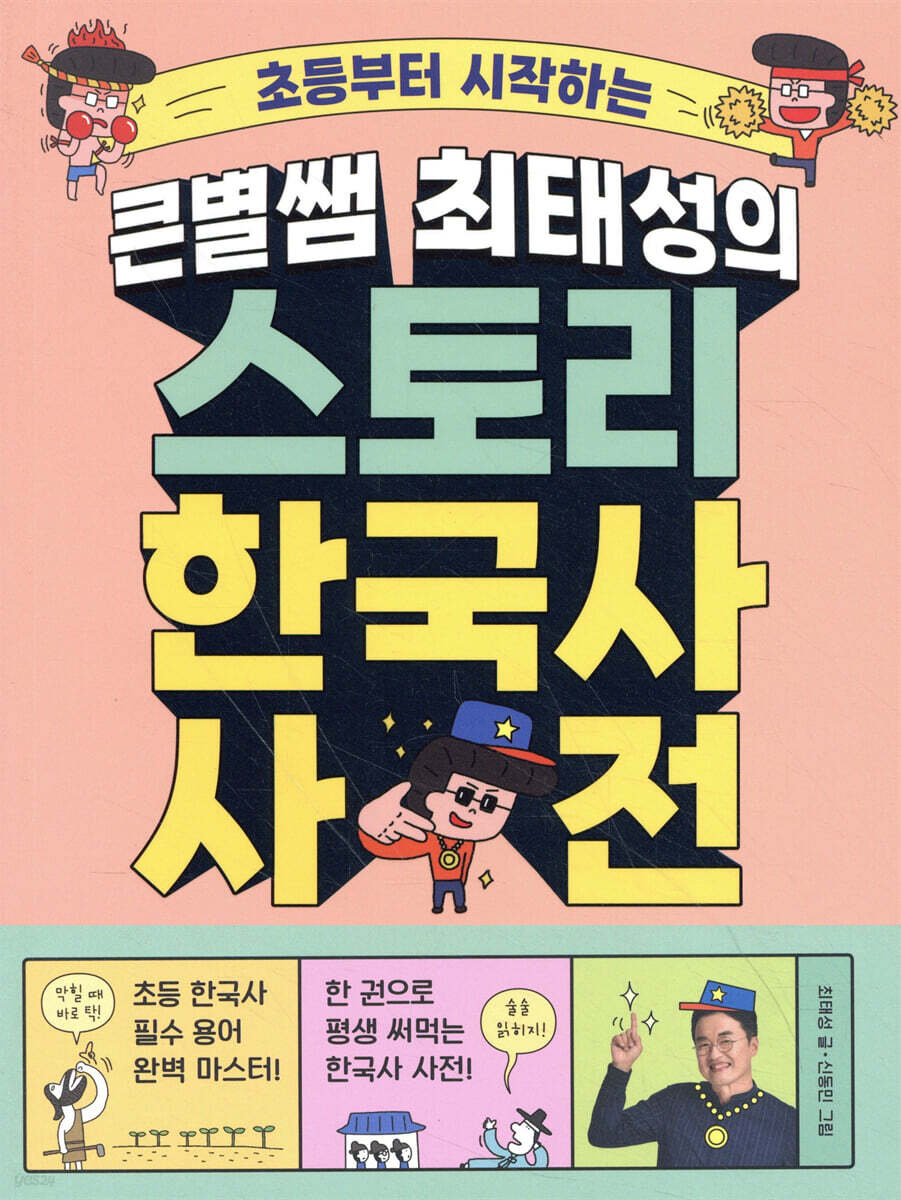
Big Star Teacher Choi Tae-seong's Story Korean History Dictionary
 |
Description
Book Introduction
This one volume is all you need to know about Korean history! A basic book that covers everything from concepts to flow. 『Big Star Teacher Choi Tae-seong's Story Korean History Dictionary』 is a book that organizes essential Korean history terms for elementary and middle school students in a story format according to historical context, so that you can see 'basic concepts all at once, lightly, and without burden, and at a glance'. The vivid, on-the-spot audio of Professor Choi Tae-seong automatically plays, allowing you to explore the flow of Korean history without losing interest until the very end. The dictionary format also makes it easy to read whenever you encounter a difficult concept. Study Korean history from beginning to end for elementary and middle school students! If you must own just one book, this is the one you should choose. |
- You can preview some of the book's contents.
Preview
index
Big Star Teacher's letter
1. The chatter of those holding prehistoric stones begins.
2 The Ancient Han River Title Match Begins
3 Korea and Korea Become One Again
4. We are a country that possesses Hangul during the early Joseon Dynasty.
5 Change the late Joseon Dynasty , change everything
Joseon, the 6th port opening era , dipped its toes into the sea of capitalism.
7 For the independence of Korea during the Japanese colonial period
8 It is written as modern Republic of Korea and read as miracle.
Search
1. The chatter of those holding prehistoric stones begins.
2 The Ancient Han River Title Match Begins
3 Korea and Korea Become One Again
4. We are a country that possesses Hangul during the early Joseon Dynasty.
5 Change the late Joseon Dynasty , change everything
Joseon, the 6th port opening era , dipped its toes into the sea of capitalism.
7 For the independence of Korea during the Japanese colonial period
8 It is written as modern Republic of Korea and read as miracle.
Search
Detailed image

Publisher's Review
Essential Korean history terms for elementary and middle school students, made easy and fun!
A Korean history mentor in the palm of your hand, giving you immediate answers to difficult terms!
Many students who have started serious elementary school studies say that Korean history is a more difficult subject than math.
Why? Because the historical terms used to describe Korean history are all unfamiliar and difficult.
Especially for children today who are not accustomed to using Chinese characters, historical terms cluttered with Chinese characters can feel like each word is a code.
To help these students, Big Star Teacher stepped forward.
We have lowered the threshold for Korean history by providing a dictionary that can be looked up whenever you encounter difficult terms.
Teacher Big Star's Korean History Dictionary is special.
Like a traditional dictionary, it not only provides the meaning of historical terms, but also provides the historical context in which each term came from and tips to help you understand it more easily.
Just by knowing that a dolmen is a ‘heaped stone’, we can understand the shape of a dolmen, and by using the term ‘Eulsa Treaty’ instead of ‘Eulsa Treaty’, we can clarify the nature of the treaty.
The description of King Gogukwon is 'a king who died an unjust death in Goguryeo', and Byeolgigun is interpreted as 'a soldier who handles strange machines', thereby drawing a line between the often confusing King Gogukcheon and King Gogukwon, Byeolmuban and Byeolgigun.
If you're finding your Korean history studies daunting because of difficult terminology, I recommend "Big Star Teacher Choi Tae-seong's Story Korean History Dictionary," a Korean history mentor in the palm of your hand that provides immediate answers.
With Big Star Teacher’s storytelling that captures the flow
Studying Korean history to see both the forest and the trees
Another reason why students find Korean history difficult is that there is too much to memorize.
Trying to cover 5,000 years of history in a short class time leaves both teachers and students breathless.
Eventually, the context of history disappears, and history becomes a subject to be memorized, with only asterisks and underlines left.
Stories that are simply recited without context will soon disappear from memory.
That's why Big Star says that to properly study Korean history, you need to "go with the flow, empathize with the times, and meet the people of that era."
I would say that flow and storytelling will provide a much deeper impression and lesson than fragmented events or content.
That is precisely why this book, “Big Star Teacher Choi Tae-seong’s Story Dictionary of Korean History,” is organized in chronological order rather than alphabetical order.
This book, which centers on the "stories" of "people" and weaves the flow of history, is filled with stories that are sometimes overwhelming and sometimes heartbreaking.
If you follow these stories one by one, by the time you close the last chapter, you will have a clear idea of why and in what direction our history has flowed.
It's also quite fun to catch the flow of the story as if you were reading a novel, and then open the book again to fill in the blanks in the chronology in your head.
To grasp both the flow and the concepts, this one book is enough.
Easy but informative!
One tap a day, a rewarding study experience
Kids these days are accustomed to fast-paced, short content like TikTok, Reels, and Shorts, so they find it incredibly difficult to read long texts. That's probably why so many students choose comics as their introduction to Korean history.
This book is much more fun, informative, and accessible than the comics.
In a short volume that can be read in about a minute, we've packed in the core lectures of Teacher Big Star and the cute and sharp illustrations of author Shin Dong-min.
The 'Big Star Teacher Talk Talk' corner provides additional key information and exciting historical backstories.
With just this one book, you can easily build a foundation of Korean history concepts without any burden, and you can also develop a consistent study habit by reading one chapter a day.
It's also easy to review.
Just by reading the terms in the title, you can grasp the flow of history, and you can also solidify the concept with the short explanations under the title.
It is an illustration that contains complex content in a clear image, so you can re-envision the content without reading the text.
This is a 'nutritious Korean history snack book' perfect for friends who find long breaths burdensome.
One youth, how to live it?
Big Star Teacher's words that give you something to think about!
The reason why Teacher Big Star's class is popular is because he guides students to learn Korean history not only in their heads but also in their hearts.
In this book, too, Teacher Big Star’s unique view of history shines through, as he once said, “Korean history is not a subject to be memorized, but a story to be empathized with.”
There are historical facts here, but also people and perspectives.
The moment Big Star Teacher's gaze falls on him, the Paleolithic hand axe that seemed like nothing special becomes an item on par with a smartphone, and the reduction of the five military camps that were remembered simply as numbers is suddenly visualized as the slumped shoulders of a father who has lost his job.
'If you know this, you're a true history king' is a corner designed to give you a new perspective on history and provide food for thought.
Here, Big Star Teacher represents the tyrants King Uija and Gung Ye, compares King Gwangjong of Goryeo and King Taejong of Joseon, who lived similar lives, and highlights the tragic fates of the martyrs Jang In-hwan and Jeon Myeong-un, who met at the same time and place on the same day with the same goal.
Let's also hear the story of Tak Gyeong-hyeon, a young Korean man who hummed Arirang with sad eyes the day before he became a kamikaze pilot and sacrificed his life for the Japanese emperor.
Readers of this book will be able to continuously ponder the question, “How should we live our youth?” posed by Big Star Teacher, through the diverse lives and choices of historical figures.
A Korean history mentor in the palm of your hand, giving you immediate answers to difficult terms!
Many students who have started serious elementary school studies say that Korean history is a more difficult subject than math.
Why? Because the historical terms used to describe Korean history are all unfamiliar and difficult.
Especially for children today who are not accustomed to using Chinese characters, historical terms cluttered with Chinese characters can feel like each word is a code.
To help these students, Big Star Teacher stepped forward.
We have lowered the threshold for Korean history by providing a dictionary that can be looked up whenever you encounter difficult terms.
Teacher Big Star's Korean History Dictionary is special.
Like a traditional dictionary, it not only provides the meaning of historical terms, but also provides the historical context in which each term came from and tips to help you understand it more easily.
Just by knowing that a dolmen is a ‘heaped stone’, we can understand the shape of a dolmen, and by using the term ‘Eulsa Treaty’ instead of ‘Eulsa Treaty’, we can clarify the nature of the treaty.
The description of King Gogukwon is 'a king who died an unjust death in Goguryeo', and Byeolgigun is interpreted as 'a soldier who handles strange machines', thereby drawing a line between the often confusing King Gogukcheon and King Gogukwon, Byeolmuban and Byeolgigun.
If you're finding your Korean history studies daunting because of difficult terminology, I recommend "Big Star Teacher Choi Tae-seong's Story Korean History Dictionary," a Korean history mentor in the palm of your hand that provides immediate answers.
With Big Star Teacher’s storytelling that captures the flow
Studying Korean history to see both the forest and the trees
Another reason why students find Korean history difficult is that there is too much to memorize.
Trying to cover 5,000 years of history in a short class time leaves both teachers and students breathless.
Eventually, the context of history disappears, and history becomes a subject to be memorized, with only asterisks and underlines left.
Stories that are simply recited without context will soon disappear from memory.
That's why Big Star says that to properly study Korean history, you need to "go with the flow, empathize with the times, and meet the people of that era."
I would say that flow and storytelling will provide a much deeper impression and lesson than fragmented events or content.
That is precisely why this book, “Big Star Teacher Choi Tae-seong’s Story Dictionary of Korean History,” is organized in chronological order rather than alphabetical order.
This book, which centers on the "stories" of "people" and weaves the flow of history, is filled with stories that are sometimes overwhelming and sometimes heartbreaking.
If you follow these stories one by one, by the time you close the last chapter, you will have a clear idea of why and in what direction our history has flowed.
It's also quite fun to catch the flow of the story as if you were reading a novel, and then open the book again to fill in the blanks in the chronology in your head.
To grasp both the flow and the concepts, this one book is enough.
Easy but informative!
One tap a day, a rewarding study experience
Kids these days are accustomed to fast-paced, short content like TikTok, Reels, and Shorts, so they find it incredibly difficult to read long texts. That's probably why so many students choose comics as their introduction to Korean history.
This book is much more fun, informative, and accessible than the comics.
In a short volume that can be read in about a minute, we've packed in the core lectures of Teacher Big Star and the cute and sharp illustrations of author Shin Dong-min.
The 'Big Star Teacher Talk Talk' corner provides additional key information and exciting historical backstories.
With just this one book, you can easily build a foundation of Korean history concepts without any burden, and you can also develop a consistent study habit by reading one chapter a day.
It's also easy to review.
Just by reading the terms in the title, you can grasp the flow of history, and you can also solidify the concept with the short explanations under the title.
It is an illustration that contains complex content in a clear image, so you can re-envision the content without reading the text.
This is a 'nutritious Korean history snack book' perfect for friends who find long breaths burdensome.
One youth, how to live it?
Big Star Teacher's words that give you something to think about!
The reason why Teacher Big Star's class is popular is because he guides students to learn Korean history not only in their heads but also in their hearts.
In this book, too, Teacher Big Star’s unique view of history shines through, as he once said, “Korean history is not a subject to be memorized, but a story to be empathized with.”
There are historical facts here, but also people and perspectives.
The moment Big Star Teacher's gaze falls on him, the Paleolithic hand axe that seemed like nothing special becomes an item on par with a smartphone, and the reduction of the five military camps that were remembered simply as numbers is suddenly visualized as the slumped shoulders of a father who has lost his job.
'If you know this, you're a true history king' is a corner designed to give you a new perspective on history and provide food for thought.
Here, Big Star Teacher represents the tyrants King Uija and Gung Ye, compares King Gwangjong of Goryeo and King Taejong of Joseon, who lived similar lives, and highlights the tragic fates of the martyrs Jang In-hwan and Jeon Myeong-un, who met at the same time and place on the same day with the same goal.
Let's also hear the story of Tak Gyeong-hyeon, a young Korean man who hummed Arirang with sad eyes the day before he became a kamikaze pilot and sacrificed his life for the Japanese emperor.
Readers of this book will be able to continuously ponder the question, “How should we live our youth?” posed by Big Star Teacher, through the diverse lives and choices of historical figures.
GOODS SPECIFICS
- Date of issue: May 2, 2024
- Page count, weight, size: 448 pages | 170*225*30mm
- ISBN13: 9791129711977
- ISBN10: 1129711978
- KC Certification: Certification Type: Conformity Confirmation
You may also like
카테고리
korean


korean

![GQ KOREA Mark (Monthly): December [2025]](http://librairie.coreenne.fr/cdn/shop/files/8ef265dbbfbf186523ed75ba7319009d.jpg?v=1765340328&width=3840)


