

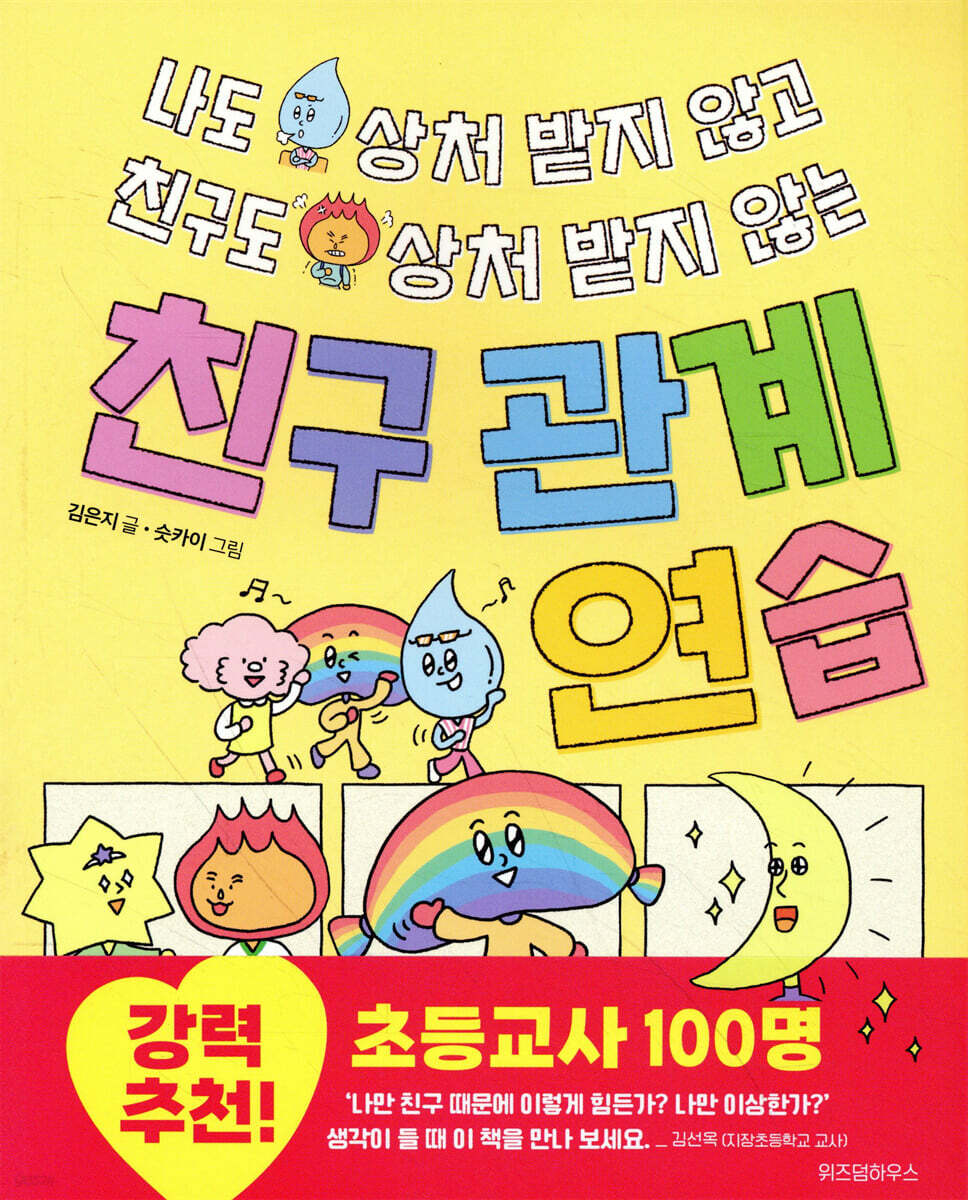
Practice friendships where neither you nor your friend gets hurt
 |
Description
Book Introduction
The sequel to the best-selling book, "Speaking Practice That Doesn't Hurt You or Your Friends"
Highly recommended by 100 elementary school teachers!
"A must-read for elementary school students!" "A huge help in adjusting to the new school year!" "A book children will want to read on their own!" "Speaking Practice: A Guide to Not Hurt Me or My Friends" became an instant bestseller, generating significant interest and acclaim! Building on this enthusiastic response, we present a new story that will foster children's social skills.
This book focuses on 'friendships,' the most difficult problem for children who begin their social life in elementary school.
It guides children, who are still learning the first steps of difficult interpersonal relationships even as adults, to build experiences in forming good relationships.
The author of this book, Dr. Eunji Kim, a specialist in pediatric and adolescent psychiatry, has included in this book her experience counseling many children in the field.
It offers warm empathy and clear advice for children with different friendship concerns depending on their temperament and personality, such as children who are timid and have difficulty approaching friends, children who are too clingy to friends, and children who have no interest in friends at all.
This will be a time to discover the wisdom of making good friends, as the 100 elementary school teachers' pre-evaluation stated, "A book of wisdom that helps you understand your heart and your friend's heart and untangle the tangled threads!"
Highly recommended by 100 elementary school teachers!
"A must-read for elementary school students!" "A huge help in adjusting to the new school year!" "A book children will want to read on their own!" "Speaking Practice: A Guide to Not Hurt Me or My Friends" became an instant bestseller, generating significant interest and acclaim! Building on this enthusiastic response, we present a new story that will foster children's social skills.
This book focuses on 'friendships,' the most difficult problem for children who begin their social life in elementary school.
It guides children, who are still learning the first steps of difficult interpersonal relationships even as adults, to build experiences in forming good relationships.
The author of this book, Dr. Eunji Kim, a specialist in pediatric and adolescent psychiatry, has included in this book her experience counseling many children in the field.
It offers warm empathy and clear advice for children with different friendship concerns depending on their temperament and personality, such as children who are timid and have difficulty approaching friends, children who are too clingy to friends, and children who have no interest in friends at all.
This will be a time to discover the wisdom of making good friends, as the 100 elementary school teachers' pre-evaluation stated, "A book of wisdom that helps you understand your heart and your friend's heart and untangle the tangled threads!"
- You can preview some of the book's contents.
Preview
index
Author's Note
Friendships, practice them like this!
Introducing friends who can share their concerns with you!
Chapter 1: It's Hard to Make Friends
1 I can't approach my friend.
2 My friends don't play with me
3 I think my friends hate me
4 The friend who approached first quickly leaves.
5 I can't join my friends' play
6 I'm the only one without a best friend
Chapter 2 I'm upset because of my friend
1 My friend keeps badmouthing me.
My best friend told me to break up with him.
3 My friends think I'm easy
4 My friend told my secret to another kid.
5 I feel like I always give in to my friends
6 I can't stand my friends playing pranks.
Chapter 3: I'm too attached to my friend.
1 I hate it when my best friend plays with other friends.
2 I'm so annoyed by friends who reply late.
3 It's frustrating when you don't know where your friends are or what they're doing.
4 I want to give everything to my friend, but my friend feels burdened.
5 I feel anxious because I feel like I'm drifting apart from my friends.
6 Things your friends ask you to do become more important than other things.
7 I even lie because I want to date that guy.
Chapter 4 I Don't Want to Make Friends
1 It's most comfortable to play alone
2 There are times when I don't understand my friends' behavior.
3 I'm annoyed because adults keep forcing me to hang out with friends.
4 It's so hard to hang out with a lot of friends.
5 Friends who are too aggressive are burdensome.
6 I don't have any friends I like.
Friendships, practice them like this!
Introducing friends who can share their concerns with you!
Chapter 1: It's Hard to Make Friends
1 I can't approach my friend.
2 My friends don't play with me
3 I think my friends hate me
4 The friend who approached first quickly leaves.
5 I can't join my friends' play
6 I'm the only one without a best friend
Chapter 2 I'm upset because of my friend
1 My friend keeps badmouthing me.
My best friend told me to break up with him.
3 My friends think I'm easy
4 My friend told my secret to another kid.
5 I feel like I always give in to my friends
6 I can't stand my friends playing pranks.
Chapter 3: I'm too attached to my friend.
1 I hate it when my best friend plays with other friends.
2 I'm so annoyed by friends who reply late.
3 It's frustrating when you don't know where your friends are or what they're doing.
4 I want to give everything to my friend, but my friend feels burdened.
5 I feel anxious because I feel like I'm drifting apart from my friends.
6 Things your friends ask you to do become more important than other things.
7 I even lie because I want to date that guy.
Chapter 4 I Don't Want to Make Friends
1 It's most comfortable to play alone
2 There are times when I don't understand my friends' behavior.
3 I'm annoyed because adults keep forcing me to hang out with friends.
4 It's so hard to hang out with a lot of friends.
5 Friends who are too aggressive are burdensome.
6 I don't have any friends I like.
Detailed image

Publisher's Review
“I think my friends hate me.”
“I keep getting swayed by my friends.”
“I’m worried that I’ll approach my friend and be rejected.”
“I don’t have any friends I like.”
A compassionate counseling center that provides solutions to the worries of children struggling with peer issues.
There are many children who are shaken by problems with friends.
A child who complains that he has no friends, a child who worries that his friends will ostracize him, a child who feels anxious because his friends don't do what he wants, a child who gets stressed because his friends drag him around, a child who plays alone because he says he doesn't need friends...
Because they have not yet escaped from self-centered thinking or have not yet developed self-esteem, the process of forming relationships is bound to be awkward.
What advice can we give to children who are just beginning to form relationships?
This book doesn't tell you the answer to solving your friendship problems.
However, it helps us to look at the problem objectively through the main character in the book who has similar concerns, to accurately understand our own mind, and to understand the mind of our friend.
For a child who has been hurt by guessing at a friend's feelings, we teach them that their friend may have his or her own circumstances, and for a child who is suffering because of a friend's mistake, we teach them that they need to express their discomfort accurately.
You can learn the know-how to build strong relationships, such as expressing yourself honestly, being respectful and considerate, and not avoiding negative emotions.
This book is filled with the author's affectionate heart, as he wanted to help children develop healthier friendships, as the wounds of interpersonal relationships experienced in childhood can remain as fears even in adulthood.
When you think, “Am I the only one having a hard time because of my friend?”
A book that provides comfort, encouragement, and builds confidence in friendships.
The book contains 25 friendship concerns carefully selected by the author.
The stories are diverse, including Gru who feels lonely because he feels like he's the only one without a best friend, Sammy who feels upset because he finds out his friend has been badmouthing him, and Byeolnan who feels upset because he always seems to be the one making concessions.
Rather than simply throwing out a problem and focusing on explaining a solution, present a specific situation in a friendly cartoon format, so children can immerse themselves in it and empathize, saying, "Oh! I've been there too!"
It gives comfort and courage to children who are suffering, thinking that they are the only ones going through this, by saying, “I’m not the only one!”
The manga's creator, Sukkai, delicately created the story with lovely characters that embody nature, such as clouds, rainbows, peanuts, and water droplets.
By creating comics with realistic dialogue and scenes, young readers can enrich their reading experience through role-playing activities at home or school.
At the end of each chapter, examples of how the main characters from the comic solved problems based on the counseling content were provided.
When children encounter similar problems, they can get hints on how to find solutions.
Through these exercises, I hope that children will become strong individuals who can confidently make friends, protect themselves, and maintain good relationships.
“I keep getting swayed by my friends.”
“I’m worried that I’ll approach my friend and be rejected.”
“I don’t have any friends I like.”
A compassionate counseling center that provides solutions to the worries of children struggling with peer issues.
There are many children who are shaken by problems with friends.
A child who complains that he has no friends, a child who worries that his friends will ostracize him, a child who feels anxious because his friends don't do what he wants, a child who gets stressed because his friends drag him around, a child who plays alone because he says he doesn't need friends...
Because they have not yet escaped from self-centered thinking or have not yet developed self-esteem, the process of forming relationships is bound to be awkward.
What advice can we give to children who are just beginning to form relationships?
This book doesn't tell you the answer to solving your friendship problems.
However, it helps us to look at the problem objectively through the main character in the book who has similar concerns, to accurately understand our own mind, and to understand the mind of our friend.
For a child who has been hurt by guessing at a friend's feelings, we teach them that their friend may have his or her own circumstances, and for a child who is suffering because of a friend's mistake, we teach them that they need to express their discomfort accurately.
You can learn the know-how to build strong relationships, such as expressing yourself honestly, being respectful and considerate, and not avoiding negative emotions.
This book is filled with the author's affectionate heart, as he wanted to help children develop healthier friendships, as the wounds of interpersonal relationships experienced in childhood can remain as fears even in adulthood.
When you think, “Am I the only one having a hard time because of my friend?”
A book that provides comfort, encouragement, and builds confidence in friendships.
The book contains 25 friendship concerns carefully selected by the author.
The stories are diverse, including Gru who feels lonely because he feels like he's the only one without a best friend, Sammy who feels upset because he finds out his friend has been badmouthing him, and Byeolnan who feels upset because he always seems to be the one making concessions.
Rather than simply throwing out a problem and focusing on explaining a solution, present a specific situation in a friendly cartoon format, so children can immerse themselves in it and empathize, saying, "Oh! I've been there too!"
It gives comfort and courage to children who are suffering, thinking that they are the only ones going through this, by saying, “I’m not the only one!”
The manga's creator, Sukkai, delicately created the story with lovely characters that embody nature, such as clouds, rainbows, peanuts, and water droplets.
By creating comics with realistic dialogue and scenes, young readers can enrich their reading experience through role-playing activities at home or school.
At the end of each chapter, examples of how the main characters from the comic solved problems based on the counseling content were provided.
When children encounter similar problems, they can get hints on how to find solutions.
Through these exercises, I hope that children will become strong individuals who can confidently make friends, protect themselves, and maintain good relationships.
GOODS SPECIFICS
- Date of issue: February 23, 2024
- Page count, weight, size: 120 pages | 292g | 168*210*8mm
- ISBN13: 9791171711321
- ISBN10: 1171711328
You may also like
카테고리
korean


korean

![GQ KOREA Mark (Monthly): December [2025]](http://librairie.coreenne.fr/cdn/shop/files/8ef265dbbfbf186523ed75ba7319009d.jpg?v=1765340328&width=3840)


