

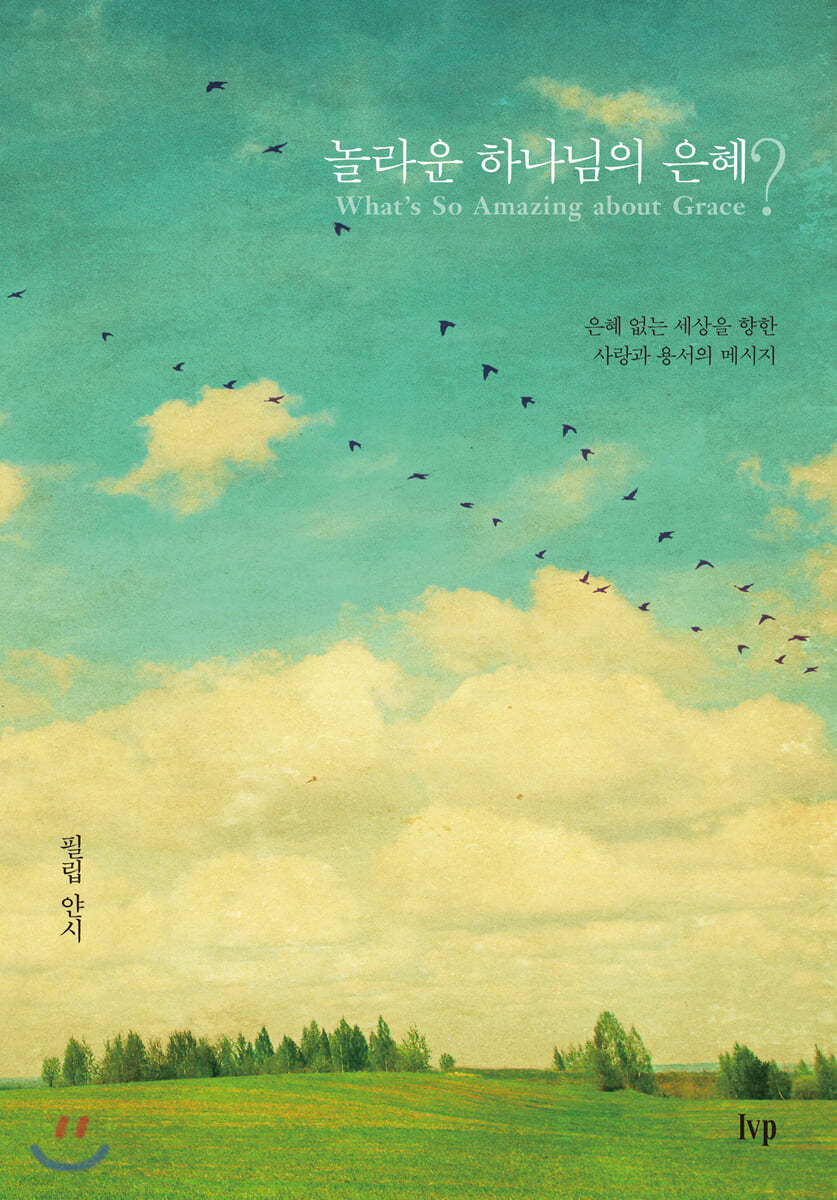
The amazing grace of God?
 |
Description
Book Introduction
The IVP bestseller, "God's Amazing Grace," returns to celebrate its 20th anniversary in Korean.
See you again in a new form.
I am amazed by God's grace!
“Yancey’s writings on the life of grace are arguably his finest work.
Readers of this book will experience tremendous change.”
James Packer, author of "Knowing God"
The bestseller, "The Amazing Grace of God," has been republished with a new cover and text to commemorate the 20th anniversary of its publication in Korean.
This 20th anniversary edition slightly changed the Korean title to "Amazing Grace of God?" to highlight the original work's meaning.
A new cover, a text design that enhances readability, and a preface sent to Korean readers by author Philip Yancey fully capture the vitality and richness of grace.
This book, a masterpiece by Philip Yancey, a spiritual mentor of our time, contains a message of love and forgiveness for a world without grace. It focuses on grace, the theme of the Bible and the pinnacle of faith, for those who wish to know, understand, and practice grace.
It lets us taste the true nature of grace.
The author brings to life the grace that seems to have lost its vitality.
Moreover, through not only biblical parables but also daily examples from his own experiences, he reveals that grace is the only remaining hope in this age.
It challenges us to live the life of grace that God has prepared for us in a cold and harsh world.
See you again in a new form.
I am amazed by God's grace!
“Yancey’s writings on the life of grace are arguably his finest work.
Readers of this book will experience tremendous change.”
James Packer, author of "Knowing God"
The bestseller, "The Amazing Grace of God," has been republished with a new cover and text to commemorate the 20th anniversary of its publication in Korean.
This 20th anniversary edition slightly changed the Korean title to "Amazing Grace of God?" to highlight the original work's meaning.
A new cover, a text design that enhances readability, and a preface sent to Korean readers by author Philip Yancey fully capture the vitality and richness of grace.
This book, a masterpiece by Philip Yancey, a spiritual mentor of our time, contains a message of love and forgiveness for a world without grace. It focuses on grace, the theme of the Bible and the pinnacle of faith, for those who wish to know, understand, and practice grace.
It lets us taste the true nature of grace.
The author brings to life the grace that seems to have lost its vitality.
Moreover, through not only biblical parables but also daily examples from his own experiences, he reveals that grace is the only remaining hope in this age.
It challenges us to live the life of grace that God has prepared for us in a cold and harsh world.
index
To Korean readers
Prologue: The Last Best Word
Part 1: The Lord's Grace is Amazing
Story One: Babette's Feast
1.
A world without grace
2.
A father in love
3.
Grace's unique calculation method
Part 2: Breaking the Chains of Ungrace
Story Two: The Unbreakable Chain
4.
unnatural acts
5.
Why forgiveness?
6.
plural
7.
Armory of Grace
Part 3: The Scent of Discord
Story 3: The House of the Illegitimate Child
8.
reject defective products
9.
Eyes healed by grace
10.
loopholes
11.
Grace aversion
Part 4: Grace's Ornament for a Deaf World
Story Four: Brother Herald
12.
mixed scents
13.
Snake-like wisdom
14.
A dot of blue land
15.
Gravity and Grace
Acknowledgements
main
Prologue: The Last Best Word
Part 1: The Lord's Grace is Amazing
Story One: Babette's Feast
1.
A world without grace
2.
A father in love
3.
Grace's unique calculation method
Part 2: Breaking the Chains of Ungrace
Story Two: The Unbreakable Chain
4.
unnatural acts
5.
Why forgiveness?
6.
plural
7.
Armory of Grace
Part 3: The Scent of Discord
Story 3: The House of the Illegitimate Child
8.
reject defective products
9.
Eyes healed by grace
10.
loopholes
11.
Grace aversion
Part 4: Grace's Ornament for a Deaf World
Story Four: Brother Herald
12.
mixed scents
13.
Snake-like wisdom
14.
A dot of blue land
15.
Gravity and Grace
Acknowledgements
main
Into the book
As I write, I end up playing with words all day long.
I play with words, try to fathom their meaning, break them down into small pieces, and fill my head with them.
Then I discovered that words, like old meat, spoil over time.
The meaning is distorted.
Consider the word 'charity'... I call it 'the last and best word' because in every instance of its use, its original glory remains somewhat alive.
This word stands like a giant rock supporting our proud civilization, reminding us that all good things come not through our own efforts but by God's grace.
Despite today's worldly trends, the fundamentals still point toward grace.
Let's see how this word is used.
Many people say grace before meals, acknowledging their daily bread as a gift from God.
We are grateful for the kindness of others (grateful), happy for good news (gratified), congratulated for success (congratulated), and gracious to guests (gracious).
If you like the service, leave a tip (gratuity).
In all these instances, there is the pure joy of one who has received something more than he deserves.… “Grace is everywhere,” says the dying priest in Georges Bernanos’s novel, Diary of a Country Priest.2 That’s right.
But how often do we just pass by the gospel without listening to it?
---From "The Last Best Words of the Prologue"
It becomes clear that Isaac Dinesen wrote "Babette's Feast" not simply as a story of a fine meal, but as a parable of grace—a gift freely received at the expense of the giver.
What did General Lobenhelm say to the congregation gathered around Babette's table, their faces stern and stiff? We've all heard that grace is something to be found within the universe.
But we humans are foolish and have short vision, so we think that even God's grace is limited.... Only when our eyes are opened do we see and realize the infinity of grace.
Dear ones, grace requires nothing.
All you have to do is wait with faith and acknowledge with gratitude.
Twelve years ago, Babette fell into the hands of ungrateful people.
As Luther's followers, they listened to sermons on grace almost every week, but during the week they tried to win God's favor through piety and asceticism.
Grace came to them in the form of a feast, Babette's feast.
It was a once-in-a-lifetime feast given to those who neither deserved it nor paid for it.
Grace came to Nordbosburg in the same way.
It came freely, without any conditions, at the benefactor's expense.
---From "A Tale of Babette's Feast"
“I grew up with the image of a calculating God who weighs my good and bad deeds on a scale and always finds the shortfall.
A merciful and generous God who breaks the harsh law of unmercifulness.
For some reason, I lived without knowing the God of the Gospel.
God tears up all those calculations and introduces a new calculation of grace, the best word for shock and reversal that leads to unexpected endings.… From the time we were in the playroom, we learn how to succeed in a world of ungrace.
The diligent bird catches the worm, no toil, no gain, nothing in life is free, claim your rights, get what you pay for.
I know these formulas well too.
Because I live by that formula.
I also like to work and win to earn money and assert my rights.
Everyone wants to receive what they deserve, nothing more, nothing less.
But if you listen closely, you will hear the whispers of grace like a roar.
I didn't receive what I deserved.
I, who deserved punishment, was forgiven.
I, who deserved wrath, was loved.
I, who deserved to go to jail for my debt, ended up with a good credit rating.
“I, who should have knelt down and repented under merciless rebuke, received a well-prepared banquet, Babette’s feast.”
---From "Chapter 3: A Different Calculation Method of Grace"
Who are my enemies? A pro-life advocate? A Hollywood producer who corrupts our culture? A politician who threatens moral principles? A drug lord who controls our inner cities? No matter how good my motives, if my political involvement drives out love, I have misunderstood the gospel of Jesus.
They are captive to the law, not the gospel of grace.
The pressing issues facing society are important and the culture war is inevitable.
But Christians must engage in war with different weapons.
We must use Dorothy Day's wonderful words, 'the weapon of mercy.'
Jesus said there is only one mark that sets us apart.
It is neither politically correct nor morally better.
It is love.
In addition, Paul said that without love, no matter what we do—no miracles of faith, no theological foundation, no self-consuming sacrifice—it is all useless (1 Corinthians 13).
I play with words, try to fathom their meaning, break them down into small pieces, and fill my head with them.
Then I discovered that words, like old meat, spoil over time.
The meaning is distorted.
Consider the word 'charity'... I call it 'the last and best word' because in every instance of its use, its original glory remains somewhat alive.
This word stands like a giant rock supporting our proud civilization, reminding us that all good things come not through our own efforts but by God's grace.
Despite today's worldly trends, the fundamentals still point toward grace.
Let's see how this word is used.
Many people say grace before meals, acknowledging their daily bread as a gift from God.
We are grateful for the kindness of others (grateful), happy for good news (gratified), congratulated for success (congratulated), and gracious to guests (gracious).
If you like the service, leave a tip (gratuity).
In all these instances, there is the pure joy of one who has received something more than he deserves.… “Grace is everywhere,” says the dying priest in Georges Bernanos’s novel, Diary of a Country Priest.2 That’s right.
But how often do we just pass by the gospel without listening to it?
---From "The Last Best Words of the Prologue"
It becomes clear that Isaac Dinesen wrote "Babette's Feast" not simply as a story of a fine meal, but as a parable of grace—a gift freely received at the expense of the giver.
What did General Lobenhelm say to the congregation gathered around Babette's table, their faces stern and stiff? We've all heard that grace is something to be found within the universe.
But we humans are foolish and have short vision, so we think that even God's grace is limited.... Only when our eyes are opened do we see and realize the infinity of grace.
Dear ones, grace requires nothing.
All you have to do is wait with faith and acknowledge with gratitude.
Twelve years ago, Babette fell into the hands of ungrateful people.
As Luther's followers, they listened to sermons on grace almost every week, but during the week they tried to win God's favor through piety and asceticism.
Grace came to them in the form of a feast, Babette's feast.
It was a once-in-a-lifetime feast given to those who neither deserved it nor paid for it.
Grace came to Nordbosburg in the same way.
It came freely, without any conditions, at the benefactor's expense.
---From "A Tale of Babette's Feast"
“I grew up with the image of a calculating God who weighs my good and bad deeds on a scale and always finds the shortfall.
A merciful and generous God who breaks the harsh law of unmercifulness.
For some reason, I lived without knowing the God of the Gospel.
God tears up all those calculations and introduces a new calculation of grace, the best word for shock and reversal that leads to unexpected endings.… From the time we were in the playroom, we learn how to succeed in a world of ungrace.
The diligent bird catches the worm, no toil, no gain, nothing in life is free, claim your rights, get what you pay for.
I know these formulas well too.
Because I live by that formula.
I also like to work and win to earn money and assert my rights.
Everyone wants to receive what they deserve, nothing more, nothing less.
But if you listen closely, you will hear the whispers of grace like a roar.
I didn't receive what I deserved.
I, who deserved punishment, was forgiven.
I, who deserved wrath, was loved.
I, who deserved to go to jail for my debt, ended up with a good credit rating.
“I, who should have knelt down and repented under merciless rebuke, received a well-prepared banquet, Babette’s feast.”
---From "Chapter 3: A Different Calculation Method of Grace"
Who are my enemies? A pro-life advocate? A Hollywood producer who corrupts our culture? A politician who threatens moral principles? A drug lord who controls our inner cities? No matter how good my motives, if my political involvement drives out love, I have misunderstood the gospel of Jesus.
They are captive to the law, not the gospel of grace.
The pressing issues facing society are important and the culture war is inevitable.
But Christians must engage in war with different weapons.
We must use Dorothy Day's wonderful words, 'the weapon of mercy.'
Jesus said there is only one mark that sets us apart.
It is neither politically correct nor morally better.
It is love.
In addition, Paul said that without love, no matter what we do—no miracles of faith, no theological foundation, no self-consuming sacrifice—it is all useless (1 Corinthians 13).
---From "Chapter 13: Snake-like Wisdom"
Publisher's Review
The great reformation of Christianity was not accomplished by discovering new things.
It happens when someone sees something that already exists in a completely different way.
Now is the time to see God's grace anew.
A must-read for those who want to experience God's grace with their heart, not just their head!
In an age when grace has disappeared even from the church,
Encounter God's amazing grace again!
20th Anniversary Edition of the Korean Version!
Philip Yancey, the greatest evangelical writer of our time who has won the ECPA's "Best Book of the Year" award six times, is a representative evangelical writer. In "Amazing Grace of God?", the author, who has been exploring alternatives to the clichés of the church with a sharp sense of problem and a dynamic writing style, brings the grace that has lost its vitality back to reality.
The theme that runs through the Bible and is the pinnacle of Christian faith is 'grace', which is received without cost.
However, the reality of conflict and strife between nations, races, classes, and generations, and the prevalence of unmerited grace even within the church, raises the question of whether grace is still valid in this age.
Author Philip Yancey brings us to this serious crossroads, as if asking, "What would you do?" through stories of his own personal experiences and vivid retellings of biblical parables.
The author's sharp and penetrating writing style and meticulous, persistent analysis bring grace, which has been reduced to an abstract word and has lost its vitality, back to reality, ultimately revealing that grace is the only remaining hope and the best word in this age.
I wrote this book from the perspective of an American who grew up in the American South.
There I attended a legalistic church steeped in a racist culture.
I began to see the tragic consequences of ungrace, a life without grace, both in the church and in the culture.
The area I lived in continued to chew on the blatant injustices left over from the Civil War, like a dog chewing on a bone.
White people resented losing their special status, while Black people harbored resentment over their history of slavery and exploitation.
Unfortunately, the church I attended talked a lot about sexual purity, but did little to heal those wounds.
If I were Korean, I would have written the book differently.
Of course, I too had to experience the war that broke out in Korea and the horrors and threats that followed.
In any case, I think that in Korea, too, the lack of grace has penetrated deeper than the obvious conflict.
I see this lack of grace in the divisions of the Korean church.
They say there are over a hundred Presbyterian denominations in Korean churches.
I also saw this lack of grace in Korea's status culture, which, like in the United States, values individuals based on degrees, success, and achievements.
In it, those who have not achieved anything feel a sense of failure.
I also saw the ungracefulness in the pressure to grade students, even children, in the name of achieving success.
But ultimately, Koreans, Americans, Russians, Chinese, and Brazilians all share a common hunger for grace.
In the parable of the prodigal son told by Jesus, there are two sons.
One was obedient and honest, but the other was a squanderer of his life.
Grace is a free gift from God, but we must reach out to receive it.
Otherwise, the gift will fall to the ground.
The brother in Jesus' story clenched his fist and did not open his hand.
There was resentment in his hands.
On the other hand, the irresponsible younger brother had no choice but to make excuses for his actions.
Rather, I had no choice but to reach out.
If you are a reader who feels abandoned or left behind, a reader who feels left behind in a competitive society, grace is for you.
If you are one of those successful people who is tempted to congratulate yourself and judge others, grace is for you.
Knowing grace is the first step to knowing God.
Because the Bible tells us, “For by grace you have been saved through faith.”
You cannot know God without grace.
-From 'To Korean Readers'
It happens when someone sees something that already exists in a completely different way.
Now is the time to see God's grace anew.
A must-read for those who want to experience God's grace with their heart, not just their head!
In an age when grace has disappeared even from the church,
Encounter God's amazing grace again!
20th Anniversary Edition of the Korean Version!
Philip Yancey, the greatest evangelical writer of our time who has won the ECPA's "Best Book of the Year" award six times, is a representative evangelical writer. In "Amazing Grace of God?", the author, who has been exploring alternatives to the clichés of the church with a sharp sense of problem and a dynamic writing style, brings the grace that has lost its vitality back to reality.
The theme that runs through the Bible and is the pinnacle of Christian faith is 'grace', which is received without cost.
However, the reality of conflict and strife between nations, races, classes, and generations, and the prevalence of unmerited grace even within the church, raises the question of whether grace is still valid in this age.
Author Philip Yancey brings us to this serious crossroads, as if asking, "What would you do?" through stories of his own personal experiences and vivid retellings of biblical parables.
The author's sharp and penetrating writing style and meticulous, persistent analysis bring grace, which has been reduced to an abstract word and has lost its vitality, back to reality, ultimately revealing that grace is the only remaining hope and the best word in this age.
I wrote this book from the perspective of an American who grew up in the American South.
There I attended a legalistic church steeped in a racist culture.
I began to see the tragic consequences of ungrace, a life without grace, both in the church and in the culture.
The area I lived in continued to chew on the blatant injustices left over from the Civil War, like a dog chewing on a bone.
White people resented losing their special status, while Black people harbored resentment over their history of slavery and exploitation.
Unfortunately, the church I attended talked a lot about sexual purity, but did little to heal those wounds.
If I were Korean, I would have written the book differently.
Of course, I too had to experience the war that broke out in Korea and the horrors and threats that followed.
In any case, I think that in Korea, too, the lack of grace has penetrated deeper than the obvious conflict.
I see this lack of grace in the divisions of the Korean church.
They say there are over a hundred Presbyterian denominations in Korean churches.
I also saw this lack of grace in Korea's status culture, which, like in the United States, values individuals based on degrees, success, and achievements.
In it, those who have not achieved anything feel a sense of failure.
I also saw the ungracefulness in the pressure to grade students, even children, in the name of achieving success.
But ultimately, Koreans, Americans, Russians, Chinese, and Brazilians all share a common hunger for grace.
In the parable of the prodigal son told by Jesus, there are two sons.
One was obedient and honest, but the other was a squanderer of his life.
Grace is a free gift from God, but we must reach out to receive it.
Otherwise, the gift will fall to the ground.
The brother in Jesus' story clenched his fist and did not open his hand.
There was resentment in his hands.
On the other hand, the irresponsible younger brother had no choice but to make excuses for his actions.
Rather, I had no choice but to reach out.
If you are a reader who feels abandoned or left behind, a reader who feels left behind in a competitive society, grace is for you.
If you are one of those successful people who is tempted to congratulate yourself and judge others, grace is for you.
Knowing grace is the first step to knowing God.
Because the Bible tells us, “For by grace you have been saved through faith.”
You cannot know God without grace.
-From 'To Korean Readers'
GOODS SPECIFICS
- Date of issue: February 25, 2020
- Page count, weight, size: 376 pages | 140*200*30mm
- ISBN13: 9788932817309
- ISBN10: 8932817308
You may also like
카테고리
korean


korean

![GQ KOREA Mark (Monthly): December [2025]](http://librairie.coreenne.fr/cdn/shop/files/8ef265dbbfbf186523ed75ba7319009d.jpg?v=1765340328&width=3840)


