

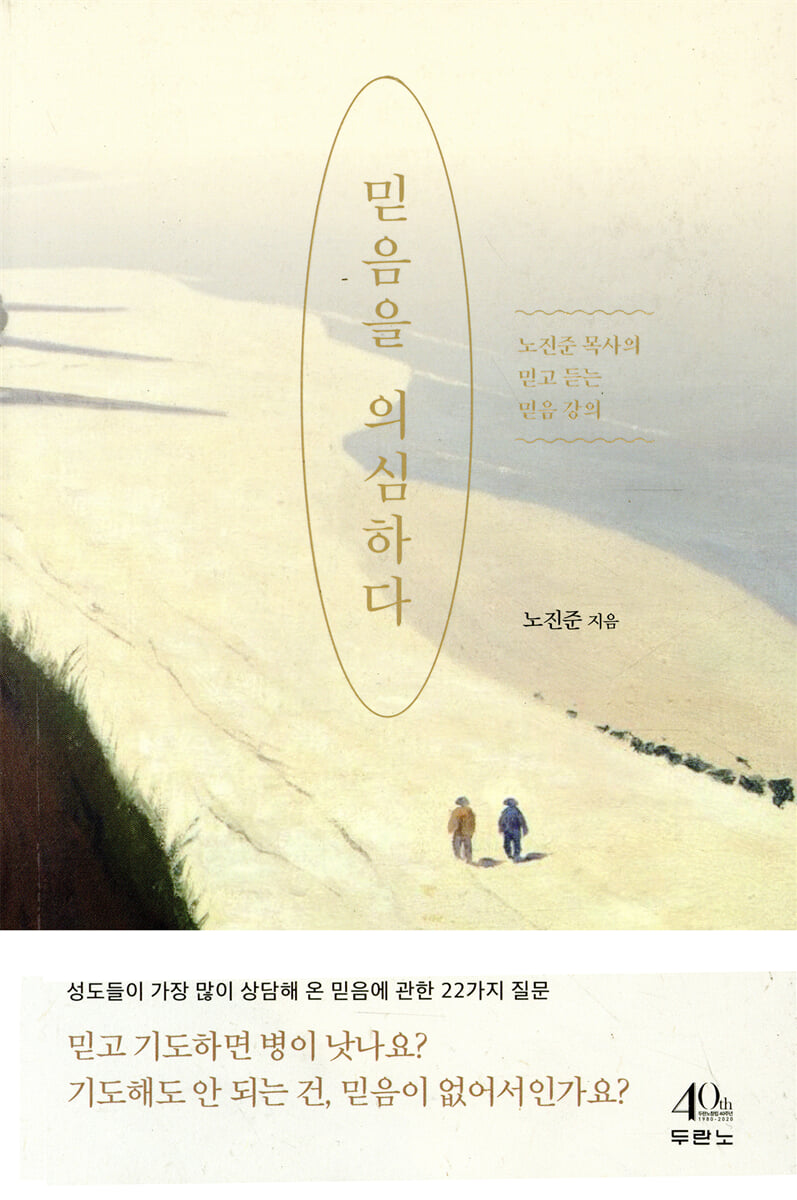
doubt one's faith
 |
Description
Book Introduction
22 Questions About Faith Most Frequently Asked by Believers Is it okay to just believe? Is it really okay to believe? Misunderstandings and ambiguities about the belief that the tail is chasing its own tail You just have to believe, but it's not something you just have to believe. Rebuilding Biblical Faith from the Errors of My Beliefs! It is time to redefine faith. “Do you believe that?” “Do you understand that story?” These are questions that Pastor Jinjun Noh frequently asks during his sermons. It is no exaggeration to say that these questions are the starting point of the message the author, as a preacher, delivers to the audience and the core of the sermon. Christians living in modern times are bound to face numerous problems that make them question their faith or make it difficult to understand reality, amidst the gap between life and faith, knowledge and life. Perhaps faith is a continuation of this continuous process of asking God and seeking answers without giving up until the very end. Pastor Noh Jin-jun says that faith is a journey. The author immigrated to the United States during high school, majored in theology, and then studied apologetics while serving as a Korean pastor for a long time. The author's sermons, based on his ability to communicate empathically, accurately inform people about God and have the power to lead them back to God. So, there is a lot of interest in restoring the intention of what the Bible is trying to say, and many counseling sessions with believers also focus on restoration in this area. The author, who is known for his apologetic preaching, says, “We must break the mold and provide a platform for believers to reaffirm what they take for granted.” If you have any questions, raise them as they arise, and if there is anything you do not understand, raise the question. At this point, empathy, acceptance, and hospitality are formed, and we hear the principles of faith that God speaks to us. The 22 questions about faith addressed in this book are thoroughly focused on “remembering Christ.” These questions ultimately lead us to understand the essence of faith and God's intentions, and they allow us to examine the true face of our faith, which is currently focused on the phenomena and results of faith. But the author's message, anchored in the authority of Scripture and the grace of God, confronts us with compromised and packaged false beliefs, yet comforts and challenges us, guiding us to seek answers from the Lord. There is a power that moves us from doubt to certainty, and from certainty to love and obedience to the Lord. So, as I read the author's writing, my heart becomes warm and I become convinced that the Lord is close to us who ask questions. Each chapter includes key points highlighted by the author and questions for sharing based on these points in small groups. |
- You can preview some of the book's contents.
Preview
index
introduction
Part 1: Why is faith necessary?
01 Can we be saved just by believing?
02 How do we live by faith alone?
03 Is there dead faith?
04 Is it true that faith is wavering?
05 Is there anything that a believer cannot do?
06 Is faith a gift?
07 Is your faith growing?
08 What is faith as small as a mustard seed?
09 Does a person who doubts have little faith?
10 Is the opposite of faith doubt?
11 Are there strong faith and weak faith?
12 Do I have to believe that what I pray for will be received?
Part 2: How to Keep the Faith
13 Is temporary faith possible for an unbeliever?
14 Can I be saved even if I don't believe in the virgin birth?
15 If you keep hearing it, will you start to believe it?
16 Is faith visible?
17 If I pray with faith, will I be healed?
18 Can faith be called a 'gift'?
19 What does it mean to be yoked with unbelievers?
20 Isn't the testing of one's faith doubting?
21 Why are those who have not seen and yet have believed blessed?
22 How can we keep our faith until the Lord comes?
Part 1: Why is faith necessary?
01 Can we be saved just by believing?
02 How do we live by faith alone?
03 Is there dead faith?
04 Is it true that faith is wavering?
05 Is there anything that a believer cannot do?
06 Is faith a gift?
07 Is your faith growing?
08 What is faith as small as a mustard seed?
09 Does a person who doubts have little faith?
10 Is the opposite of faith doubt?
11 Are there strong faith and weak faith?
12 Do I have to believe that what I pray for will be received?
Part 2: How to Keep the Faith
13 Is temporary faith possible for an unbeliever?
14 Can I be saved even if I don't believe in the virgin birth?
15 If you keep hearing it, will you start to believe it?
16 Is faith visible?
17 If I pray with faith, will I be healed?
18 Can faith be called a 'gift'?
19 What does it mean to be yoked with unbelievers?
20 Isn't the testing of one's faith doubting?
21 Why are those who have not seen and yet have believed blessed?
22 How can we keep our faith until the Lord comes?
Into the book
To believe means to agree that Jesus is the Son of God and to trust and follow what he says.
So paradoxically, you just have to believe, but you don't have to believe.
Because intelligent agreement presupposes trust.
…It is time to reaffirm that faith is not simply an intellectual assent, but an intellectual assent to believe that true salvation comes when Jesus Christ is the Son of God and is the Lord of our lives, and to trust Him completely.
--- p.20~21
Ultimately, it becomes a question of perspective whether faith is seen as an act of human obedience or an act of Christ's obedience.
However, the Bible calls the viewpoint of Christ's obedient actions 'faith.'
The statement, “You will be saved if you just believe” should not be understood to mean, “You will be saved if you just say you believe” or “You will be saved if you just admit that you believe.”
Rather, it should be taken to mean 'only through the obedience of Christ.'
This involves elements of both intellectual agreement and trust.
But what is clear is that the basis of our salvation is not the state of our hearts, but the obedience of Christ.
This is grace.
So, if you just believe, you will be saved.
--- p.26
Dead faith is not faith.
Moreover, James said that faith without works is dead (James 2:26).
Therefore, it was possible to make the logical leap that one cannot be saved without works, and that works are the means to salvation.
But James did not say, "How can we be saved?" but rather, "How can our faith be active?"
In other words, I am talking about a way to show that faith is alive.
--- p.45
They say they believe but have no faith.
The contrast is a little clearer in the English Bible.
“I believe; help my unbelief!” (ESV).
This is not a contradiction, but a paradox.
It doesn't mean that you have half and half faith, half and half disbelief, or that you believe and half and half but it refers to a state of tension where you believe completely but are still anxious and unsure.
--- p.65
The cry of the Father, “I believe; help my unbelief,” is not the cry of an unbeliever.
It is the cry of a person who tries to live by faith because he believes.
In the phrase “I clearly believe, so why am I so uneasy?” the word “clearly” is not a lie or hypocrisy.
Even the most sincere confessions can be unsettling.
It's like when you're sitting on a boat at sea, it's natural for the boat to rock back and forth with the waves, but when it rocks violently, you get anxious as if the boat might capsize (even if you're sure it won't).
Even though the confession of faith is a one-time event, it is only the beginning of the journey of faith.
Faith is a beginning, even if it is the most certain beginning and the outcome is very clear.
If we say that faith is the end, the time from the moment we begin to believe until the moment the Lord calls us can easily become a meaningless blank space.
--- p.68
It is not that human willful decision is an absolute condition without which even God cannot do anything, but rather that it is a condition required by God, who has already accomplished the work, to confirm the relationship and for the saints to enjoy within that relationship.
Therefore, the demand for faith is a demand for love.
In this sense, the command and demand to “believe” is actually a gift and a confirmation of the gift.
But at the same time, we cannot ignore or neglect God's call to "believe" and to make a decision of our own will.
Responding to the Lord's request with a sincere heart will bring joy to God and infinite blessing to us.
--- p.96
The phrase 'of little faith' means someone who is shaken by the waves in the situation at the time.
The phrase, “Did you doubt?” is not a rebuke, but rather a description of the state of mind at the time.
So, this does not mean that Peter originally had less faith than the other disciples, but rather that he wavered in that situation.
When we stand before tribulation, we are shaken dozens of times a day.
Even those who are courageous in the face of adversity may waver and lose their composure when faced with temptation.
That moment of sway is a state of little faith.
So, it is not that there are people with little faith, but rather that everyone experiences a state of little faith.
--- p.134~135
The phrase, “Believe and doubt nothing” does not mean to find peace of mind, but to not lose sight of God’s goodness in the midst of suffering.
A state of not having any doubts in the midst of suffering does not mean a peaceful (or indifferent) state with little feeling, but rather a state of holding on tightly to the good God.
The words, “Ask in faith, nothing wavering,” do not mean that we should believe that what we ask will be granted, but rather that we should not waver in our belief in God’s goodness and tell God about all our circumstances and situations.
--- p.151~152
Jesus is the one who has mercy on us, the one who can solve our problems, and the Messiah.
Jesus did not come to heal the sick, but to have mercy on us, free us from sin, and give us eternal life.
So the Lord showed that Christ is the Messiah through healing the sick.
Because the Lord had mercy on us.
But when Jesus healed the sick, faith was mentioned.
This faith is not the faith that leads to salvation.
This faith is a kind of confidence that Jesus can heal the sick.
Therefore, the Gospel does not see this faith as the faith that leads to salvation, but rather as the faith that begins to look to the Lord so that one can attain that faith.
With this belief, you may not be healed and may not be saved.
So, theologically, this faith is sometimes called ‘working faith’ to distinguish it from ‘saving faith.’
--- p.196
Vaguely hoping that God will make things work out for us is not the reality of what we hope for.
The reality of what we hope for is Jesus Christ, the proof of God's love who is with us without change, no matter what the circumstances.
We have already seen Christ come to this earth through the Word and through the inspiration of the Holy Spirit.
We have the substance of things hoped for, and have seen the evidence of things not seen.
So, we are united with Christ and are walking with Christ on this earth now.
--- p.243
The question, “What do Christians believe and what do they pursue?” was a truly serious one for Paul.
Because that is the essence of faith.
I believe that in order to understand what Paul is trying to say, we need to delve deeper into the "Christian identity" that Paul is ultimately concerned with.
Otherwise, this issue could devolve into a discourse of speculative religious practice.
This is a question that belongs to the essence of faith.
In other words, the essence of faith is that Christians are not simply people who go to heaven when they die, but people who live as sojourners on this earth precisely because of that hope.
So paradoxically, you just have to believe, but you don't have to believe.
Because intelligent agreement presupposes trust.
…It is time to reaffirm that faith is not simply an intellectual assent, but an intellectual assent to believe that true salvation comes when Jesus Christ is the Son of God and is the Lord of our lives, and to trust Him completely.
--- p.20~21
Ultimately, it becomes a question of perspective whether faith is seen as an act of human obedience or an act of Christ's obedience.
However, the Bible calls the viewpoint of Christ's obedient actions 'faith.'
The statement, “You will be saved if you just believe” should not be understood to mean, “You will be saved if you just say you believe” or “You will be saved if you just admit that you believe.”
Rather, it should be taken to mean 'only through the obedience of Christ.'
This involves elements of both intellectual agreement and trust.
But what is clear is that the basis of our salvation is not the state of our hearts, but the obedience of Christ.
This is grace.
So, if you just believe, you will be saved.
--- p.26
Dead faith is not faith.
Moreover, James said that faith without works is dead (James 2:26).
Therefore, it was possible to make the logical leap that one cannot be saved without works, and that works are the means to salvation.
But James did not say, "How can we be saved?" but rather, "How can our faith be active?"
In other words, I am talking about a way to show that faith is alive.
--- p.45
They say they believe but have no faith.
The contrast is a little clearer in the English Bible.
“I believe; help my unbelief!” (ESV).
This is not a contradiction, but a paradox.
It doesn't mean that you have half and half faith, half and half disbelief, or that you believe and half and half but it refers to a state of tension where you believe completely but are still anxious and unsure.
--- p.65
The cry of the Father, “I believe; help my unbelief,” is not the cry of an unbeliever.
It is the cry of a person who tries to live by faith because he believes.
In the phrase “I clearly believe, so why am I so uneasy?” the word “clearly” is not a lie or hypocrisy.
Even the most sincere confessions can be unsettling.
It's like when you're sitting on a boat at sea, it's natural for the boat to rock back and forth with the waves, but when it rocks violently, you get anxious as if the boat might capsize (even if you're sure it won't).
Even though the confession of faith is a one-time event, it is only the beginning of the journey of faith.
Faith is a beginning, even if it is the most certain beginning and the outcome is very clear.
If we say that faith is the end, the time from the moment we begin to believe until the moment the Lord calls us can easily become a meaningless blank space.
--- p.68
It is not that human willful decision is an absolute condition without which even God cannot do anything, but rather that it is a condition required by God, who has already accomplished the work, to confirm the relationship and for the saints to enjoy within that relationship.
Therefore, the demand for faith is a demand for love.
In this sense, the command and demand to “believe” is actually a gift and a confirmation of the gift.
But at the same time, we cannot ignore or neglect God's call to "believe" and to make a decision of our own will.
Responding to the Lord's request with a sincere heart will bring joy to God and infinite blessing to us.
--- p.96
The phrase 'of little faith' means someone who is shaken by the waves in the situation at the time.
The phrase, “Did you doubt?” is not a rebuke, but rather a description of the state of mind at the time.
So, this does not mean that Peter originally had less faith than the other disciples, but rather that he wavered in that situation.
When we stand before tribulation, we are shaken dozens of times a day.
Even those who are courageous in the face of adversity may waver and lose their composure when faced with temptation.
That moment of sway is a state of little faith.
So, it is not that there are people with little faith, but rather that everyone experiences a state of little faith.
--- p.134~135
The phrase, “Believe and doubt nothing” does not mean to find peace of mind, but to not lose sight of God’s goodness in the midst of suffering.
A state of not having any doubts in the midst of suffering does not mean a peaceful (or indifferent) state with little feeling, but rather a state of holding on tightly to the good God.
The words, “Ask in faith, nothing wavering,” do not mean that we should believe that what we ask will be granted, but rather that we should not waver in our belief in God’s goodness and tell God about all our circumstances and situations.
--- p.151~152
Jesus is the one who has mercy on us, the one who can solve our problems, and the Messiah.
Jesus did not come to heal the sick, but to have mercy on us, free us from sin, and give us eternal life.
So the Lord showed that Christ is the Messiah through healing the sick.
Because the Lord had mercy on us.
But when Jesus healed the sick, faith was mentioned.
This faith is not the faith that leads to salvation.
This faith is a kind of confidence that Jesus can heal the sick.
Therefore, the Gospel does not see this faith as the faith that leads to salvation, but rather as the faith that begins to look to the Lord so that one can attain that faith.
With this belief, you may not be healed and may not be saved.
So, theologically, this faith is sometimes called ‘working faith’ to distinguish it from ‘saving faith.’
--- p.196
Vaguely hoping that God will make things work out for us is not the reality of what we hope for.
The reality of what we hope for is Jesus Christ, the proof of God's love who is with us without change, no matter what the circumstances.
We have already seen Christ come to this earth through the Word and through the inspiration of the Holy Spirit.
We have the substance of things hoped for, and have seen the evidence of things not seen.
So, we are united with Christ and are walking with Christ on this earth now.
--- p.243
The question, “What do Christians believe and what do they pursue?” was a truly serious one for Paul.
Because that is the essence of faith.
I believe that in order to understand what Paul is trying to say, we need to delve deeper into the "Christian identity" that Paul is ultimately concerned with.
Otherwise, this issue could devolve into a discourse of speculative religious practice.
This is a question that belongs to the essence of faith.
In other words, the essence of faith is that Christians are not simply people who go to heaven when they die, but people who live as sojourners on this earth precisely because of that hope.
--- p.282
Publisher's Review
In the preface
“Just believe.
There is a paradox in faith that it always seems to return to the same place, as if the most unpleasant answer, “That’s what faith is,” turns out to be the right answer we arrive at after wandering around in search of the right answer.
We have within us the paradox of certainty and ambiguity in the words of the father who came to the Lord to heal his son: “I believe; help my faith.”
There is a sense of intellectual and ethical arrogance within us that we should believe without question, yet we oversimplify things and confidently claim to believe them as if we had grasped some profound truth.
For modern people, who are not accustomed to tension, faith can seem like an obstacle to maintaining the tension that comes with being both an evangelist and a seeker.
While doing pastoral work, I received many questions about faith.
At this point, after finishing my ministry, I would like to be able to say, "I wrestled with so many questions and found the answers, and here are the answers I've summarized."
But looking back, I only think that the answer was short, and I can only confess that I still don't know.
The only consolation is the excuse, not the excuse, that it's natural not to know the answer.
…
As I share these questions with you, what I have in mind is a desire to know and love God more.
I miss God so much.
On a day when the word faith will have little meaning, I want to learn from Him, in direct fellowship with Him, before Him.
“Just believe.
There is a paradox in faith that it always seems to return to the same place, as if the most unpleasant answer, “That’s what faith is,” turns out to be the right answer we arrive at after wandering around in search of the right answer.
We have within us the paradox of certainty and ambiguity in the words of the father who came to the Lord to heal his son: “I believe; help my faith.”
There is a sense of intellectual and ethical arrogance within us that we should believe without question, yet we oversimplify things and confidently claim to believe them as if we had grasped some profound truth.
For modern people, who are not accustomed to tension, faith can seem like an obstacle to maintaining the tension that comes with being both an evangelist and a seeker.
While doing pastoral work, I received many questions about faith.
At this point, after finishing my ministry, I would like to be able to say, "I wrestled with so many questions and found the answers, and here are the answers I've summarized."
But looking back, I only think that the answer was short, and I can only confess that I still don't know.
The only consolation is the excuse, not the excuse, that it's natural not to know the answer.
…
As I share these questions with you, what I have in mind is a desire to know and love God more.
I miss God so much.
On a day when the word faith will have little meaning, I want to learn from Him, in direct fellowship with Him, before Him.
GOODS SPECIFICS
- Publication date: February 19, 2020
- Page count, weight, size: 332 pages | 340g | 125*185*30mm
- ISBN13: 9788953136779
- ISBN10: 8953136776
You may also like
카테고리
korean


korean

![GQ KOREA Mark (Monthly): December [2025]](http://librairie.coreenne.fr/cdn/shop/files/8ef265dbbfbf186523ed75ba7319009d.jpg?v=1765340328&width=3840)


