

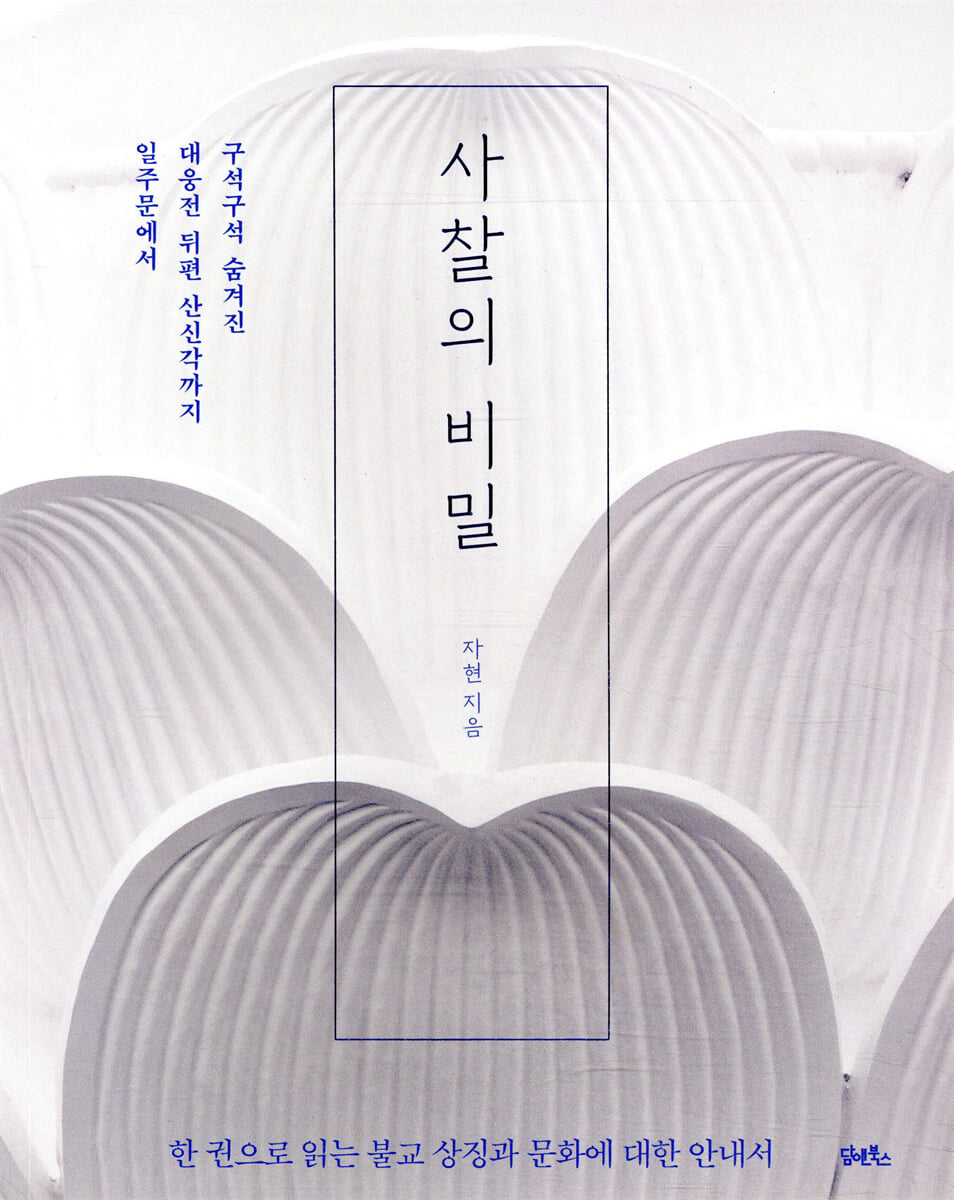
Secrets of the Temple
 |
Description
Book Introduction
Revised edition of Buddhist bestseller "Secrets of the Temple" published
Added more colorful images and detailed and detailed glossary of terms.
A comprehensive guide to Buddhist culture and temples in one volume.
- Why are there multiple Buddhas in the temple instead of just one?
- How can we know when a pavilion or tower was built?
- What does the string attached to the pavilion mean?
- Why are there so many animal sculptures and paintings inside the pavilion?
- Why do we offer rice or candles in front of Buddha?
- Why are Samshin Halmi and King Yeomra at the temple?
These are the scenes we see without thinking when we go to a temple, but since no one explains them, we end up forgetting the questions.
However, it is difficult for Buddhism alone to provide an answer to this question.
Buddhism, which has taken root in this land, has already accumulated weight over a long period of 2,600 years.
Besides, it's a long way from India, through China, to the Korean Peninsula.
Therefore, in order to properly view the scenery in the temple, various tools are needed.
Most of the books published so far have explained only Buddhist doctrines or focused only on changes in form.
Of course, there are many cases where incorrect information is repeatedly produced.
But this book is different.
Using Buddhism, which originated in India, as the warp and the indigenous ideas of immortality and folk beliefs as the warp, this book provides a comprehensive explanation of the temples that have silently preserved their place, crossing over history and culture.
Sometimes, we had to go beyond India to Greece and Rome, or even beyond Confucianism and Taoism, and even to Christianity and Islam.
Added more colorful images and detailed and detailed glossary of terms.
A comprehensive guide to Buddhist culture and temples in one volume.
- Why are there multiple Buddhas in the temple instead of just one?
- How can we know when a pavilion or tower was built?
- What does the string attached to the pavilion mean?
- Why are there so many animal sculptures and paintings inside the pavilion?
- Why do we offer rice or candles in front of Buddha?
- Why are Samshin Halmi and King Yeomra at the temple?
These are the scenes we see without thinking when we go to a temple, but since no one explains them, we end up forgetting the questions.
However, it is difficult for Buddhism alone to provide an answer to this question.
Buddhism, which has taken root in this land, has already accumulated weight over a long period of 2,600 years.
Besides, it's a long way from India, through China, to the Korean Peninsula.
Therefore, in order to properly view the scenery in the temple, various tools are needed.
Most of the books published so far have explained only Buddhist doctrines or focused only on changes in form.
Of course, there are many cases where incorrect information is repeatedly produced.
But this book is different.
Using Buddhism, which originated in India, as the warp and the indigenous ideas of immortality and folk beliefs as the warp, this book provides a comprehensive explanation of the temples that have silently preserved their place, crossing over history and culture.
Sometimes, we had to go beyond India to Greece and Rome, or even beyond Confucianism and Taoism, and even to Christianity and Islam.
- You can preview some of the book's contents.
Preview
index
Chapter 1
The prose opens and a name is born
01. Why did the monk go to the mountain?
The story of Sansa, the representative name of the temple
02. The temple was not just a place for prayer and practice.
The diverse functions of temples, including Bibo Temple, Yeokcham Temple, and Neungchim Temple
03. There are also principles when naming temples.
The names of temples vary depending on their size and structure, such as sa, won, hermitage, cave, and nanya.
Chapter 2
From Iljumun to Daeungjeon
04. From here on out, it's a temple, so everyone get off your horses.
Hamabi and Danggan at the temple entrance
05. How did Indian makeup culture become part of Buddhism?
Burial and cremation
06. What meaning is hidden in the door without a wall?
The structure and meaning of the temple's three gates
07. Why are all the floors of the tower odd?
Principles of Tower Construction
08. Can you tell when a tower was built by looking at its shape?
How to Distinguish Pagodas from Unified Silla, Goryeo, and Joseon
09. The stone lantern had no lighting function.
The story of the stone lanterns that adorn the temple grounds
Chapter 3
The layout and grandeur of the pavilion
10. There are principles for Garam placement.
Pavilions arranged in a straight line
11. Why are there so many buildings and Buddhas in the temple?
Central and subsidiary pavilions
12. There is a hidden pavilion in the temple.
Sanshin-gak, Dokseonggak, Chilseonggak
13. A temple is more precious than a palace, and Buddha is higher than a king.
Roof tiles and Dancheong of the pavilion
14. A dragon lives in the temple.
Dragon decorations inside and outside the temple
15. The temple is a palace adorned with flowers.
Lotus and peonies in the temple
16. There is a hierarchy among the pillars of the pavilion.
Pillars and cornerstones of the temple
17. The aesthetics of the times can be seen even on the roofs of buildings.
The pavilion as seen from the roof shape and the fear
18. What is the meaning of the winding Chinese characters?
The meaning of the lotus flowers hanging on the pillars of the temple
Chapter 4
The temple seen from inside
19. Why are there multiple Buddhas in the Dharma Hall, not just one?
One Buddha, Three Buddhas, Seven Buddhas, and Ten Thousand Buddhas
20. Is the left side higher or the right side?
How to distinguish between left and right
21. Does Buddha give a sign with his hand?
How to distinguish the mudras of a Buddha statue
22. Buddhist cosmology gathered in one place
Sumidan and closed house
23. Why do we offer rice and candles before the Buddha?
The meaning of the six-dharma offerings offered on the Buddhist altar
24. When you can't tell the difference between a Bodhisattva and a Bodhisattva, look at their accessories.
Bodhisattva and the earth
25. Bodhisattva rides on lions and elephants?
Bodhisattva and animals
26. Why is King Yeomra in a temple?
The Indian god Yama and King Yeomra
27. Even the Buddha's teachings have had their own "trends" over time.
Changes in beliefs and the creation of Buddhist statues over time
28. Even Buddha has his own 'zone'
Location of the Buddha statue
29. The Ideal Personality of Hinayana Buddhism Falls from Mahayana Buddhism
Arhats and Arhat beliefs
Chapter 5
Symbols of practice and ritual
30. The temple is an animal farm.
The meaning of the dragon, lion, turtle, and crane in the temple
31. The Secret of Numbers Used in Buddhism
The numbers 3, 4, 7, and 108 represent Buddhism.
32. There are symbols in temples too.
Circle, three dots, one-pointed star, swastika
33. You said they beat drums and gongs at the temple?
Representative ritual and practice tools of temples
The prose opens and a name is born
01. Why did the monk go to the mountain?
The story of Sansa, the representative name of the temple
02. The temple was not just a place for prayer and practice.
The diverse functions of temples, including Bibo Temple, Yeokcham Temple, and Neungchim Temple
03. There are also principles when naming temples.
The names of temples vary depending on their size and structure, such as sa, won, hermitage, cave, and nanya.
Chapter 2
From Iljumun to Daeungjeon
04. From here on out, it's a temple, so everyone get off your horses.
Hamabi and Danggan at the temple entrance
05. How did Indian makeup culture become part of Buddhism?
Burial and cremation
06. What meaning is hidden in the door without a wall?
The structure and meaning of the temple's three gates
07. Why are all the floors of the tower odd?
Principles of Tower Construction
08. Can you tell when a tower was built by looking at its shape?
How to Distinguish Pagodas from Unified Silla, Goryeo, and Joseon
09. The stone lantern had no lighting function.
The story of the stone lanterns that adorn the temple grounds
Chapter 3
The layout and grandeur of the pavilion
10. There are principles for Garam placement.
Pavilions arranged in a straight line
11. Why are there so many buildings and Buddhas in the temple?
Central and subsidiary pavilions
12. There is a hidden pavilion in the temple.
Sanshin-gak, Dokseonggak, Chilseonggak
13. A temple is more precious than a palace, and Buddha is higher than a king.
Roof tiles and Dancheong of the pavilion
14. A dragon lives in the temple.
Dragon decorations inside and outside the temple
15. The temple is a palace adorned with flowers.
Lotus and peonies in the temple
16. There is a hierarchy among the pillars of the pavilion.
Pillars and cornerstones of the temple
17. The aesthetics of the times can be seen even on the roofs of buildings.
The pavilion as seen from the roof shape and the fear
18. What is the meaning of the winding Chinese characters?
The meaning of the lotus flowers hanging on the pillars of the temple
Chapter 4
The temple seen from inside
19. Why are there multiple Buddhas in the Dharma Hall, not just one?
One Buddha, Three Buddhas, Seven Buddhas, and Ten Thousand Buddhas
20. Is the left side higher or the right side?
How to distinguish between left and right
21. Does Buddha give a sign with his hand?
How to distinguish the mudras of a Buddha statue
22. Buddhist cosmology gathered in one place
Sumidan and closed house
23. Why do we offer rice and candles before the Buddha?
The meaning of the six-dharma offerings offered on the Buddhist altar
24. When you can't tell the difference between a Bodhisattva and a Bodhisattva, look at their accessories.
Bodhisattva and the earth
25. Bodhisattva rides on lions and elephants?
Bodhisattva and animals
26. Why is King Yeomra in a temple?
The Indian god Yama and King Yeomra
27. Even the Buddha's teachings have had their own "trends" over time.
Changes in beliefs and the creation of Buddhist statues over time
28. Even Buddha has his own 'zone'
Location of the Buddha statue
29. The Ideal Personality of Hinayana Buddhism Falls from Mahayana Buddhism
Arhats and Arhat beliefs
Chapter 5
Symbols of practice and ritual
30. The temple is an animal farm.
The meaning of the dragon, lion, turtle, and crane in the temple
31. The Secret of Numbers Used in Buddhism
The numbers 3, 4, 7, and 108 represent Buddhism.
32. There are symbols in temples too.
Circle, three dots, one-pointed star, swastika
33. You said they beat drums and gongs at the temple?
Representative ritual and practice tools of temples
Into the book
Round pillars are used in buildings that house Buddha statues, while square pillars are often used in buildings such as the monks' residences and offering rooms.
In East Asian architecture, round things were considered to have much higher value than square things.
In this way, in temple architecture, a hierarchy was established for each building.
In East Asian architecture, round things were considered to have much higher value than square things.
In this way, in temple architecture, a hierarchy was established for each building.
---From “There is a hierarchy even among the pillars of the pavilion”
Publisher's Review
A comprehensive guide to Buddhist culture and temples in one volume.
A crossover humanities book on temples
The reason why the 'Buddhist culture books' published so far have not been able to fully satisfy readers' curiosity is because they have explained 'temples' by focusing only on the development of Buddhism or changes in style.
However, the author explores the development process, noting that each and every culture of the region through which Buddhism passed has influenced our 'temples'.
This is why this book has been consistently loved since its publication in 2013.
Of course, since this book is not an academic book, these contents are explained in an easy-to-understand manner to suit the readers' level.
In this book, the author persuasively explains to readers the 'secrets' hidden throughout the temple, starting from the Hamabina Iljumun Gate, each hall, and even the various tools used in rituals.
The explanation mobilized not only changes in form but also changes in faith.
Through Q&A, the author tells interesting stories about the culture and history embedded within the temple.
For those who believe in Buddhism, it provides deeper faith and enlightenment, and for those who wish to enjoy the culture, it provides deeper history and understanding.
The revised edition features a larger format and updated images for added sophistication, and includes explanations for difficult terms to enhance understanding.
A crossover humanities book on temples
The reason why the 'Buddhist culture books' published so far have not been able to fully satisfy readers' curiosity is because they have explained 'temples' by focusing only on the development of Buddhism or changes in style.
However, the author explores the development process, noting that each and every culture of the region through which Buddhism passed has influenced our 'temples'.
This is why this book has been consistently loved since its publication in 2013.
Of course, since this book is not an academic book, these contents are explained in an easy-to-understand manner to suit the readers' level.
In this book, the author persuasively explains to readers the 'secrets' hidden throughout the temple, starting from the Hamabina Iljumun Gate, each hall, and even the various tools used in rituals.
The explanation mobilized not only changes in form but also changes in faith.
Through Q&A, the author tells interesting stories about the culture and history embedded within the temple.
For those who believe in Buddhism, it provides deeper faith and enlightenment, and for those who wish to enjoy the culture, it provides deeper history and understanding.
The revised edition features a larger format and updated images for added sophistication, and includes explanations for difficult terms to enhance understanding.
GOODS SPECIFICS
- Date of publication: June 26, 2019
- Page count, weight, size: 304 pages | 658g | 177*221*18mm
- ISBN13: 9791162011645
- ISBN10: 1162011645
You may also like
카테고리
korean


korean

![GQ KOREA Mark (Monthly): December [2025]](http://librairie.coreenne.fr/cdn/shop/files/8ef265dbbfbf186523ed75ba7319009d.jpg?v=1765340328&width=3840)


