

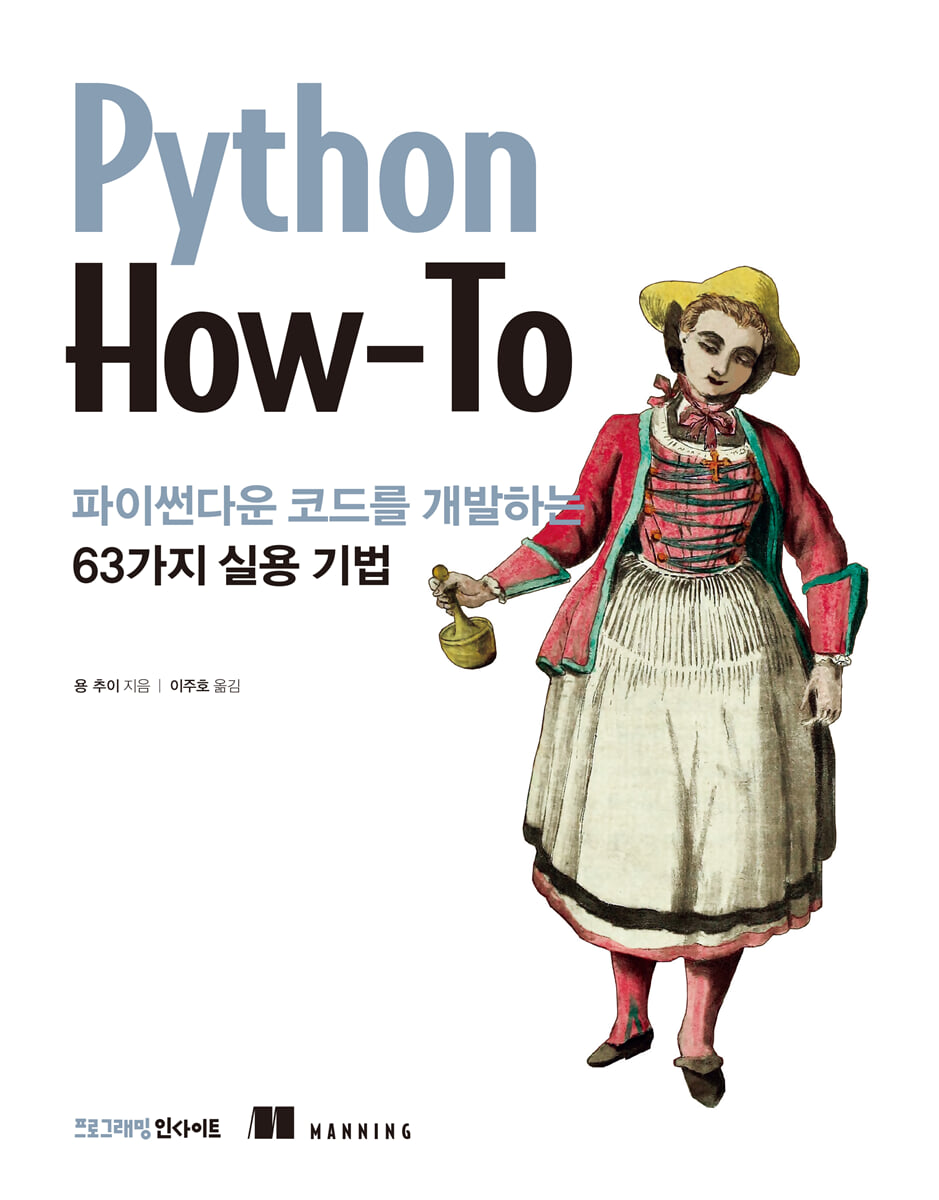
63 Practical Techniques for Developing Python-Like Code
 |
Description
Book Introduction
The perfect practical guide for those looking to move beyond beginner level to intermediate level!
"63 Practical Techniques for Developing Pythonic Code" presents a simple yet powerful way to master 63 core Python skills.
For example, it starts with a question like 'How do I find an item in a sequence?' and shows a very clear, basic solution as an example.
We continue to explore many interesting questions, such as how to find substrings or how to check if custom classes are equal.
After training with challenges at the end of each topic, you move on to the next topic.
This practical guide covers all the programming language features you need to work with Python.
By reading the book, you will learn best practices for writing great Python code.
You will discover key techniques that can be applied effectively in real-world work through practical suggestions and related pictorial explanations.
With the helpful guidance of Dr. Yong-Chui Yong, who organizes the book in a cross-referenced manner, you will soon learn functions and concepts that can be reused in a variety of contexts.
"63 Practical Techniques for Developing Pythonic Code" presents a simple yet powerful way to master 63 core Python skills.
For example, it starts with a question like 'How do I find an item in a sequence?' and shows a very clear, basic solution as an example.
We continue to explore many interesting questions, such as how to find substrings or how to check if custom classes are equal.
After training with challenges at the end of each topic, you move on to the next topic.
This practical guide covers all the programming language features you need to work with Python.
By reading the book, you will learn best practices for writing great Python code.
You will discover key techniques that can be applied effectively in real-world work through practical suggestions and related pictorial explanations.
With the helpful guidance of Dr. Yong-Chui Yong, who organizes the book in a cross-referenced manner, you will soon learn functions and concepts that can be reused in a variety of contexts.
- You can preview some of the book's contents.
Preview
index
Chapter 1: Developing Practical Learning Strategies
1.1 Becoming a Practical Developer
1.2 What Python Does Better or as Good as Other Languages
1.3 What Python Can't Do or Doesn't Do Well
1.4 What you will learn in this book
1.5 Summary
Part 1: Using Built-in Data Models
Chapter 2 String Handling and Formatting
2.1 How to use f-strings for string interpolation and formatting?
2.2 How do I convert a string to extract data?
2.3 How to concatenate or split strings?
2.4 What is the core of regular expressions?
2.5 How to use regular expressions for text processing?
2.6 Summary
Chapter 3 Built-in Data Containers
3.1 Which should I choose between lists and tuples?
3.2 How to sort a list containing complex data using a user-defined function?
3.3 How to build a lightweight data model with named tuples?
3.4 How to access keys, values, and items in a dictionary?
3.5 When should I use dictionaries and sets instead of lists and tuples?
3.6 How to check the relationship between lists using set operations?
3.7 Summary
Chapter 4 Sequence Data
4.1 How to handle subsequences with slice objects?
4.2 Can I use positive or negative indexes when retrieving items?
4.3 How do I find an item in a sequence?
4.4 How to unpack a sequence? Going beyond tuple unpacking.
4.5 When should we consider data models other than lists and tuples?
4.6 Summary
Chapter 5 Iterables and Iteration
5.1 How to create a basic data container from an iterable?
5.2 What are list, dictionary, and set comprehensions?
5.3 What built-in function improves the iteration of a for loop?
5.4 How to use selection statements in for and while loops?
5.5 Summary
Part 2: Defining Functions
Chapter 6: Defining User-Friendly Functions
6.1 How do I set default arguments to make calling a function easier?
6.2 How to use a return value set in a function call?
6.3 How to write easy-to-understand functions with type hints?
6.4 How to increase the flexibility of functions with *args and **kwargs?
6.5 How to write a correct docstring for a function?
6.6 Summary
Chapter 7: Advanced Function Utilization
7.1 How to use lambda functions for simple tasks?
7.2 What does it mean to say that functions are also objects?
7.3 Can I test function performance with decorators?
7.4 How to use generator functions as data providers that use memory efficiently?
7.5 How to create partial functions that make everyday function calls easier?
7.6 Summary
Defining a 3-part class
Chapter 8 User-Friendly Classes
8.1 How to define an initialization method for a class?
8.2 When should I define instance methods, static methods, and class methods?
8.3 Can we apply more fine-grained access control to classes?
8.4 How do I set the string representing the class to whatever I want?
8.5 Why should we create parent and child classes?
8.6 Summary
Chapter 9: Advanced Class Utilization
9.1 How can I create an enumeration?
9.2 How to eliminate boilerplate using data classes?
9.3 How to prepare and process JSON data?
9.4 How to create a delay property to improve performance?
9.5 How to define classes by interests?
9.6 Summary
Part 4: Handling Objects and Files
Chapter 10: Object Basics
10.1 How should object types be checked to increase code flexibility?
10.2 What is the lifecycle of an instance object?
10.3 How to copy an object?
10.4 How to use or change variables in other scopes?
10.5 What is callability and what does it mean?
10.6 Summary
Chapter 11: Handling Files
11.1 How to read and write files using context managers?
11.2 How to handle tabular data files?
11.3 How to save data to a file using pickling?
11.4 How do I manage files on my computer?
11.5 How to query the metadata of a file?
11.6 Summary
Part 5: Securing Your Codebase
Chapter 12 Logging and Exception Handling
12.1 How do I monitor the program I created by leaving a log?
12.2 How to save log records correctly?
12.3 How should exceptions be handled?
12.4 How to use else and finally clauses in exception handling?
12.5 How to raise an exception with more information using a custom exception class?
12.6 Summary
Chapter 13 Debugging and Testing
13.1 How to find problems in traceback information?
13.2 Can I debug my program interactively?
13.3 How to automatically test the functions I write?
13.4 How to automatically test the classes I write?
13.5 Summary
Part 6: Creating a Web Application
Chapter 14: Completing the Project
14.1 How do I use a virtual environment in my project? 488
14.2 How do I create a data model for my project?
14.3 Can I use SQLite as the database for my application?
14.4 How to make the frontend a web application?
14.5 Summary
Challenge Answers
Search
1.1 Becoming a Practical Developer
1.2 What Python Does Better or as Good as Other Languages
1.3 What Python Can't Do or Doesn't Do Well
1.4 What you will learn in this book
1.5 Summary
Part 1: Using Built-in Data Models
Chapter 2 String Handling and Formatting
2.1 How to use f-strings for string interpolation and formatting?
2.2 How do I convert a string to extract data?
2.3 How to concatenate or split strings?
2.4 What is the core of regular expressions?
2.5 How to use regular expressions for text processing?
2.6 Summary
Chapter 3 Built-in Data Containers
3.1 Which should I choose between lists and tuples?
3.2 How to sort a list containing complex data using a user-defined function?
3.3 How to build a lightweight data model with named tuples?
3.4 How to access keys, values, and items in a dictionary?
3.5 When should I use dictionaries and sets instead of lists and tuples?
3.6 How to check the relationship between lists using set operations?
3.7 Summary
Chapter 4 Sequence Data
4.1 How to handle subsequences with slice objects?
4.2 Can I use positive or negative indexes when retrieving items?
4.3 How do I find an item in a sequence?
4.4 How to unpack a sequence? Going beyond tuple unpacking.
4.5 When should we consider data models other than lists and tuples?
4.6 Summary
Chapter 5 Iterables and Iteration
5.1 How to create a basic data container from an iterable?
5.2 What are list, dictionary, and set comprehensions?
5.3 What built-in function improves the iteration of a for loop?
5.4 How to use selection statements in for and while loops?
5.5 Summary
Part 2: Defining Functions
Chapter 6: Defining User-Friendly Functions
6.1 How do I set default arguments to make calling a function easier?
6.2 How to use a return value set in a function call?
6.3 How to write easy-to-understand functions with type hints?
6.4 How to increase the flexibility of functions with *args and **kwargs?
6.5 How to write a correct docstring for a function?
6.6 Summary
Chapter 7: Advanced Function Utilization
7.1 How to use lambda functions for simple tasks?
7.2 What does it mean to say that functions are also objects?
7.3 Can I test function performance with decorators?
7.4 How to use generator functions as data providers that use memory efficiently?
7.5 How to create partial functions that make everyday function calls easier?
7.6 Summary
Defining a 3-part class
Chapter 8 User-Friendly Classes
8.1 How to define an initialization method for a class?
8.2 When should I define instance methods, static methods, and class methods?
8.3 Can we apply more fine-grained access control to classes?
8.4 How do I set the string representing the class to whatever I want?
8.5 Why should we create parent and child classes?
8.6 Summary
Chapter 9: Advanced Class Utilization
9.1 How can I create an enumeration?
9.2 How to eliminate boilerplate using data classes?
9.3 How to prepare and process JSON data?
9.4 How to create a delay property to improve performance?
9.5 How to define classes by interests?
9.6 Summary
Part 4: Handling Objects and Files
Chapter 10: Object Basics
10.1 How should object types be checked to increase code flexibility?
10.2 What is the lifecycle of an instance object?
10.3 How to copy an object?
10.4 How to use or change variables in other scopes?
10.5 What is callability and what does it mean?
10.6 Summary
Chapter 11: Handling Files
11.1 How to read and write files using context managers?
11.2 How to handle tabular data files?
11.3 How to save data to a file using pickling?
11.4 How do I manage files on my computer?
11.5 How to query the metadata of a file?
11.6 Summary
Part 5: Securing Your Codebase
Chapter 12 Logging and Exception Handling
12.1 How do I monitor the program I created by leaving a log?
12.2 How to save log records correctly?
12.3 How should exceptions be handled?
12.4 How to use else and finally clauses in exception handling?
12.5 How to raise an exception with more information using a custom exception class?
12.6 Summary
Chapter 13 Debugging and Testing
13.1 How to find problems in traceback information?
13.2 Can I debug my program interactively?
13.3 How to automatically test the functions I write?
13.4 How to automatically test the classes I write?
13.5 Summary
Part 6: Creating a Web Application
Chapter 14: Completing the Project
14.1 How do I use a virtual environment in my project? 488
14.2 How do I create a data model for my project?
14.3 Can I use SQLite as the database for my application?
14.4 How to make the frontend a web application?
14.5 Summary
Challenge Answers
Search
Into the book
“Most Python books on the market are either for beginners who cover the basic features of the language in detail, or for advanced users who cover specialized techniques that are difficult to generalize.
Some Python books are undoubtedly really good.
However, from a learning curve perspective, I felt there was a lack of books for learners who are just getting past the beginner level of Python or at the early intermediate level.
This step is very important for learners because it is the step where they form the habit of writing code using Python techniques appropriate to the given context.
In terms of content, I thought it would be nice to have a book that addresses common programming problems readers face in their work, whether it's web development, data science, or anything else using Python.
That is, I thought that a book that provides general knowledge that is not domain-specific would be useful to more readers.
I wrote this book in an attempt to bridge the gap between beginner and advanced books.
I hope that after reading this book, you will feel that you have gained something from it.”
Some Python books are undoubtedly really good.
However, from a learning curve perspective, I felt there was a lack of books for learners who are just getting past the beginner level of Python or at the early intermediate level.
This step is very important for learners because it is the step where they form the habit of writing code using Python techniques appropriate to the given context.
In terms of content, I thought it would be nice to have a book that addresses common programming problems readers face in their work, whether it's web development, data science, or anything else using Python.
That is, I thought that a book that provides general knowledge that is not domain-specific would be useful to more readers.
I wrote this book in an attempt to bridge the gap between beginner and advanced books.
I hope that after reading this book, you will feel that you have gained something from it.”
--- From "The Author's Note"
Publisher's Review
What this book covers
ㆍ How to concatenate and split strings
ㆍ How to access keys, values, and items in a dictionary
ㆍ How to set and use return values in function calls
ㆍ How to process JSON data
How to create delay properties to improve performance
ㆍ Changing variable values in different namespaces
ㆍ How to concatenate and split strings
ㆍ How to access keys, values, and items in a dictionary
ㆍ How to set and use return values in function calls
ㆍ How to process JSON data
How to create delay properties to improve performance
ㆍ Changing variable values in different namespaces
GOODS SPECIFICS
- Date of issue: August 20, 2025
- Page count, weight, size: 607 pages | 1,152g | 188*240*28mm
- ISBN13: 9788966264766
You may also like
카테고리
korean


korean

![GQ KOREA Mark (Monthly): December [2025]](http://librairie.coreenne.fr/cdn/shop/files/8ef265dbbfbf186523ed75ba7319009d.jpg?v=1765340328&width=3840)


