

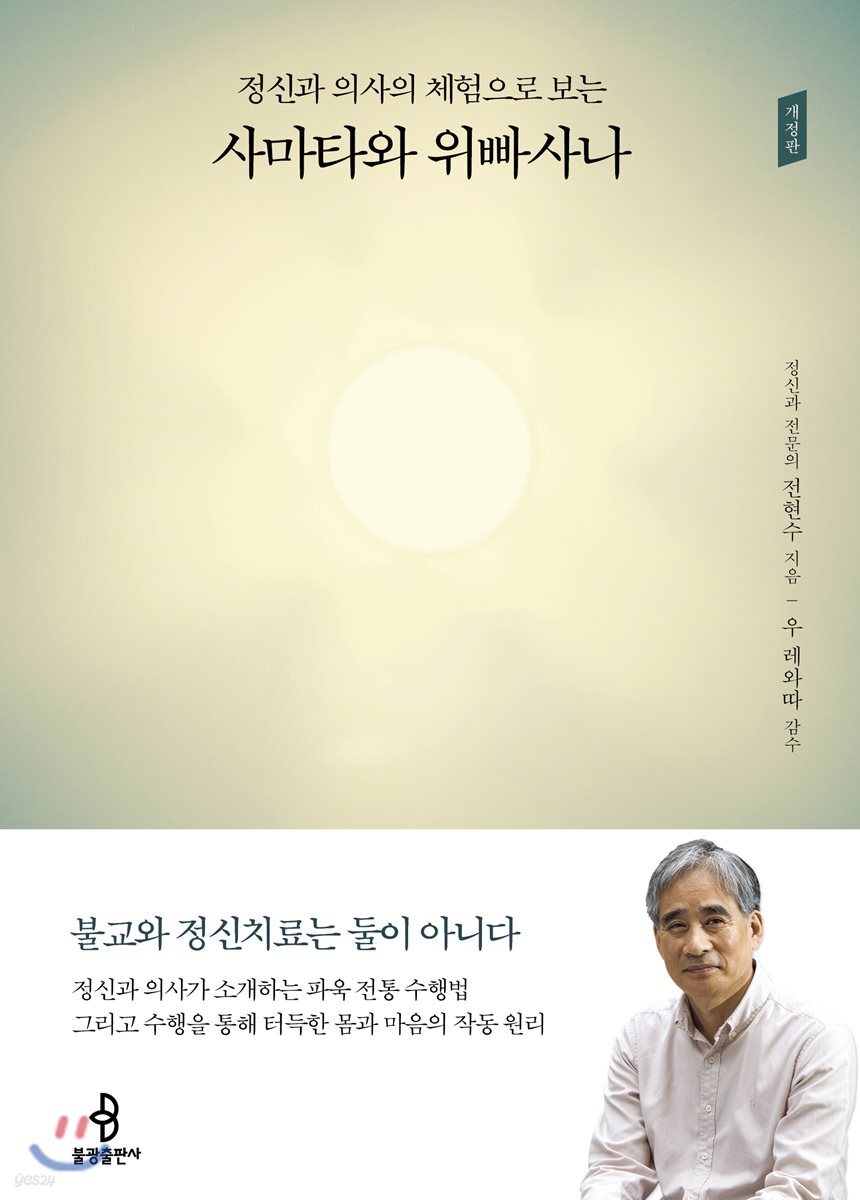
Samatha and Vipassana from the Perspective of a Psychiatrist
 |
Description
Book Introduction
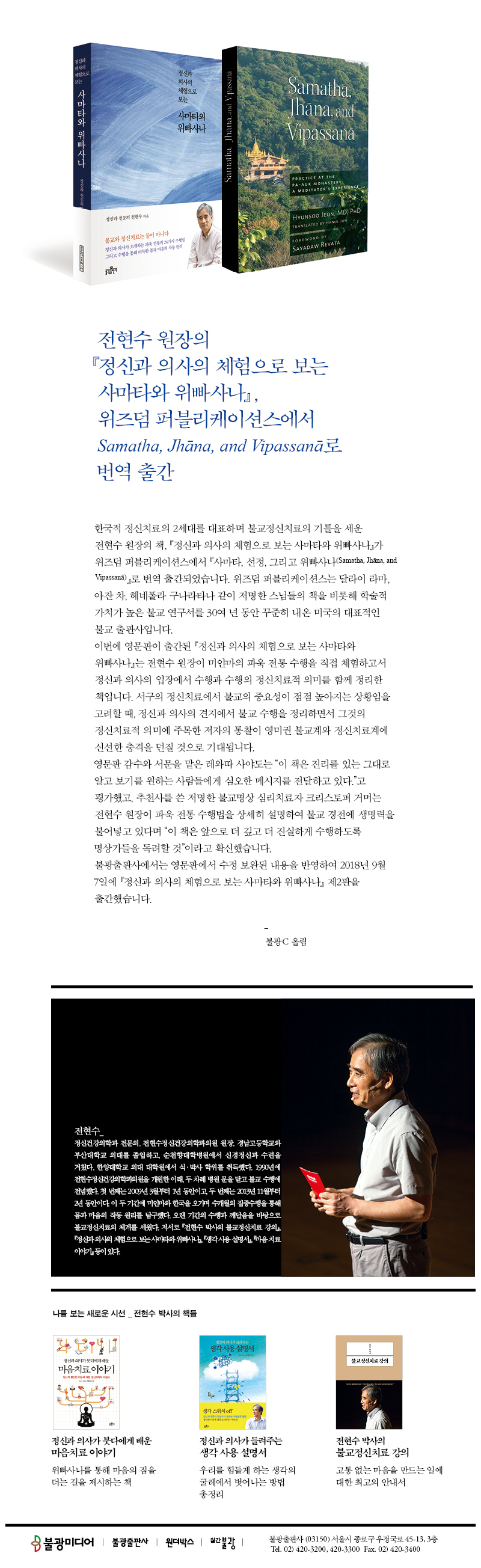
Psychiatrist Jeon Hyeon-su first encountered Buddhism in 1985, during his second year of psychiatry residency, and noticed the similarities between Buddhism and psychotherapy. Since then, he has consistently incorporated Buddhism into psychotherapy.
At some point, I realized that Buddhism and psychotherapy are not 'two' things, and that Buddhism itself is an excellent psychotherapy, so I tried psychotherapy through Buddhism.
To achieve this, he felt the need to understand Buddhism more deeply, so he quickly read Buddhist scriptures and, in order to experience the contents of the scriptures in person, closed his hospital in 2009 and 2013 and devoted himself to training while traveling between Myanmar and Korea.
This book contains everything about Samatha and Vipassana practice, which is the basis of Buddhist psychotherapy that he established, and among them, Pauk practice.
The author has compiled the contents of his practice under the direct teachings of Pauk Sayadaw and his disciples according to the program of the Pauk Forest Retreat Center, but also guides readers on the path to true practice by adding his own experiences and understanding.
This book has unique features that are hard to find in other Buddhist practice books.
The author understands the psychotherapeutic significance of Buddhist practice from the perspective of a psychiatrist.
Practice is not for the sake of practice itself, but for life, and it is about pointing out what points to keep in mind in order to do so.
This is precisely why this book is especially useful for those who want to change their lives through practice.
At some point, I realized that Buddhism and psychotherapy are not 'two' things, and that Buddhism itself is an excellent psychotherapy, so I tried psychotherapy through Buddhism.
To achieve this, he felt the need to understand Buddhism more deeply, so he quickly read Buddhist scriptures and, in order to experience the contents of the scriptures in person, closed his hospital in 2009 and 2013 and devoted himself to training while traveling between Myanmar and Korea.
This book contains everything about Samatha and Vipassana practice, which is the basis of Buddhist psychotherapy that he established, and among them, Pauk practice.
The author has compiled the contents of his practice under the direct teachings of Pauk Sayadaw and his disciples according to the program of the Pauk Forest Retreat Center, but also guides readers on the path to true practice by adding his own experiences and understanding.
This book has unique features that are hard to find in other Buddhist practice books.
The author understands the psychotherapeutic significance of Buddhist practice from the perspective of a psychiatrist.
Practice is not for the sake of practice itself, but for life, and it is about pointing out what points to keep in mind in order to do so.
This is precisely why this book is especially useful for those who want to change their lives through practice.
- You can preview some of the book's contents.
Preview
index
Recommendation
Preface to the Revised Edition
Preface to the first edition
Chapter 1: What is the practice of Pauk?
Before embarking on this path of practice
Pāṭṭṭhaṭha and the Four Noble Truths
Chapter 2: Samatha Practice
Meaning of selection
40 Ways to Achieve Samadhi
Mindfulness of breathing
Mindfulness of the 32 parts of the body
Practice of Dhyana through Kasina
Formless Dhyana practice
The Four Sacred Mind Practices
4. Protection Meditation
When we unite our hearts, we gain strength.
Chapter 3 Material Performance
Four major practices
Material performance
Getting out of the ego
Chapter 4 Mental Practice
Seeing the spirit as it is
Selection recognition process
The process of cognitive awareness? The beneficial mind of the desire realm
5-step recognition process
Identification of the Five Agans
How does mental practice heal the mind?
Chapter 5: Acting
5 Ways to See Smoke
1.
Fifth method
Identifying the Five Elements Inside and Out
View past lives
The 5 Ons of Regeneration Connection
The five aggregates of Bhavavaga
Pure question recognition process
The Five Doors of Recognition? The Five Aggregates of the Five Doors of Conversion
Identifying the causes and effects of your past lives
Future life
2.
First method
Observe the twelve links of dependent origination
When ignorance arises, action arises.
A row occurs, so a meal occurs.
When food arises, mind and matter arise.
When mind and matter arise, the six sense bases arise.
Contact occurs because the six sense bases arise.
Feeling occurs because contact occurs.
When a feeling arises, craving arises.
Because craving arises, attachment arises.
Existence arises because attachment arises.
Because existence arises, birth arises.
Because birth occurs, aging and death occur.
The impact of acting practice on one's attitude toward life
Chapter 6: Vipassana Practice
Entering Vipassana
The Four Aspects of Matter
The Four Aspects of the Mind
The Four Aspects of Acting
Vipassana? Seeing impermanence, suffering, and non-self
Why Vipassana Meditation Can Help Your Daily Life
Conclusion
Preface to the Revised Edition
Preface to the first edition
Chapter 1: What is the practice of Pauk?
Before embarking on this path of practice
Pāṭṭṭhaṭha and the Four Noble Truths
Chapter 2: Samatha Practice
Meaning of selection
40 Ways to Achieve Samadhi
Mindfulness of breathing
Mindfulness of the 32 parts of the body
Practice of Dhyana through Kasina
Formless Dhyana practice
The Four Sacred Mind Practices
4. Protection Meditation
When we unite our hearts, we gain strength.
Chapter 3 Material Performance
Four major practices
Material performance
Getting out of the ego
Chapter 4 Mental Practice
Seeing the spirit as it is
Selection recognition process
The process of cognitive awareness? The beneficial mind of the desire realm
5-step recognition process
Identification of the Five Agans
How does mental practice heal the mind?
Chapter 5: Acting
5 Ways to See Smoke
1.
Fifth method
Identifying the Five Elements Inside and Out
View past lives
The 5 Ons of Regeneration Connection
The five aggregates of Bhavavaga
Pure question recognition process
The Five Doors of Recognition? The Five Aggregates of the Five Doors of Conversion
Identifying the causes and effects of your past lives
Future life
2.
First method
Observe the twelve links of dependent origination
When ignorance arises, action arises.
A row occurs, so a meal occurs.
When food arises, mind and matter arise.
When mind and matter arise, the six sense bases arise.
Contact occurs because the six sense bases arise.
Feeling occurs because contact occurs.
When a feeling arises, craving arises.
Because craving arises, attachment arises.
Existence arises because attachment arises.
Because existence arises, birth arises.
Because birth occurs, aging and death occur.
The impact of acting practice on one's attitude toward life
Chapter 6: Vipassana Practice
Entering Vipassana
The Four Aspects of Matter
The Four Aspects of the Mind
The Four Aspects of Acting
Vipassana? Seeing impermanence, suffering, and non-self
Why Vipassana Meditation Can Help Your Daily Life
Conclusion
Detailed image
Into the book
People, to varying degrees, do not all see things as they are.
We live our lives in a state of emotional overload or foolishness.
Getting out of it is the goal of the selection practice.
- Page 46
The practice of selection is the practice of letting go.
To focus the mind on one object, it must be continually brought back to its original object, letting go whenever the mind wanders to another object.
Continuously training it is the practice of meditation, and as a result, the system that unites the mind is established within us.
- Page 67
The experience of formless meditation also helps one understand and become familiar with the celestial world or its existence.
Because the celestial world cannot be seen with our naked eyes, it is easy to think that it does not exist.
The Buddhist worldview is not limited to the world seen with our physical eyes or proven by science.
The world that the Buddha and his disciples saw through high-level practice and observation includes the heavenly world.
After selecting the formless realm, you can experience the various worlds mentioned in Buddhism through the practice of the 'Four Holy Minds'.
- Pages 87-88
‘Ah, this is peace!’ (omitted) Because there is only a balanced mind that is not biased toward all beings.
- Page 113
The body and mind move according to their own laws of cause and effect, and there is absolutely no room for our thoughts or desires to interfere.
Given the circumstances, suffering is inevitable, and we cannot help but endure this inevitable suffering.
Resisting it will only add to your suffering.
The best we can do is to allow only the suffering that must be endured to exist.
Even in Western psychotherapy today, the focus is on distinguishing between unavoidable suffering and self-induced suffering and reducing the latter.
- Pages 311-312
We live our lives in a state of emotional overload or foolishness.
Getting out of it is the goal of the selection practice.
- Page 46
The practice of selection is the practice of letting go.
To focus the mind on one object, it must be continually brought back to its original object, letting go whenever the mind wanders to another object.
Continuously training it is the practice of meditation, and as a result, the system that unites the mind is established within us.
- Page 67
The experience of formless meditation also helps one understand and become familiar with the celestial world or its existence.
Because the celestial world cannot be seen with our naked eyes, it is easy to think that it does not exist.
The Buddhist worldview is not limited to the world seen with our physical eyes or proven by science.
The world that the Buddha and his disciples saw through high-level practice and observation includes the heavenly world.
After selecting the formless realm, you can experience the various worlds mentioned in Buddhism through the practice of the 'Four Holy Minds'.
- Pages 87-88
‘Ah, this is peace!’ (omitted) Because there is only a balanced mind that is not biased toward all beings.
- Page 113
The body and mind move according to their own laws of cause and effect, and there is absolutely no room for our thoughts or desires to interfere.
Given the circumstances, suffering is inevitable, and we cannot help but endure this inevitable suffering.
Resisting it will only add to your suffering.
The best we can do is to allow only the suffering that must be endured to exist.
Even in Western psychotherapy today, the focus is on distinguishing between unavoidable suffering and self-induced suffering and reducing the latter.
- Pages 311-312
--- From the text
Publisher's Review
The power of 'attention' to determine beneficial and harmful minds
When my mind is complicated, I feel calm even when I see something I like, but when my mind is light, I can smile just by looking at leaves blowing in the wind.
I didn't set out to do something, it just happened on its own.
In the practice of observing beneficial and harmful minds, we can see how they arise.
The key is what kind of 'attention' you have when facing the object.
When we encounter an object with our eyes, ears, nose, tongue, body, and mind, if we pay foolish attention, a mechanism that causes harmful thoughts to arise is activated, and if we pay wise attention, a mechanism that causes beneficial thoughts to arise is activated.
As you become aware of this process through practice, you will naturally find yourself harboring few foolish cautions.
Because we know that it is harmful to ourselves, we naturally take wise precautions.
Naturally, harmful thoughts will decrease and beneficial thoughts will increase.
So what is wise caution?
Know it as it is
We encounter people and things through our own thoughts and desires.
By seeing things as you see them and ordering them according to your desires, you hope that everything will revolve around you.
But we are beings who cannot control even our own thoughts, let alone the world.
Everything just works according to its own laws.
This is where mental illness arises.
Problems arise when the world does not turn the way you want it to or when you cannot fulfill your desires, and you cannot naturally overcome this.
When his disciple Ananda asked his teacher Buddha about the purpose and benefits of samadhi obtained through practice, the Buddha answered.
“The purpose is to know and see things as they are, and the benefit is to know and see things as they are.” Buddhism informs us of the true nature, structure, and operating principles of this world, including humans, and allows us to choose the best path based on that knowledge.
In other words, Buddhism clearly reminds us that there is no room for our thoughts or desires in this world, and leads us to accept the world as it really is.
It completely blows away the foundation of mental illness.
Buddhism and psychotherapy are one
Perhaps that's why a psychiatrist with deep Buddhist experience said that the core of Buddhism is "not taking external appearances and reflecting the mind."
'Don't judge by appearances, but look at your own heart' means to stop projecting your desires or thoughts onto external objects and see the world as it is.
In this respect, Buddhism and psychotherapy have something in common.
This is because psychotherapy is also a process that helps people escape from mental pain or problems by helping them change themselves after they have learned what their own mind and the minds of others are like.
In essence, Buddhism and psychotherapy are one.
When you trust your acting, a faithful life follows.
While performing the act, the author sees his past and future lives.
I have had six previous lives: a life as a police officer or soldier, a life as a dog, a life as a prince, a life as a monk, and a life as a celestial being.
He said that he saw four future lives: he would be a monk, a god, a Brahma, and then a monk again.
It is said that through this practice of looking into past and future lives, one comes to know and believe that life is also made up of cause and effect.
The author says that people who believe in reincarnation do not commit suicide or fear death.
Life is not only a continuation of the next life, but the present life is the cause for the next life to unfold accordingly. So, instead of hastening or fearing death, we should practice more faithfully in this life to prepare the cause that will lead to a better next life.
The key to a fulfilling and satisfying life lies in believing in reincarnation and not being swayed by ups and downs.
When my mind is complicated, I feel calm even when I see something I like, but when my mind is light, I can smile just by looking at leaves blowing in the wind.
I didn't set out to do something, it just happened on its own.
In the practice of observing beneficial and harmful minds, we can see how they arise.
The key is what kind of 'attention' you have when facing the object.
When we encounter an object with our eyes, ears, nose, tongue, body, and mind, if we pay foolish attention, a mechanism that causes harmful thoughts to arise is activated, and if we pay wise attention, a mechanism that causes beneficial thoughts to arise is activated.
As you become aware of this process through practice, you will naturally find yourself harboring few foolish cautions.
Because we know that it is harmful to ourselves, we naturally take wise precautions.
Naturally, harmful thoughts will decrease and beneficial thoughts will increase.
So what is wise caution?
Know it as it is
We encounter people and things through our own thoughts and desires.
By seeing things as you see them and ordering them according to your desires, you hope that everything will revolve around you.
But we are beings who cannot control even our own thoughts, let alone the world.
Everything just works according to its own laws.
This is where mental illness arises.
Problems arise when the world does not turn the way you want it to or when you cannot fulfill your desires, and you cannot naturally overcome this.
When his disciple Ananda asked his teacher Buddha about the purpose and benefits of samadhi obtained through practice, the Buddha answered.
“The purpose is to know and see things as they are, and the benefit is to know and see things as they are.” Buddhism informs us of the true nature, structure, and operating principles of this world, including humans, and allows us to choose the best path based on that knowledge.
In other words, Buddhism clearly reminds us that there is no room for our thoughts or desires in this world, and leads us to accept the world as it really is.
It completely blows away the foundation of mental illness.
Buddhism and psychotherapy are one
Perhaps that's why a psychiatrist with deep Buddhist experience said that the core of Buddhism is "not taking external appearances and reflecting the mind."
'Don't judge by appearances, but look at your own heart' means to stop projecting your desires or thoughts onto external objects and see the world as it is.
In this respect, Buddhism and psychotherapy have something in common.
This is because psychotherapy is also a process that helps people escape from mental pain or problems by helping them change themselves after they have learned what their own mind and the minds of others are like.
In essence, Buddhism and psychotherapy are one.
When you trust your acting, a faithful life follows.
While performing the act, the author sees his past and future lives.
I have had six previous lives: a life as a police officer or soldier, a life as a dog, a life as a prince, a life as a monk, and a life as a celestial being.
He said that he saw four future lives: he would be a monk, a god, a Brahma, and then a monk again.
It is said that through this practice of looking into past and future lives, one comes to know and believe that life is also made up of cause and effect.
The author says that people who believe in reincarnation do not commit suicide or fear death.
Life is not only a continuation of the next life, but the present life is the cause for the next life to unfold accordingly. So, instead of hastening or fearing death, we should practice more faithfully in this life to prepare the cause that will lead to a better next life.
The key to a fulfilling and satisfying life lies in believing in reincarnation and not being swayed by ups and downs.
GOODS SPECIFICS
- Date of publication: September 7, 2018
- Page count, weight, size: 319 pages | 454g | 152*210*20mm
- ISBN13: 9788974794484
- ISBN10: 8974794489
You may also like
카테고리
korean


korean

![GQ KOREA Mark (Monthly): December [2025]](http://librairie.coreenne.fr/cdn/shop/files/8ef265dbbfbf186523ed75ba7319009d.jpg?v=1765340328&width=3840)


