

AI and Interpretation and Translation Education
 |
Description
Book Introduction
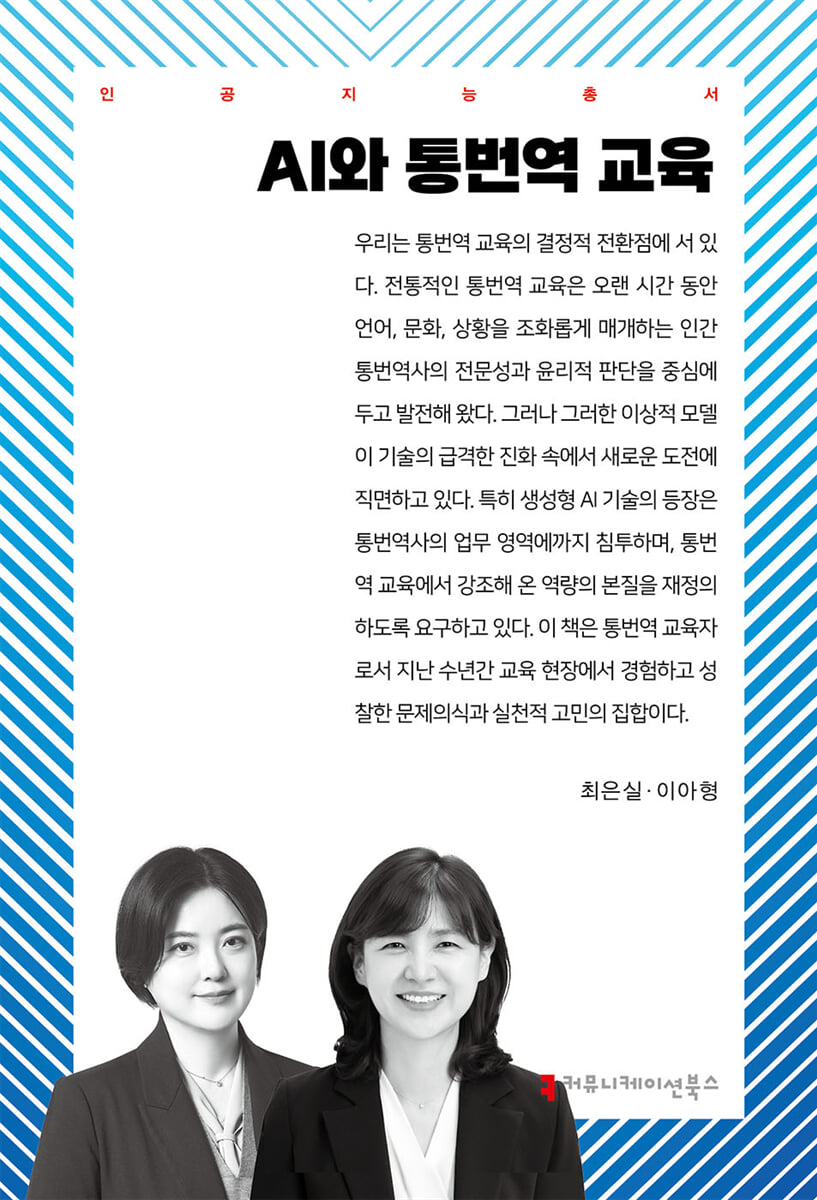
The emergence of AI presents both a crisis and an opportunity for interpretation and translation education.
In an era where collaboration between technology and humans is essential, this paper presents the competencies that interpreters and translators must possess and the educational methods that instructors should design.
Artificial Intelligence Encyclopedia.
You can find the artificial intelligence knowledge you need at aiseries.oopy.io.
In an era where collaboration between technology and humans is essential, this paper presents the competencies that interpreters and translators must possess and the educational methods that instructors should design.
Artificial Intelligence Encyclopedia.
You can find the artificial intelligence knowledge you need at aiseries.oopy.io.
- You can preview some of the book's contents.
Preview
index
Babel, powered by AI, builds a new language tower.
01 Traditional interpretation and translation skills
02 Machine Translation and Post-Editing
03 AI-based translation tools and their use
04 Quality Assessment and Verification of AI Translation
05 The Fantasy and Reality of Machine Interpreting
06 Interpreting in the AI Era
07 AI Challenges the Nobel Prize in Literature
08 Interpretation and Translation Capabilities in the AI Era
09 Redesign of the Interpretation and Translation Education Curriculum
10 Ethical and Copyright Issues and Sustainable Ecosystems
01 Traditional interpretation and translation skills
02 Machine Translation and Post-Editing
03 AI-based translation tools and their use
04 Quality Assessment and Verification of AI Translation
05 The Fantasy and Reality of Machine Interpreting
06 Interpreting in the AI Era
07 AI Challenges the Nobel Prize in Literature
08 Interpretation and Translation Capabilities in the AI Era
09 Redesign of the Interpretation and Translation Education Curriculum
10 Ethical and Copyright Issues and Sustainable Ecosystems
Into the book
Like the Pakte Group, the EMT translation competency model presents five core competency areas: language and culture, translation, technical skills, personal and interpersonal skills, and service delivery.
First, linguistic and cultural competence includes the ability to understand language variations, cultural elements, values, and references, and to write according to the cultural conventions of the culture in which the target text is used.
Translation competence encompasses strategic, methodological, and thematic skills for translation.
Technical skills include the ability to use IT applications, search engine corpora, CAT tools, file management, web technologies, data literacy, and workflow management tools.
Personal and interpersonal skills and service delivery capabilities are what differentiate us at Pakte Group, and include time management, teamwork, lifelong learning, and meeting deadlines.
--- From "01_Traditional Interpretation and Translation Skills"
Papago is a translation service launched by the Korean portal company Naver in 2017, and is an NMT engine optimized for Korean-based language pairs.
'Papago' means parrot in Esperanto, and as its name suggests, it aims to provide AI translation that imitates and speaks various languages.
Papago has adopted pure neural network translation since its launch, and has touted its strengths in context-sensitive translation through machine learning in core language pairs such as Korean↔English/Chinese/Japanese.
It has a translation algorithm that reflects Korean linguistic characteristics such as word order, particles, and vocabulary usage, making it particularly strong in translating everyday conversational or colloquial language.
The user interface is also simple and optimized for mobile use, making it highly accessible for learners and general users.
Additionally, Naver continuously improves quality by learning from the vast web text data and user feedback it possesses.
--- From "03_AI-based Translation Tools and Their Use"
The development of three key technologies has made this remarkable transformation possible.
First, the performance of mobile processors has improved tremendously.
The latest chips, such as Apple's A17 Pro and Qualcomm's Snapdragon 8 Gen 3, now boast PC-level computing power and even feature dedicated AI NPUs, making them capable of handling complex AI tasks.
With over 12GB of RAM and 1TB of storage, it's now possible to run even the largest language models on a smartphone.
Finally, thanks to 5G networks, connectivity to cloud AI services has also become faster.
--- From "06_Interpreting in the AI Era"
A comprehensive review of recent research suggests that translation and interpretation education models utilizing generative AI can be broadly categorized into three types.
The first is AI-assisted learning, which partially utilizes AI tools in existing classes. Typical examples include comparing and editing AI translation results, searching for terms, and storing them in memory.
The second is AI-centric, which uses AI as a primary content creation tool.
This includes prompt design, text generation, and role-play script creation.
The third is AI integration, which redesigns the entire curriculum by incorporating AI.
This includes real-time feedback, self-learning scenarios, and the use of AI tutors.
First, linguistic and cultural competence includes the ability to understand language variations, cultural elements, values, and references, and to write according to the cultural conventions of the culture in which the target text is used.
Translation competence encompasses strategic, methodological, and thematic skills for translation.
Technical skills include the ability to use IT applications, search engine corpora, CAT tools, file management, web technologies, data literacy, and workflow management tools.
Personal and interpersonal skills and service delivery capabilities are what differentiate us at Pakte Group, and include time management, teamwork, lifelong learning, and meeting deadlines.
--- From "01_Traditional Interpretation and Translation Skills"
Papago is a translation service launched by the Korean portal company Naver in 2017, and is an NMT engine optimized for Korean-based language pairs.
'Papago' means parrot in Esperanto, and as its name suggests, it aims to provide AI translation that imitates and speaks various languages.
Papago has adopted pure neural network translation since its launch, and has touted its strengths in context-sensitive translation through machine learning in core language pairs such as Korean↔English/Chinese/Japanese.
It has a translation algorithm that reflects Korean linguistic characteristics such as word order, particles, and vocabulary usage, making it particularly strong in translating everyday conversational or colloquial language.
The user interface is also simple and optimized for mobile use, making it highly accessible for learners and general users.
Additionally, Naver continuously improves quality by learning from the vast web text data and user feedback it possesses.
--- From "03_AI-based Translation Tools and Their Use"
The development of three key technologies has made this remarkable transformation possible.
First, the performance of mobile processors has improved tremendously.
The latest chips, such as Apple's A17 Pro and Qualcomm's Snapdragon 8 Gen 3, now boast PC-level computing power and even feature dedicated AI NPUs, making them capable of handling complex AI tasks.
With over 12GB of RAM and 1TB of storage, it's now possible to run even the largest language models on a smartphone.
Finally, thanks to 5G networks, connectivity to cloud AI services has also become faster.
--- From "06_Interpreting in the AI Era"
A comprehensive review of recent research suggests that translation and interpretation education models utilizing generative AI can be broadly categorized into three types.
The first is AI-assisted learning, which partially utilizes AI tools in existing classes. Typical examples include comparing and editing AI translation results, searching for terms, and storing them in memory.
The second is AI-centric, which uses AI as a primary content creation tool.
This includes prompt design, text generation, and role-play script creation.
The third is AI integration, which redesigns the entire curriculum by incorporating AI.
This includes real-time feedback, self-learning scenarios, and the use of AI tutors.
--- From "09_Redesign of Interpretation and Translation Education Curriculum"
Publisher's Review
Translation and interpretation education is undergoing a transformation in the AI era.
This book directly addresses the turning point in interpretation and translation education, which is rapidly changing due to the emergence of generative AI.
Amidst the growing sense of crisis that interpreters and translators will be replaced by AI, the importance of human interpreters' unique capabilities—understanding cultural context, emotional empathy, and ethical judgment—is being re-evaluated.
This book proposes new educational strategies, including AI tool utilization skills, collaborative scenario training, and critical AI literacy education, in addition to traditional language training. It emphasizes that interpretation and translation education should go beyond simple technical acquisition and become a place to cultivate hybrid experts who lead the "coexistence of humans and machines."
Professors must transform themselves into educational designers and value defenders, and students must become active designers of the interpretation and translation ecosystem, rather than passively adapting to change.
This book directly addresses the turning point in interpretation and translation education, which is rapidly changing due to the emergence of generative AI.
Amidst the growing sense of crisis that interpreters and translators will be replaced by AI, the importance of human interpreters' unique capabilities—understanding cultural context, emotional empathy, and ethical judgment—is being re-evaluated.
This book proposes new educational strategies, including AI tool utilization skills, collaborative scenario training, and critical AI literacy education, in addition to traditional language training. It emphasizes that interpretation and translation education should go beyond simple technical acquisition and become a place to cultivate hybrid experts who lead the "coexistence of humans and machines."
Professors must transform themselves into educational designers and value defenders, and students must become active designers of the interpretation and translation ecosystem, rather than passively adapting to change.
GOODS SPECIFICS
- Date of issue: August 20, 2025
- Page count, weight, size: 134 pages | 128*188*8mm
- ISBN13: 9791143006554
You may also like
카테고리
korean


korean

![GQ KOREA Mark (Monthly): December [2025]](http://librairie.coreenne.fr/cdn/shop/files/8ef265dbbfbf186523ed75ba7319009d.jpg?v=1765340328&width=3840)


