

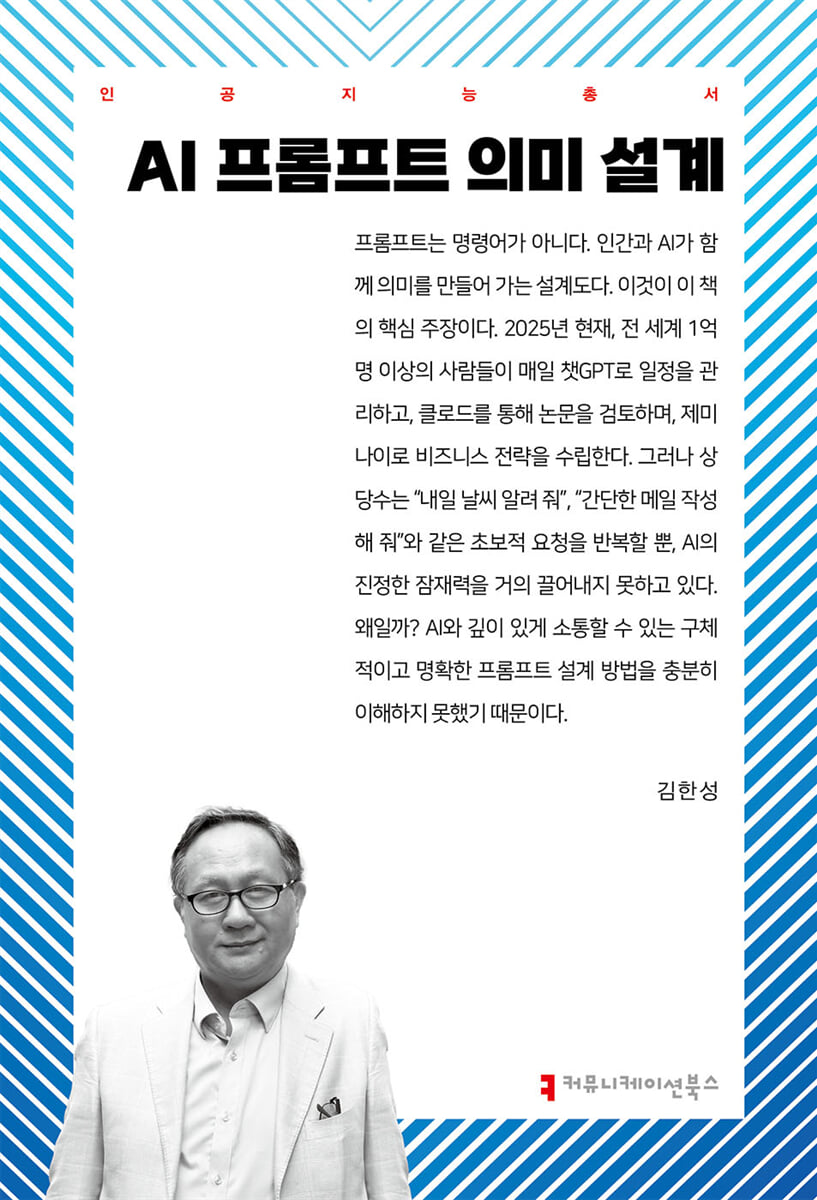
AI prompt meaning design
 |
Description
Book Introduction
AI doesn't understand meaning.
But humans can achieve meaningful results through design.
We redefine prompts from mere instructions to "design of meaning," and present a PMD methodology that encompasses role, context, and purpose. In the age of AI, we must all become designers of meaning.
Artificial Intelligence Encyclopedia.
You can find the artificial intelligence knowledge you need at aiseries.oopy.io.
But humans can achieve meaningful results through design.
We redefine prompts from mere instructions to "design of meaning," and present a PMD methodology that encompasses role, context, and purpose. In the age of AI, we must all become designers of meaning.
Artificial Intelligence Encyclopedia.
You can find the artificial intelligence knowledge you need at aiseries.oopy.io.
- You can preview some of the book's contents.
Preview
index
Prompt, connecting humans and AI
01 Language Operations
02 Attention Mechanism
03 Context Window
04 Prompt Framework
05 Generative Imagination
06 Meta Prompting
07 Semiotic Modeling
08 Designing Ethical Prompts
09 Explainable Prompting
10 Human-AI Understanding Protocols
01 Language Operations
02 Attention Mechanism
03 Context Window
04 Prompt Framework
05 Generative Imagination
06 Meta Prompting
07 Semiotic Modeling
08 Designing Ethical Prompts
09 Explainable Prompting
10 Human-AI Understanding Protocols
Into the book
If you input the three sentences “read a book,” “read a book,” and “read a book” into AI, an interesting phenomenon appears.
These all mean reading, but they are different in common expression, Chinese character expression, and colloquial expression.
The reason AI responds with different tones to each of the three greetings is simple: AI interprets the same words differently depending on the context.
Just as the word "apple" can mean either a fruit or an apology, AI groups similar expressions close together and selects the appropriate one for the situation.
This is how AI distinguishes the nuances of our language.
--- From "01_Language Operations"
This is because Korean's complex honorific system and context-dependent nature pose additional challenges for AI.
First, there is a breakdown in the consistency of honorifics.
Let's say you're writing a customer service manual.
At first, the extremely polite expression “Customer…” is used, but in the middle, the level drops to “Customer…”, and in the latter half, shockingly, the condescending expression “You guys…” may pop out.
The complex honorific system of Korean is a difficult task for AI to maintain.
Second, the subject restoration failed.
Korean often omits subjects.
In the sentence “Please attend the meeting,” the “who” is clear in context, but after a long conversation, AI may misinterpret it as “All employees must attend the meeting.”
The meaning is distorted in the process of restoring the omitted subject.
Third, there is the distortion of metaphor.
The powerful metaphor that “data is the crude oil of the 21st century” has become trivialized over time into “data is a valuable resource,” and eventually into the dry expression “data is simply information.”
The rich figurative expressions of the Korean language are gradually losing their vitality.
Avoiding these problems requires a strategic approach.
It is effective to periodically repeat key information, explicitly remind readers of the style and level of honorifics, and provide definitions for important metaphors and terms.
--- From "03_Context Window"
Self-correcting meta-prompting gives AI a dual role.
First, answer the question as an 'answerer', then switch to an 'evaluator' and critically review the answer.
It's like the writer rereading the draft from the editor's perspective.
AI performs completeness verification (checking for logical gaps), accuracy checks (data reliability), clarity assessments (ease of understanding), and practicality checks (usability).
Based on this self-assessment, you can improve your answers and repeat the process.
--- From "06_Meta-Prompting"
Counterfactual prompting consists of four patterns that elicit hidden insights from AI through the assumption of “what if?”
First, Condition Alteration changes key variables to verify the robustness of the strategy.
Changing the simple question, “What are the chances of this strategy succeeding?” to “What if the budget were reduced by 50%?” makes the strategy’s vulnerabilities and alternatives clear.
In addition to budget, you can change various conditions such as human resources, market environment, and regulations.
Second, temporal shift shifts the point of decision-making to understand the importance of timing.
Asking the question, “What if this were a year ago?” or “What if this were a year from now?” about your current market entry strategy allows you to simultaneously assess the timeliness and sustainability of your current strategy.
Third, perspective reversal discovers blind spots by looking at things from the opposite perspective.
Instead of asking, "What are our product's strengths?", turn the question around and ask, "What if a competitor attacks us?" and you'll uncover weaknesses you may not have recognized before.
Fourth, extreme scenarios test the limits of strategy by assuming best and worst outcomes.
Instead of asking “what is the expected performance?” ask “can we survive the worst case scenario?”
The extremes allow us to more clearly capture the risks of the middle ground.
Combining these four patterns makes them even more powerful.
The true durability of a strategy is revealed when you simultaneously assume "a halved budget, a six-month delay, competitor perspectives, and a worst-case scenario."
Counterfactual prompting is a key technique for transforming AI from a simple predictor into a multidimensional analysis tool.
These all mean reading, but they are different in common expression, Chinese character expression, and colloquial expression.
The reason AI responds with different tones to each of the three greetings is simple: AI interprets the same words differently depending on the context.
Just as the word "apple" can mean either a fruit or an apology, AI groups similar expressions close together and selects the appropriate one for the situation.
This is how AI distinguishes the nuances of our language.
--- From "01_Language Operations"
This is because Korean's complex honorific system and context-dependent nature pose additional challenges for AI.
First, there is a breakdown in the consistency of honorifics.
Let's say you're writing a customer service manual.
At first, the extremely polite expression “Customer…” is used, but in the middle, the level drops to “Customer…”, and in the latter half, shockingly, the condescending expression “You guys…” may pop out.
The complex honorific system of Korean is a difficult task for AI to maintain.
Second, the subject restoration failed.
Korean often omits subjects.
In the sentence “Please attend the meeting,” the “who” is clear in context, but after a long conversation, AI may misinterpret it as “All employees must attend the meeting.”
The meaning is distorted in the process of restoring the omitted subject.
Third, there is the distortion of metaphor.
The powerful metaphor that “data is the crude oil of the 21st century” has become trivialized over time into “data is a valuable resource,” and eventually into the dry expression “data is simply information.”
The rich figurative expressions of the Korean language are gradually losing their vitality.
Avoiding these problems requires a strategic approach.
It is effective to periodically repeat key information, explicitly remind readers of the style and level of honorifics, and provide definitions for important metaphors and terms.
--- From "03_Context Window"
Self-correcting meta-prompting gives AI a dual role.
First, answer the question as an 'answerer', then switch to an 'evaluator' and critically review the answer.
It's like the writer rereading the draft from the editor's perspective.
AI performs completeness verification (checking for logical gaps), accuracy checks (data reliability), clarity assessments (ease of understanding), and practicality checks (usability).
Based on this self-assessment, you can improve your answers and repeat the process.
--- From "06_Meta-Prompting"
Counterfactual prompting consists of four patterns that elicit hidden insights from AI through the assumption of “what if?”
First, Condition Alteration changes key variables to verify the robustness of the strategy.
Changing the simple question, “What are the chances of this strategy succeeding?” to “What if the budget were reduced by 50%?” makes the strategy’s vulnerabilities and alternatives clear.
In addition to budget, you can change various conditions such as human resources, market environment, and regulations.
Second, temporal shift shifts the point of decision-making to understand the importance of timing.
Asking the question, “What if this were a year ago?” or “What if this were a year from now?” about your current market entry strategy allows you to simultaneously assess the timeliness and sustainability of your current strategy.
Third, perspective reversal discovers blind spots by looking at things from the opposite perspective.
Instead of asking, "What are our product's strengths?", turn the question around and ask, "What if a competitor attacks us?" and you'll uncover weaknesses you may not have recognized before.
Fourth, extreme scenarios test the limits of strategy by assuming best and worst outcomes.
Instead of asking “what is the expected performance?” ask “can we survive the worst case scenario?”
The extremes allow us to more clearly capture the risks of the middle ground.
Combining these four patterns makes them even more powerful.
The true durability of a strategy is revealed when you simultaneously assume "a halved budget, a six-month delay, competitor perspectives, and a worst-case scenario."
Counterfactual prompting is a key technique for transforming AI from a simple predictor into a multidimensional analysis tool.
--- From "09_Explainable Prompting"
Publisher's Review
Design meaning, AI will follow.
In the age of AI, we hold the most powerful intelligence tools in our hands, yet we fail to utilize them effectively.
There is only one reason: they misunderstand 'prompt' as a simple command.
This book redefines prompts as designs in which humans and AI work together to construct 'meaning'.
Rather than simply giving instructions, it emphasizes a meaning-based approach through role assignment, context provision, and purpose setting, and presents a systematic design methodology called 'PMD (Prompt Meaning Design)'.
AI doesn't understand meaning like humans do, but properly constructed prompts can produce results that make sense to humans.
It covers everything from theory to practice, creative application, and ethical design, and offers various entry paths depending on the reader's purpose and background.
Prompts are no longer just a technology; they are a new language that we must create together with AI.
We guide you through how to write, design, and evolve that language. Your journey to becoming a "designer" who creates meaning with AI begins now.
In the age of AI, we hold the most powerful intelligence tools in our hands, yet we fail to utilize them effectively.
There is only one reason: they misunderstand 'prompt' as a simple command.
This book redefines prompts as designs in which humans and AI work together to construct 'meaning'.
Rather than simply giving instructions, it emphasizes a meaning-based approach through role assignment, context provision, and purpose setting, and presents a systematic design methodology called 'PMD (Prompt Meaning Design)'.
AI doesn't understand meaning like humans do, but properly constructed prompts can produce results that make sense to humans.
It covers everything from theory to practice, creative application, and ethical design, and offers various entry paths depending on the reader's purpose and background.
Prompts are no longer just a technology; they are a new language that we must create together with AI.
We guide you through how to write, design, and evolve that language. Your journey to becoming a "designer" who creates meaning with AI begins now.
GOODS SPECIFICS
- Date of issue: August 7, 2025
- Page count, weight, size: 148 pages | 128*188*8mm
- ISBN13: 9791143007681
You may also like
카테고리
korean


korean

![GQ KOREA Mark (Monthly): December [2025]](http://librairie.coreenne.fr/cdn/shop/files/8ef265dbbfbf186523ed75ba7319009d.jpg?v=1765340328&width=3840)


