

Why don't you ask first?
 |
Description
Book Introduction
"Boundary Respect Education": An Essential Concept for a Coexisting Society
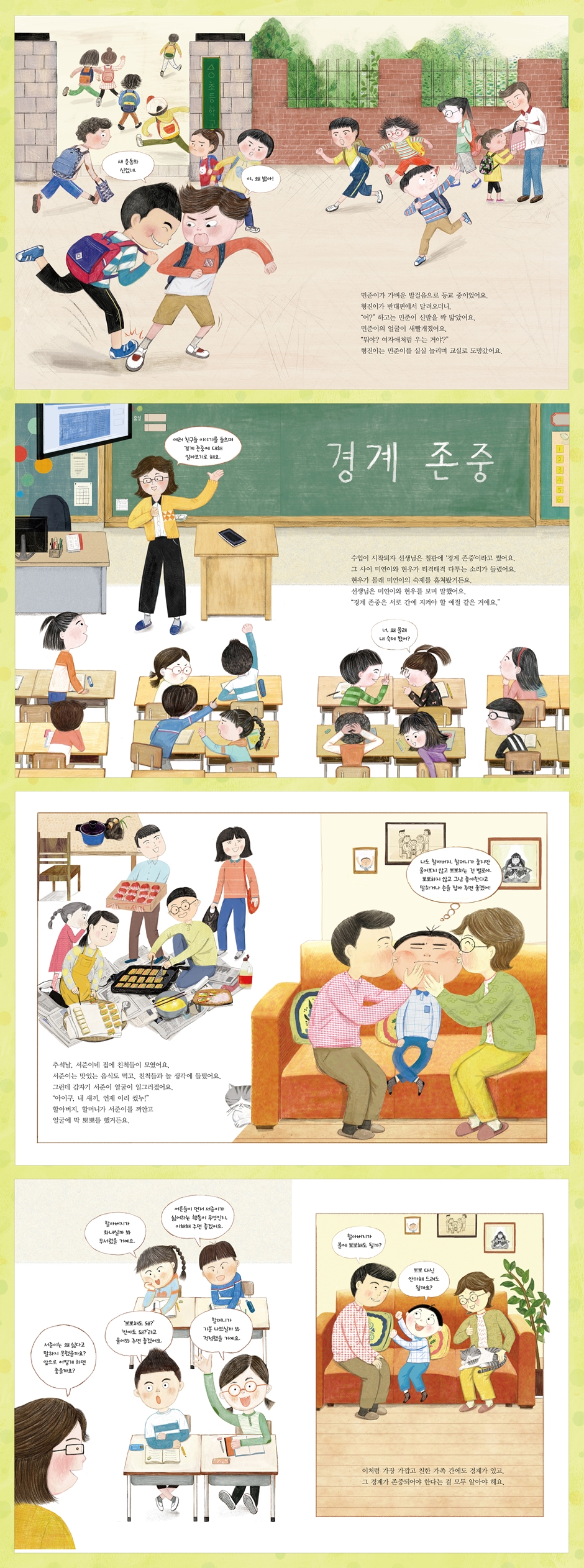
Minjun is upset when his friend suddenly steps on his new sneakers; Seojun is uncomfortable when his grandparents hug and kiss him without asking; Minho is embarrassed when his friends hold his hand or link arms without permission when they see him; and Seonwoo hates when the neighborhood older brother teases him for being a girl and rubs his shoulders.
These are unpleasant situations that often occur around us.
All of these situations are called 'boundary violations'.
Boundary violations are actions taken without the other person's permission.
It happens more often with close friends, family, older siblings, and even strangers.
So boundary respect education is needed everywhere, at home, at school, etc.
‘Respect for boundaries’ is an essential concept for living happily in modern society where many people live together.
So, the beginning of boundary respect education is to teach people to recognize their own and others' boundaries and not to violate each other's boundaries.
[Why Don't You Ask First?] will provide you with an opportunity to reflect on yourself and the situations around you by looking at various examples of boundary violations.
Furthermore, it will help them learn the importance of respect and consideration for others and grow into mature adults who can respect their own and others' human rights.
Minjun is upset when his friend suddenly steps on his new sneakers; Seojun is uncomfortable when his grandparents hug and kiss him without asking; Minho is embarrassed when his friends hold his hand or link arms without permission when they see him; and Seonwoo hates when the neighborhood older brother teases him for being a girl and rubs his shoulders.
These are unpleasant situations that often occur around us.
All of these situations are called 'boundary violations'.
Boundary violations are actions taken without the other person's permission.
It happens more often with close friends, family, older siblings, and even strangers.
So boundary respect education is needed everywhere, at home, at school, etc.
‘Respect for boundaries’ is an essential concept for living happily in modern society where many people live together.
So, the beginning of boundary respect education is to teach people to recognize their own and others' boundaries and not to violate each other's boundaries.
[Why Don't You Ask First?] will provide you with an opportunity to reflect on yourself and the situations around you by looking at various examples of boundary violations.
Furthermore, it will help them learn the importance of respect and consideration for others and grow into mature adults who can respect their own and others' human rights.
- You can preview some of the book's contents.
Preview
Detailed image
Publisher's Review
There are areas that people must protect depending on the level of closeness between them.
This is called 'boundary', and to have a healthy relationship, you have to respect each other's boundaries.
"Why Don't You Ask First?" is a picture book that provides an easy and fun way to learn how boundary violations occur in everyday life and how to respect boundaries through the stories of friends who have experienced various boundary violations.
Boundary respect education that everyone should read and practice together.
Boundary violations are often committed by those with power against those with less power.
It is mostly the case that a strong friend does it to a weaker friend, a senior to a junior, or an adult to a child.
So when a boundary violation occurs, it's difficult to tell the other person not to do it.
Furthermore, there are many cases where the person who has been harmed or the person who has committed the crime is unaware of the boundary violation and passes it over.
So boundary respect education is necessary not only for children, but also for adolescents and adults.
"Why Don't You Ask First?" presents boundary violations that occur in various relationships in an easy and fun way through everyday situations.
Not only that, it kindly guides you on how to resolve the situation and ask for help.
You can relate to the examples introduced of 'gender role stereotypes' and 'gender discrimination', which are frequently discussed in society these days.
At the end of the book, there is a detailed explanation of how boundaries are divided and the types of boundary violations.
It also introduces specific ways to respect boundaries in everyday life, making it easy and fun to learn even professional knowledge.
This book will serve as a guide for children to develop healthy identities and social skills, and it will provide an opportunity for adults who have previously taken boundary respect and boundary violation lightly to improve.
A book filled with the vivid experiences and know-how of experts
Author Lee Hyeon-hye, who planned and wrote this book, has served as a professor at the Korea Institute for Gender Equality Education for a long time, giving lectures and conducting activities to protect children's human rights and realize gender equality.
He wrote "I Hug You Because I Like You, But Why?" in 2015 because he felt that there was a need for a book that would explain "boundaries" in an easy and fun way for children and to inform them of the need for "boundary respect education."
The previous work, full of vivid and diverse experiences and know-how, received great response not only from general readers but also from educational settings.
Later, back in the field, he realized that in order to respect each other's boundaries, it was necessary to have specific experiences of how boundaries were violated and to talk about them.
After collecting various cases and planning for a long time, we have published the follow-up work, “Why Don’t You Ask First?”
This book presents not only various cases but also expert solutions and directions for improvement in an easy and fun way.
Additionally, Kim Joo-ri's illustrations, which humorously depict children's school life and daily life, enrich the book even more.
In particular, the children's facial expressions and movements are dramatically portrayed, making it easy to empathize with the emotions of each situation.
This is called 'boundary', and to have a healthy relationship, you have to respect each other's boundaries.
"Why Don't You Ask First?" is a picture book that provides an easy and fun way to learn how boundary violations occur in everyday life and how to respect boundaries through the stories of friends who have experienced various boundary violations.
Boundary respect education that everyone should read and practice together.
Boundary violations are often committed by those with power against those with less power.
It is mostly the case that a strong friend does it to a weaker friend, a senior to a junior, or an adult to a child.
So when a boundary violation occurs, it's difficult to tell the other person not to do it.
Furthermore, there are many cases where the person who has been harmed or the person who has committed the crime is unaware of the boundary violation and passes it over.
So boundary respect education is necessary not only for children, but also for adolescents and adults.
"Why Don't You Ask First?" presents boundary violations that occur in various relationships in an easy and fun way through everyday situations.
Not only that, it kindly guides you on how to resolve the situation and ask for help.
You can relate to the examples introduced of 'gender role stereotypes' and 'gender discrimination', which are frequently discussed in society these days.
At the end of the book, there is a detailed explanation of how boundaries are divided and the types of boundary violations.
It also introduces specific ways to respect boundaries in everyday life, making it easy and fun to learn even professional knowledge.
This book will serve as a guide for children to develop healthy identities and social skills, and it will provide an opportunity for adults who have previously taken boundary respect and boundary violation lightly to improve.
A book filled with the vivid experiences and know-how of experts
Author Lee Hyeon-hye, who planned and wrote this book, has served as a professor at the Korea Institute for Gender Equality Education for a long time, giving lectures and conducting activities to protect children's human rights and realize gender equality.
He wrote "I Hug You Because I Like You, But Why?" in 2015 because he felt that there was a need for a book that would explain "boundaries" in an easy and fun way for children and to inform them of the need for "boundary respect education."
The previous work, full of vivid and diverse experiences and know-how, received great response not only from general readers but also from educational settings.
Later, back in the field, he realized that in order to respect each other's boundaries, it was necessary to have specific experiences of how boundaries were violated and to talk about them.
After collecting various cases and planning for a long time, we have published the follow-up work, “Why Don’t You Ask First?”
This book presents not only various cases but also expert solutions and directions for improvement in an easy and fun way.
Additionally, Kim Joo-ri's illustrations, which humorously depict children's school life and daily life, enrich the book even more.
In particular, the children's facial expressions and movements are dramatically portrayed, making it easy to empathize with the emotions of each situation.
GOODS SPECIFICS
- Date of issue: September 10, 2020
- Format: Hardcover book binding method guide
- Page count, weight, size: 40 pages | 348g | 200*268*15mm
- ISBN13: 9791165730802
- ISBN10: 1165730804
- KC Certification: Certification Type: Conformity Confirmation
You may also like
카테고리
korean


korean

![GQ KOREA Mark (Monthly): December [2025]](http://librairie.coreenne.fr/cdn/shop/files/8ef265dbbfbf186523ed75ba7319009d.jpg?v=1765340328&width=3840)


