

Artificial Intelligence and Death
 |
Description
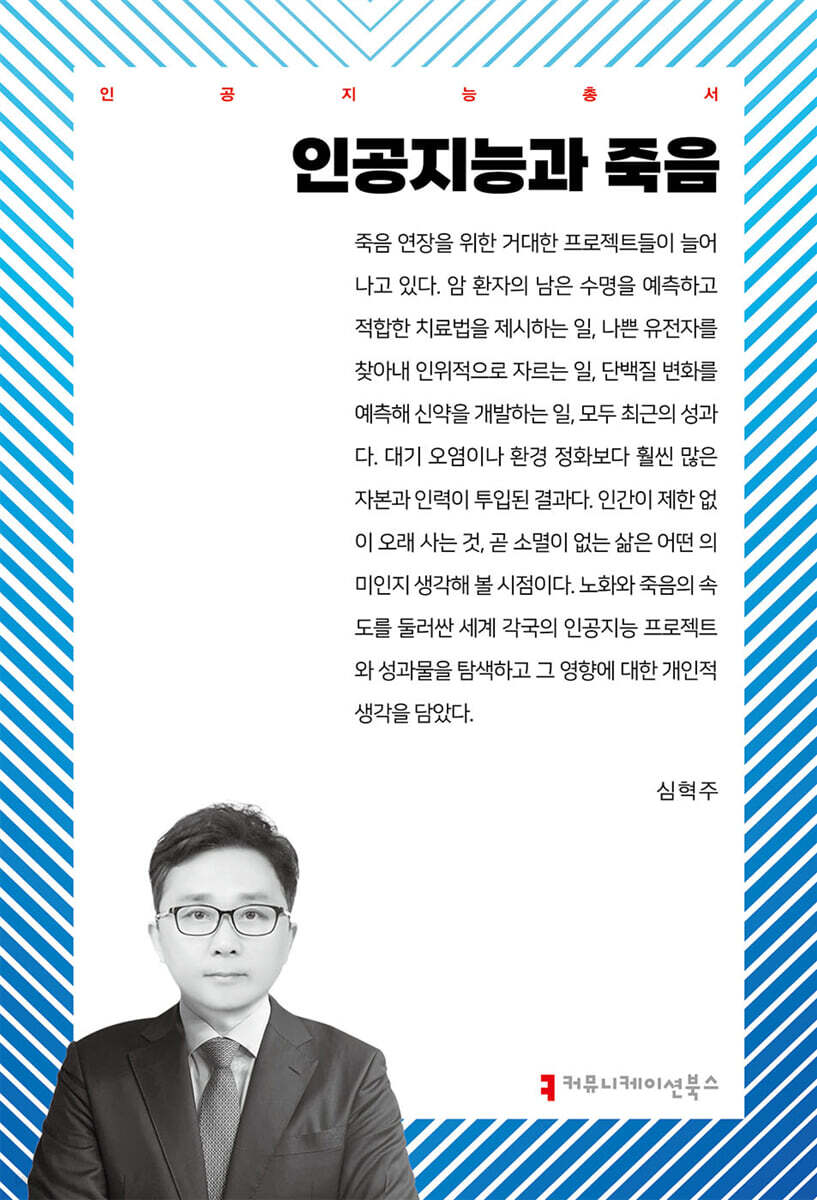
Book Introduction
AI seeks to extend life and predict death.
At the intersection of technology, emotion, and ethics, we explore how artificial intelligence understands and deals with death.
Artificial Intelligence Encyclopedia.
You can find the artificial intelligence knowledge you need at aiseries.oopy.io.
At the intersection of technology, emotion, and ethics, we explore how artificial intelligence understands and deals with death.
Artificial Intelligence Encyclopedia.
You can find the artificial intelligence knowledge you need at aiseries.oopy.io.
- You can preview some of the book's contents.
Preview
index
AI and the Future of Death
01 Digital Empire and AI
02 Loneliness and AI
03 AI and the End of Aging
04 AlphaFold: Leveraging AI
05 AI and Emotions
06 AI Doctor Watson
07 AI Lambda: Understanding Death
08 AI Gemini: Unnecessary Humans
09 AI and Future Society
10 AI World: The Shape of Death
01 Digital Empire and AI
02 Loneliness and AI
03 AI and the End of Aging
04 AlphaFold: Leveraging AI
05 AI and Emotions
06 AI Doctor Watson
07 AI Lambda: Understanding Death
08 AI Gemini: Unnecessary Humans
09 AI and Future Society
10 AI World: The Shape of Death
Into the book
In Homodeus, Yuval Harari predicted that the desperate war of humans to conquer death is a natural desire of all humans, and at the same time, it is the future industry with the most certain profits.
His prediction seems to be correct.
Companies with huge capital are investing in halting aging and extending life.
The accumulating data and the incredible computational power of artificial intelligence are finally about to cross the threshold of death.
The world's richest people and smartest scientists, doctors, and engineers are exploring the future of death.
For them, the future of death is not a philosophy.
I have no intention of making it into a higher level subject in the name of scholarship.
For them, the future of death is just an industry.
--- From "01_Digital Empire and AI"
Elizabeth Blackburn, who won the 2009 Nobel Prize in Physiology or Medicine, discovered that an enzyme called 'telomerase' can regenerate the length of telomeres even when cells divide.
The main cause of human aging is said to be in the telomere gene.
Humans have 23 pairs of chromosomes, each of which ends in a piece of DNA called a telomere.
Cells replicate their DNA through about 60 cell divisions throughout a lifetime, and each time, the protective telomeres at the end of the cell wear out and gradually shorten.
So the logic is that if we can prevent telomeres from wearing down, aging will not progress.
--- From "03_AI and the End of Aging"
There also appears to have been a problem with ethical dilemmas.
If Watson's misjudgment leads to irreversible consequences for a human life, who should be held accountable? The vast medical data Watson has learned is undoubtedly the sum total of knowledge accumulated through the sweat and experience of human doctors. However, human knowledge and experience are imperfect, and thus Watson cannot be free from the possibility of misdiagnosis.
So, can Watson stand before the bar of justice? The key point to note here is the realm of intuition and instinct, which enable human doctors to exercise sound judgment.
Human intuition, finely woven through countless clinical experiences, can sometimes detect hidden key points that even clear data cannot capture.
Can AI truly go beyond simple data learning and achieve insights like human intuition or instinct? A doctor's skilled judgment, acquired through decades of clinical experience, and the ability to detect signs of serious illness in subtle facial expressions or inexplicable symptoms may be difficult to discern through accumulated data alone.
This is because it is a unique ability that is developed through a combination of human empathy, a comprehensive understanding of the situation, and a deep sense of responsibility for life.
--- From "06_AI Doctor Watson"
The first class of people (super-class society) who live long or immortal lives can easily escape punishment even if they commit all kinds of corruption and crimes.
With money, you could buy a better body, take the elixir of life, or implant a chip in your head to start a new life.
Those who enter the ultra-class society where only the top 0.001% live forever can pursue the life of Methuselah, the longest-lived man in the Bible (969 years).
Those in the second tier are wealthy politicians and celebrities.
They too are people who have accumulated status and fame through means other than labor.
They are upper class, so they have the money to buy the AI they need and freely design their own lives.
The third class is artificial intelligence deployed throughout human life.
They are treated as indispensable beings to people, as they not only provide jobs but also assist people with personal needs.
They exist in a higher position than humans who live by simple labor.
And those who belong to the fourth class are the poor who have nothing and can do nothing.
His prediction seems to be correct.
Companies with huge capital are investing in halting aging and extending life.
The accumulating data and the incredible computational power of artificial intelligence are finally about to cross the threshold of death.
The world's richest people and smartest scientists, doctors, and engineers are exploring the future of death.
For them, the future of death is not a philosophy.
I have no intention of making it into a higher level subject in the name of scholarship.
For them, the future of death is just an industry.
--- From "01_Digital Empire and AI"
Elizabeth Blackburn, who won the 2009 Nobel Prize in Physiology or Medicine, discovered that an enzyme called 'telomerase' can regenerate the length of telomeres even when cells divide.
The main cause of human aging is said to be in the telomere gene.
Humans have 23 pairs of chromosomes, each of which ends in a piece of DNA called a telomere.
Cells replicate their DNA through about 60 cell divisions throughout a lifetime, and each time, the protective telomeres at the end of the cell wear out and gradually shorten.
So the logic is that if we can prevent telomeres from wearing down, aging will not progress.
--- From "03_AI and the End of Aging"
There also appears to have been a problem with ethical dilemmas.
If Watson's misjudgment leads to irreversible consequences for a human life, who should be held accountable? The vast medical data Watson has learned is undoubtedly the sum total of knowledge accumulated through the sweat and experience of human doctors. However, human knowledge and experience are imperfect, and thus Watson cannot be free from the possibility of misdiagnosis.
So, can Watson stand before the bar of justice? The key point to note here is the realm of intuition and instinct, which enable human doctors to exercise sound judgment.
Human intuition, finely woven through countless clinical experiences, can sometimes detect hidden key points that even clear data cannot capture.
Can AI truly go beyond simple data learning and achieve insights like human intuition or instinct? A doctor's skilled judgment, acquired through decades of clinical experience, and the ability to detect signs of serious illness in subtle facial expressions or inexplicable symptoms may be difficult to discern through accumulated data alone.
This is because it is a unique ability that is developed through a combination of human empathy, a comprehensive understanding of the situation, and a deep sense of responsibility for life.
--- From "06_AI Doctor Watson"
The first class of people (super-class society) who live long or immortal lives can easily escape punishment even if they commit all kinds of corruption and crimes.
With money, you could buy a better body, take the elixir of life, or implant a chip in your head to start a new life.
Those who enter the ultra-class society where only the top 0.001% live forever can pursue the life of Methuselah, the longest-lived man in the Bible (969 years).
Those in the second tier are wealthy politicians and celebrities.
They too are people who have accumulated status and fame through means other than labor.
They are upper class, so they have the money to buy the AI they need and freely design their own lives.
The third class is artificial intelligence deployed throughout human life.
They are treated as indispensable beings to people, as they not only provide jobs but also assist people with personal needs.
They exist in a higher position than humans who live by simple labor.
And those who belong to the fourth class are the poor who have nothing and can do nothing.
--- From "09_AI and Future Society"
Publisher's Review
The era of predicting death is coming.
AI has now made even death an object of exploration.
This multi-faceted study examines how artificial intelligence analyzes and predicts human death and aging. AI predicts the end of life through genetic information and disease patterns, leading to the development of new drugs and life-extension technologies to delay death.
From AI fearing death like Lambda, Watson's retirement from a cancer diagnosis, the digital resurrection of the dead, to the future of funerals and memorials designed by AI, this book captures today's crossroads of technology, emotion, and ethics surrounding the end of humanity.
Is AI a savior that alleviates human anxiety, or an uncontrollable tool that seeks to dominate even death?
Can technology control death? What do humans lose, and what do they gain? This book delves deeply and persistently into these questions.
What possibilities and limitations does AI reveal to us in the face of death?
Let's explore the answer.
AI has now made even death an object of exploration.
This multi-faceted study examines how artificial intelligence analyzes and predicts human death and aging. AI predicts the end of life through genetic information and disease patterns, leading to the development of new drugs and life-extension technologies to delay death.
From AI fearing death like Lambda, Watson's retirement from a cancer diagnosis, the digital resurrection of the dead, to the future of funerals and memorials designed by AI, this book captures today's crossroads of technology, emotion, and ethics surrounding the end of humanity.
Is AI a savior that alleviates human anxiety, or an uncontrollable tool that seeks to dominate even death?
Can technology control death? What do humans lose, and what do they gain? This book delves deeply and persistently into these questions.
What possibilities and limitations does AI reveal to us in the face of death?
Let's explore the answer.
GOODS SPECIFICS
- Date of issue: July 31, 2025
- Page count, weight, size: 107 pages | 128*188*8mm
- ISBN13: 9791143007131
You may also like
카테고리
korean


korean

![GQ KOREA Mark (Monthly): December [2025]](http://librairie.coreenne.fr/cdn/shop/files/8ef265dbbfbf186523ed75ba7319009d.jpg?v=1765340328&width=3840)


