

AI Convergence Education Teacher
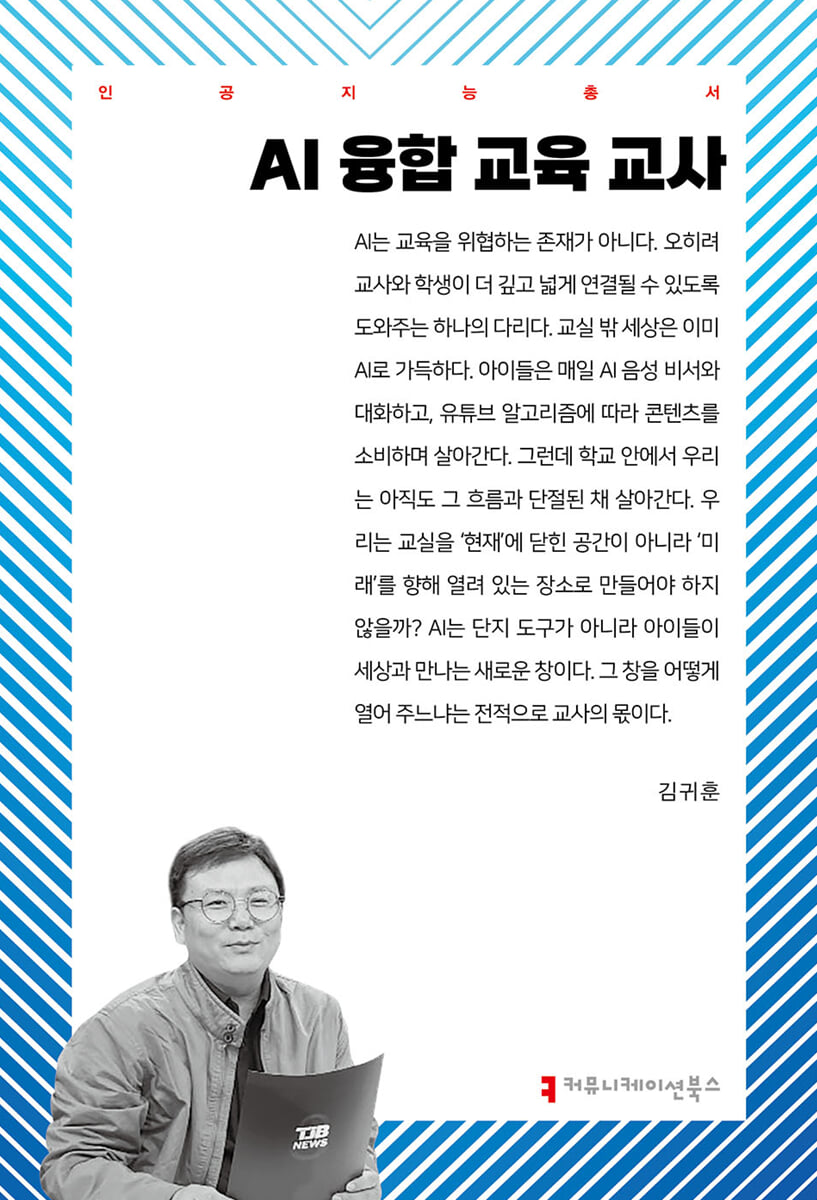 |
Description
Book Introduction
We explore the path to change together through real-life stories of teachers who embrace AI as a friend in their classrooms, with courage rather than fear.
It starts with the heart of a teacher who puts children before technology.
Artificial Intelligence Encyclopedia.
You can find the artificial intelligence knowledge you need at aiseries.oopy.io.
It starts with the heart of a teacher who puts children before technology.
Artificial Intelligence Encyclopedia.
You can find the artificial intelligence knowledge you need at aiseries.oopy.io.
- You can preview some of the book's contents.
Preview
index
On the Path to AI and Teacher Transformation
01 Elementary school teacher who can do everything
02 AI Convergence Education for Elementary School Teachers
03 AI Convergence Education with Upper Elementary School Teachers
04 Secondary school teachers specializing in AI in their subjects
05 Math Teacher and AI Convergence Education
06 Science Teacher and AI Convergence Education
07 English Teacher and AI Convergence Education
08 Art Teacher and AI Convergence Education
09 Information Teachers Demonstrating Leadership
10 I also won the Nobel Prize, making children's dreams come true
01 Elementary school teacher who can do everything
02 AI Convergence Education for Elementary School Teachers
03 AI Convergence Education with Upper Elementary School Teachers
04 Secondary school teachers specializing in AI in their subjects
05 Math Teacher and AI Convergence Education
06 Science Teacher and AI Convergence Education
07 English Teacher and AI Convergence Education
08 Art Teacher and AI Convergence Education
09 Information Teachers Demonstrating Leadership
10 I also won the Nobel Prize, making children's dreams come true
Into the book
AI is not a technology that requires teachers to learn everything from scratch.
Many educational tools have already been developed to meet the needs of both teachers and students.
Below are some representative AI tools that elementary school teachers can easily utilize.
Teachable Machines is Google's web-based platform that allows you to easily create models that learn and classify images, sounds, poses, and more.
Scratch and extension blocks add AI-based camera recognition and voice recognition capabilities.
The Bing Image Generator is a generative AI that creates images based on input sentences. AI for Ocean (Code.
org) is a tool that allows you to naturally learn the concept of AI through a game of sorting trash in the ocean.
These tools not only extend the lessons, but also provide opportunities for teachers to be creative.
--- From "01_Elementary School Teacher Who Can Do Everything"
Students in grades 5 and 6 are beginning to explore their interests and strengths in earnest, and AI projects are a great way to naturally connect these interests with career education.
For example, a student who dreams of becoming a journalist can participate in a project that uses AI voice recognition technology to create a news reporting app, while a student interested in cooking can participate in a project that creates a system that recognizes photos of ingredients and recommends recipes.
Additionally, students hoping to become veterinarians can realize their dreams through activities such as developing a chatbot that recognizes the emotions of companion animals.
These experiences help children understand how their interests can connect with AI technology, and provide valuable opportunities to interpret and express the technology in their own words.
--- From "03_AI Convergence Education with Elementary School Teachers in Upper Grades"
AI can be effectively applied to a variety of topics in Earth science classes, including climate change, earthquake prediction, celestial movements, and atmospheric phenomena.
Mr. S, a middle school earth science teacher, planned an AI class using weather data in the 'Climate Change and Prediction' unit.
In this class, we analyzed temperature, humidity, and wind speed data provided by the Korea Meteorological Administration using Pandas, and students used this data to build a simple regression model to predict future temperatures.
The final period of the class featured a project where students transformed into AI weathercasters and presented their predictions, increasing learning immersion and a sense of accomplishment.
Students who participated in the class shared their thoughts, saying, "This was a class that fostered both scientific thinking and presentation skills," and "It was the first time I realized that data can explain the climate crisis," demonstrating the simultaneous significance of scientific inquiry and real-life applications.
--- From "06_Science Teachers and AI Convergence Education"
English and information teachers can collaborate to create classes where students' essays are analyzed and feedback is provided using AI editing tools. Collaborating with history teachers can also lead to projects that visualize historical events as data and leverage AI to predict future trends.
When physical education teachers and information teachers work together, they can create classes that collect students' exercise data and generate personalized health reports. Collaborating with music teachers can also enable creative activities like creating your own music album using AI composition tools.
Many educational tools have already been developed to meet the needs of both teachers and students.
Below are some representative AI tools that elementary school teachers can easily utilize.
Teachable Machines is Google's web-based platform that allows you to easily create models that learn and classify images, sounds, poses, and more.
Scratch and extension blocks add AI-based camera recognition and voice recognition capabilities.
The Bing Image Generator is a generative AI that creates images based on input sentences. AI for Ocean (Code.
org) is a tool that allows you to naturally learn the concept of AI through a game of sorting trash in the ocean.
These tools not only extend the lessons, but also provide opportunities for teachers to be creative.
--- From "01_Elementary School Teacher Who Can Do Everything"
Students in grades 5 and 6 are beginning to explore their interests and strengths in earnest, and AI projects are a great way to naturally connect these interests with career education.
For example, a student who dreams of becoming a journalist can participate in a project that uses AI voice recognition technology to create a news reporting app, while a student interested in cooking can participate in a project that creates a system that recognizes photos of ingredients and recommends recipes.
Additionally, students hoping to become veterinarians can realize their dreams through activities such as developing a chatbot that recognizes the emotions of companion animals.
These experiences help children understand how their interests can connect with AI technology, and provide valuable opportunities to interpret and express the technology in their own words.
--- From "03_AI Convergence Education with Elementary School Teachers in Upper Grades"
AI can be effectively applied to a variety of topics in Earth science classes, including climate change, earthquake prediction, celestial movements, and atmospheric phenomena.
Mr. S, a middle school earth science teacher, planned an AI class using weather data in the 'Climate Change and Prediction' unit.
In this class, we analyzed temperature, humidity, and wind speed data provided by the Korea Meteorological Administration using Pandas, and students used this data to build a simple regression model to predict future temperatures.
The final period of the class featured a project where students transformed into AI weathercasters and presented their predictions, increasing learning immersion and a sense of accomplishment.
Students who participated in the class shared their thoughts, saying, "This was a class that fostered both scientific thinking and presentation skills," and "It was the first time I realized that data can explain the climate crisis," demonstrating the simultaneous significance of scientific inquiry and real-life applications.
--- From "06_Science Teachers and AI Convergence Education"
English and information teachers can collaborate to create classes where students' essays are analyzed and feedback is provided using AI editing tools. Collaborating with history teachers can also lead to projects that visualize historical events as data and leverage AI to predict future trends.
When physical education teachers and information teachers work together, they can create classes that collect students' exercise data and generate personalized health reports. Collaborating with music teachers can also enable creative activities like creating your own music album using AI composition tools.
--- From "09_Information Teachers Demonstrating Leadership"
Publisher's Review
Rethinking the Path of Teaching in the AI Era
AI is knocking on the classroom door.
Many teachers express their fears, asking, “Will it be okay if I don’t know AI?”
It warmly addresses that anxiety and vividly portrays the process of a teacher learning with AI.
It's okay if you don't know the technology.
What matters is the teacher's desire to communicate better with children.
This book is not about teaching AI, but about relearning and growing as a teacher.
It contains a practical journey of expressing emotions with AI even if you can't draw, planning an interview with GPT in a history class, and transforming a small, old classroom into a world connected by AI.
In a classroom where teachers and students learn together and are inspired by one another, the teacher remains at the center of it all. AI is not a threat, but rather an extension of teacher performance.
With curiosity instead of fear, this book encourages teachers to change.
AI is knocking on the classroom door.
Many teachers express their fears, asking, “Will it be okay if I don’t know AI?”
It warmly addresses that anxiety and vividly portrays the process of a teacher learning with AI.
It's okay if you don't know the technology.
What matters is the teacher's desire to communicate better with children.
This book is not about teaching AI, but about relearning and growing as a teacher.
It contains a practical journey of expressing emotions with AI even if you can't draw, planning an interview with GPT in a history class, and transforming a small, old classroom into a world connected by AI.
In a classroom where teachers and students learn together and are inspired by one another, the teacher remains at the center of it all. AI is not a threat, but rather an extension of teacher performance.
With curiosity instead of fear, this book encourages teachers to change.
GOODS SPECIFICS
- Date of issue: July 18, 2025
- Page count, weight, size: 105 pages | 128*188*8mm
- ISBN13: 9791143005090
- ISBN10: 1143005090
You may also like
카테고리
korean


korean

![GQ KOREA Mark (Monthly): December [2025]](http://librairie.coreenne.fr/cdn/shop/files/8ef265dbbfbf186523ed75ba7319009d.jpg?v=1765340328&width=3840)


