

Right mind
 |
Description
Book Introduction
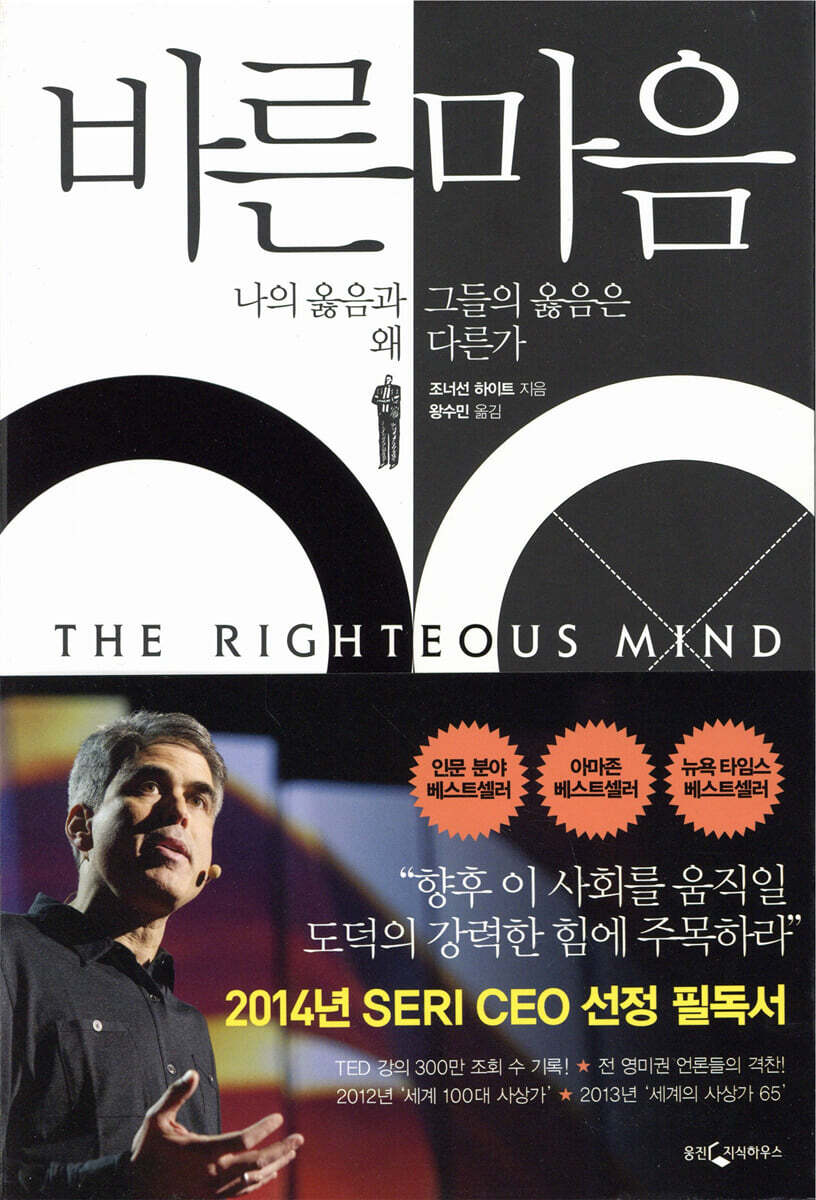
Just three lectures turned the intellectual world upside down. "All the important issues of our time will be a battle between right and wrong." Amazon Bestseller, New York Times Bestseller TED Talk 3 million views Rave reviews from the New York Times, Washington Post, Wall Street Journal, BBC, Guardian, Publisher's Weekly, and more! Jonathan Haidt's hit work has created a buzz around the world, transcending left and right! There are many different political ideologies, religious beliefs, and social values in the world. However, people believe that the one they chose is the 'most correct'. They form groups, act, and even sacrifice their entire lives for that 'rightness'. So how does the power of right come about, and how does it work? How can we achieve that moral high ground, and how can we transform it into a force that can change the world? While previous books on ethics and justice focused on the question of "why we shouldn't do something" in moral dilemmas, Haidt directly observed human behavior and explained the reasons for why we act that way. He says that 'morality', which we often narrowly understand as an individual's ethical issues or good character, is actually a very powerful factor that determines human judgment and collective behavior. The reason he insisted on proposing the concept of 'right mind' was to highlight the power of this moral emotion and its aspect of individual potential. He argues that morality operates more in the realm of emotions and the physical than in the realm of thought and judgment, and that it is more powerful than any belief or ideology in matters of collective power and leadership, as well as in the realm of individual happiness and taste. A hotly debated book that sparks interesting debate and thought on the topic of "right mind" based on various studies in anthropology, psychology, brain science, and evolutionary theory. As we explore cultural differences, economic issues, and political issues that were previously considered completely unrelated to morality, we will find ourselves redefining various issues we once thought had clear answers. |
- You can preview some of the book's contents.
Preview
index
Preface to the Korean edition
Entering: “Please, let’s get along.”
Why Righteousness, Not Morality | Three Principles of Moral Psychology
Part 1, Principle 1: The right mind is thoroughly selfish and strategic.
_ Intuition comes first, strategic reasoning comes second.
Chapter 1: Where Does Morality Come From?
Neither Nature nor Nurture | The Common Denominator of Progressives | Children Know What They Should Be Protecting | Are There Different Morals in Other Worlds | The Great Debate between Shweder and Tuuriel | Disgust and Contempt | Creating Victims
Chapter 2: Morality is Too Emotional
The Relationship Between Evolution and Morality | How We Came to Think of Morality as a Realm of Reason | Even Atheists Don't Sell Their Souls | Judging by Sight vs. Seeking Reason
Chapter 3: I am right, others are wrong
How does the brain evaluate morality? | The more social and political we are, the more emotional we are. | Morality is influenced by our physical condition. | Murderers only have thoughts. | Even newborns can recognize good people. | What happens in the brain when we make moral judgments? | How to overturn moral intuition?
Chapter 4: Morality is like a politician trying to get votes.
Vote for me | We are obsessed with public opinion | The competent spokesperson within me | I fool myself into thinking I am good | Just believe me, I will provide evidence | If it supports us, it is all right | The rationalist's delusion
Part 2, Principle 2: A Right Mind Has Many Powers
_ Morality is not limited to the dimensions of harm and fairness.
Chapter 5 Beyond Narrow Morality
Three Faces of Ethics | A New Morality Discovered in India | Stepping Out of the Matrix
Chapter 6: The Six Tastes of a Right Mind
The Birth of Morality | The Right Mind Lost in Empathy | Bentham and the Utilitarian Restaurant | Kant and the Deontologist Restaurant | Expanding Your Moral Sense | Morality-Based Theory
Chapter 7: How Politics Uses Morality
Things that were already created before birth | Consideration and harm | Fairness and injustice | Loyalty and betrayal | Authority and subversion | Nobility and ugliness
Chapter 8: The Moral Man Wins
Measuring Morality | Why Poor People Vote Conservative | The Unexpected | Freedom and Oppression | You Get What You Work For | The Three Moral Foundations of Progressives vs. the Six Moral Foundations of Conservatives
Part 3, Principle 3: Righteousness is more powerful in groups than in individuals.
Morality can either unite people or blind them.
Chapter 9: Why We Are So Collective
The Winning Tribe | Our interests are more important than mine | Evidence A: A massive evolutionary shift | Evidence B: Running together toward a single goal | Evidence C: Genes and culture evolve together | Evidence D: Evolution can happen at a rapid pace
Chapter 10: The Cluster Switch: The Ability to Lose Yourself and Lose Yourself in Something Big
The Herd Hypothesis | The More We Gather, the More Excited We Get | Various Ways to Let Go of "I" and Enter "We" | Where Is the Human Herd Switch? | The Joy of Working Together | From Progressive to Conservative Communities
Chapter 11: Religion is not a matter of faith.
The Lonely Single | The New Atheist's Argument: Religion is an Illusion | A More Coherent Theory: Religion, Too, is a Human Choice | Durkheim's Theory: A Powerful Force Leading the Community | Is God Really Good or Evil? | Can We Live Without God and Religion? | The Definition of Morality Finally Appears
Chapter 12: Can't We Fight More Constructively?
On political diversity | From genes to the moral matrix | The grand narrative of progressivism and conservatism | The power of moral capital to sustain communities | One yin, two yang | Yin: Lessons from progressives | The first yang: Lessons from liberals | The second yang: Lessons from social conservatives | Towards a more civilized politics
In closing
Acknowledgements
main
References
Search
Entering: “Please, let’s get along.”
Why Righteousness, Not Morality | Three Principles of Moral Psychology
Part 1, Principle 1: The right mind is thoroughly selfish and strategic.
_ Intuition comes first, strategic reasoning comes second.
Chapter 1: Where Does Morality Come From?
Neither Nature nor Nurture | The Common Denominator of Progressives | Children Know What They Should Be Protecting | Are There Different Morals in Other Worlds | The Great Debate between Shweder and Tuuriel | Disgust and Contempt | Creating Victims
Chapter 2: Morality is Too Emotional
The Relationship Between Evolution and Morality | How We Came to Think of Morality as a Realm of Reason | Even Atheists Don't Sell Their Souls | Judging by Sight vs. Seeking Reason
Chapter 3: I am right, others are wrong
How does the brain evaluate morality? | The more social and political we are, the more emotional we are. | Morality is influenced by our physical condition. | Murderers only have thoughts. | Even newborns can recognize good people. | What happens in the brain when we make moral judgments? | How to overturn moral intuition?
Chapter 4: Morality is like a politician trying to get votes.
Vote for me | We are obsessed with public opinion | The competent spokesperson within me | I fool myself into thinking I am good | Just believe me, I will provide evidence | If it supports us, it is all right | The rationalist's delusion
Part 2, Principle 2: A Right Mind Has Many Powers
_ Morality is not limited to the dimensions of harm and fairness.
Chapter 5 Beyond Narrow Morality
Three Faces of Ethics | A New Morality Discovered in India | Stepping Out of the Matrix
Chapter 6: The Six Tastes of a Right Mind
The Birth of Morality | The Right Mind Lost in Empathy | Bentham and the Utilitarian Restaurant | Kant and the Deontologist Restaurant | Expanding Your Moral Sense | Morality-Based Theory
Chapter 7: How Politics Uses Morality
Things that were already created before birth | Consideration and harm | Fairness and injustice | Loyalty and betrayal | Authority and subversion | Nobility and ugliness
Chapter 8: The Moral Man Wins
Measuring Morality | Why Poor People Vote Conservative | The Unexpected | Freedom and Oppression | You Get What You Work For | The Three Moral Foundations of Progressives vs. the Six Moral Foundations of Conservatives
Part 3, Principle 3: Righteousness is more powerful in groups than in individuals.
Morality can either unite people or blind them.
Chapter 9: Why We Are So Collective
The Winning Tribe | Our interests are more important than mine | Evidence A: A massive evolutionary shift | Evidence B: Running together toward a single goal | Evidence C: Genes and culture evolve together | Evidence D: Evolution can happen at a rapid pace
Chapter 10: The Cluster Switch: The Ability to Lose Yourself and Lose Yourself in Something Big
The Herd Hypothesis | The More We Gather, the More Excited We Get | Various Ways to Let Go of "I" and Enter "We" | Where Is the Human Herd Switch? | The Joy of Working Together | From Progressive to Conservative Communities
Chapter 11: Religion is not a matter of faith.
The Lonely Single | The New Atheist's Argument: Religion is an Illusion | A More Coherent Theory: Religion, Too, is a Human Choice | Durkheim's Theory: A Powerful Force Leading the Community | Is God Really Good or Evil? | Can We Live Without God and Religion? | The Definition of Morality Finally Appears
Chapter 12: Can't We Fight More Constructively?
On political diversity | From genes to the moral matrix | The grand narrative of progressivism and conservatism | The power of moral capital to sustain communities | One yin, two yang | Yin: Lessons from progressives | The first yang: Lessons from liberals | The second yang: Lessons from social conservatives | Towards a more civilized politics
In closing
Acknowledgements
main
References
Search
Into the book
I could have titled this book 'Moral Mind'.
This means that just as the human mind was designed from the beginning to engage in numerous activities such as language, sex, and music, the human mind was designed from the beginning to 'practice' morality.
However, I decided to title this book 'Righteous Mind'.
The idea was to convey the idea that human nature is inherently moral, but also that it is moral and good at criticizing and judging.
_ Introduction (page 18)
There is a man here.
He goes to the market once a week to buy raw chicken.
But before cooking the chicken, he has sex with it.
Then cook it and eat it.
(...) no one is harmed and no one knows about this except the person involved.
At face value, it was simply a case of recycling resources for their own use (as some of the subjects in the study put it).
But the feeling of wanting to vomit is much stronger in this story, and this behavior is, how can I put it, so shameful.
So is this behavior wrong?
Where does morality come from? (page 30)
Why do people so fervently uphold certain objects (national flags, crosses), places (Mecca, battlefields that served as the birthplace of nations), people (saints, heroes), and principles (freedom, camaraderie, equality) as if they possessed infinite value? Regardless of its origins, this mentality of nobility is undeniably a force that unites disparate individuals and creates a moral community.
And if someone within a moral community undermines the sacred pillars that support the community, people all rise up emotionally and try to punish him in some way.
How Politics Uses Morality (p. 278)
The left relies primarily on the consideration-based and fairness-based platforms, while the right appears to utilize all five platforms.
But if that's really true, doesn't that mean the morality of the left is a bit like the food at The True Taste restaurant?
Left-wing morality activates only one or two taste receptors, while right-wing morality stimulates a broader gustatory system, encompassing loyalty, authority, and nobility.
If that's the case, doesn't that mean conservative politicians ultimately have a wider and more diverse way to connect with voters?
How Politics Uses Morality (p. 286)
Human nature is largely selfish, but there is also a degree of heterogeneity hidden behind it, and this heterogeneity arises because natural selection occurs simultaneously at various levels.
(...) Competition also occurs between groups, and in this competition, groups with true team players have an advantage.
That is, people who are willing to cooperate and work for the group even though it would be better for them to be lazy, deceive others, or leave the group.
In this way, competition between individuals and between groups has pushed human nature in different directions, and as a result, as we see today, selfishness and altruism are strangely mixed within us.
_Why We Are So Collective (p. 346)
This book attempts to explain why people are divided into different factions because of politics and religion.
The answer is not that some people are good and some are bad.
Rather, the answer in this book was that our minds are designed to pursue collective righteousness.
We humans are extremely intuitive creatures, and our ability to reason strategically is actually driven by intuition.
So, when we meet people from different matrices than us, especially since their moral matrices often rely on moral foundations arranged differently from ours, it is not easy (but not impossible) to connect with them.
This means that just as the human mind was designed from the beginning to engage in numerous activities such as language, sex, and music, the human mind was designed from the beginning to 'practice' morality.
However, I decided to title this book 'Righteous Mind'.
The idea was to convey the idea that human nature is inherently moral, but also that it is moral and good at criticizing and judging.
_ Introduction (page 18)
There is a man here.
He goes to the market once a week to buy raw chicken.
But before cooking the chicken, he has sex with it.
Then cook it and eat it.
(...) no one is harmed and no one knows about this except the person involved.
At face value, it was simply a case of recycling resources for their own use (as some of the subjects in the study put it).
But the feeling of wanting to vomit is much stronger in this story, and this behavior is, how can I put it, so shameful.
So is this behavior wrong?
Where does morality come from? (page 30)
Why do people so fervently uphold certain objects (national flags, crosses), places (Mecca, battlefields that served as the birthplace of nations), people (saints, heroes), and principles (freedom, camaraderie, equality) as if they possessed infinite value? Regardless of its origins, this mentality of nobility is undeniably a force that unites disparate individuals and creates a moral community.
And if someone within a moral community undermines the sacred pillars that support the community, people all rise up emotionally and try to punish him in some way.
How Politics Uses Morality (p. 278)
The left relies primarily on the consideration-based and fairness-based platforms, while the right appears to utilize all five platforms.
But if that's really true, doesn't that mean the morality of the left is a bit like the food at The True Taste restaurant?
Left-wing morality activates only one or two taste receptors, while right-wing morality stimulates a broader gustatory system, encompassing loyalty, authority, and nobility.
If that's the case, doesn't that mean conservative politicians ultimately have a wider and more diverse way to connect with voters?
How Politics Uses Morality (p. 286)
Human nature is largely selfish, but there is also a degree of heterogeneity hidden behind it, and this heterogeneity arises because natural selection occurs simultaneously at various levels.
(...) Competition also occurs between groups, and in this competition, groups with true team players have an advantage.
That is, people who are willing to cooperate and work for the group even though it would be better for them to be lazy, deceive others, or leave the group.
In this way, competition between individuals and between groups has pushed human nature in different directions, and as a result, as we see today, selfishness and altruism are strangely mixed within us.
_Why We Are So Collective (p. 346)
This book attempts to explain why people are divided into different factions because of politics and religion.
The answer is not that some people are good and some are bad.
Rather, the answer in this book was that our minds are designed to pursue collective righteousness.
We humans are extremely intuitive creatures, and our ability to reason strategically is actually driven by intuition.
So, when we meet people from different matrices than us, especially since their moral matrices often rely on moral foundations arranged differently from ours, it is not easy (but not impossible) to connect with them.
---From the text
Publisher's Review
Economic crisis, political polarization, conflict between groups…
All the important issues of this age will be a battle between right and wrong.
Hidden in our deepest self
The only book that analyzes the powerful force of morality!
★ Amazon Bestseller, New York Times Bestseller ★
★ TED Talk 3 million views ★
★Jonathan Haidt's hit work that has transcended left and right and created a buzz around the world!★
Rave reviews from the New York Times, Washington Post, Wall Street Journal, BBC, Guardian, Publisher's Weekly, and more!
One of the world's top 100 thinkers selected by Foreign Policy, an American international diplomacy magazine.
Selected as one of the world's 65 most influential thinkers by the British political journal Prospect
Why are progressives and conservatives so at odds? Why do we feel offended when we see a student speaking informally to an elderly person on the street? What motivates us to stay up until dawn every time there's a sporting event to cheer on the Republic of Korea, to sacrifice our personal lives for the team's success, and to dedicate ourselves to our work? What is the underlying psychology that permeates these seemingly disparate issues? It is the power of a "righteous mind."
There are many different political leanings, religious beliefs, and social values in the world.
However, people do not feel much confusion in choosing one of them.
It's so easy to choose what you think is right, and sometimes you even sacrifice your whole life for that one thing.
So, which of these diverse values will become the majority, win the competition, change the world, and create new power?
Three TED Talks Turn the Intellectual World Upside Down
Why are scholars and media around the world focusing on the "right mind"?
Jonathan Haidt, a professor at New York University's Stern School of Business and currently the hottest social psychologist in the English-speaking world, discovers the 'righteous mind' that lies at the root of human thought and behavior through this book, 'The Righteous Mind.'
In 2008, Hite's 18-minute TED talk on the weighty topic of "The Moral Roots of Progress and Conservatism" created a huge buzz as soon as it was posted.
Since then, three lectures, including “Religion, Evolution, and the Happiness of Self-Transcendence” and “How Common Threats Create Common (Political) Consensus,” have attracted explosive views of over 3 million and have become a hot topic around the world.
The author, who has studied moral emotions for a long time, expanded on the content of his 2008 TED lecture and published “Right Mind” in 2012, which summarizes his research findings.
As soon as this book was published in the United States, it received great attention from both the left and the right, as well as from intellectuals, and it was a rare academic book to reach the top 10 on Amazon's bestseller list.
He has received praise such as “a monumental contribution to humanity’s self-understanding” (The New York Times), “a book that will change the way we think and talk about politics, religion, and human nature” (NPR), and “a book that compellingly depicts the rich complexity and potential flexibility of the moral world” (Kirkus Reviews), and the world’s media has been competing to select him as a major thinker, and he is receiving keen attention not only in the fields of psychology but also in politics and economics.
Even before its publication in Korea, scholars from various fields have been praising Haidt's exceptional insight and have mentioned the book.
The powerful force of the 'right mind' hidden deep within the human mind
Completely overturning the moral framework that has dominated for thousands of years.
In this book, Haidt reestablished three principles of moral psychology.
While previous books on ethics and justice focused on the question of "why we shouldn't do something" in moral dilemmas, Haidt directly observed human behavior and explained the reasons for "why we act this way."
He says that 'morality', which we often narrowly understand as an individual's ethical issues or good character, is actually a very powerful factor that determines human judgment and collective behavior.
The reason he insisted on proposing the concept of 'right mind' was to highlight the power of this moral emotion and its aspect of individual potential.
In particular, he argues that morality operates more importantly in the realm of emotions and the physical than in the realm of thought and judgment, and that it is more powerful than any belief or ideology in matters of collective power and leadership, as well as in the realm of individual happiness and taste.
First principle.
The right mind is thoroughly selfish and strategic.
Morality, discussed in terms of Kant's deontology and Bentham's utilitarianism, formalized the diagram of morality = reason.
But moral judgments are also very intuitive and emotional.
There are acts that do not directly harm others, but are disgusting the moment you hear about them, such as people who eat human flesh with each other's consent or people who have sex with a dead chicken and then cook and eat it.
When we ask people to explain why something is morally wrong, our reasoning begins to find reasons that fit the judgments our moral intuitions make.
Moreover, ‘morality’ is not simply ‘living correctly’ on how to live, but rather an act of looking at the reputation of those around you and trying to gain a good reputation, like a “politician trying to get votes.”
The fact that humans are thoroughly selfish and strategic in their use of morality overturns the existing framework of morality.
Second principle.
A right mind has many powers.
Haight says that morality goes beyond not harming others and not living a life that is shameful to oneself.
If it were simply expressed from this one mind, everyone's sense of morality would be the same, regardless of culture, personal inclination, or upbringing.
But in India, husbands beating their wives and strict hierarchical structures like the caste system are all considered moral.
Haight argues that morality is like taste, and that various moral tastes powerfully influence human values, beliefs, and judgments.
For example, as political polarization has deepened, progressives have constantly wondered why poor people vote for conservative parties.
According to Haidt, conservatives use more catchphrases that appeal to voters' "right minds," such as family values, national values, respect for authority figures, and an emphasis on sexual purity.
That's why you vote according to your moral beliefs, not what will benefit you.
Third principle.
Righteousness is more powerful at the collective level than at the individual level.
What is the most powerful force capable of moving many people as a single organism? Why do those who seek to mobilize groups cling to moral superiority? Haidt argues that this too stems from the human moral nature of pursuing "collective righteousness."
How to get selfish people to abandon their selfishness and sacrifice for the group has been a topic of intense debate among many scholars.
Darwin attempted to prove human altruism through group selection in his theory of evolution, but was pushed out of the academic world because he argued that human altruism also stemmed from selfishness and failed to resolve the problem of free riders.
But in this book, Haidt revives group selection theory.
Humans have something called a 'herd switch', and when it's activated, they act for the benefit of the group they belong to, just like bees.
This could be a national crisis like 9/11, or it could be a form of cheering we often see in team sports.
The power that blinds people and brings them together is the 'right mind' of altruism for the group, that is, this collectivity.
Why don't they agree with the values I take for granted?
"All the important issues of our time will be battles between right and wrong."
They say we live in an age where even the slightest conscience has disappeared, an age where all values have lost their meaning, but the sharp issues we face are all battles between right and wrong.
Hite says that a new world opens up the moment we recognize how our values and theirs are 'different', rather than how we are right and they are wrong.
And he emphasizes that in order to recognize that 'difference', we must know the appearance of the 'right mind', which is the most intimate nature of humans.
This book provokes interesting debate and thought on the topic of "right mind" based on various studies in anthropology, psychology, brain science, and evolutionary theory.
As we explore cultural differences, economic issues, and political issues that we might otherwise think have nothing to do with morality, we find ourselves redefining many questions we once thought had clear answers.
Aspects of human society driven by the "righteous mind" are reinterpreted, such as why some political forces are welcomed as new and others are shunned as old, why morality favors conservatives, why some people push forward with such strong self-confidence despite opposition from the majority, and why corporations at the pinnacle of profit-seeking care so much about corporate ethics.
The most important thing in living in this world, but the source of the human mind that no sociology, political science, or psychology has been able to explain so far.
This book rediscovers morality as the most special ability of human beings.
Now, we reveal the true nature of the "right mind," from how to make society more constructive to how to enable an individual to live his or her life with meaning.
All the important issues of this age will be a battle between right and wrong.
Hidden in our deepest self
The only book that analyzes the powerful force of morality!
★ Amazon Bestseller, New York Times Bestseller ★
★ TED Talk 3 million views ★
★Jonathan Haidt's hit work that has transcended left and right and created a buzz around the world!★
Rave reviews from the New York Times, Washington Post, Wall Street Journal, BBC, Guardian, Publisher's Weekly, and more!
One of the world's top 100 thinkers selected by Foreign Policy, an American international diplomacy magazine.
Selected as one of the world's 65 most influential thinkers by the British political journal Prospect
Why are progressives and conservatives so at odds? Why do we feel offended when we see a student speaking informally to an elderly person on the street? What motivates us to stay up until dawn every time there's a sporting event to cheer on the Republic of Korea, to sacrifice our personal lives for the team's success, and to dedicate ourselves to our work? What is the underlying psychology that permeates these seemingly disparate issues? It is the power of a "righteous mind."
There are many different political leanings, religious beliefs, and social values in the world.
However, people do not feel much confusion in choosing one of them.
It's so easy to choose what you think is right, and sometimes you even sacrifice your whole life for that one thing.
So, which of these diverse values will become the majority, win the competition, change the world, and create new power?
Three TED Talks Turn the Intellectual World Upside Down
Why are scholars and media around the world focusing on the "right mind"?
Jonathan Haidt, a professor at New York University's Stern School of Business and currently the hottest social psychologist in the English-speaking world, discovers the 'righteous mind' that lies at the root of human thought and behavior through this book, 'The Righteous Mind.'
In 2008, Hite's 18-minute TED talk on the weighty topic of "The Moral Roots of Progress and Conservatism" created a huge buzz as soon as it was posted.
Since then, three lectures, including “Religion, Evolution, and the Happiness of Self-Transcendence” and “How Common Threats Create Common (Political) Consensus,” have attracted explosive views of over 3 million and have become a hot topic around the world.
The author, who has studied moral emotions for a long time, expanded on the content of his 2008 TED lecture and published “Right Mind” in 2012, which summarizes his research findings.
As soon as this book was published in the United States, it received great attention from both the left and the right, as well as from intellectuals, and it was a rare academic book to reach the top 10 on Amazon's bestseller list.
He has received praise such as “a monumental contribution to humanity’s self-understanding” (The New York Times), “a book that will change the way we think and talk about politics, religion, and human nature” (NPR), and “a book that compellingly depicts the rich complexity and potential flexibility of the moral world” (Kirkus Reviews), and the world’s media has been competing to select him as a major thinker, and he is receiving keen attention not only in the fields of psychology but also in politics and economics.
Even before its publication in Korea, scholars from various fields have been praising Haidt's exceptional insight and have mentioned the book.
The powerful force of the 'right mind' hidden deep within the human mind
Completely overturning the moral framework that has dominated for thousands of years.
In this book, Haidt reestablished three principles of moral psychology.
While previous books on ethics and justice focused on the question of "why we shouldn't do something" in moral dilemmas, Haidt directly observed human behavior and explained the reasons for "why we act this way."
He says that 'morality', which we often narrowly understand as an individual's ethical issues or good character, is actually a very powerful factor that determines human judgment and collective behavior.
The reason he insisted on proposing the concept of 'right mind' was to highlight the power of this moral emotion and its aspect of individual potential.
In particular, he argues that morality operates more importantly in the realm of emotions and the physical than in the realm of thought and judgment, and that it is more powerful than any belief or ideology in matters of collective power and leadership, as well as in the realm of individual happiness and taste.
First principle.
The right mind is thoroughly selfish and strategic.
Morality, discussed in terms of Kant's deontology and Bentham's utilitarianism, formalized the diagram of morality = reason.
But moral judgments are also very intuitive and emotional.
There are acts that do not directly harm others, but are disgusting the moment you hear about them, such as people who eat human flesh with each other's consent or people who have sex with a dead chicken and then cook and eat it.
When we ask people to explain why something is morally wrong, our reasoning begins to find reasons that fit the judgments our moral intuitions make.
Moreover, ‘morality’ is not simply ‘living correctly’ on how to live, but rather an act of looking at the reputation of those around you and trying to gain a good reputation, like a “politician trying to get votes.”
The fact that humans are thoroughly selfish and strategic in their use of morality overturns the existing framework of morality.
Second principle.
A right mind has many powers.
Haight says that morality goes beyond not harming others and not living a life that is shameful to oneself.
If it were simply expressed from this one mind, everyone's sense of morality would be the same, regardless of culture, personal inclination, or upbringing.
But in India, husbands beating their wives and strict hierarchical structures like the caste system are all considered moral.
Haight argues that morality is like taste, and that various moral tastes powerfully influence human values, beliefs, and judgments.
For example, as political polarization has deepened, progressives have constantly wondered why poor people vote for conservative parties.
According to Haidt, conservatives use more catchphrases that appeal to voters' "right minds," such as family values, national values, respect for authority figures, and an emphasis on sexual purity.
That's why you vote according to your moral beliefs, not what will benefit you.
Third principle.
Righteousness is more powerful at the collective level than at the individual level.
What is the most powerful force capable of moving many people as a single organism? Why do those who seek to mobilize groups cling to moral superiority? Haidt argues that this too stems from the human moral nature of pursuing "collective righteousness."
How to get selfish people to abandon their selfishness and sacrifice for the group has been a topic of intense debate among many scholars.
Darwin attempted to prove human altruism through group selection in his theory of evolution, but was pushed out of the academic world because he argued that human altruism also stemmed from selfishness and failed to resolve the problem of free riders.
But in this book, Haidt revives group selection theory.
Humans have something called a 'herd switch', and when it's activated, they act for the benefit of the group they belong to, just like bees.
This could be a national crisis like 9/11, or it could be a form of cheering we often see in team sports.
The power that blinds people and brings them together is the 'right mind' of altruism for the group, that is, this collectivity.
Why don't they agree with the values I take for granted?
"All the important issues of our time will be battles between right and wrong."
They say we live in an age where even the slightest conscience has disappeared, an age where all values have lost their meaning, but the sharp issues we face are all battles between right and wrong.
Hite says that a new world opens up the moment we recognize how our values and theirs are 'different', rather than how we are right and they are wrong.
And he emphasizes that in order to recognize that 'difference', we must know the appearance of the 'right mind', which is the most intimate nature of humans.
This book provokes interesting debate and thought on the topic of "right mind" based on various studies in anthropology, psychology, brain science, and evolutionary theory.
As we explore cultural differences, economic issues, and political issues that we might otherwise think have nothing to do with morality, we find ourselves redefining many questions we once thought had clear answers.
Aspects of human society driven by the "righteous mind" are reinterpreted, such as why some political forces are welcomed as new and others are shunned as old, why morality favors conservatives, why some people push forward with such strong self-confidence despite opposition from the majority, and why corporations at the pinnacle of profit-seeking care so much about corporate ethics.
The most important thing in living in this world, but the source of the human mind that no sociology, political science, or psychology has been able to explain so far.
This book rediscovers morality as the most special ability of human beings.
Now, we reveal the true nature of the "right mind," from how to make society more constructive to how to enable an individual to live his or her life with meaning.
GOODS SPECIFICS
- Date of issue: April 21, 2014
- Page count, weight, size: 692 pages | 886g | 152*225*35mm
- ISBN13: 9788901163673
- ISBN10: 8901163675
You may also like
카테고리
korean


korean

![GQ KOREA Mark (Monthly): December [2025]](http://librairie.coreenne.fr/cdn/shop/files/8ef265dbbfbf186523ed75ba7319009d.jpg?v=1765340328&width=3840)


