

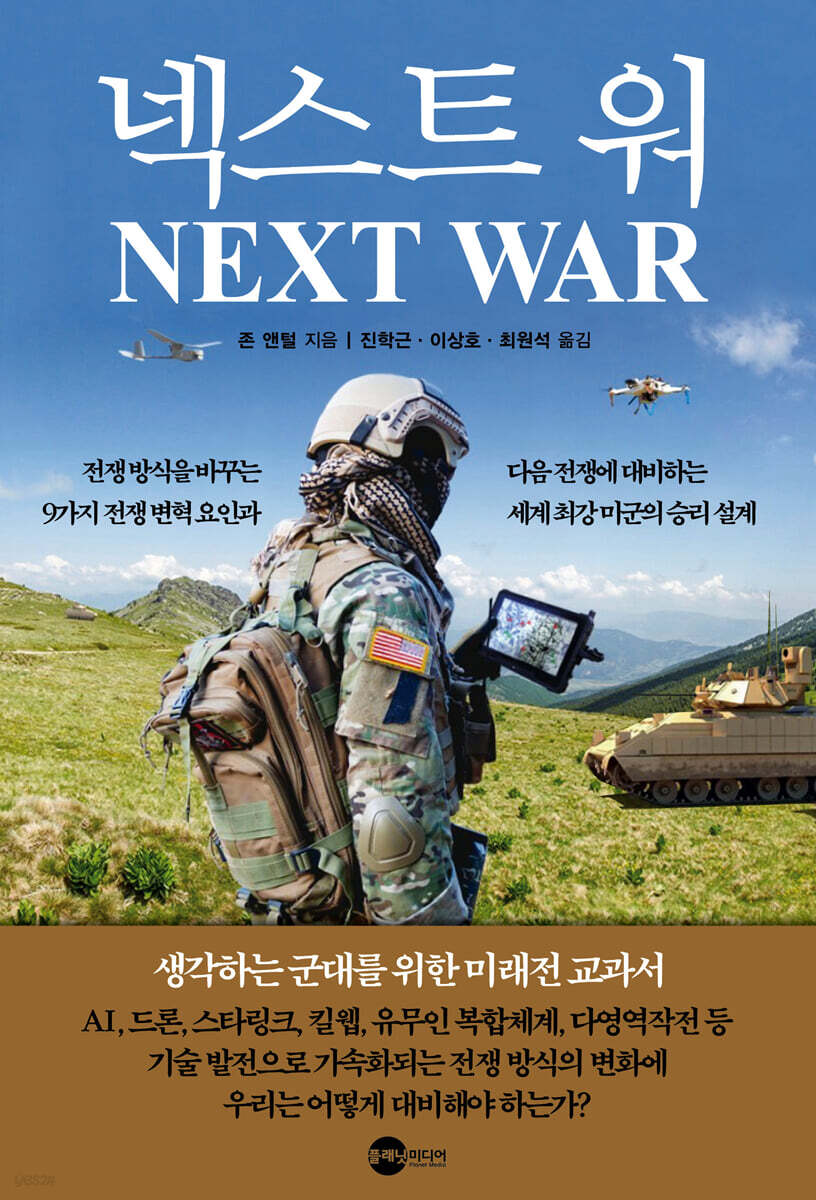
Next War
 |
Description
Book Introduction
9 war transformation factors that change the way we fight
Designing the World's Strongest US Military for Victory in the Next War
★
Future Warfare Textbook for a Thinking Army
★
AI, drones, Starlink, Kill Web, autonomous weapons, manned-unmanned complex systems, multi-domain operations, etc.
The changes in warfare methods that are accelerating due to technological advancements
How is the world's strongest US military preparing?
How should we prepare?
★
To reimagine and innovate the way war is waged
A good starting point
Throughout the history of warfare, the emergence of new technologies and weapons has always triggered fundamental changes in the way war is fought.
But in recent years, the way war is waged has changed in surprising and sometimes frightening ways.
As seen in the Russia-Ukraine war, new technologies such as AI (artificial intelligence), drones, and Starlink have become 'core elements' of war rather than 'auxiliary means' of war, and 'the way of war has completely changed from the past.
This is an era in which cheap drones can not only collect information, conduct surveillance, and reconnaissance, but also destroy expensive tanks and high-value targets worth millions of dollars; Starlink can restore communication through satellite internet even when ground communication networks are destroyed or paralyzed; AI can quickly analyze massive battlefield data to predict enemy locations and movements and automatically identify targets; and commanders can grasp the battlespace in real time without having to see it with their own eyes and make decisions in seconds according to the AI's computational speed.
The author of this book, John Antel, meticulously analyzed recent events such as the Second Nagorno-Karabakh War, the Israel-Hamas War, and the Russia-Ukraine War. This led him to write "The Next War" out of a pressing sense that past doctrines, training, and methods of warfare can no longer respond to new forms of war.
The author served as a combat unit officer in the U.S. Army for 30 years and retired as an Army colonel. He is a military strategist who has researched future warfare, AI warfare, autonomous weapon systems, and information warfare. Based on his practical experience, he served as a leadership and tactics instructor at the U.S. Army Armor School and West Point, and is a leadership expert who has trained thousands of officers.
This book explains in detail the nine factors of war transformation derived by the author through research on recent wars: transparent battlespace, the benefits of preemptive strike, unmanned aerial attacks, AI and the accelerating tempo of war, transition to fully autonomous weapons, kill web, super swarms, battlespace visualization, and decision advantage. It can be said to be a textbook on future warfare that presents how the US military must prepare in the levels of command, design, training, combat, and support to win the next war, such as utilizing Starlink, preparing for future urban battles, high-low mix strategies such as the Big Blue Blanket, a light tactical aircraft operation strategy for counter-drone operations, human-robot hybrid units, command post operation rules, and creating combat shock.
The author says, “Future wars depend on how humans and machines cooperate.
Current AI isn't advanced enough to command multi-domain battles on its own, but combining it with human cognitive abilities could create a truly intelligent and powerful system.
…the human element is crucial in this combination. While AI still has significant systemic vulnerabilities, human intervention can transform vulnerable AI into a better weapon system for configuring and coordinating robotic network systems.
We cannot create an AI that can think like a human, and we should not try to create one.
“However, the next step will require the integration of humans and machines, and this will be the key variable that determines the winners and losers of the next war,” he predicts.
It also raises a fundamental question: "When technological advancements surpass human control, what criteria will guide our warfare?" In today's world, where AI, autonomous weapons, drones, and robotic combat vehicles (RCVs) are deployed into battlespace, the question of who holds "control" and "responsibility" is emerging as a new challenge.
The author first emphasizes the importance of ‘asking the right questions.’
Rather than being overwhelmed by the pace of technological advancement, we need to be clear about “what problems we really need to solve.”
The author argues that the fundamental question, rather than the technology itself, is “what place should human judgment have in war?”
The crux of this issue boils down to “whether to command or control the robot.”
He argues that “attempts to ‘control’ robotic systems ultimately make humans subordinate to technology, but if we maintain the concept of ‘command,’ humans can still be at the center of purpose and judgment.”
In other words, humans should not be seen as mere 'manipulators' of technology, but rather as subjects who determine its direction and 'give it meaning.'
The author warns that no matter how much technology advances, “we must be able to ask the right questions and have humans answer them for themselves.”
Because the outcome of the next war will depend more on the decisions made by the humans using the weapons than on the performance of the weapons themselves.
The author states, “The world’s most lethal weapon is a human combatant, properly trained, properly equipped, and determined to fight as part of a team.
Even in the midst of chaos and confusion caused by a network breakdown, well-trained and determined men and women who can follow and execute mission-oriented commands are more important than technology.
No technology can replace a team of well-trained, prepared, and determined fighters.
However, when such a team has the best skills and tactics, it can create an overwhelming advantage at crucial moments.
By combining these elements and applying them appropriately, you can inflict battle shock on your enemies.
To achieve this, we must effectively combine command, design, training, combat, and support to ensure victory in the next war,” he argues.
This book is not simply a military theory book. It is a "textbook for future warfare" and a "strategic thinking training manual," asking how human thinking and leadership must evolve in an era where AI, various sensors, autonomous weapons, and satellites are transforming the way warfare is conducted and dominating the pace of warfare.
Although the author wrote this book strictly for the U.S. military, it provides useful guidance for thinking about and designing how the South Korean military should prepare for future wars, given the security realities of the Korean Peninsula, which is not only in a sharp standoff with North Korea but also surrounded by powerful powers like China and Russia.
The South Korean military also needs to heed the author's message that it must move beyond technology-centered war preparation to thinking-centered preparation—to become "a military that can imagine the next war, a thinking military."
The author warns that an army that is late in making a decision to command is bound to be defeated, citing General MacArthur's words, "The failure of war can be summarized in two words: 'Too Late.'" He adds, "The best way to prevent war is to prepare for war, and if war breaks out, the goal should be to win as quickly as possible.
A commander who thinks and acts in a timely manner is invaluable.
As important as technology is to winning a war, human leadership is equally important.
Leadership that can win a war requires technical prowess, imagination, and foresight.
You must use your imagination as you read, think critically, ask relevant questions, derive answers, and test your conclusions.
Efforts to develop foresight should not be postponed until tomorrow.
“We must start right now,” he emphasizes.
Amidst the US-China rivalry, China's threat of invasion of Taiwan, North Korea's nuclear threat, and the aftermath of the Russo-Ukrainian War, the security environment on the Korean Peninsula is more complex and uncertain than ever.
In this situation, predicting the changing nature of war and developing preparedness is not a 'choice' but a 'necessity'.
This book will serve as a good starting point for reimagining and innovating the way war is waged.
Designing the World's Strongest US Military for Victory in the Next War
★
Future Warfare Textbook for a Thinking Army
★
AI, drones, Starlink, Kill Web, autonomous weapons, manned-unmanned complex systems, multi-domain operations, etc.
The changes in warfare methods that are accelerating due to technological advancements
How is the world's strongest US military preparing?
How should we prepare?
★
To reimagine and innovate the way war is waged
A good starting point
Throughout the history of warfare, the emergence of new technologies and weapons has always triggered fundamental changes in the way war is fought.
But in recent years, the way war is waged has changed in surprising and sometimes frightening ways.
As seen in the Russia-Ukraine war, new technologies such as AI (artificial intelligence), drones, and Starlink have become 'core elements' of war rather than 'auxiliary means' of war, and 'the way of war has completely changed from the past.
This is an era in which cheap drones can not only collect information, conduct surveillance, and reconnaissance, but also destroy expensive tanks and high-value targets worth millions of dollars; Starlink can restore communication through satellite internet even when ground communication networks are destroyed or paralyzed; AI can quickly analyze massive battlefield data to predict enemy locations and movements and automatically identify targets; and commanders can grasp the battlespace in real time without having to see it with their own eyes and make decisions in seconds according to the AI's computational speed.
The author of this book, John Antel, meticulously analyzed recent events such as the Second Nagorno-Karabakh War, the Israel-Hamas War, and the Russia-Ukraine War. This led him to write "The Next War" out of a pressing sense that past doctrines, training, and methods of warfare can no longer respond to new forms of war.
The author served as a combat unit officer in the U.S. Army for 30 years and retired as an Army colonel. He is a military strategist who has researched future warfare, AI warfare, autonomous weapon systems, and information warfare. Based on his practical experience, he served as a leadership and tactics instructor at the U.S. Army Armor School and West Point, and is a leadership expert who has trained thousands of officers.
This book explains in detail the nine factors of war transformation derived by the author through research on recent wars: transparent battlespace, the benefits of preemptive strike, unmanned aerial attacks, AI and the accelerating tempo of war, transition to fully autonomous weapons, kill web, super swarms, battlespace visualization, and decision advantage. It can be said to be a textbook on future warfare that presents how the US military must prepare in the levels of command, design, training, combat, and support to win the next war, such as utilizing Starlink, preparing for future urban battles, high-low mix strategies such as the Big Blue Blanket, a light tactical aircraft operation strategy for counter-drone operations, human-robot hybrid units, command post operation rules, and creating combat shock.
The author says, “Future wars depend on how humans and machines cooperate.
Current AI isn't advanced enough to command multi-domain battles on its own, but combining it with human cognitive abilities could create a truly intelligent and powerful system.
…the human element is crucial in this combination. While AI still has significant systemic vulnerabilities, human intervention can transform vulnerable AI into a better weapon system for configuring and coordinating robotic network systems.
We cannot create an AI that can think like a human, and we should not try to create one.
“However, the next step will require the integration of humans and machines, and this will be the key variable that determines the winners and losers of the next war,” he predicts.
It also raises a fundamental question: "When technological advancements surpass human control, what criteria will guide our warfare?" In today's world, where AI, autonomous weapons, drones, and robotic combat vehicles (RCVs) are deployed into battlespace, the question of who holds "control" and "responsibility" is emerging as a new challenge.
The author first emphasizes the importance of ‘asking the right questions.’
Rather than being overwhelmed by the pace of technological advancement, we need to be clear about “what problems we really need to solve.”
The author argues that the fundamental question, rather than the technology itself, is “what place should human judgment have in war?”
The crux of this issue boils down to “whether to command or control the robot.”
He argues that “attempts to ‘control’ robotic systems ultimately make humans subordinate to technology, but if we maintain the concept of ‘command,’ humans can still be at the center of purpose and judgment.”
In other words, humans should not be seen as mere 'manipulators' of technology, but rather as subjects who determine its direction and 'give it meaning.'
The author warns that no matter how much technology advances, “we must be able to ask the right questions and have humans answer them for themselves.”
Because the outcome of the next war will depend more on the decisions made by the humans using the weapons than on the performance of the weapons themselves.
The author states, “The world’s most lethal weapon is a human combatant, properly trained, properly equipped, and determined to fight as part of a team.
Even in the midst of chaos and confusion caused by a network breakdown, well-trained and determined men and women who can follow and execute mission-oriented commands are more important than technology.
No technology can replace a team of well-trained, prepared, and determined fighters.
However, when such a team has the best skills and tactics, it can create an overwhelming advantage at crucial moments.
By combining these elements and applying them appropriately, you can inflict battle shock on your enemies.
To achieve this, we must effectively combine command, design, training, combat, and support to ensure victory in the next war,” he argues.
This book is not simply a military theory book. It is a "textbook for future warfare" and a "strategic thinking training manual," asking how human thinking and leadership must evolve in an era where AI, various sensors, autonomous weapons, and satellites are transforming the way warfare is conducted and dominating the pace of warfare.
Although the author wrote this book strictly for the U.S. military, it provides useful guidance for thinking about and designing how the South Korean military should prepare for future wars, given the security realities of the Korean Peninsula, which is not only in a sharp standoff with North Korea but also surrounded by powerful powers like China and Russia.
The South Korean military also needs to heed the author's message that it must move beyond technology-centered war preparation to thinking-centered preparation—to become "a military that can imagine the next war, a thinking military."
The author warns that an army that is late in making a decision to command is bound to be defeated, citing General MacArthur's words, "The failure of war can be summarized in two words: 'Too Late.'" He adds, "The best way to prevent war is to prepare for war, and if war breaks out, the goal should be to win as quickly as possible.
A commander who thinks and acts in a timely manner is invaluable.
As important as technology is to winning a war, human leadership is equally important.
Leadership that can win a war requires technical prowess, imagination, and foresight.
You must use your imagination as you read, think critically, ask relevant questions, derive answers, and test your conclusions.
Efforts to develop foresight should not be postponed until tomorrow.
“We must start right now,” he emphasizes.
Amidst the US-China rivalry, China's threat of invasion of Taiwan, North Korea's nuclear threat, and the aftermath of the Russo-Ukrainian War, the security environment on the Korean Peninsula is more complex and uncertain than ever.
In this situation, predicting the changing nature of war and developing preparedness is not a 'choice' but a 'necessity'.
This book will serve as a good starting point for reimagining and innovating the way war is waged.
- You can preview some of the book's contents.
Preview
index
| Recommendation | I think, therefore I am (Cogito ergo sum), the revival of Descartes
- Kang Shin-cheol (retired Army general)
Translator's Preface: Are We Prepared for a Changing Way of War?
| Recommendation | A good starting point for reimagining and innovating the way war is waged.
- Mike Rounds (US Senator, Member of the Senate Armed Services Committee)
| Preface | He who thinks wins!
| Acknowledgements |
CHAPTER 1 Lack of Imagination
Nine Key Transformative Factors in Modern Warfare
CHAPTER 2 Transparent Battlespace
optical signal
heat signature
electronic signal
Acoustic and seismic (wave) spectra
quantum spectrum
hide and seek game
CHAPTER 3 The Benefits of a Preemptive Strike
Unmanned combat aircraft and suicide drones
New striking means
Adapting to the new reality of drone warfare
First, hit hard.
CHAPTER 4 Unmanned Aerial Attacks
How to Repel Drone Attacks
laser
microwave
Electronic warfare jamming
physical means of destruction
Unmanned aerial strikes are a decisive engagement method.
CHAPTER 5: AI and the Accelerating Tempo of War
The fastest one wins
CHAPTER 6: Transition to Fully Autonomous Weapons
Masking of fully autonomous weapons
Multi-domain fusion will evolve into all-domain operations.
CHAPTER 7 Kill Web
Kill Chain
Kill Web
CHAPTER 8 Superclusters
Cluster attack tactics
Definition of a supercluster
CHAPTER 9 Visualizing the Battlespace
holistic perspective
Intuition
minimalist
Reduce cognitive load
Various forms of feedback
Locus of configurability and control
Automation
Development of a common operational situation map for all areas
Speed and AI
How JADC2 Works
CHAPTER 10 The Decision Advantage
The key to decisive superiority is skilled commanders and combatants.
Live Synth
Configuration Tactical Simulation - Virtual Battlespace
Arma 3
Rifts and Quests
CHAPTER 11 The First Starlink War
What is Starlink?
Ukraine Uses Starlink in War
CHAPTER 12 Preparing for Future Urban Combat
Mobile strike power
Future sensors, strike weapons, and jammers
Cluster ISR and strike
Controlling the city skies and the stratosphere
ISR and strike for future urban combat
CHAPTER 13 Big Blue Blanket: Light Tactics for Counter-Drone Operations
CHAPTER 14 Human-Robot Hybrid Unit
difficult problem
Asking the right questions
Will you command or pilot the robot?
CHAPTER 15 Command Post Operation Rules
CHAPTER 16 Battle Shock
command
design
training
battle
backup
victory
Next war
| Author's note |
- Kang Shin-cheol (retired Army general)
Translator's Preface: Are We Prepared for a Changing Way of War?
| Recommendation | A good starting point for reimagining and innovating the way war is waged.
- Mike Rounds (US Senator, Member of the Senate Armed Services Committee)
| Preface | He who thinks wins!
| Acknowledgements |
CHAPTER 1 Lack of Imagination
Nine Key Transformative Factors in Modern Warfare
CHAPTER 2 Transparent Battlespace
optical signal
heat signature
electronic signal
Acoustic and seismic (wave) spectra
quantum spectrum
hide and seek game
CHAPTER 3 The Benefits of a Preemptive Strike
Unmanned combat aircraft and suicide drones
New striking means
Adapting to the new reality of drone warfare
First, hit hard.
CHAPTER 4 Unmanned Aerial Attacks
How to Repel Drone Attacks
laser
microwave
Electronic warfare jamming
physical means of destruction
Unmanned aerial strikes are a decisive engagement method.
CHAPTER 5: AI and the Accelerating Tempo of War
The fastest one wins
CHAPTER 6: Transition to Fully Autonomous Weapons
Masking of fully autonomous weapons
Multi-domain fusion will evolve into all-domain operations.
CHAPTER 7 Kill Web
Kill Chain
Kill Web
CHAPTER 8 Superclusters
Cluster attack tactics
Definition of a supercluster
CHAPTER 9 Visualizing the Battlespace
holistic perspective
Intuition
minimalist
Reduce cognitive load
Various forms of feedback
Locus of configurability and control
Automation
Development of a common operational situation map for all areas
Speed and AI
How JADC2 Works
CHAPTER 10 The Decision Advantage
The key to decisive superiority is skilled commanders and combatants.
Live Synth
Configuration Tactical Simulation - Virtual Battlespace
Arma 3
Rifts and Quests
CHAPTER 11 The First Starlink War
What is Starlink?
Ukraine Uses Starlink in War
CHAPTER 12 Preparing for Future Urban Combat
Mobile strike power
Future sensors, strike weapons, and jammers
Cluster ISR and strike
Controlling the city skies and the stratosphere
ISR and strike for future urban combat
CHAPTER 13 Big Blue Blanket: Light Tactics for Counter-Drone Operations
CHAPTER 14 Human-Robot Hybrid Unit
difficult problem
Asking the right questions
Will you command or pilot the robot?
CHAPTER 15 Command Post Operation Rules
CHAPTER 16 Battle Shock
command
design
training
battle
backup
victory
Next war
| Author's note |
Publisher's Review
Chapter 1: Lack of Imagination
In Chapter 1, the author points out that the greatest danger in preparing for future wars is the inability to imagine new forms of war.
He points out that a lack of imagination is the root cause of strategic failures that have been repeated throughout the history of war, and says that defeat begins the moment we become complacent with past experiences and think that the next war will be the same as the previous one.
Citing the Pearl Harbor attack as an example, he points out that although the United States had all the information and technology to anticipate a Japanese attack, it failed to respond because it could not have imagined such an attack would occur.
Using this historical example, the author warns that today's military is repeating the same mistakes. Despite new technologies like AI, autonomous weapons, drones, and Starlink already transforming the battlefield, many military leaders remain stuck in old war doctrines and structures.
The author emphasizes that the first step in preparing for future wars is not 'prediction' but 'imagination,' saying, "If we fail to imagine new forms of war, we will ultimately fall behind and lose in that war."
“War is changing.
The question is not technology, but whether we have the imagination to see it.”
Chapter 2: Transparent Battlespace
Chapter 2 describes the battlespace made transparent by satellites, drones, reconnaissance aircraft, sensors, and electronic signal detection networks.
The author argues that traditional 'concealment' alone is no longer sufficient in a transparent battlespace.
In an environment where all troops and equipment are monitored and their locations exposed, 'masking' (a technique to block or distort enemy sensors and detection lines) is emphasized as a key to combat power.
Masking is not simply camouflage; it is an active defense technique that deceives enemy detection systems and induces false detections.
The author presents masking as “the only way to survive in a visualized battlespace,” and introduces new forms of “digital concealment” such as electronic warfare, thermal camouflage, radar shielding, and satellite jamming as practical response concepts.
In a “transparent battle space where everything is visible,” paradoxically, the ability to “make invisible” (masking) determines victory or defeat.
Chapter 3: The Benefits of a Preemptive Strike
Chapter 3 uses the 2022 Russian invasion of Ukraine as an example, diagnosing that despite launching a preemptive strike, Russia failed to sufficiently destroy or paralyze its target and failed to secure the integrated speed of information, determination, and strike, thereby failing to capitalize on the benefits of a preemptive strike.
To achieve this, a system that seamlessly combines detection, judgment, and concentrated strikes is essential, and it is emphasized that a true advantage is secured only when the enemy's command, control, and combat capabilities are decisively neutralized (i.e., 'hit hard') through a preemptive strike.
Chapter 4: Unmanned Aerial Attacks
Chapter 4 highlights the reality that drones have emerged from simple reconnaissance to become "sky artillery" capable of autonomous strikes.
Cases where cheap commercial drones can neutralize multi-million dollar tanks or air defense systems have reshaped the economics of combat, and the ability of AI-powered drones to operate in swarms and identify and track targets has the potential to overwhelm traditional air defenses and command systems.
Accordingly, the author diagnoses that unmanned aerial attacks are no longer just auxiliary means, but have established themselves as a decisive engagement method that determines the outcome of a battle.
The author also presents four axes as practical countermeasures to the drone threat.
This method involves quickly neutralizing small, low-altitude drones with high-power lasers, paralyzing the drone's electronic equipment with high-power microwaves (HPM), disrupting the drone's GPS, communication, and control links with electronic warfare (EW) jamming to paralyze the drone's navigation, and directly shooting down and eliminating the drone with physical interception (interceptor missiles, unmanned interceptors, anti-drone bullets, etc.).
The author cautions against viewing these technologies as a single solution, and emphasizes the need for a multi-layered combination of radar, optics, electronic warfare, energy weapons, and interceptor weapons (the so-called "blue blanket") to integrate the entire process of detection, identification, tracking, and defeat to secure response speed and resilience.
Chapter 5: AI and the Accelerating Tempo of War
Chapter 5 focuses on how AI is changing the tempo and decision-making process of the entire process.
The author states that while past wars were conducted sequentially based on human judgment and command, we have now entered an era where AI performs detection, analysis, decision, and strike almost simultaneously.
The battlespace is changing at an ever-increasing pace, and the amount and speed of information is reaching levels that humans cannot cope with.
The author analyzes that AI is a key factor in shortening the decision-making cycle amidst these changes. AI integrates massive sensor data to classify threats in real time and suggest optimal response measures.
This is transforming decisions that used to take minutes or hours into 'automatic decisions' that can be made in seconds.
However, the author points out that “if humans cannot keep up with this pace, there is a risk that AI decisions will soon determine the direction of war.”
The author argues that what is needed in AI-driven warfare is not simply faster technology, but “a mindset that can control speed.”
In other words, the computational speed of AI must be adjusted to the tempo of war, but human strategic judgment must not be completely excluded.
The author emphasizes the principle that AI should drive the pace of war, but humans should determine its direction.
Chapter 6: Transition to Fully Autonomous Weapons
Chapter 6 analyzes how advances in AI and robotics are leading to a "combat system that operates without human command."
The author argues that autonomous weapons are moving beyond simple remote control to the stage of making their own judgments and decisions, fundamentally changing the nature of war.
He presents examples of actual weapons currently under development, such as robotic combat vehicles (RCVs), autonomous drones, and AI artillery systems, and diagnoses that these weapons herald “an era of fully autonomous combat.”
In particular, the combination of edge computing and AI has enabled "situational intelligence" that can analyze, judge, and attack data on-site, thereby reducing human intervention.
However, it warns of the ethical and strategic problems (loss of control, risk of miscalculation, and responsibility) that these technological advances may bring.
Ultimately, he emphasizes that “the transition to fully autonomous weapons is inevitable, but human control and responsibility must not be completely eliminated.”
Autonomous weapons maximize the speed and precision of warfare, but when human value judgment disappears, war can degenerate into a simple algorithmic competition.
Therefore, it is predicted that the future command system will be reorganized from a “human-in-the-loop” where humans make decisions, to a “human-on-the-loop” where AI executes but humans supervise.
Chapter 7 Kill Web
Chapter 7 covers a new networked combat system that has changed the pace and structure of war.
The author explains that the existing 'Kill Chain', in which detection, decision, and strike are carried out sequentially, has now evolved into the 'Kill Web', a 'multi-dimensional network-type battle network in which sensors, AI, and weapons are connected in real time to quickly detect, judge, and destroy targets.'
In this system, sensors, command centers, and weapon platforms are all connected, providing the flexibility for any one sensor to guide multiple weapons simultaneously, and for any weapon to utilize information from multiple sensors simultaneously.
As a result, battles unfold much faster and more decentralized, and if one node (unit/equipment) is destroyed, another node immediately takes over the mission.
But he also warns that such network-centric warfare is extremely vulnerable to cyberattacks and communications disruptions.
The author emphasizes that “the kill web is a double-edged sword that accelerates war, but can also turn against itself if not controlled,” and that the ability to integrate and manage security, command and control, and data fusion will determine the outcome of future wars.
Chapter 8 Superclusters
Chapter 8 explains that "super swarms," a combat method in which hundreds of drones cooperate and attack as a single organism, are changing the landscape of warfare by combining AI and autonomous control technology.
Each drone communicates with others, shares targets, and divides tasks among themselves to make collective decisions.
These swarms would overwhelm conventional air defenses, and their scale and flexibility would be beyond human command.
The author defines this as “the birth of an AI ecosystem that networked the battlespace,” and warns that mass-produced, low-cost, and intelligent weapon systems will destroy the asymmetry of war.
Chapter 9 Visualizing the Battlespace
Chapter 9 deals with a revolutionary change in the way commanders 'see' the battlespace.
Battlespace awareness, which previously relied on reports, radio transmissions, and maps, is now integrated and visualized in real time through a data flow that integrates AI, satellites, drones, and various sensors.
The author calls this “visualization of the battlespace.”
He presents the following as keys to effective battlespace visualization: holistic perspective, intuitiveness, minimalism, cognitive load reduction, various forms of feedback, configurability and locus of control, automation, and development of a full-domain operational situation map.
In other words, the screen, data, and command structure must be simplified so that commanders can immediately grasp only the key points in the sea of information, and AI must handle complex information processing, leaving humans to focus on decision-making.
This concept is embodied in the US military's All-Domain Common Operating Picture (ADCOP) and Joint All-Domain Command and Control System (JADC2).
The Joint All-Domain Command and Control (JADC2) system connects all stages of sensor, decision, and strike with AI, enabling a "decision advantage" on the battlefield through a combination of speed and accuracy.
The author emphasizes that “a visible battlefield is half the battle won,” and that the “combination of speed and AI” is the new formula for victory.
Chapter 10: The Decision Advantage
Chapter 10 emphasizes that in the "War of Speed," who can make judgments and decisions faster and more accurately is the key factor in determining victory or defeat in the war.
Citing U.S. Air Force strategist John Boyd's concept of the Uda Loop (Observe, Judge, Decide, Act), the author explains that AI and network systems are compressing and accelerating this Uda Loop cycle. AI analyzes data in real time, performing "Observe" and "Judge," while humans make strategic decisions in the "Decide" and "Act" stages.
The key to decisive advantage remains the judgment of skilled commanders and combatants. Even if AI provides speed, it is human experience and insight that gives that speed meaning.
To reinforce this, the authors present real-time virtual training systems such as Live Synths and configuration tactical simulations.
Through immersive training using the tactical simulator 'Arma 3' and VR equipment Rift and Quest, commanders can repeatedly master the Uda Loop and increase the speed of their resolve.
The author defines decision advantage as “the ability to perceive a situation faster and more clearly than an enemy, and to act before the enemy can respond,” and emphasizes that while AI is a tool that makes this possible, decision-making still remains the responsibility of humans.
Chapter 11: The First Starlink War
Chapter 11 analyzes the Russo-Ukrainian War, examining how the civilian satellite communications network Starlink served as a key infrastructure for the war effort.
As Russian forces crippled communications networks with electronic warfare and cyberattacks, Elon Musk's Starlink terminals reconnected the battlespace.
This satellite network allowed the command center to restore the chain of command, and the drone unit to transmit real-time images and strike targets.
The author emphasizes that Earth's orbit and frequency have now become key strategic assets.
Geostationary orbit is already largely occupied, and competition is now shifting to low Earth orbit (LEO) and medium Earth orbit (MEO).
Low Earth orbit can accommodate about 50,000 satellites, and if SpaceX launches 42,000 as planned, more than 80% of them will be Starlink.
SpaceX is monopolizing strategic resources by preemptively dominating space.
In this way, Starlink has become not just a simple communications network, but an information infrastructure that dominates the battlefield.
This chapter warns that whoever controls space will control the neural network of war, and the first target of the next war will no longer be the ground command center, but the network above.
The author emphasizes that the fusion of civilian technology and military operations will be a prerequisite for all future wars.
Chapter 12: Preparing for Future Urban Combat
Chapter 12, citing the examples of intense urban fighting in Bakhmut and Mariupol during the Russo-Ukrainian War, argues that the main battlefield of the future will be urban spaces, not vast plains.
Much of the fighting in the war between Russia and Ukraine took place in complex environments intertwined with high-rise buildings, underground facilities, and civilian infrastructure, foreshadowing future urban warfare.
The author first emphasizes the mobile striking power.
In urban environments, the rapid movement, dispersed deployment, and concentrated strikes of small mobile units determine victory or defeat, rather than large-scale military forces.
Next, it is analyzed that the integrated operation of future sensors, strike weapons, and jammers is the key to urban warfare.
Based on information collected by high-precision satellites, high-resolution drones, and thermal and electronic sensors, AI analyzes targets in real time, and guided weapons and robotic combat systems immediately strike them, while jammers and electronic warfare equipment disrupt enemy communications and guidance systems, increasing the survivability of friendly forces.
Additionally, the combination of cluster ISR (intelligence collection, surveillance, and reconnaissance) and strike systems is expected to lead to tactical innovation in urban combat.
A network of small drones and sensors share information, and AI integrates and analyzes this information to trigger an immediate response.
He further suggests that control of the urban skies and stratosphere is a crucial element in future urban combat.
Medium-, high-, and stratospheric platforms will be responsible for communications and surveillance, providing the "eyes" and "nerve networks" of the battlespace.
Finally, it emphasizes the need to build an integrated ISR and strike system for future urban combat.
This task goes beyond the development of technical equipment; it requires innovation in command structures and doctrine, and a redesign of practical training systems.
The author notes that “Urban combat in Ukraine already offers a glimpse into the future,” and warns that the U.S. military and its allies must develop multidomain operational capabilities to cope with such environments.
Chapter 13: The Big Blue Blanket: Light Tactics for Counter-Drone Operations
Chapter 13 presents the concept of the "Big Blue Blanket" and emphasizes the need for a low-cost, multi-layered defense network to counter large-scale drone threats.
The key is to create a broad air defense network that combines lasers, high-power microwaves (HPM), electronic warfare jamming, small interceptors, and light tactical aircraft, rather than relying solely on advanced interception systems costing hundreds of millions of dollars.
This would allow for the economical deterrence of small, low-cost threats (such as large numbers of small drones) while still providing the flexibility to deploy more precise means against more advanced threats.
The author's practical prescription is a high-low mix strategy.
In other words, high-performance, expensive systems (high-performance radar, long-range interceptor missiles, space, and high-altitude platforms) should be deployed for strategic deterrence and precision engagement, while low-cost, high-frequency systems (light tactical weapons, lasers, HPM, electronic warfare equipment, and unmanned interceptors) should be responsible for responding to everyday, large-scale threats.
The authors argue that this approach offers both cost-effectiveness and operational flexibility.
Furthermore, rather than relying on a single technology, it is necessary to operate a multi-layered loop that connects detection, identification, disruption, and repulsion to shorten the time from detection to repulsion and to compensate for vulnerabilities caused by jamming and cyberattacks.
Chapter 14: Human-Robot Hybrid Units
Chapter 14 emphasizes that the core of future warfare lies in human-machine collaboration. As new technologies such as AI, autonomous driving, robotic combat vehicles (RCVs), and unmanned aerial vehicles (UAVs) are fully deployed in combat, speeds and complexities are emerging that cannot be handled by human cognitive abilities alone.
Accordingly, the U.S. military is developing the concept of a "human-robot hybrid unit" that combines human judgment with the rapid execution of robots.
Robotic combat vehicles perform surveillance, reconnaissance, and strike missions on the battlefield without human control, and are linked at the platoon and company level to assist manned tanks.
The author describes these systems as being like "Patton's Ghost Army," which suddenly appear in battlespace to confuse and strike the enemy, and believes that the initiative in future wars will depend on the combined power of humans and robots.
He also points out that the race to experiment with human-robot integration systems is already in full swing, citing examples such as Russia's Uran-9 and Marker combat robots.
But just as important as the pace of technological advancement is the philosophical shift.
The author poses the fundamental question, “Should we command robots or control them?” and emphasizes the need for a systematic shift from simple remote control to applying mission-oriented command principles to robots.
Ultimately, he concludes that a human-robot hybrid combat system, combining human judgment and resolve with robotic precision and speed, will provide a new asymmetrical advantage that will ensure victory in future wars.
Chapter 15 Command Post Operation Rules
Chapter 15 covers key principles for ensuring the survivability and sustainability of command posts (CPs) in modern warfare.
The author quotes General MacArthur's words, "The failure of war can be summed up in the phrase 'Too Late,'" and warns that an army that is late in making a decision to command is bound to be defeated.
He points out, using the example of the Ukrainian war, that there are no longer any "safe zones" in today's battlespace, and that command posts can be exposed to enemy precision strikes, drones, and electronic warfare at any time.
The solution proposed for this is ‘distributed mission command.’
Rather than centralizing the command center in one location, it is structured as a series of small, mobile 'function nodes' that are distributed throughout the battle space.
Each node is connected to the network and shares command functions, so if one node is hit, another node immediately takes over command.
These mesh command posts are presented as a future command model that simultaneously secures command continuity and survivability.
Drawing on real-world experience, the author presents 18 operational rules to enhance command post survivability in the transparent and lethal modern battlespace.
First, the purpose of the command post is to enable mission-oriented command.
Second, develop distributed mission command to reduce reliance on a single command post.
Third, the command post must be constantly moving and changing its location, as it is more likely to be destroyed by the enemy if it is stationary.
Fourth, mask to survive.
Fifth, train like it's real.
Sixth, make it small.
Seventh, use the red team to verify the command post configuration.
Eighth, form a command post with three or four vehicles.
Ninth, armor up.
Tenth, execute and train mission-oriented command while on the move.
Eleventh, all command posts shall assume and exercise full command authority when necessary.
Twelfth, occupy the urban area.
Thirteenth, evaluate your command post from the enemy's perspective.
Fourteenth, train for the 'what if'.
Fifteenth, use cover.
Sixteenth, create a common operational situation map for all areas.
Seventeenth, formulate a plan for the battle against the drones.
Eighteenth, have a behavioral bias.
Chapter 16: Battle Shock
Chapter 16 begins with the proposition that the decision to attack and the impact of battle determine victory or defeat in battle.
The author, Donald A. Starry, said, “If you don’t attack, you can’t win.”
Citing the lessons of Starry, he states that today's offensive operations require cunning techniques and tactics.
The author also makes it clear that while technology is changing the way war is fought, the essence of war remains a conflict between groups of willing human beings, and that the surest way to deter war is to maintain a state of complete readiness so that the enemy will not dare to fight.
The author asserts that “the world’s most lethal weapon is a well-trained, properly equipped, and determined human combatant working as part of a team,” and that the core of combat impact is ultimately people, command, and training.
Well-trained, determined men and women who can follow and execute mission-oriented command even when networks are disrupted and situations descend into chaos are more important than any technology, and when combined with the capabilities of the Army, Navy, Air Force, Marine Corps, and Space Force, America's asymmetrical advantage is always guaranteed.
No technology can replace a well-trained team, but when such a team possesses top-notch skills and tactics, it creates an overwhelming advantage in crucial moments.
The author argues that we must organically combine command, design, training, combat, and support to create combat shock in the next war and ensure victory.
In Chapter 1, the author points out that the greatest danger in preparing for future wars is the inability to imagine new forms of war.
He points out that a lack of imagination is the root cause of strategic failures that have been repeated throughout the history of war, and says that defeat begins the moment we become complacent with past experiences and think that the next war will be the same as the previous one.
Citing the Pearl Harbor attack as an example, he points out that although the United States had all the information and technology to anticipate a Japanese attack, it failed to respond because it could not have imagined such an attack would occur.
Using this historical example, the author warns that today's military is repeating the same mistakes. Despite new technologies like AI, autonomous weapons, drones, and Starlink already transforming the battlefield, many military leaders remain stuck in old war doctrines and structures.
The author emphasizes that the first step in preparing for future wars is not 'prediction' but 'imagination,' saying, "If we fail to imagine new forms of war, we will ultimately fall behind and lose in that war."
“War is changing.
The question is not technology, but whether we have the imagination to see it.”
Chapter 2: Transparent Battlespace
Chapter 2 describes the battlespace made transparent by satellites, drones, reconnaissance aircraft, sensors, and electronic signal detection networks.
The author argues that traditional 'concealment' alone is no longer sufficient in a transparent battlespace.
In an environment where all troops and equipment are monitored and their locations exposed, 'masking' (a technique to block or distort enemy sensors and detection lines) is emphasized as a key to combat power.
Masking is not simply camouflage; it is an active defense technique that deceives enemy detection systems and induces false detections.
The author presents masking as “the only way to survive in a visualized battlespace,” and introduces new forms of “digital concealment” such as electronic warfare, thermal camouflage, radar shielding, and satellite jamming as practical response concepts.
In a “transparent battle space where everything is visible,” paradoxically, the ability to “make invisible” (masking) determines victory or defeat.
Chapter 3: The Benefits of a Preemptive Strike
Chapter 3 uses the 2022 Russian invasion of Ukraine as an example, diagnosing that despite launching a preemptive strike, Russia failed to sufficiently destroy or paralyze its target and failed to secure the integrated speed of information, determination, and strike, thereby failing to capitalize on the benefits of a preemptive strike.
To achieve this, a system that seamlessly combines detection, judgment, and concentrated strikes is essential, and it is emphasized that a true advantage is secured only when the enemy's command, control, and combat capabilities are decisively neutralized (i.e., 'hit hard') through a preemptive strike.
Chapter 4: Unmanned Aerial Attacks
Chapter 4 highlights the reality that drones have emerged from simple reconnaissance to become "sky artillery" capable of autonomous strikes.
Cases where cheap commercial drones can neutralize multi-million dollar tanks or air defense systems have reshaped the economics of combat, and the ability of AI-powered drones to operate in swarms and identify and track targets has the potential to overwhelm traditional air defenses and command systems.
Accordingly, the author diagnoses that unmanned aerial attacks are no longer just auxiliary means, but have established themselves as a decisive engagement method that determines the outcome of a battle.
The author also presents four axes as practical countermeasures to the drone threat.
This method involves quickly neutralizing small, low-altitude drones with high-power lasers, paralyzing the drone's electronic equipment with high-power microwaves (HPM), disrupting the drone's GPS, communication, and control links with electronic warfare (EW) jamming to paralyze the drone's navigation, and directly shooting down and eliminating the drone with physical interception (interceptor missiles, unmanned interceptors, anti-drone bullets, etc.).
The author cautions against viewing these technologies as a single solution, and emphasizes the need for a multi-layered combination of radar, optics, electronic warfare, energy weapons, and interceptor weapons (the so-called "blue blanket") to integrate the entire process of detection, identification, tracking, and defeat to secure response speed and resilience.
Chapter 5: AI and the Accelerating Tempo of War
Chapter 5 focuses on how AI is changing the tempo and decision-making process of the entire process.
The author states that while past wars were conducted sequentially based on human judgment and command, we have now entered an era where AI performs detection, analysis, decision, and strike almost simultaneously.
The battlespace is changing at an ever-increasing pace, and the amount and speed of information is reaching levels that humans cannot cope with.
The author analyzes that AI is a key factor in shortening the decision-making cycle amidst these changes. AI integrates massive sensor data to classify threats in real time and suggest optimal response measures.
This is transforming decisions that used to take minutes or hours into 'automatic decisions' that can be made in seconds.
However, the author points out that “if humans cannot keep up with this pace, there is a risk that AI decisions will soon determine the direction of war.”
The author argues that what is needed in AI-driven warfare is not simply faster technology, but “a mindset that can control speed.”
In other words, the computational speed of AI must be adjusted to the tempo of war, but human strategic judgment must not be completely excluded.
The author emphasizes the principle that AI should drive the pace of war, but humans should determine its direction.
Chapter 6: Transition to Fully Autonomous Weapons
Chapter 6 analyzes how advances in AI and robotics are leading to a "combat system that operates without human command."
The author argues that autonomous weapons are moving beyond simple remote control to the stage of making their own judgments and decisions, fundamentally changing the nature of war.
He presents examples of actual weapons currently under development, such as robotic combat vehicles (RCVs), autonomous drones, and AI artillery systems, and diagnoses that these weapons herald “an era of fully autonomous combat.”
In particular, the combination of edge computing and AI has enabled "situational intelligence" that can analyze, judge, and attack data on-site, thereby reducing human intervention.
However, it warns of the ethical and strategic problems (loss of control, risk of miscalculation, and responsibility) that these technological advances may bring.
Ultimately, he emphasizes that “the transition to fully autonomous weapons is inevitable, but human control and responsibility must not be completely eliminated.”
Autonomous weapons maximize the speed and precision of warfare, but when human value judgment disappears, war can degenerate into a simple algorithmic competition.
Therefore, it is predicted that the future command system will be reorganized from a “human-in-the-loop” where humans make decisions, to a “human-on-the-loop” where AI executes but humans supervise.
Chapter 7 Kill Web
Chapter 7 covers a new networked combat system that has changed the pace and structure of war.
The author explains that the existing 'Kill Chain', in which detection, decision, and strike are carried out sequentially, has now evolved into the 'Kill Web', a 'multi-dimensional network-type battle network in which sensors, AI, and weapons are connected in real time to quickly detect, judge, and destroy targets.'
In this system, sensors, command centers, and weapon platforms are all connected, providing the flexibility for any one sensor to guide multiple weapons simultaneously, and for any weapon to utilize information from multiple sensors simultaneously.
As a result, battles unfold much faster and more decentralized, and if one node (unit/equipment) is destroyed, another node immediately takes over the mission.
But he also warns that such network-centric warfare is extremely vulnerable to cyberattacks and communications disruptions.
The author emphasizes that “the kill web is a double-edged sword that accelerates war, but can also turn against itself if not controlled,” and that the ability to integrate and manage security, command and control, and data fusion will determine the outcome of future wars.
Chapter 8 Superclusters
Chapter 8 explains that "super swarms," a combat method in which hundreds of drones cooperate and attack as a single organism, are changing the landscape of warfare by combining AI and autonomous control technology.
Each drone communicates with others, shares targets, and divides tasks among themselves to make collective decisions.
These swarms would overwhelm conventional air defenses, and their scale and flexibility would be beyond human command.
The author defines this as “the birth of an AI ecosystem that networked the battlespace,” and warns that mass-produced, low-cost, and intelligent weapon systems will destroy the asymmetry of war.
Chapter 9 Visualizing the Battlespace
Chapter 9 deals with a revolutionary change in the way commanders 'see' the battlespace.
Battlespace awareness, which previously relied on reports, radio transmissions, and maps, is now integrated and visualized in real time through a data flow that integrates AI, satellites, drones, and various sensors.
The author calls this “visualization of the battlespace.”
He presents the following as keys to effective battlespace visualization: holistic perspective, intuitiveness, minimalism, cognitive load reduction, various forms of feedback, configurability and locus of control, automation, and development of a full-domain operational situation map.
In other words, the screen, data, and command structure must be simplified so that commanders can immediately grasp only the key points in the sea of information, and AI must handle complex information processing, leaving humans to focus on decision-making.
This concept is embodied in the US military's All-Domain Common Operating Picture (ADCOP) and Joint All-Domain Command and Control System (JADC2).
The Joint All-Domain Command and Control (JADC2) system connects all stages of sensor, decision, and strike with AI, enabling a "decision advantage" on the battlefield through a combination of speed and accuracy.
The author emphasizes that “a visible battlefield is half the battle won,” and that the “combination of speed and AI” is the new formula for victory.
Chapter 10: The Decision Advantage
Chapter 10 emphasizes that in the "War of Speed," who can make judgments and decisions faster and more accurately is the key factor in determining victory or defeat in the war.
Citing U.S. Air Force strategist John Boyd's concept of the Uda Loop (Observe, Judge, Decide, Act), the author explains that AI and network systems are compressing and accelerating this Uda Loop cycle. AI analyzes data in real time, performing "Observe" and "Judge," while humans make strategic decisions in the "Decide" and "Act" stages.
The key to decisive advantage remains the judgment of skilled commanders and combatants. Even if AI provides speed, it is human experience and insight that gives that speed meaning.
To reinforce this, the authors present real-time virtual training systems such as Live Synths and configuration tactical simulations.
Through immersive training using the tactical simulator 'Arma 3' and VR equipment Rift and Quest, commanders can repeatedly master the Uda Loop and increase the speed of their resolve.
The author defines decision advantage as “the ability to perceive a situation faster and more clearly than an enemy, and to act before the enemy can respond,” and emphasizes that while AI is a tool that makes this possible, decision-making still remains the responsibility of humans.
Chapter 11: The First Starlink War
Chapter 11 analyzes the Russo-Ukrainian War, examining how the civilian satellite communications network Starlink served as a key infrastructure for the war effort.
As Russian forces crippled communications networks with electronic warfare and cyberattacks, Elon Musk's Starlink terminals reconnected the battlespace.
This satellite network allowed the command center to restore the chain of command, and the drone unit to transmit real-time images and strike targets.
The author emphasizes that Earth's orbit and frequency have now become key strategic assets.
Geostationary orbit is already largely occupied, and competition is now shifting to low Earth orbit (LEO) and medium Earth orbit (MEO).
Low Earth orbit can accommodate about 50,000 satellites, and if SpaceX launches 42,000 as planned, more than 80% of them will be Starlink.
SpaceX is monopolizing strategic resources by preemptively dominating space.
In this way, Starlink has become not just a simple communications network, but an information infrastructure that dominates the battlefield.
This chapter warns that whoever controls space will control the neural network of war, and the first target of the next war will no longer be the ground command center, but the network above.
The author emphasizes that the fusion of civilian technology and military operations will be a prerequisite for all future wars.
Chapter 12: Preparing for Future Urban Combat
Chapter 12, citing the examples of intense urban fighting in Bakhmut and Mariupol during the Russo-Ukrainian War, argues that the main battlefield of the future will be urban spaces, not vast plains.
Much of the fighting in the war between Russia and Ukraine took place in complex environments intertwined with high-rise buildings, underground facilities, and civilian infrastructure, foreshadowing future urban warfare.
The author first emphasizes the mobile striking power.
In urban environments, the rapid movement, dispersed deployment, and concentrated strikes of small mobile units determine victory or defeat, rather than large-scale military forces.
Next, it is analyzed that the integrated operation of future sensors, strike weapons, and jammers is the key to urban warfare.
Based on information collected by high-precision satellites, high-resolution drones, and thermal and electronic sensors, AI analyzes targets in real time, and guided weapons and robotic combat systems immediately strike them, while jammers and electronic warfare equipment disrupt enemy communications and guidance systems, increasing the survivability of friendly forces.
Additionally, the combination of cluster ISR (intelligence collection, surveillance, and reconnaissance) and strike systems is expected to lead to tactical innovation in urban combat.
A network of small drones and sensors share information, and AI integrates and analyzes this information to trigger an immediate response.
He further suggests that control of the urban skies and stratosphere is a crucial element in future urban combat.
Medium-, high-, and stratospheric platforms will be responsible for communications and surveillance, providing the "eyes" and "nerve networks" of the battlespace.
Finally, it emphasizes the need to build an integrated ISR and strike system for future urban combat.
This task goes beyond the development of technical equipment; it requires innovation in command structures and doctrine, and a redesign of practical training systems.
The author notes that “Urban combat in Ukraine already offers a glimpse into the future,” and warns that the U.S. military and its allies must develop multidomain operational capabilities to cope with such environments.
Chapter 13: The Big Blue Blanket: Light Tactics for Counter-Drone Operations
Chapter 13 presents the concept of the "Big Blue Blanket" and emphasizes the need for a low-cost, multi-layered defense network to counter large-scale drone threats.
The key is to create a broad air defense network that combines lasers, high-power microwaves (HPM), electronic warfare jamming, small interceptors, and light tactical aircraft, rather than relying solely on advanced interception systems costing hundreds of millions of dollars.
This would allow for the economical deterrence of small, low-cost threats (such as large numbers of small drones) while still providing the flexibility to deploy more precise means against more advanced threats.
The author's practical prescription is a high-low mix strategy.
In other words, high-performance, expensive systems (high-performance radar, long-range interceptor missiles, space, and high-altitude platforms) should be deployed for strategic deterrence and precision engagement, while low-cost, high-frequency systems (light tactical weapons, lasers, HPM, electronic warfare equipment, and unmanned interceptors) should be responsible for responding to everyday, large-scale threats.
The authors argue that this approach offers both cost-effectiveness and operational flexibility.
Furthermore, rather than relying on a single technology, it is necessary to operate a multi-layered loop that connects detection, identification, disruption, and repulsion to shorten the time from detection to repulsion and to compensate for vulnerabilities caused by jamming and cyberattacks.
Chapter 14: Human-Robot Hybrid Units
Chapter 14 emphasizes that the core of future warfare lies in human-machine collaboration. As new technologies such as AI, autonomous driving, robotic combat vehicles (RCVs), and unmanned aerial vehicles (UAVs) are fully deployed in combat, speeds and complexities are emerging that cannot be handled by human cognitive abilities alone.
Accordingly, the U.S. military is developing the concept of a "human-robot hybrid unit" that combines human judgment with the rapid execution of robots.
Robotic combat vehicles perform surveillance, reconnaissance, and strike missions on the battlefield without human control, and are linked at the platoon and company level to assist manned tanks.
The author describes these systems as being like "Patton's Ghost Army," which suddenly appear in battlespace to confuse and strike the enemy, and believes that the initiative in future wars will depend on the combined power of humans and robots.
He also points out that the race to experiment with human-robot integration systems is already in full swing, citing examples such as Russia's Uran-9 and Marker combat robots.
But just as important as the pace of technological advancement is the philosophical shift.
The author poses the fundamental question, “Should we command robots or control them?” and emphasizes the need for a systematic shift from simple remote control to applying mission-oriented command principles to robots.
Ultimately, he concludes that a human-robot hybrid combat system, combining human judgment and resolve with robotic precision and speed, will provide a new asymmetrical advantage that will ensure victory in future wars.
Chapter 15 Command Post Operation Rules
Chapter 15 covers key principles for ensuring the survivability and sustainability of command posts (CPs) in modern warfare.
The author quotes General MacArthur's words, "The failure of war can be summed up in the phrase 'Too Late,'" and warns that an army that is late in making a decision to command is bound to be defeated.
He points out, using the example of the Ukrainian war, that there are no longer any "safe zones" in today's battlespace, and that command posts can be exposed to enemy precision strikes, drones, and electronic warfare at any time.
The solution proposed for this is ‘distributed mission command.’
Rather than centralizing the command center in one location, it is structured as a series of small, mobile 'function nodes' that are distributed throughout the battle space.
Each node is connected to the network and shares command functions, so if one node is hit, another node immediately takes over command.
These mesh command posts are presented as a future command model that simultaneously secures command continuity and survivability.
Drawing on real-world experience, the author presents 18 operational rules to enhance command post survivability in the transparent and lethal modern battlespace.
First, the purpose of the command post is to enable mission-oriented command.
Second, develop distributed mission command to reduce reliance on a single command post.
Third, the command post must be constantly moving and changing its location, as it is more likely to be destroyed by the enemy if it is stationary.
Fourth, mask to survive.
Fifth, train like it's real.
Sixth, make it small.
Seventh, use the red team to verify the command post configuration.
Eighth, form a command post with three or four vehicles.
Ninth, armor up.
Tenth, execute and train mission-oriented command while on the move.
Eleventh, all command posts shall assume and exercise full command authority when necessary.
Twelfth, occupy the urban area.
Thirteenth, evaluate your command post from the enemy's perspective.
Fourteenth, train for the 'what if'.
Fifteenth, use cover.
Sixteenth, create a common operational situation map for all areas.
Seventeenth, formulate a plan for the battle against the drones.
Eighteenth, have a behavioral bias.
Chapter 16: Battle Shock
Chapter 16 begins with the proposition that the decision to attack and the impact of battle determine victory or defeat in battle.
The author, Donald A. Starry, said, “If you don’t attack, you can’t win.”
Citing the lessons of Starry, he states that today's offensive operations require cunning techniques and tactics.
The author also makes it clear that while technology is changing the way war is fought, the essence of war remains a conflict between groups of willing human beings, and that the surest way to deter war is to maintain a state of complete readiness so that the enemy will not dare to fight.
The author asserts that “the world’s most lethal weapon is a well-trained, properly equipped, and determined human combatant working as part of a team,” and that the core of combat impact is ultimately people, command, and training.
Well-trained, determined men and women who can follow and execute mission-oriented command even when networks are disrupted and situations descend into chaos are more important than any technology, and when combined with the capabilities of the Army, Navy, Air Force, Marine Corps, and Space Force, America's asymmetrical advantage is always guaranteed.
No technology can replace a well-trained team, but when such a team possesses top-notch skills and tactics, it creates an overwhelming advantage in crucial moments.
The author argues that we must organically combine command, design, training, combat, and support to create combat shock in the next war and ensure victory.
GOODS SPECIFICS
- Date of issue: October 29, 2025
- Page count, weight, size: 472 pages | 646g | 154*225*25mm
- ISBN13: 9791187822998
- ISBN10: 118782299X
You may also like
카테고리
korean


korean

![GQ KOREA Mark (Monthly): December [2025]](http://librairie.coreenne.fr/cdn/shop/files/8ef265dbbfbf186523ed75ba7319009d.jpg?v=1765340328&width=3840)


