

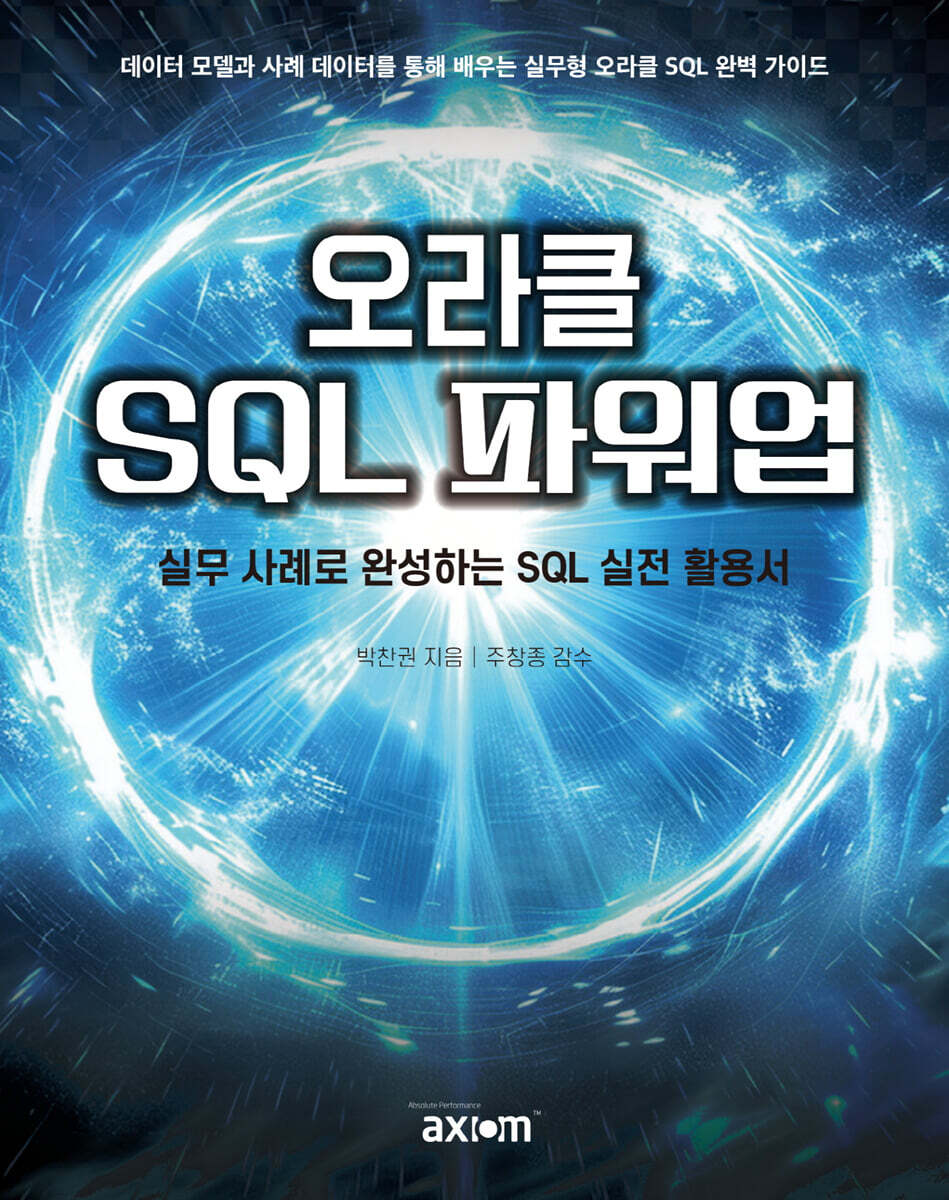
Oracle SQL PowerUp
 |
Description
Book Introduction
SQL, do you want to go beyond just writing?
Power up with practice.
"Oracle SQL Power-Up" is a practical textbook designed to help you learn how to understand and write SQL on a business-by-business basis, based on real-world project scenarios.
It covers the entire process of understanding the workflow, analyzing the data structure, and then designing and implementing SQL that fits the purpose.
This book provides over a million real-world examples and guides you through a step-by-step design process to naturally learn how to create and refine complex SQL.
In addition to frequently used joins, it implements scenarios that frequently appear in actual work, such as hierarchical structures (e.g., departments, product classifications), ordering, receipt/shipping, and sales flows, and you can take your SQL skills to the next level through a total of 13 practical scenarios.
Experience designing and implementing SQL based on workflows. For beginner-intermediate developers who want to take their SQL skills to the next level, this book will serve as a turning point in their development.
Power up with practice.
"Oracle SQL Power-Up" is a practical textbook designed to help you learn how to understand and write SQL on a business-by-business basis, based on real-world project scenarios.
It covers the entire process of understanding the workflow, analyzing the data structure, and then designing and implementing SQL that fits the purpose.
This book provides over a million real-world examples and guides you through a step-by-step design process to naturally learn how to create and refine complex SQL.
In addition to frequently used joins, it implements scenarios that frequently appear in actual work, such as hierarchical structures (e.g., departments, product classifications), ordering, receipt/shipping, and sales flows, and you can take your SQL skills to the next level through a total of 13 practical scenarios.
Experience designing and implementing SQL based on workflows. For beginner-intermediate developers who want to take their SQL skills to the next level, this book will serve as a turning point in their development.
index
PART 01.
Project Preparation
Section 01 Introduction to the Job
Section 02 Data Model and Table Data
2.1.
Data Model and Entity Classification
2.2.
Entity Description
2.3.
Building table data
Section 03 Getting to Know Data
3.1.
goods
3.2.
burial
3.3.
mosque
3.4.
correspondent
3.5.
Category
3.6.
department
3.7.
Common code
Section 04 Getting to know your work
4.1.
Orders and ordered products
4.2.
Incoming and outgoing goods and incoming and outgoing goods
4.3.
Sales and Products for Sale
PART 02.
Project Development
Section 01 Project Structure
Section 02 Business Partner Inquiry
Section 03 Store Search
Section 04 Employee Inquiry
Section 05 Common Code Inquiry
Section 06 Department Inquiry
Section 07 Category Search
Section 08 Product Inquiry
Section 09 Order Inquiry and Order Status
9.1.
Order Inquiry
9.2.
Order status
Section 10: Inquiry and status of receipt
10.1.
Inquiry on receipt
10.2.
Incoming status
10.3.
Shipment Inquiry
10.4.
Shipping status
Section 11 Sales Inquiry and Sales Status
11.1.
Sales Inquiry
11.2.
Sales status
Section 12 Data Summary (Aggregation)
12.1.
Order Summary (by Business Partner)
12.2.
Sales Summary (by Store)
12.3.
Order Summary (by Date and Product - Vertical)
12.4.
Inventory Summary (by date and product - vertical)
12.5.
Sales Summary (by Date and Product - Vertical)
12.6.
Order Summary (by date and customer - vertical)
12.7.
Sales Summary (by store by date - vertical)
12.8.
Quantity in stock compared to order (product)
12.9.
Sales volume compared to orders (products)
12.10.
Sales Summary (Sales by Store - Horizontal)
12.11.
Sales Summary (Sales Quantity and Amount by Store - Horizontal)
Section 13 Inventory
13.1.
Inventory Inquiry
13.2.
Inventory entry
Project Preparation
Section 01 Introduction to the Job
Section 02 Data Model and Table Data
2.1.
Data Model and Entity Classification
2.2.
Entity Description
2.3.
Building table data
Section 03 Getting to Know Data
3.1.
goods
3.2.
burial
3.3.
mosque
3.4.
correspondent
3.5.
Category
3.6.
department
3.7.
Common code
Section 04 Getting to know your work
4.1.
Orders and ordered products
4.2.
Incoming and outgoing goods and incoming and outgoing goods
4.3.
Sales and Products for Sale
PART 02.
Project Development
Section 01 Project Structure
Section 02 Business Partner Inquiry
Section 03 Store Search
Section 04 Employee Inquiry
Section 05 Common Code Inquiry
Section 06 Department Inquiry
Section 07 Category Search
Section 08 Product Inquiry
Section 09 Order Inquiry and Order Status
9.1.
Order Inquiry
9.2.
Order status
Section 10: Inquiry and status of receipt
10.1.
Inquiry on receipt
10.2.
Incoming status
10.3.
Shipment Inquiry
10.4.
Shipping status
Section 11 Sales Inquiry and Sales Status
11.1.
Sales Inquiry
11.2.
Sales status
Section 12 Data Summary (Aggregation)
12.1.
Order Summary (by Business Partner)
12.2.
Sales Summary (by Store)
12.3.
Order Summary (by Date and Product - Vertical)
12.4.
Inventory Summary (by date and product - vertical)
12.5.
Sales Summary (by Date and Product - Vertical)
12.6.
Order Summary (by date and customer - vertical)
12.7.
Sales Summary (by store by date - vertical)
12.8.
Quantity in stock compared to order (product)
12.9.
Sales volume compared to orders (products)
12.10.
Sales Summary (Sales by Store - Horizontal)
12.11.
Sales Summary (Sales Quantity and Amount by Store - Horizontal)
Section 13 Inventory
13.1.
Inventory Inquiry
13.2.
Inventory entry
Publisher's Review
Oracle SQL Power-Up is a practical textbook that goes beyond simple SQL grammar learning and guides you through designing and writing SQL within real-world workflows.
This course is designed to help developers overcome the feeling of "I've learned SQL, but I don't know where to start when it comes to actual work." It's designed to help you learn SQL step by step, following project-based scenarios.
In particular, this book provides over a million real-world data sets and explains the entire process of creating complex SQL, from purpose to design and implementation.
Rather than simply writing queries, you'll naturally acquire the SQL sensibilities needed for practical work through the process of interpreting business data, reflecting requirements, and deriving optimal results.
Target audience for this book
Developers who have mastered SQL grammar but are stuck in practice
After completing basic learning, readers who want to take their skills to the next level
Practitioners who want to understand practical data flow and write SQL
Beginners who want to practice SQL on a project basis
Developers who want to solve complex tasks with a single SQL, but also want to know the process and criteria for judgment.
Practitioners who want to write structurally high-performance SQL
This book is largely divided into two parts. Part 1 covers the preparatory phase for understanding the project. Part 2 explains the process by which the development team forms, negotiates requirements with the client, and completes them step by step.
PART 01.
Project Preparation
This part covers the background of the entire hands-on project and familiarizing yourself with the data structures that will be used to implement SQL in the future.
Based on the familiar business model of a coffee franchise, we examine how data frequently appearing in real-world practice—products, stores, business partners, orders, receipts/shipments, sales, etc.—are structured.
Starting with an introduction to the business, we will learn about data modeling perspectives through logical/physical models.
We focus on intuitively understanding what data is contained in each table and how they are related.
PART 02.
Project Development
This part is structured like a real-world project, and is a story-based learning structure that follows the requirements negotiation and implementation process that occurs in the field.
Manager Lee Hyo-mi and Assistant Manager Song Hae-gyo from the ordering company convey the requirements, and Manager Hong Du-sik, Deputy Manager Yang Hae-gyeong, Manager Byeon Seong-jun, and Assistant Manager Joo Seon-yeong from the development company form a team to implement the requirements and proceed with the project.
Among these, Manager Byeon Seong-jun and Assistant Manager Joo Seon-yeong are in charge of actual implementation and leading the project, while Deputy Manager Yang Hae-kyung plays an important coordination role as a practical leader who presents technical direction and judgment criteria.
Initially, you will learn the basics of SQL by implementing simple list search functions for customers, stores, and employees, but you will gradually deal with difficult practical problems such as hierarchical structure processing, complex joins, aggregate functions, window functions, and various aggregate tasks, as well as inventory according to time.
In this process, Assistant Manager Joo Seon-yeong, who started out as a SQL beginner, quickly grows, and Manager Byun Seong-jun demonstrates advanced SQL implementation capabilities based on practical experience and solid fundamentals.
Readers can also follow this flow and naturally develop practical skills and SQL problem-solving skills.
As you follow this book, you will find yourself growing like Manager Byun Seong-jun and Assistant Manager Joo Seon-yeong, or even more so.
This course is designed to help developers overcome the feeling of "I've learned SQL, but I don't know where to start when it comes to actual work." It's designed to help you learn SQL step by step, following project-based scenarios.
In particular, this book provides over a million real-world data sets and explains the entire process of creating complex SQL, from purpose to design and implementation.
Rather than simply writing queries, you'll naturally acquire the SQL sensibilities needed for practical work through the process of interpreting business data, reflecting requirements, and deriving optimal results.
Target audience for this book
Developers who have mastered SQL grammar but are stuck in practice
After completing basic learning, readers who want to take their skills to the next level
Practitioners who want to understand practical data flow and write SQL
Beginners who want to practice SQL on a project basis
Developers who want to solve complex tasks with a single SQL, but also want to know the process and criteria for judgment.
Practitioners who want to write structurally high-performance SQL
This book is largely divided into two parts. Part 1 covers the preparatory phase for understanding the project. Part 2 explains the process by which the development team forms, negotiates requirements with the client, and completes them step by step.
PART 01.
Project Preparation
This part covers the background of the entire hands-on project and familiarizing yourself with the data structures that will be used to implement SQL in the future.
Based on the familiar business model of a coffee franchise, we examine how data frequently appearing in real-world practice—products, stores, business partners, orders, receipts/shipments, sales, etc.—are structured.
Starting with an introduction to the business, we will learn about data modeling perspectives through logical/physical models.
We focus on intuitively understanding what data is contained in each table and how they are related.
PART 02.
Project Development
This part is structured like a real-world project, and is a story-based learning structure that follows the requirements negotiation and implementation process that occurs in the field.
Manager Lee Hyo-mi and Assistant Manager Song Hae-gyo from the ordering company convey the requirements, and Manager Hong Du-sik, Deputy Manager Yang Hae-gyeong, Manager Byeon Seong-jun, and Assistant Manager Joo Seon-yeong from the development company form a team to implement the requirements and proceed with the project.
Among these, Manager Byeon Seong-jun and Assistant Manager Joo Seon-yeong are in charge of actual implementation and leading the project, while Deputy Manager Yang Hae-kyung plays an important coordination role as a practical leader who presents technical direction and judgment criteria.
Initially, you will learn the basics of SQL by implementing simple list search functions for customers, stores, and employees, but you will gradually deal with difficult practical problems such as hierarchical structure processing, complex joins, aggregate functions, window functions, and various aggregate tasks, as well as inventory according to time.
In this process, Assistant Manager Joo Seon-yeong, who started out as a SQL beginner, quickly grows, and Manager Byun Seong-jun demonstrates advanced SQL implementation capabilities based on practical experience and solid fundamentals.
Readers can also follow this flow and naturally develop practical skills and SQL problem-solving skills.
As you follow this book, you will find yourself growing like Manager Byun Seong-jun and Assistant Manager Joo Seon-yeong, or even more so.
GOODS SPECIFICS
- Date of issue: June 27, 2025
- Page count, weight, size: 344 pages | 681g | 190*240*17mm
- ISBN13: 9791195942589
- ISBN10: 1195942583
You may also like
카테고리
korean


korean

![GQ KOREA Mark (Monthly): December [2025]](http://librairie.coreenne.fr/cdn/shop/files/8ef265dbbfbf186523ed75ba7319009d.jpg?v=1765340328&width=3840)


