

What is a nation?
 |
Description
Book Introduction
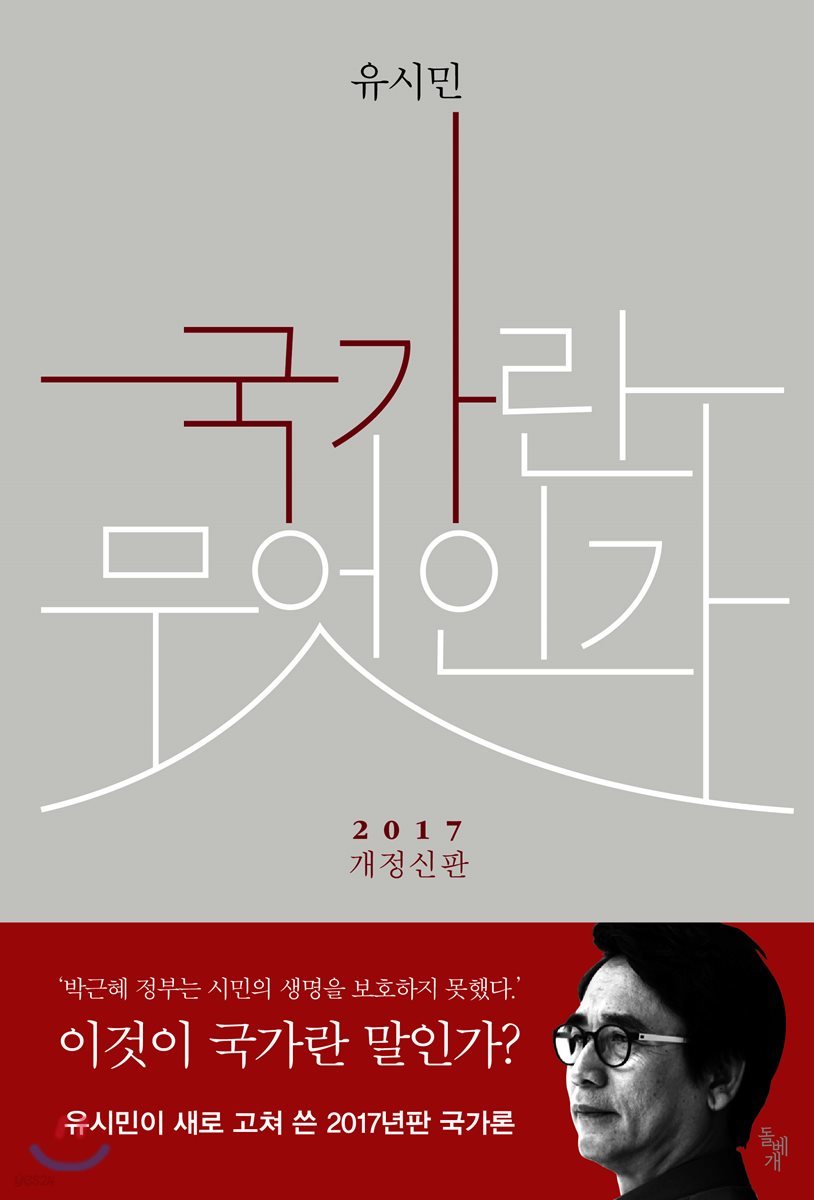
What does your country, the Republic of Korea, look like now? Ask questions about the country and imagine a great country. The Choi Soon-sil scandal that rocked the nation since late October 2016, President Park Geun-hye's three national addresses, the subsequent hearings and special prosecutors, the impeachment of the president, and numerous other issues that have yet to be decided. Anyone who has observed this series of events will have asked themselves this question at least once. Why do we live in this country? What kind of president do we want, what kind of country do we want? It's a positive development that we're now routinely asking these questions, born of our times. It is also a valuable opportunity to reexamine what kind of president you want and what your national view is. Like it or not, aren't you a citizen of the Republic of Korea? To avoid repeating the same mistakes in the presidential election that will come sooner than expected, we must take this time to reflect more seriously. In 2011, Yoo Si-min, then the leader of a political party, published “What is a Nation?” in the process of exploring what a just and desirable nation is. Because it was a book that boldly revealed its political stance, I thought it would become an outdated theory over time. However, there were readers who consistently visited the book, and many of them asked for a revised edition with new cases added. Yoo Si-min, who was present amidst the citizens' lament and anger last year, felt that he could no longer delay the revision process. I wanted to convey more persuasively that there are various perspectives on the country, and to reiterate the importance of understanding and caring about the country. I wanted to imagine what would happen after the candlelight vigils and create the possibility that we could build a great nation. In the preface to the revised edition, Yoo Si-min states, “I want to make it clear that readers who have read the first edition do not necessarily need to read the revised edition” (p. 8). In fact, this book has the same structure and basic framework as the first edition. After classifying the perspectives on the state into three categories (Chapters 1-3), we examine what kind of qualities a state should have in order to be governed (Chapter 4) and what it means to love the state properly (Chapter 5). And it discusses how national transformation is possible (Chapter 6), what true progressive politics is (Chapter 7), what values a nation should idealize (Chapter 8), and finally, what ethics are necessary for politicians (Chapter 9). However, this book cannot be said to be the same as the first edition. Yoo Si-min's circumstances have changed, the political situation has changed rapidly, and the citizens have changed as well. The revised edition includes those changes. I hope this book will reach those who question what a proper nation should look like, those who held candles in the cold winter square, and those who, even in despair, still cling to hope for their nation. |
- You can preview some of the book's contents.
Preview
index
Preface to the Revised Edition
Preface to the first edition
Chapter 1: What is a State? 1_Legal Violence
The nation that appeared in the Namildang building
Leviathan, The Birth of a Nation
Absolute Monarchy_Hobbes' Ideal State
If there were no states_Somalia and Syria
Machiavelli's Art of Governing
The Origin of the Republic of Korea_The Korean War
Ideological Conservative_Nationalist
Chapter 2: What is a State? 2_Public Goods Provider
Rule of law_restraint on rulers
Freedom will enrich you_Smith
The state and the government are different_Rousseau
Freedom that cannot be violated under any circumstances_Mill
The government that governs the least_Soro
Market-type conservative/liberal
Chapter 3: What is a State? 3_A Tool of Class Domination
The proletariat has no fatherland
Communist Revolution and the Demise of the State
Desire for fundamental change and political cynicism
The frustrated dream of social revolution
Chapter 4: Who Should Rule?
Philosophers should be kings_Plato
A gentleman must rule_Mencius
Justice is the advantage of the strong_Thrasymachus
How to Minimize Evil_Democracy
Who should rule
Chapter 5: Is Patriotism a Noble Emotion?
The Two Faces of Patriotism
The only thing that is eternal is the fatherland_Fichte
Patriotism is an evil emotion_Tolstoy
The Will of the People to Belong Together_Renan
Chapter 6: Revolution or Reform?
The nation does not die
When does the revolution happen?
Tolstoy's despair
Utopian Engineering and Progressive Engineering_Popper
When the path to reform is blocked, the door to revolution opens.
The Frightened Liberal_Hayek
Libertarianism Trapped in the Trap of Logic
Slippery slope theory
Chapter 7: What is Progressive Politics?
All humans are conservative_Veblen
Progress is Overcoming Capitalism_Kim Sang-bong
Expanding Human Freedom_Lee Nam-gok
The telos of a nation is justice_Aristotle
Boron_Welfare State Theory
Chapter 8: What is the moral ideal of the nation?
Moral Man and Immoral Society_Niebuhr
What is justice?
The market does not deliver justice
progressive liberalism
Chapter 9: What moral code should politicians follow?
Act according to your own maxim_Kant
Politics is about taking responsibility for the results_Weber
A politician who lost but won_Bernstein
Coalition politics and ethics of responsibility
Conclusion: Thinking of a Great Nation
Americas
Search
Preface to the first edition
Chapter 1: What is a State? 1_Legal Violence
The nation that appeared in the Namildang building
Leviathan, The Birth of a Nation
Absolute Monarchy_Hobbes' Ideal State
If there were no states_Somalia and Syria
Machiavelli's Art of Governing
The Origin of the Republic of Korea_The Korean War
Ideological Conservative_Nationalist
Chapter 2: What is a State? 2_Public Goods Provider
Rule of law_restraint on rulers
Freedom will enrich you_Smith
The state and the government are different_Rousseau
Freedom that cannot be violated under any circumstances_Mill
The government that governs the least_Soro
Market-type conservative/liberal
Chapter 3: What is a State? 3_A Tool of Class Domination
The proletariat has no fatherland
Communist Revolution and the Demise of the State
Desire for fundamental change and political cynicism
The frustrated dream of social revolution
Chapter 4: Who Should Rule?
Philosophers should be kings_Plato
A gentleman must rule_Mencius
Justice is the advantage of the strong_Thrasymachus
How to Minimize Evil_Democracy
Who should rule
Chapter 5: Is Patriotism a Noble Emotion?
The Two Faces of Patriotism
The only thing that is eternal is the fatherland_Fichte
Patriotism is an evil emotion_Tolstoy
The Will of the People to Belong Together_Renan
Chapter 6: Revolution or Reform?
The nation does not die
When does the revolution happen?
Tolstoy's despair
Utopian Engineering and Progressive Engineering_Popper
When the path to reform is blocked, the door to revolution opens.
The Frightened Liberal_Hayek
Libertarianism Trapped in the Trap of Logic
Slippery slope theory
Chapter 7: What is Progressive Politics?
All humans are conservative_Veblen
Progress is Overcoming Capitalism_Kim Sang-bong
Expanding Human Freedom_Lee Nam-gok
The telos of a nation is justice_Aristotle
Boron_Welfare State Theory
Chapter 8: What is the moral ideal of the nation?
Moral Man and Immoral Society_Niebuhr
What is justice?
The market does not deliver justice
progressive liberalism
Chapter 9: What moral code should politicians follow?
Act according to your own maxim_Kant
Politics is about taking responsibility for the results_Weber
A politician who lost but won_Bernstein
Coalition politics and ethics of responsibility
Conclusion: Thinking of a Great Nation
Americas
Search
Publisher's Review
Features of this book: What's different from the first edition?
1.
From professional politician to full-time writer, citizen Yoo Si-min asks, "What is a nation?"
At the time of writing the first edition (2010), Yoo Si-min was the leader of the now-defunct People's Participation Party.
The book "What is a State?" was written by a progressive intellectual and practical politician as part of his efforts to seriously question the essence of the state and find the direction that progressive politics should pursue.
I tried to look critically at previous regimes and find out what a good country looks like.
And now, six years later, he has retired from politics and is living as a full-time writer.
The people I meet often and the areas of activity have changed, and I spend most of my time reading books and writing.
By publishing a book on writing, he has been able to meet readers of various age groups up close, and he has also appeared on television current affairs and entertainment programs to point out current social issues with his witty and blunt remarks.
This change in Yoo Si-min's life became a kind of driving force that led to the writing of a revised edition.
As I transitioned from being a politician to being a citizen, my perspective on the country also changed, and I realized anew what kind of national theory the citizens of today truly need.
So, I removed all the parts that I had included in the first edition, including my political stance, arguments, and analysis of the country and politics.
Rather than insisting that the country should be like this, I tried to properly convey that there can be various perspectives on the country.
In the revised edition, you will be able to encounter a more balanced and clearer theory of the state by Yoo Si-min.
2.
Yoo Si-min's Changing Writing
One of the things that Yoo Si-min focused on while publishing this revised edition was the writing style.
Although the content is largely the same as the previous edition, the method of delivery, that is, the method of expression, has been completely changed.
The tone of the entire book changed as I reviewed the entire text, from small details like words and sentence structures to large-scale revisions to entire paragraphs.
It's still changing, so it's difficult to generalize, but there's a significant reduction in modifiers and adverbs, and a warm, thoughtful perspective permeates sentences.
A persuasive and sympathetic tone took the place of a sharp tongue.
Astute readers who have consistently read Yoo Si-min's books will be able to fully sense these differences, and it will be quite enjoyable to read while comparing the differences from the first edition.
3.
Remember what happened during the Lee Myung-bak and Park Geun-hye administrations.
In the preface to the first edition, Yoo Si-min reveals that the Yongsan tragedy in 2009 prompted him to begin serious reflection and study on the nation.
The Yongsan tragedy, which occurred in the third year of the Lee Myung-bak administration, repeatedly raised questions about what a nation, government, and public power are, and numerous politicians and intellectuals expressed their opinions on this matter.
But this was just the beginning.
Since then, Korean society has been plagued by a series of brutal incidents that are impossible to rank.
Every day, we see and experience dramatic events that are no less dramatic than any movie: the Four Major Rivers Project, the Sewol Ferry Disaster, the MERS outbreak, the death of farmer Baek Nam-gi, the Choi Soon-sil scandal, and the impeachment of President Park Geun-hye.
The problem is that these incidents are all deeply related to the 'nation' and the 'government', yet we either ignore them or easily forget about them.
In the revised edition, Yoo Si-min filled in various parts with events that occurred during the Lee Myung-bak and Park Geun-hye administrations since the first edition in 2011.
Not to criticize or evaluate.
Let's recall it again and clearly see the state that lies behind it like a shadow.
4.
What the 2016 Candlelight Vigil Left Us
The biggest trigger that led Yoo Si-min to work on the revised edition was when an article related to the Choi Soon-sil Gate was reported on JTBC on October 24, 2016.
What Yoo Si-min focused on here was not the incompetence of the Park Geun-hye administration, but the fact that millions of citizens, enraged and deplored by it, gathered in the square and held candlelight vigils together 16 times.
On December 9, 2016, the arrow of impeachment was fired, but a clear verdict has not yet been handed down.
Some people are starting to give up as they see President Park Geun-hye and her aides consistently making excuses and lack of response, as well as the countless people involved.
But we shouldn't stop here.
We need to go further.
This is why Yoo Si-min tells a story in the revised edition that is not much different from the one he told six years ago.
If you want to live in a great country, a just country, each citizen must become better.
Rather than spending all our energy lamenting the country's incompetence, we should think about what we can do and then take action.
In order not to forget your heart that held a candle in the cold winter, we must become better ourselves.
5.
A comprehensive guide to the study of the state in one volume
From the time of its first edition, "What is a State?" was praised as a well-organized theory of the state in one volume.
The book clearly presents the diverse views on the 'state' put forth by prominent philosophers and theorists from the East and the West, past and present, and examines four theories of the state (Plato's teleological state theory, Hobbes' statist state theory, Locke and Mill's liberal state theory, and Marx's instrumental state theory) one by one.
The revised edition basically retains the same structure as the first edition, so these advantages remain intact.
It will serve as a classic introductory text introducing the discourse on nationalism.
However, I simply wrote down the words of the thinkers that were directly quoted at length in the first edition.
Of course, for readers who want to read more deeply, I have left the source of the content in the footnotes.
As Yoo Si-min said, what is important now is to accurately understand and accept that there are various and detailed perspectives on the country.
To properly criticize a country, a government, or a president, you must first study.
This is also our duty as citizens of a country.
1.
From professional politician to full-time writer, citizen Yoo Si-min asks, "What is a nation?"
At the time of writing the first edition (2010), Yoo Si-min was the leader of the now-defunct People's Participation Party.
The book "What is a State?" was written by a progressive intellectual and practical politician as part of his efforts to seriously question the essence of the state and find the direction that progressive politics should pursue.
I tried to look critically at previous regimes and find out what a good country looks like.
And now, six years later, he has retired from politics and is living as a full-time writer.
The people I meet often and the areas of activity have changed, and I spend most of my time reading books and writing.
By publishing a book on writing, he has been able to meet readers of various age groups up close, and he has also appeared on television current affairs and entertainment programs to point out current social issues with his witty and blunt remarks.
This change in Yoo Si-min's life became a kind of driving force that led to the writing of a revised edition.
As I transitioned from being a politician to being a citizen, my perspective on the country also changed, and I realized anew what kind of national theory the citizens of today truly need.
So, I removed all the parts that I had included in the first edition, including my political stance, arguments, and analysis of the country and politics.
Rather than insisting that the country should be like this, I tried to properly convey that there can be various perspectives on the country.
In the revised edition, you will be able to encounter a more balanced and clearer theory of the state by Yoo Si-min.
2.
Yoo Si-min's Changing Writing
One of the things that Yoo Si-min focused on while publishing this revised edition was the writing style.
Although the content is largely the same as the previous edition, the method of delivery, that is, the method of expression, has been completely changed.
The tone of the entire book changed as I reviewed the entire text, from small details like words and sentence structures to large-scale revisions to entire paragraphs.
It's still changing, so it's difficult to generalize, but there's a significant reduction in modifiers and adverbs, and a warm, thoughtful perspective permeates sentences.
A persuasive and sympathetic tone took the place of a sharp tongue.
Astute readers who have consistently read Yoo Si-min's books will be able to fully sense these differences, and it will be quite enjoyable to read while comparing the differences from the first edition.
3.
Remember what happened during the Lee Myung-bak and Park Geun-hye administrations.
In the preface to the first edition, Yoo Si-min reveals that the Yongsan tragedy in 2009 prompted him to begin serious reflection and study on the nation.
The Yongsan tragedy, which occurred in the third year of the Lee Myung-bak administration, repeatedly raised questions about what a nation, government, and public power are, and numerous politicians and intellectuals expressed their opinions on this matter.
But this was just the beginning.
Since then, Korean society has been plagued by a series of brutal incidents that are impossible to rank.
Every day, we see and experience dramatic events that are no less dramatic than any movie: the Four Major Rivers Project, the Sewol Ferry Disaster, the MERS outbreak, the death of farmer Baek Nam-gi, the Choi Soon-sil scandal, and the impeachment of President Park Geun-hye.
The problem is that these incidents are all deeply related to the 'nation' and the 'government', yet we either ignore them or easily forget about them.
In the revised edition, Yoo Si-min filled in various parts with events that occurred during the Lee Myung-bak and Park Geun-hye administrations since the first edition in 2011.
Not to criticize or evaluate.
Let's recall it again and clearly see the state that lies behind it like a shadow.
4.
What the 2016 Candlelight Vigil Left Us
The biggest trigger that led Yoo Si-min to work on the revised edition was when an article related to the Choi Soon-sil Gate was reported on JTBC on October 24, 2016.
What Yoo Si-min focused on here was not the incompetence of the Park Geun-hye administration, but the fact that millions of citizens, enraged and deplored by it, gathered in the square and held candlelight vigils together 16 times.
On December 9, 2016, the arrow of impeachment was fired, but a clear verdict has not yet been handed down.
Some people are starting to give up as they see President Park Geun-hye and her aides consistently making excuses and lack of response, as well as the countless people involved.
But we shouldn't stop here.
We need to go further.
This is why Yoo Si-min tells a story in the revised edition that is not much different from the one he told six years ago.
If you want to live in a great country, a just country, each citizen must become better.
Rather than spending all our energy lamenting the country's incompetence, we should think about what we can do and then take action.
In order not to forget your heart that held a candle in the cold winter, we must become better ourselves.
5.
A comprehensive guide to the study of the state in one volume
From the time of its first edition, "What is a State?" was praised as a well-organized theory of the state in one volume.
The book clearly presents the diverse views on the 'state' put forth by prominent philosophers and theorists from the East and the West, past and present, and examines four theories of the state (Plato's teleological state theory, Hobbes' statist state theory, Locke and Mill's liberal state theory, and Marx's instrumental state theory) one by one.
The revised edition basically retains the same structure as the first edition, so these advantages remain intact.
It will serve as a classic introductory text introducing the discourse on nationalism.
However, I simply wrote down the words of the thinkers that were directly quoted at length in the first edition.
Of course, for readers who want to read more deeply, I have left the source of the content in the footnotes.
As Yoo Si-min said, what is important now is to accurately understand and accept that there are various and detailed perspectives on the country.
To properly criticize a country, a government, or a president, you must first study.
This is also our duty as citizens of a country.
GOODS SPECIFICS
- Date of publication: January 23, 2017
- Page count, weight, size: 334 pages | 588g | 153*224*30mm
- ISBN13: 9788971998014
- ISBN10: 8971998016
You may also like
카테고리
korean


korean

![GQ KOREA Mark (Monthly): December [2025]](http://librairie.coreenne.fr/cdn/shop/files/8ef265dbbfbf186523ed75ba7319009d.jpg?v=1765340328&width=3840)


