

Thinking Class for Questioning Children
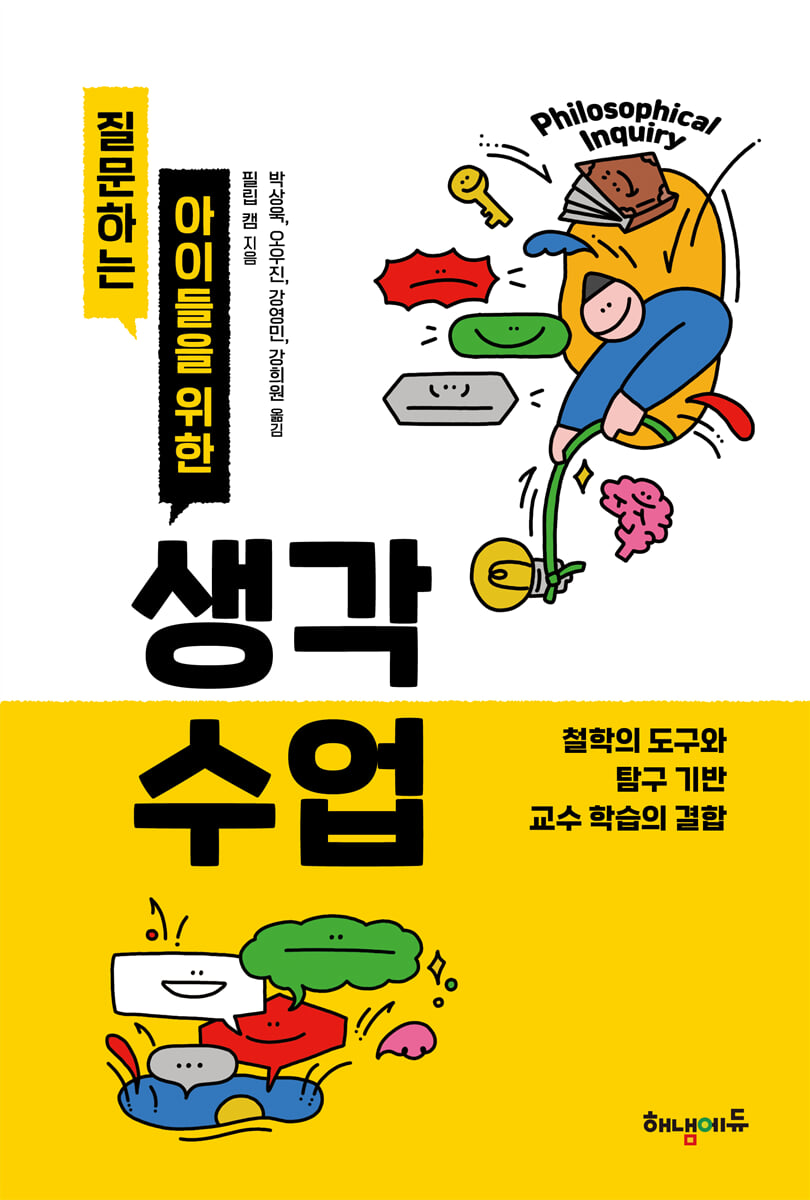 |
Description
Book Introduction
A classroom philosophy class that fosters critical thinking skills, "Thinking Class for Questioning Children" published!
A philosophy discussion textbook for teachers and students that develops inquiry, concept exploration, and reasoning training through collaborative inquiry classes in the classroom.
"Thinking Classes for Questioning Children" is a book translated by Korean teachers based on the book "Philosophical Inquiry" by Philip Kam, an Australian philosophy education expert.
This book guides teaching and learning methods that enable students to think, discuss, and explore independently in the classroom, focusing on three thinking tools: questioning, exploring concepts, and reasoning.
Rather than simply an introduction to philosophy, it offers concrete practical strategies that can be applied immediately in real-world classes, complete with classroom activities and practice problems.
"Thinking Class for Questioning Children" provides young people with critical thinking and discussion skills, and teachers with new teaching methods, helping philosophy become a living exploration in the classroom.
A philosophy discussion textbook for teachers and students that develops inquiry, concept exploration, and reasoning training through collaborative inquiry classes in the classroom.
"Thinking Classes for Questioning Children" is a book translated by Korean teachers based on the book "Philosophical Inquiry" by Philip Kam, an Australian philosophy education expert.
This book guides teaching and learning methods that enable students to think, discuss, and explore independently in the classroom, focusing on three thinking tools: questioning, exploring concepts, and reasoning.
Rather than simply an introduction to philosophy, it offers concrete practical strategies that can be applied immediately in real-world classes, complete with classroom activities and practice problems.
"Thinking Class for Questioning Children" provides young people with critical thinking and discussion skills, and teachers with new teaching methods, helping philosophy become a living exploration in the classroom.
- You can preview some of the book's contents.
Preview
index
To Korean readers
preface
introduction
Acknowledgements
Introduction to this book
Chapter 1 Getting Started
1.
Setting up classroom layout and rules
2.
Structuring Classes
3.
Toolbox for Thinking
4.
Learning effect
Chapter 2: Asking Questions
1.
Start asking questions
2.
Think about how to answer the question
3.
Question Quadrant
4.
Factual, evaluative, and conceptual questions
5.
Setting discussion questions
6.
Analyzing questions and problems
7.
Teacher as procedural questioner
8.
Characteristics of philosophical questions
9.
Developing a Discussion Plan
10.
Practice Problems and Activities
Chapter 3: Exploring Concepts
1.
categorical operations
2.
Comparison manipulation
3.
complex concept
4.
Clarification
5.
Practice Problems and Activities
Chapter 4 Inference
1.
The language of reasoning
2.
Justification and reasoning
3.
Conditional inference
4.
deductive reasoning
5.
inductive reasoning
6.
Necessary and sufficient conditions
7.
Contradiction and logical impossibility
8.
Analyze and evaluate inferences
9.
Schematicizing Arguments in Debate
10.
Practice Problems and Activities
References
preface
introduction
Acknowledgements
Introduction to this book
Chapter 1 Getting Started
1.
Setting up classroom layout and rules
2.
Structuring Classes
3.
Toolbox for Thinking
4.
Learning effect
Chapter 2: Asking Questions
1.
Start asking questions
2.
Think about how to answer the question
3.
Question Quadrant
4.
Factual, evaluative, and conceptual questions
5.
Setting discussion questions
6.
Analyzing questions and problems
7.
Teacher as procedural questioner
8.
Characteristics of philosophical questions
9.
Developing a Discussion Plan
10.
Practice Problems and Activities
Chapter 3: Exploring Concepts
1.
categorical operations
2.
Comparison manipulation
3.
complex concept
4.
Clarification
5.
Practice Problems and Activities
Chapter 4 Inference
1.
The language of reasoning
2.
Justification and reasoning
3.
Conditional inference
4.
deductive reasoning
5.
inductive reasoning
6.
Necessary and sufficient conditions
7.
Contradiction and logical impossibility
8.
Analyze and evaluate inferences
9.
Schematicizing Arguments in Debate
10.
Practice Problems and Activities
References
Detailed image

Into the book
Education is no longer sufficient simply to instill reproducible subject knowledge.
To thrive socially and economically today, we must be able to think critically, creatively, and socially responsible.
This means using knowledge to solve problems, address important topics, and explore possibilities, both individually and collaboratively with others.
--- From the "Preface"
The basic idea is to meet the demands of school education by engaging students in collaborative, inquiry-based learning using tools and ways of thinking derived from philosophy.
So, to help students develop the skills they need to survive in a changing world, we are returning to the age-old discipline of philosophy.
--- From "Chapter 1 Getting Started"
Children are already active questioners long before they enter school, but that doesn't mean they can immediately formulate appropriate questions in an educational context.
Children need to learn how to ask questions to guide them in the right direction when exploring topics in the classroom.
Like other general skills we cultivate in school, the ability to question requires ongoing effort through systematic guidance and collaborative, inquiry-based teaching and learning.
--- From "Chapter 2: Asking Questions"
People who learn to reason well are more adept at solving problems and making good decisions on their own.
They are more inclined to look closely at the situation before them and think carefully.
This is also true in the classroom.
Students who are comfortable reasoning about a learning topic are better able to grasp the implications of what they are given rather than simply memorizing it verbatim.
To thrive socially and economically today, we must be able to think critically, creatively, and socially responsible.
This means using knowledge to solve problems, address important topics, and explore possibilities, both individually and collaboratively with others.
--- From the "Preface"
The basic idea is to meet the demands of school education by engaging students in collaborative, inquiry-based learning using tools and ways of thinking derived from philosophy.
So, to help students develop the skills they need to survive in a changing world, we are returning to the age-old discipline of philosophy.
--- From "Chapter 1 Getting Started"
Children are already active questioners long before they enter school, but that doesn't mean they can immediately formulate appropriate questions in an educational context.
Children need to learn how to ask questions to guide them in the right direction when exploring topics in the classroom.
Like other general skills we cultivate in school, the ability to question requires ongoing effort through systematic guidance and collaborative, inquiry-based teaching and learning.
--- From "Chapter 2: Asking Questions"
People who learn to reason well are more adept at solving problems and making good decisions on their own.
They are more inclined to look closely at the situation before them and think carefully.
This is also true in the classroom.
Students who are comfortable reasoning about a learning topic are better able to grasp the implications of what they are given rather than simply memorizing it verbatim.
--- From "Chapter 4 Inference"
Publisher's Review
“Thinking children change the future.”
A crucial task of education today is to go beyond simply imparting knowledge and to cultivate citizens who can think for themselves, ask questions, and engage in debate.
"Thinking Class for Children Who Ask Questions" is a practical guide to achieving that goal.
This book brings fundamental questions raised by philosophy from both the East and the West into the classroom.
Through three thinking tools—questioning, exploring concepts, and reasoning—students learn to listen to others, develop their own ideas, and critically examine differing perspectives.
This process is not simply learning, but is a core training for growing into a democratic citizen.
Philosophical inquiry does not instill answers.
Instead, it opens up various social issues and discussions, leading us to reflect on the values and concepts hidden within them.
Through this, students develop the ability to question, debate, and judge for themselves, rather than simply leaving the question of 'right and wrong' to an external authority.
"Thinking Class for Questioning Children" offers teachers a new horizon for teaching, and provides young people with a path to think, debate, and grow on their own.
Ultimately, this book will serve as a solid foundation for living as conscious, moral citizens beyond the classroom and into the broader society.
A crucial task of education today is to go beyond simply imparting knowledge and to cultivate citizens who can think for themselves, ask questions, and engage in debate.
"Thinking Class for Children Who Ask Questions" is a practical guide to achieving that goal.
This book brings fundamental questions raised by philosophy from both the East and the West into the classroom.
Through three thinking tools—questioning, exploring concepts, and reasoning—students learn to listen to others, develop their own ideas, and critically examine differing perspectives.
This process is not simply learning, but is a core training for growing into a democratic citizen.
Philosophical inquiry does not instill answers.
Instead, it opens up various social issues and discussions, leading us to reflect on the values and concepts hidden within them.
Through this, students develop the ability to question, debate, and judge for themselves, rather than simply leaving the question of 'right and wrong' to an external authority.
"Thinking Class for Questioning Children" offers teachers a new horizon for teaching, and provides young people with a path to think, debate, and grow on their own.
Ultimately, this book will serve as a solid foundation for living as conscious, moral citizens beyond the classroom and into the broader society.
GOODS SPECIFICS
- Date of issue: September 15, 2025
- Page count, weight, size: 324 pages | 152*225*19mm
- ISBN13: 9788964462874
You may also like
카테고리
korean


korean

![GQ KOREA Mark (Monthly): December [2025]](http://librairie.coreenne.fr/cdn/shop/files/8ef265dbbfbf186523ed75ba7319009d.jpg?v=1765340328&width=3840)


