

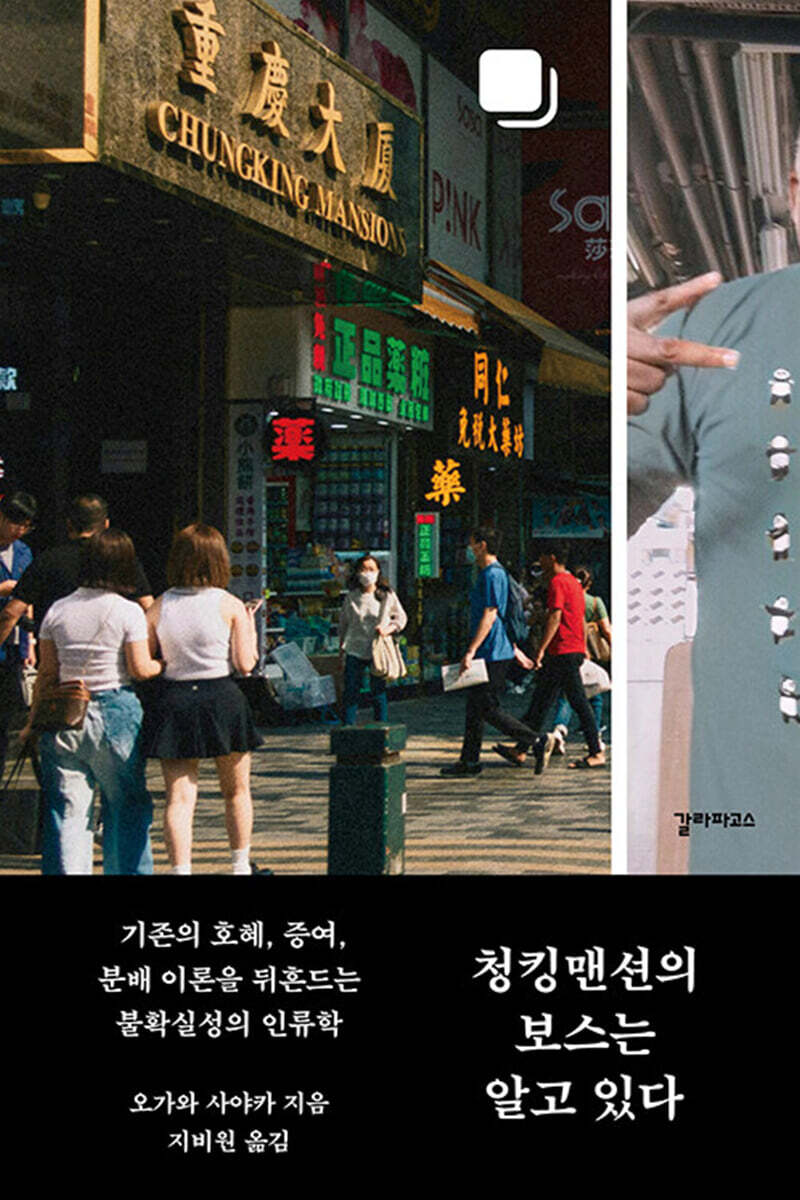
The boss of Chungking Mansions knows
 |
Description
Book Introduction
No human being in the world can be trusted.
So, can we live together? An anthropological imagination toward a "society where we connect even without trust"! This anthropological masterpiece created a sensation by winning both the Soichi Oya Nonfiction Award, often called the Akutagawa Prize and Naoki Prize of Japanese nonfiction, and the prestigious Hayao Kawai Academic Award.
It has been reprinted over 17 times in Japan, establishing itself as a ‘new anthropology classic.’
Sayaka Ogawa, a cultural anthropologist born in 1978, has a unique background, having learned Swahili and learned the trade of selling used clothes from street vendors while traveling to Tanzania since the age of 23.
While staying at Chungking Mansions in Hong Kong, he meets Karama, the self-proclaimed "Boss of Chungking Mansions", and begins to observe the work and play of the residents of Chungking Mansions who are engaged in shady businesses.
This book is filled with keywords that will capture the reader's curiosity and attention, including Hong Kong's "dark caves," the informal economy, African brokers, anarchic markets, commerce utilizing social media, nightlife, and underground banking.
Based on the middle ground of Chungking Mansions, it delves into reciprocity, gifting, distribution, the sharing economy, the commons, and even the essence of life in an interesting way, overturning stereotypes. Immediately after its publication in Japan, it received attention from numerous media outlets with responses such as, “There’s this kind of anthropology too,” and “This is overwhelmingly interesting.”
Having experienced countless betrayals, Chungking Mansions boss Karama and the Tanzanian residents live by the motto, “You can’t trust anyone in this world.”
But in reality, they were building a society where no one was excluded and everything could be shared.
What is the strange commons-like way of life that the author witnessed unfolding in a world where "trust no one" is the rule? It offers a glimpse into the circuits of coexistence discovered within an ever-expanding network by people who have no expectations of institutions whatsoever.
So, can we live together? An anthropological imagination toward a "society where we connect even without trust"! This anthropological masterpiece created a sensation by winning both the Soichi Oya Nonfiction Award, often called the Akutagawa Prize and Naoki Prize of Japanese nonfiction, and the prestigious Hayao Kawai Academic Award.
It has been reprinted over 17 times in Japan, establishing itself as a ‘new anthropology classic.’
Sayaka Ogawa, a cultural anthropologist born in 1978, has a unique background, having learned Swahili and learned the trade of selling used clothes from street vendors while traveling to Tanzania since the age of 23.
While staying at Chungking Mansions in Hong Kong, he meets Karama, the self-proclaimed "Boss of Chungking Mansions", and begins to observe the work and play of the residents of Chungking Mansions who are engaged in shady businesses.
This book is filled with keywords that will capture the reader's curiosity and attention, including Hong Kong's "dark caves," the informal economy, African brokers, anarchic markets, commerce utilizing social media, nightlife, and underground banking.
Based on the middle ground of Chungking Mansions, it delves into reciprocity, gifting, distribution, the sharing economy, the commons, and even the essence of life in an interesting way, overturning stereotypes. Immediately after its publication in Japan, it received attention from numerous media outlets with responses such as, “There’s this kind of anthropology too,” and “This is overwhelmingly interesting.”
Having experienced countless betrayals, Chungking Mansions boss Karama and the Tanzanian residents live by the motto, “You can’t trust anyone in this world.”
But in reality, they were building a society where no one was excluded and everything could be shared.
What is the strange commons-like way of life that the author witnessed unfolding in a world where "trust no one" is the rule? It offers a glimpse into the circuits of coexistence discovered within an ever-expanding network by people who have no expectations of institutions whatsoever.
- You can preview some of the book's contents.
Preview
index
-Recommendation/Handidi (author of "What is the Commons")
-letter
Meeting the Boss | Meeting the Boss of Chungking Mansions | Big Brother, But Less Human | Informal Business and Open Lakes Across Borders
Chapter 1: Tanzanians in Chungking Mansions
The Life of Karama, the Boss of Chungking Mansions | From Natural Stone to Used Cars | Thoughtful Indifference
Chapter 2: The Safety Net Built by "Gyeomsa Gyeomsa": The Tanzania-Hong Kong Union as a "Platform"
Building Community in Hong Kong | The Formation of the Tanzania-Hong Kong Cooperative | Supporting One Another in Times of Misfortune | Operating a Cooperative with a Fluid Membership | Adhering to the Standard of "Not Overdoing It" | The Logic of "Humility"
-Chapter 3 The Work of a Hong Kong Broker
Going to meet your business partner when they miss you | The Pakistani dealer who wants Karama as his exclusive agent | The relationship between a Hong Kong dealer and an African broker | A bulk used car buying tour | Abbasi and Samir's shopping spree in Hong Kong | The profession of a broker | Brokers rely on brokers | Not invading the customer-friend network
Chapter 4: TRUST: Supporting the Sharing Economy: A Network Connected by "That Humanity"
Spontaneous auctions utilizing social media | TRUST as a cooperative commons | TRUST as a 'safety net' | The greatest pleasure is Instagram live broadcasting | SNS activities responsible for the lack of 'credit' and the creation of 'trust' | The significance of not being a professional economic platform | The order of 'play' and 'work'
Chapter 5: Between Betrayal and Help: Those Who Succeed and Those Who Fall
The man who succeeded in the mobile phone business | The 'betrayed' natural stone importer | The 'imprisoned' clothing trader | In the gap between living with colleagues and living independently
Chapter 6: The Secret of Love and Friendship is Making Money
Wife on Paper, Husband on Paper | Hong Kong Nightlife | Sugar Mommy and Kibenten | I Don't Go Back Because I Can Always | Investing in My Homeland, Embedded in Hong Kong Life | When the Day Comes When I'm Asked to Make a Decision | Money Making and the Joys of Life
-The boss of Chungking Mansions knows the final chapter.
Life in the "Flexible" Chungking Mansions | Cultivating the "Humility" of Self and Others | The Meaning of "Waste" and "Not-so-Great" | Playing is Work | Real Life and the "Temporary Me" | The Unfounded Confidence of Being Loved
-In conclusion
-letter
Meeting the Boss | Meeting the Boss of Chungking Mansions | Big Brother, But Less Human | Informal Business and Open Lakes Across Borders
Chapter 1: Tanzanians in Chungking Mansions
The Life of Karama, the Boss of Chungking Mansions | From Natural Stone to Used Cars | Thoughtful Indifference
Chapter 2: The Safety Net Built by "Gyeomsa Gyeomsa": The Tanzania-Hong Kong Union as a "Platform"
Building Community in Hong Kong | The Formation of the Tanzania-Hong Kong Cooperative | Supporting One Another in Times of Misfortune | Operating a Cooperative with a Fluid Membership | Adhering to the Standard of "Not Overdoing It" | The Logic of "Humility"
-Chapter 3 The Work of a Hong Kong Broker
Going to meet your business partner when they miss you | The Pakistani dealer who wants Karama as his exclusive agent | The relationship between a Hong Kong dealer and an African broker | A bulk used car buying tour | Abbasi and Samir's shopping spree in Hong Kong | The profession of a broker | Brokers rely on brokers | Not invading the customer-friend network
Chapter 4: TRUST: Supporting the Sharing Economy: A Network Connected by "That Humanity"
Spontaneous auctions utilizing social media | TRUST as a cooperative commons | TRUST as a 'safety net' | The greatest pleasure is Instagram live broadcasting | SNS activities responsible for the lack of 'credit' and the creation of 'trust' | The significance of not being a professional economic platform | The order of 'play' and 'work'
Chapter 5: Between Betrayal and Help: Those Who Succeed and Those Who Fall
The man who succeeded in the mobile phone business | The 'betrayed' natural stone importer | The 'imprisoned' clothing trader | In the gap between living with colleagues and living independently
Chapter 6: The Secret of Love and Friendship is Making Money
Wife on Paper, Husband on Paper | Hong Kong Nightlife | Sugar Mommy and Kibenten | I Don't Go Back Because I Can Always | Investing in My Homeland, Embedded in Hong Kong Life | When the Day Comes When I'm Asked to Make a Decision | Money Making and the Joys of Life
-The boss of Chungking Mansions knows the final chapter.
Life in the "Flexible" Chungking Mansions | Cultivating the "Humility" of Self and Others | The Meaning of "Waste" and "Not-so-Great" | Playing is Work | Real Life and the "Temporary Me" | The Unfounded Confidence of Being Loved
-In conclusion
Detailed image
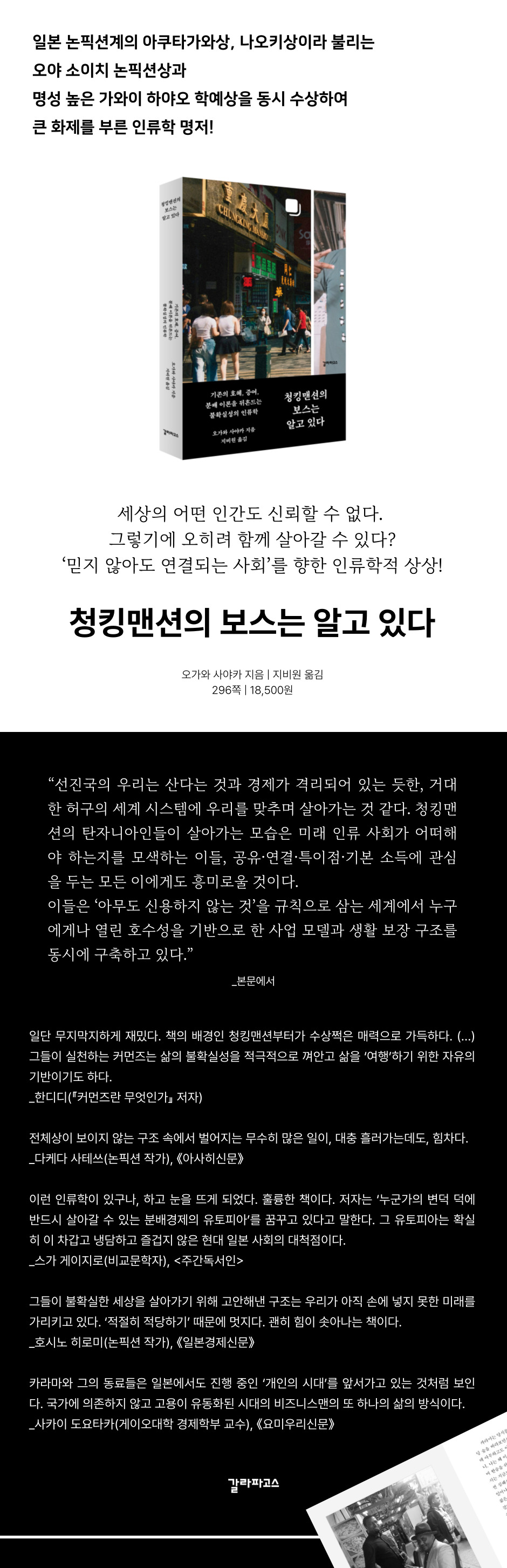
Into the book
At that moment, a middle-aged African man wearing a tweed jacket and a hunting hat passed by.
A Nigerian man who was drinking with him stopped him and said, “Hey, Karama,” and said, “This woman seems to speak Swahili. Why don’t you try and say something?”
When I greeted him in Swahili, he said, “I am Mr. Karama.
He introduced himself as “the boss of Chungking Mansions.”
And to the Nigerian who tried to tease me by saying, “Oh, you really speak Swahili,” I said, “The world is big.
“There are Asians like this too,” he said, and left immediately.
Karama later said, "I was so lucky that Sayaka got to know me in the first place," and looking back now, that really was true.
This meeting with Karama gave me a glimpse into the everyday relationships between Tanzanian merchants and their colleagues living in Hong Kong and China.
--- p.19~20
We in developed countries seem to live in a vast, fictional world system where life and the economy seem to be isolated.
The logic of ‘modernity’ and fundamental economics intersect throughout human history.
The lives of the Tanzanians in Chungking Mansions will be of interest to those who explore what future human society should be like, and to anyone interested in sharing, connection, singularity, and basic income.
They are building a business model and a life security structure based on openness to everyone in a world where the rule is "trust no one."
--- p.31
As I said before, they always say, “I don’t trust anyone.”
Rather than being ignorant of one's 'nature' or 'business that cannot be done openly', it seems to be based on the understanding that anyone can change for the better or for the worse depending on the situation they are in.
Karama and his colleagues only evaluate others based on the current situation, saying things like, “That person is doing well now, so it’s okay to lend them money,” “That person is losing a lot of money because the quality of the imported natural stones is poor, so you’d better be a little careful,” and “If that person’s lover is with them, they’re a good guy, so go have fun.”
At first glance, it may seem cold, but this is also a kind of tolerance.
In other words, it is not that they think that they cannot trust someone because they do not know their 'bare face', but rather that they recognize that there is no consistent, unchanging self that can be held responsible.
--- p.91~92
One day Karama asked me.
“Sayaka, do you know who can give you the most helpful information if you get scammed?” I said, “Um… the police or a lawyer?” “No.
Of course he's a friend of a conman.
You never know who might be able to help you later.
Because no one knows the future.
If you're successful, your colleagues who are executives at large corporations may become important.
But when you're arrested, your fellow inmates become important.
If the day comes when I go to Japan, I will ask Sayaka, who is Japanese, to show me the way, but I might end up going to Thailand.
What matters is not the number of colleagues.
“I have all kinds of colleagues [of different types],” he says.
By building on an "open network" where people within the infinitely expanding network do what they can, without interfering in the "circumstances" of others and without regard for strict affiliation or obligations and responsibilities between members, they are promoting burden-free "mutual help" and creating a huge safety net that transcends borders.
--- p.96~97
On the way back, I asked, "Aren't you working hard? If you go to Ismail, you can handle a lot of car sales and earn a lot of commission. Why don't you go every day?"
Then Karama gave a very interesting answer.
“If I go see Ismail every day, he will start to think of me as inferior.
If I act in a manner that is in keeping with Ismail's words when he gets angry, he will treat me like his employee.
I've been working with Pakistanis for years, so this isn't a prediction, it's fact.
If I get hired by Ismail, only Ismail will make money and I will work for his money.
“If we Africans want to do business on equal terms with Hong Kong businessmen, it would be best to go when they miss me.”
--- p.107~108
Furthermore, the most significant characteristic that demonstrates that TRUST was created with a different concept from official secondhand trading/auction sites is that it is not a platform that gradually sorts out "trustworthy brokers/customers" from "untrustworthy brokers/customers." TRUST maintains a world and human perspective where everyone can be trusted and no one can be trusted, and opportunities are available to everyone regardless of trading performance, capital size, past failures, or betrayals. The balance of "distrust" and "trust" among TRUST's participating brokers is created through the (frankly, not at all funny) humorous videos Karamana and his colleagues show daily, the "commemorative photos" they frequently seek out, the live broadcasts that even attract taxi drivers, and the daily mutual aid and cooperative activities they engage in with "commercial travelers."
--- p.157~158
As we've discussed so far, they don't initially try to know the past or present of others in detail, and they build limited trust based on the circumstances and context of each time, assuming that humans can always change.
Although it is so blatant that it may seem inhumane, the financial stability and personal status of the person at the time are effective grounds for raising expectations that the person would not betray for this level of profit.
Of course, they also know very well that the assumption that rich people are good people and poor people are bad people is completely wrong.
--- p.166~167
As the man left, Chester said, “That guy is an alcoholic.
I don't know what he does for a living, how old he is, or what his name is.
“I just know that if you give him too much money (because he spends it on alcohol), it will shorten his life,” he explained.
When I asked in surprise, “You don’t know me? And yet you give me 100 yuan every day?” he calmly replied, “Before I knew you were addicted, I gave you 200 yuan every day.”
When I looked even more surprised, he said, “Sayaka, I’m giving you money because I don’t know you.
“If it were an acquaintance, I would have watched over him and taken care of him all day,” he said with a look of regret.
--- p.241~242
The small business owners in Tanzania I studied during my doctoral studies and the Tanzanians in Hong Kong all say, “Life is a journey (maisha ni safari).”
When it comes to traveling, I worry about the end of the trip.
I have been talking about this with the understanding that they do not plan for a linear future as an extension of the present, nor are they conscious of clear life stages such as 'retirement' or 'old age'.
Yet, when I imagine that someday we will all reach our respective destinations, quietly accepting our own lives, I find it difficult to become free.
I quickly become caught up in the belief that my precarious position in Hong Kong, a life where even a moment of success can lead to a roller coaster crash with a little misfortune or carelessness, is merely a journey to reach my destination.
But if there is joy to be found in everyday life itself, what problem is there in ending one's life as just a journey?
--- p.244
However, as I said before, I am always skeptical about directly expressing or pursuing the pleasure of others needing me or the pleasure of pleasing others.
And in search of answers to my own doubts, I have been writing about the structure of trade that continues to promote voluntary help and does not impose undue burdens on anyone, and about platform-type union activities that organize 'mutual aid', or about the mutual help between men and women who are interlocked like cogwheels.
The reason why they are not offended or feel arrogant when they boldly declare, “Well, I’m the boss of Chungking Mansions,” and openly reveal that they are needed and loved by many people is probably because their goals are neither “becoming a boss” nor “being loved.”
These are businessmen, and their officially stated goal is simply to 'make money'. They do not try to be bosses or good people, so you can like them without hesitation.
--- p.248
The world we live in today cries out for "peace of mind" and "safety," and promotes the idea that the future must be predictable and risks reduced.
This way of thinking reinforces the social convention that "you can't give without a promise to give" and creates an attitude of wanting to immediately liquidate what is "lent" and what is "borrowed."
I feel anxious if I don't get a prompt response to a text message or a friendly message.
I'm worried about leaving debt behind for an uncertain future.
In such a relationship, I worry about whether what I give and what the other person gives are equivalent, and whether the amount I lend and borrow at each moment is calculated to be exactly the same.
Therefore, if one side feels that it is being 'at a loss', the virtuous cycle of reciprocity can easily turn into a vicious cycle of reciprocity.
In modern Japan, the discontent that "I'm the only one struggling" and "I'm the only one suffering" and the fears this breeds (e.g., hate speech) have a wide range of effects, from the feeling that forming relationships with friends or spouses is a hassle to distrust of social institutions such as pensions and basic livelihood security.
Angspark concludes that to break out of this vicious cycle, someone must sacrifice themselves and throw themselves into the virtuous cycle.
However, this can be a dangerous mentality for those who cannot alleviate their anxiety about the future, and it also runs the risk of being linked to totalitarianism.
--- p.259~260
The typist listens to difficult advice and lets it slide, and breaks promises according to his own circumstances.
In fact, no one manages the union's activities or donations, and if you can't participate because of work or don't have the financial means, it's okay not to contribute.
To begin with, I cannot force others, who live independently and have no choice but to move around fluidly and find their own lives, to listen to my wishes and accept everything about me that I do not even know.
However, the fact that a random idea or SOS signal is caught by someone and some way to make money or make a living is discovered, even if it is not as initially expected, is not because they expect others to sympathize or act in a public manner.
This is because they welcome the ‘unknown truth’ of others as an ‘unknown/unknown possibility’ and readily try to connect with others by ‘mutually exchanging kindness’ not only with the CEO of a listed company or the secretary of the president, but also with people who do illegal work.
--- p.263
Likewise, instead of betting on one's own potential by striving to become a perfect human being who can do anything on one's own, or by forming deep relationships with a homogeneous minority with similar values and qualities and responding reliably to the corresponding obligations of responsiveness, it is not an unreasonable strategy in a situation of 'high heterogeneity and fluidity, and the uncertainty of who will respond' to bet on the possibility of 'contingent responses' created by the diversity of others, by being as loosely connected as possible with people with different abilities, qualities, standards of good and evil, and humanity.
It is about surviving in an uncertain world by becoming a generalist who can do anything in his own way and at the same time, a generalist who can get along with any person in his own way.
--- p.264
I hope that a distribution system will be formed in the heart of the market economy, where goods, services, and information are naturally distributed to those who need them at the time, without imposing undue burden or authority on anyone.
What if the system I briefly experienced in Chapter 5, where people become comrades by sharing with one another, and thus continue to share resources they happen to possess—free-rider memberships and leftover merchandise—were realized as a broad network?
Accordingly, I dream of building a utopia of a distribution economy where everyone can survive, even if they are not particularly outstanding and sometimes dishonest, thanks to someone's whim.
I think it doesn't matter if it's artificial intelligence or traditional religion, as long as it can be realized.
A Nigerian man who was drinking with him stopped him and said, “Hey, Karama,” and said, “This woman seems to speak Swahili. Why don’t you try and say something?”
When I greeted him in Swahili, he said, “I am Mr. Karama.
He introduced himself as “the boss of Chungking Mansions.”
And to the Nigerian who tried to tease me by saying, “Oh, you really speak Swahili,” I said, “The world is big.
“There are Asians like this too,” he said, and left immediately.
Karama later said, "I was so lucky that Sayaka got to know me in the first place," and looking back now, that really was true.
This meeting with Karama gave me a glimpse into the everyday relationships between Tanzanian merchants and their colleagues living in Hong Kong and China.
--- p.19~20
We in developed countries seem to live in a vast, fictional world system where life and the economy seem to be isolated.
The logic of ‘modernity’ and fundamental economics intersect throughout human history.
The lives of the Tanzanians in Chungking Mansions will be of interest to those who explore what future human society should be like, and to anyone interested in sharing, connection, singularity, and basic income.
They are building a business model and a life security structure based on openness to everyone in a world where the rule is "trust no one."
--- p.31
As I said before, they always say, “I don’t trust anyone.”
Rather than being ignorant of one's 'nature' or 'business that cannot be done openly', it seems to be based on the understanding that anyone can change for the better or for the worse depending on the situation they are in.
Karama and his colleagues only evaluate others based on the current situation, saying things like, “That person is doing well now, so it’s okay to lend them money,” “That person is losing a lot of money because the quality of the imported natural stones is poor, so you’d better be a little careful,” and “If that person’s lover is with them, they’re a good guy, so go have fun.”
At first glance, it may seem cold, but this is also a kind of tolerance.
In other words, it is not that they think that they cannot trust someone because they do not know their 'bare face', but rather that they recognize that there is no consistent, unchanging self that can be held responsible.
--- p.91~92
One day Karama asked me.
“Sayaka, do you know who can give you the most helpful information if you get scammed?” I said, “Um… the police or a lawyer?” “No.
Of course he's a friend of a conman.
You never know who might be able to help you later.
Because no one knows the future.
If you're successful, your colleagues who are executives at large corporations may become important.
But when you're arrested, your fellow inmates become important.
If the day comes when I go to Japan, I will ask Sayaka, who is Japanese, to show me the way, but I might end up going to Thailand.
What matters is not the number of colleagues.
“I have all kinds of colleagues [of different types],” he says.
By building on an "open network" where people within the infinitely expanding network do what they can, without interfering in the "circumstances" of others and without regard for strict affiliation or obligations and responsibilities between members, they are promoting burden-free "mutual help" and creating a huge safety net that transcends borders.
--- p.96~97
On the way back, I asked, "Aren't you working hard? If you go to Ismail, you can handle a lot of car sales and earn a lot of commission. Why don't you go every day?"
Then Karama gave a very interesting answer.
“If I go see Ismail every day, he will start to think of me as inferior.
If I act in a manner that is in keeping with Ismail's words when he gets angry, he will treat me like his employee.
I've been working with Pakistanis for years, so this isn't a prediction, it's fact.
If I get hired by Ismail, only Ismail will make money and I will work for his money.
“If we Africans want to do business on equal terms with Hong Kong businessmen, it would be best to go when they miss me.”
--- p.107~108
Furthermore, the most significant characteristic that demonstrates that TRUST was created with a different concept from official secondhand trading/auction sites is that it is not a platform that gradually sorts out "trustworthy brokers/customers" from "untrustworthy brokers/customers." TRUST maintains a world and human perspective where everyone can be trusted and no one can be trusted, and opportunities are available to everyone regardless of trading performance, capital size, past failures, or betrayals. The balance of "distrust" and "trust" among TRUST's participating brokers is created through the (frankly, not at all funny) humorous videos Karamana and his colleagues show daily, the "commemorative photos" they frequently seek out, the live broadcasts that even attract taxi drivers, and the daily mutual aid and cooperative activities they engage in with "commercial travelers."
--- p.157~158
As we've discussed so far, they don't initially try to know the past or present of others in detail, and they build limited trust based on the circumstances and context of each time, assuming that humans can always change.
Although it is so blatant that it may seem inhumane, the financial stability and personal status of the person at the time are effective grounds for raising expectations that the person would not betray for this level of profit.
Of course, they also know very well that the assumption that rich people are good people and poor people are bad people is completely wrong.
--- p.166~167
As the man left, Chester said, “That guy is an alcoholic.
I don't know what he does for a living, how old he is, or what his name is.
“I just know that if you give him too much money (because he spends it on alcohol), it will shorten his life,” he explained.
When I asked in surprise, “You don’t know me? And yet you give me 100 yuan every day?” he calmly replied, “Before I knew you were addicted, I gave you 200 yuan every day.”
When I looked even more surprised, he said, “Sayaka, I’m giving you money because I don’t know you.
“If it were an acquaintance, I would have watched over him and taken care of him all day,” he said with a look of regret.
--- p.241~242
The small business owners in Tanzania I studied during my doctoral studies and the Tanzanians in Hong Kong all say, “Life is a journey (maisha ni safari).”
When it comes to traveling, I worry about the end of the trip.
I have been talking about this with the understanding that they do not plan for a linear future as an extension of the present, nor are they conscious of clear life stages such as 'retirement' or 'old age'.
Yet, when I imagine that someday we will all reach our respective destinations, quietly accepting our own lives, I find it difficult to become free.
I quickly become caught up in the belief that my precarious position in Hong Kong, a life where even a moment of success can lead to a roller coaster crash with a little misfortune or carelessness, is merely a journey to reach my destination.
But if there is joy to be found in everyday life itself, what problem is there in ending one's life as just a journey?
--- p.244
However, as I said before, I am always skeptical about directly expressing or pursuing the pleasure of others needing me or the pleasure of pleasing others.
And in search of answers to my own doubts, I have been writing about the structure of trade that continues to promote voluntary help and does not impose undue burdens on anyone, and about platform-type union activities that organize 'mutual aid', or about the mutual help between men and women who are interlocked like cogwheels.
The reason why they are not offended or feel arrogant when they boldly declare, “Well, I’m the boss of Chungking Mansions,” and openly reveal that they are needed and loved by many people is probably because their goals are neither “becoming a boss” nor “being loved.”
These are businessmen, and their officially stated goal is simply to 'make money'. They do not try to be bosses or good people, so you can like them without hesitation.
--- p.248
The world we live in today cries out for "peace of mind" and "safety," and promotes the idea that the future must be predictable and risks reduced.
This way of thinking reinforces the social convention that "you can't give without a promise to give" and creates an attitude of wanting to immediately liquidate what is "lent" and what is "borrowed."
I feel anxious if I don't get a prompt response to a text message or a friendly message.
I'm worried about leaving debt behind for an uncertain future.
In such a relationship, I worry about whether what I give and what the other person gives are equivalent, and whether the amount I lend and borrow at each moment is calculated to be exactly the same.
Therefore, if one side feels that it is being 'at a loss', the virtuous cycle of reciprocity can easily turn into a vicious cycle of reciprocity.
In modern Japan, the discontent that "I'm the only one struggling" and "I'm the only one suffering" and the fears this breeds (e.g., hate speech) have a wide range of effects, from the feeling that forming relationships with friends or spouses is a hassle to distrust of social institutions such as pensions and basic livelihood security.
Angspark concludes that to break out of this vicious cycle, someone must sacrifice themselves and throw themselves into the virtuous cycle.
However, this can be a dangerous mentality for those who cannot alleviate their anxiety about the future, and it also runs the risk of being linked to totalitarianism.
--- p.259~260
The typist listens to difficult advice and lets it slide, and breaks promises according to his own circumstances.
In fact, no one manages the union's activities or donations, and if you can't participate because of work or don't have the financial means, it's okay not to contribute.
To begin with, I cannot force others, who live independently and have no choice but to move around fluidly and find their own lives, to listen to my wishes and accept everything about me that I do not even know.
However, the fact that a random idea or SOS signal is caught by someone and some way to make money or make a living is discovered, even if it is not as initially expected, is not because they expect others to sympathize or act in a public manner.
This is because they welcome the ‘unknown truth’ of others as an ‘unknown/unknown possibility’ and readily try to connect with others by ‘mutually exchanging kindness’ not only with the CEO of a listed company or the secretary of the president, but also with people who do illegal work.
--- p.263
Likewise, instead of betting on one's own potential by striving to become a perfect human being who can do anything on one's own, or by forming deep relationships with a homogeneous minority with similar values and qualities and responding reliably to the corresponding obligations of responsiveness, it is not an unreasonable strategy in a situation of 'high heterogeneity and fluidity, and the uncertainty of who will respond' to bet on the possibility of 'contingent responses' created by the diversity of others, by being as loosely connected as possible with people with different abilities, qualities, standards of good and evil, and humanity.
It is about surviving in an uncertain world by becoming a generalist who can do anything in his own way and at the same time, a generalist who can get along with any person in his own way.
--- p.264
I hope that a distribution system will be formed in the heart of the market economy, where goods, services, and information are naturally distributed to those who need them at the time, without imposing undue burden or authority on anyone.
What if the system I briefly experienced in Chapter 5, where people become comrades by sharing with one another, and thus continue to share resources they happen to possess—free-rider memberships and leftover merchandise—were realized as a broad network?
Accordingly, I dream of building a utopia of a distribution economy where everyone can survive, even if they are not particularly outstanding and sometimes dishonest, thanks to someone's whim.
I think it doesn't matter if it's artificial intelligence or traditional religion, as long as it can be realized.
--- p.285
Publisher's Review
★★ The Akutagawa Prize and Naoki Prize of the Japanese non-fiction world
Oya Soichi Nonfiction Award
He also received the prestigious Hayao Kawai Academic Award.
A masterpiece in anthropology that created a huge buzz!
No human being in the world can be trusted.
So, can we live together instead?
Anthropological imagination toward a society where people are connected even without trust!
Hong Kong's 'magic hole', Chungking Mansions, is widely known as a hub of the international informal economy.
The author, who has been studying the dynamic informal economy between East Africa and China in relation to counterfeit and imitation goods, chooses Chungking Mansions as his accommodation when he goes to Hong Kong for overseas research.
And by chance, he meets Karama, the self-proclaimed and known 'Boss of Chungking Mansions'.
Karama, a Tanzanian, is a long-time used car broker in Hong Kong, and the multi-national Chungking Mansions residents from all over the world rely on him for anything.
But the author soon discovers his other true side.
'Big Brother' Karama was a problematic person who was lazy, full of nonsense, and broke promises as easily as eating!
Guided by the unconventional boss Karama, the author enters the lives and businesses of Tanzanians in Chungking Mansions, a place where exotic cultures and emotions mingle.
These people, each with a variety of circumstances, are all involved in businesses, illegal residence, or illegal labor that are deep or shallow in the gray zone. Some are very wealthy, while others struggle to make ends meet even once a day.
But, strangely enough, in this world where 'distrust' is the default, aren't all these people in very different situations armed with the spirit of 'humility' and building a commons-like way of life through loose cooperation?
Indeed, is a utopia of a distribution economy, where even the most unspectacular and sometimes dishonest individuals can survive at someone's whim, even if it means living off the whims of others, even if it means living off the whims of others? As author Handidi, who wrote the recommendation, says, this book offers a fascinating journey into a world where we imagine and practice the commons, the sharing economy, and ultimately, the relationships between the people who create such relationships, in a completely different way.
“If I help you, someone else will help me.”
Shaking up the existing theories of reciprocity, gift, and distribution
The philosophy of 'moderateness and modesty'
“Why do I have to be the only one helped?”, “Why does that person always have to take the beating?” These discontents, which are widespread throughout Korean society today, are leading to hatred, criticism of the welfare system, and obsessive evaluations of one another.
We live under pressure in a vicious cycle of reciprocity, where we must repay what we receive, and cannot give without a promise to give.
But as for the Tanzanians in Chungking Mansions, first of all, they don't delve deeply into the circumstances of others and don't trust each other, but they help each other out 'in a jiffy'.
It is a loose solidarity of 'gyeomsa gyeomsa' that includes providing shelter to strangers, helping businesses, and even large-scale projects such as transporting the bodies of compatriots across borders.
Furthermore, since everyone is showing that they are taking advantage of the 'gyeomsa gyeomsa' trend, they do not repay help even when they receive it, and those who help do not expect anything in return.
By not immediately reciprocating kindness, we are building a society where no one is burdened or empowered, and where mutual aid is encouraged.
The spirit of 'mutual benefit', which is embedded in all of their daily activities and businesses, has created a world where reciprocity and imbalance in gifts are not issues.
Meanwhile, the reason why they help others 'without any effort' in the first place is not because they are compatriots, but because they accept the unknown true nature of others as 'unknown possibilities.'
There is pleasure in helping others.
And the help I give may come back to me and lead to some opportunity later.
These people, who are businessmen to the core, decide to help others 'within reason', based on the pleasure and the loose expectation of an opportunity that might come later.
Therefore, what is important to them is the sense of discovering their own 'opportunity' in the diversity of unfamiliar others.
This practice of readily connecting with and offering help not only to high-ranking officials or the wealthy, but also to those engaged in "illegal" activities, presents a new model of coexistence, one in which we can live together without excluding the heterogeneous others.
“When a structure is built in which selfish interests in business and altruistic actions toward others become difficult to distinguish, a world is created in which, even if someone does me a kindness that I may not repay directly, it may lead to an opportunity for them, and even if someone does not repay me a kindness that I have shown to someone else, I may have already seized the opportunity.
In other words, there is a device here that creates a huge safety net that transcends borders by making the ‘burden’ ambiguous and encouraging voluntary help, thereby ensuring that ‘someone will definitely help.’”_From the text
Beyond a simple alternative to capitalist economy
Even if you are not a perfect 'good citizen'
A welcoming sharing economy system,
The 'TRUST' of Chungking Mansions Brokers
Over the past decade, as technology has advanced and the problems caused by the capitalist economy have become more apparent, the sharing economy and commons have begun to attract attention as alternatives to the capitalist economy.
However, discussions about this and the sharing economy platforms that have emerged are largely based on the logic of civil society.
Sharing economy platforms such as Airbnb, Uber, and food delivery services have adopted an evaluation economic system that excludes those who fail to properly perform the functions of 'giving,' 'receiving,' and 'paying back.'
But what about those left out of the sharing economy or commons among these "good citizens"? The author questions whether a membership application with "zero deposit, unknown address, occupation: conman, hobby: wandering" would be acceptable.
The trading methods of the Tanzanian brokers at Chungking Mansions are more 'modern' than you might imagine.
The system they built using social media, collectively known as TRUST, is not only a money-making platform, but also a safety net that guarantees a minimum standard of living for each individual through functions such as crowdfunding.
Moreover, rather than excluding those who are likely to be untrustworthy, we engage in transactions and help each other based on an understanding of each individual's evolving personality, as seen through social media.
Tanzanians believe that humans do not have an 'immutable self'.
Even if you have been betrayed before, you can still trust and join hands again, depending on the other person's situation.
And in fact, this attitude is a very rational one for living in the absurd and uncertain world of today.
“Rather than categorizing specific brokers into ‘trustworthy’ and ‘untrustworthy’ as they say, based on the perspective that ‘no one can be trusted, and anyone can be trusted depending on the situation,’ considering the situation each broker is in and being willing to trust them as many times as the situation changes even if they have been betrayed once, wouldn’t that make it easier to live in an absurd world where one can fail or face disaster regardless of one’s efforts?”_From the text
Paradoxically, they can easily ask each other for help because they declare, "We're only interested in making money; making money is a good thing; we can turn any opportunity to our advantage."
It is up to each businessperson to determine how to transform the other person's request into a win-win situation and the joy of living together.
Here, the author does not view the gift economy or distribution economy as simply an 'alternative' to the capitalist economy, but argues that the negative aspects inherent in the gift economy or distribution economy can be effectively utilized by the capitalist economy.
“Life is a journey.”
Actively embracing the uncertainty of life
The Commons as a Foundation for Freedom to 'Travel' Life
Tanzanians say, “Life is a journey.”
The reason they left their hometown and came to Chungking Mansions in faraway Hong Kong was not just to support their families in their home country or to build a better future for themselves.
They consider life in Hong Kong to be the same as their life in their home country, and they discover the joy and pleasure buried in everyday life by living here with others of various realities.
It is about becoming a 'generalist' who can get along with any person in his or her own way and living cleverly in an uncertain world.
And in this way, through the practice of mutual aid that “makes the world itself a commons,” he unfolds his own project.
“A life where business becomes an adventure into an open world (not an endless competition), where you can make a fortune, but you can also go broke, and where you can start over from where you failed.
They also hope that in this adventure/life, they will meet each other as equal human beings, not as employees or subordinates to someone.
In other words, the commons they practice is also the basis of freedom to actively embrace the uncertainty of life and 'travel' through life.”_「Recommendation」, Handidi
In this book, the author explores the structures and logics that allow people who are not necessarily "good citizens" or "good neighbors"—people who assert that they "cannot trust" one another—to help one another. He examines a world where the unknown of the other is permitted, and the sharing economy, commons, and methods of gifting that are not simply based on the logic of civil society.
He hopes this book will help us think about how we can share without necessarily excluding the 'dangerous other' or the 'heterogeneous other'.
This masterpiece of anthropology, while suggesting the possibility of a new human society, also penetrates the essence of life, work, and freedom. It is recommended to all those who, in the absurdity of modern society, are constantly preoccupied with work and plagued by anxiety about the future.
Oya Soichi Nonfiction Award
He also received the prestigious Hayao Kawai Academic Award.
A masterpiece in anthropology that created a huge buzz!
No human being in the world can be trusted.
So, can we live together instead?
Anthropological imagination toward a society where people are connected even without trust!
Hong Kong's 'magic hole', Chungking Mansions, is widely known as a hub of the international informal economy.
The author, who has been studying the dynamic informal economy between East Africa and China in relation to counterfeit and imitation goods, chooses Chungking Mansions as his accommodation when he goes to Hong Kong for overseas research.
And by chance, he meets Karama, the self-proclaimed and known 'Boss of Chungking Mansions'.
Karama, a Tanzanian, is a long-time used car broker in Hong Kong, and the multi-national Chungking Mansions residents from all over the world rely on him for anything.
But the author soon discovers his other true side.
'Big Brother' Karama was a problematic person who was lazy, full of nonsense, and broke promises as easily as eating!
Guided by the unconventional boss Karama, the author enters the lives and businesses of Tanzanians in Chungking Mansions, a place where exotic cultures and emotions mingle.
These people, each with a variety of circumstances, are all involved in businesses, illegal residence, or illegal labor that are deep or shallow in the gray zone. Some are very wealthy, while others struggle to make ends meet even once a day.
But, strangely enough, in this world where 'distrust' is the default, aren't all these people in very different situations armed with the spirit of 'humility' and building a commons-like way of life through loose cooperation?
Indeed, is a utopia of a distribution economy, where even the most unspectacular and sometimes dishonest individuals can survive at someone's whim, even if it means living off the whims of others, even if it means living off the whims of others? As author Handidi, who wrote the recommendation, says, this book offers a fascinating journey into a world where we imagine and practice the commons, the sharing economy, and ultimately, the relationships between the people who create such relationships, in a completely different way.
“If I help you, someone else will help me.”
Shaking up the existing theories of reciprocity, gift, and distribution
The philosophy of 'moderateness and modesty'
“Why do I have to be the only one helped?”, “Why does that person always have to take the beating?” These discontents, which are widespread throughout Korean society today, are leading to hatred, criticism of the welfare system, and obsessive evaluations of one another.
We live under pressure in a vicious cycle of reciprocity, where we must repay what we receive, and cannot give without a promise to give.
But as for the Tanzanians in Chungking Mansions, first of all, they don't delve deeply into the circumstances of others and don't trust each other, but they help each other out 'in a jiffy'.
It is a loose solidarity of 'gyeomsa gyeomsa' that includes providing shelter to strangers, helping businesses, and even large-scale projects such as transporting the bodies of compatriots across borders.
Furthermore, since everyone is showing that they are taking advantage of the 'gyeomsa gyeomsa' trend, they do not repay help even when they receive it, and those who help do not expect anything in return.
By not immediately reciprocating kindness, we are building a society where no one is burdened or empowered, and where mutual aid is encouraged.
The spirit of 'mutual benefit', which is embedded in all of their daily activities and businesses, has created a world where reciprocity and imbalance in gifts are not issues.
Meanwhile, the reason why they help others 'without any effort' in the first place is not because they are compatriots, but because they accept the unknown true nature of others as 'unknown possibilities.'
There is pleasure in helping others.
And the help I give may come back to me and lead to some opportunity later.
These people, who are businessmen to the core, decide to help others 'within reason', based on the pleasure and the loose expectation of an opportunity that might come later.
Therefore, what is important to them is the sense of discovering their own 'opportunity' in the diversity of unfamiliar others.
This practice of readily connecting with and offering help not only to high-ranking officials or the wealthy, but also to those engaged in "illegal" activities, presents a new model of coexistence, one in which we can live together without excluding the heterogeneous others.
“When a structure is built in which selfish interests in business and altruistic actions toward others become difficult to distinguish, a world is created in which, even if someone does me a kindness that I may not repay directly, it may lead to an opportunity for them, and even if someone does not repay me a kindness that I have shown to someone else, I may have already seized the opportunity.
In other words, there is a device here that creates a huge safety net that transcends borders by making the ‘burden’ ambiguous and encouraging voluntary help, thereby ensuring that ‘someone will definitely help.’”_From the text
Beyond a simple alternative to capitalist economy
Even if you are not a perfect 'good citizen'
A welcoming sharing economy system,
The 'TRUST' of Chungking Mansions Brokers
Over the past decade, as technology has advanced and the problems caused by the capitalist economy have become more apparent, the sharing economy and commons have begun to attract attention as alternatives to the capitalist economy.
However, discussions about this and the sharing economy platforms that have emerged are largely based on the logic of civil society.
Sharing economy platforms such as Airbnb, Uber, and food delivery services have adopted an evaluation economic system that excludes those who fail to properly perform the functions of 'giving,' 'receiving,' and 'paying back.'
But what about those left out of the sharing economy or commons among these "good citizens"? The author questions whether a membership application with "zero deposit, unknown address, occupation: conman, hobby: wandering" would be acceptable.
The trading methods of the Tanzanian brokers at Chungking Mansions are more 'modern' than you might imagine.
The system they built using social media, collectively known as TRUST, is not only a money-making platform, but also a safety net that guarantees a minimum standard of living for each individual through functions such as crowdfunding.
Moreover, rather than excluding those who are likely to be untrustworthy, we engage in transactions and help each other based on an understanding of each individual's evolving personality, as seen through social media.
Tanzanians believe that humans do not have an 'immutable self'.
Even if you have been betrayed before, you can still trust and join hands again, depending on the other person's situation.
And in fact, this attitude is a very rational one for living in the absurd and uncertain world of today.
“Rather than categorizing specific brokers into ‘trustworthy’ and ‘untrustworthy’ as they say, based on the perspective that ‘no one can be trusted, and anyone can be trusted depending on the situation,’ considering the situation each broker is in and being willing to trust them as many times as the situation changes even if they have been betrayed once, wouldn’t that make it easier to live in an absurd world where one can fail or face disaster regardless of one’s efforts?”_From the text
Paradoxically, they can easily ask each other for help because they declare, "We're only interested in making money; making money is a good thing; we can turn any opportunity to our advantage."
It is up to each businessperson to determine how to transform the other person's request into a win-win situation and the joy of living together.
Here, the author does not view the gift economy or distribution economy as simply an 'alternative' to the capitalist economy, but argues that the negative aspects inherent in the gift economy or distribution economy can be effectively utilized by the capitalist economy.
“Life is a journey.”
Actively embracing the uncertainty of life
The Commons as a Foundation for Freedom to 'Travel' Life
Tanzanians say, “Life is a journey.”
The reason they left their hometown and came to Chungking Mansions in faraway Hong Kong was not just to support their families in their home country or to build a better future for themselves.
They consider life in Hong Kong to be the same as their life in their home country, and they discover the joy and pleasure buried in everyday life by living here with others of various realities.
It is about becoming a 'generalist' who can get along with any person in his or her own way and living cleverly in an uncertain world.
And in this way, through the practice of mutual aid that “makes the world itself a commons,” he unfolds his own project.
“A life where business becomes an adventure into an open world (not an endless competition), where you can make a fortune, but you can also go broke, and where you can start over from where you failed.
They also hope that in this adventure/life, they will meet each other as equal human beings, not as employees or subordinates to someone.
In other words, the commons they practice is also the basis of freedom to actively embrace the uncertainty of life and 'travel' through life.”_「Recommendation」, Handidi
In this book, the author explores the structures and logics that allow people who are not necessarily "good citizens" or "good neighbors"—people who assert that they "cannot trust" one another—to help one another. He examines a world where the unknown of the other is permitted, and the sharing economy, commons, and methods of gifting that are not simply based on the logic of civil society.
He hopes this book will help us think about how we can share without necessarily excluding the 'dangerous other' or the 'heterogeneous other'.
This masterpiece of anthropology, while suggesting the possibility of a new human society, also penetrates the essence of life, work, and freedom. It is recommended to all those who, in the absurdity of modern society, are constantly preoccupied with work and plagued by anxiety about the future.
GOODS SPECIFICS
- Date of issue: June 20, 2025
- Page count, weight, size: 296 pages | 430g | 130*195*22mm
- ISBN13: 9791193482124
You may also like
카테고리
korean


korean

![GQ KOREA Mark (Monthly): December [2025]](http://librairie.coreenne.fr/cdn/shop/files/8ef265dbbfbf186523ed75ba7319009d.jpg?v=1765340328&width=3840)


