

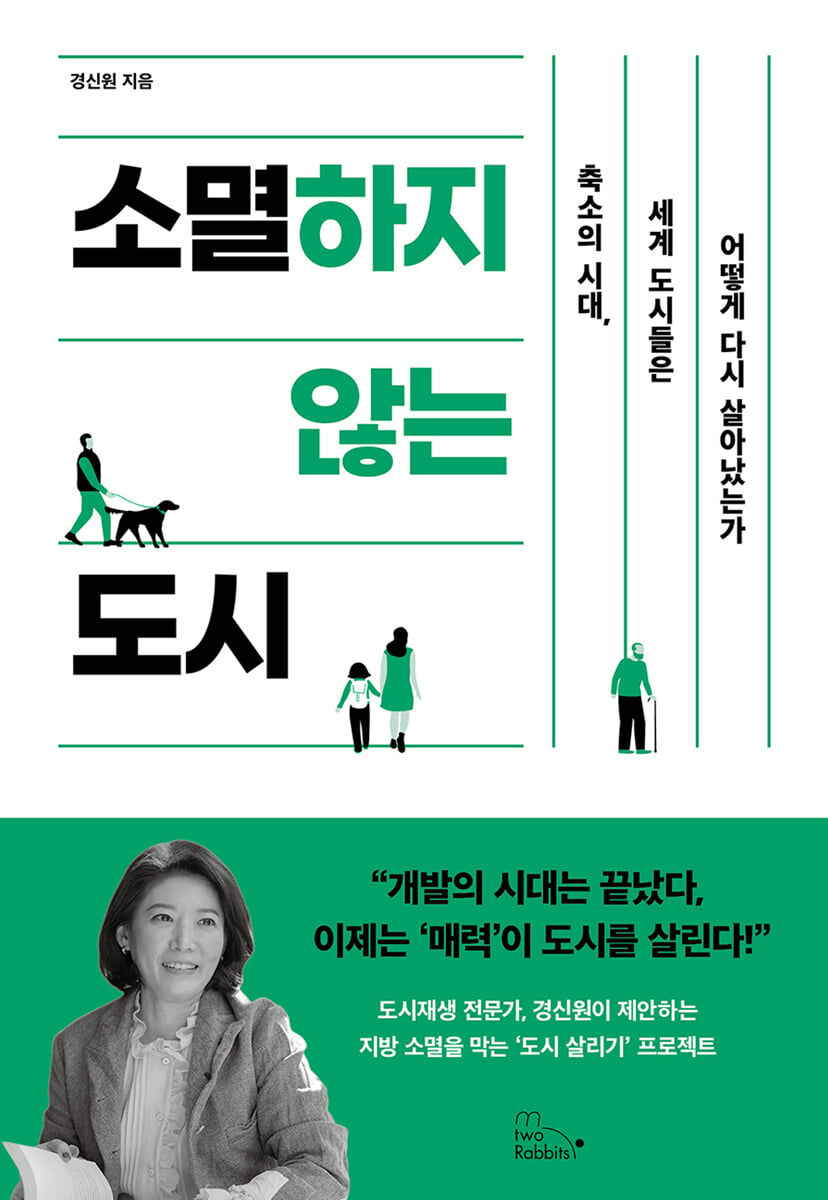
The city that never disappears
 |
Description
Book Introduction
The era of development is over, now it's 'charm' that saves cities!
Survival Strategies for Cities in a Shrinking Age
“Will raising the birth rate help revitalize the region?”
“Will attracting businesses revitalize the city?”
For decades, governments and local governments have poured childbirth incentives, industrial complexes, and various development strategies into trying to answer this question.
But the reality is different.
The birth rate remains the lowest in the world, and business attraction is concentrated in the metropolitan area.
The school closes, and the town quietly empties.
However, the compass of policy still remains on ‘growth.’
《The City That Never Disappears》(written by Kyung Shin-won) talks about the only way for a city to survive in an age of shrinkage: ‘charm.’
The insight is that it is not the bigger budget or the flashier development that will ultimately survive, but the cities where people want to stay and return.
This book poses a fundamental question to Korea's urban policy: "What needs to change now?"
The author views the current crisis not as a simple decline, but as an opportunity for a new transformation.
Through firsthand observations of decline and recovery in cities around the world, including the UK, Australia, and the US, we analyze the common strategies of 'cities that have regained their charm'.
The examples of London's Borough Market, Lisbon's Howard Smith's Wharf, and Hay-on-Wye, the book town in Wales, show that the vitality of a city lies not in grand architecture or large-scale development, but in traces of life, community, and citizen participation.
The book proposes five specific strategies for cities to revitalize: discovering and experiencing their charm, co-creating, fostering creativity, and designing for limits.
All these strategies start from local assets and the imagination of citizens, not from massive infrastructure.
Cities now draw their strength not from their ‘appearance’ but from their ‘stories’ and ‘people’.
"The City That Never Disappears" is a guidebook that opens an era of "rediscovery," not development.
It convincingly explains why the city is once again attracting people and the secrets of its charm.
Survival Strategies for Cities in a Shrinking Age
“Will raising the birth rate help revitalize the region?”
“Will attracting businesses revitalize the city?”
For decades, governments and local governments have poured childbirth incentives, industrial complexes, and various development strategies into trying to answer this question.
But the reality is different.
The birth rate remains the lowest in the world, and business attraction is concentrated in the metropolitan area.
The school closes, and the town quietly empties.
However, the compass of policy still remains on ‘growth.’
《The City That Never Disappears》(written by Kyung Shin-won) talks about the only way for a city to survive in an age of shrinkage: ‘charm.’
The insight is that it is not the bigger budget or the flashier development that will ultimately survive, but the cities where people want to stay and return.
This book poses a fundamental question to Korea's urban policy: "What needs to change now?"
The author views the current crisis not as a simple decline, but as an opportunity for a new transformation.
Through firsthand observations of decline and recovery in cities around the world, including the UK, Australia, and the US, we analyze the common strategies of 'cities that have regained their charm'.
The examples of London's Borough Market, Lisbon's Howard Smith's Wharf, and Hay-on-Wye, the book town in Wales, show that the vitality of a city lies not in grand architecture or large-scale development, but in traces of life, community, and citizen participation.
The book proposes five specific strategies for cities to revitalize: discovering and experiencing their charm, co-creating, fostering creativity, and designing for limits.
All these strategies start from local assets and the imagination of citizens, not from massive infrastructure.
Cities now draw their strength not from their ‘appearance’ but from their ‘stories’ and ‘people’.
"The City That Never Disappears" is a guidebook that opens an era of "rediscovery," not development.
It convincingly explains why the city is once again attracting people and the secrets of its charm.
- You can preview some of the book's contents.
Preview
index
preface.
In an age of shrinking, what saves cities is their charm.
Part 1.
Disappearing people, collapsing cities
1.
The Birth of the Chimney-Free City #The Urban Structure Changed by Deindustrialization
2.
Globalization vs. Deglobalization #Cities at the Crossroads
3.
How Cities Reduce Population #Urbanization and Birth Rate Changes
4.
The Migration of People, the Rise and Fall of Cities #Social and Economic Changes Brought About by Population Migration
5.
Migration, an Unfinished Journey #From Rural to Urban and Beyond
6.
Why Young People Are Leaving Cities #Job Shortages and a Thirst for Quality of Life
7.
Where did all those people go? #Idle spaces in a city where people have left
Part 2.
How to Create an Attractive City
8.
Secrets of the World's Most Fascinating Cities #2024 Resonance Rankings
9.
How far has Seoul's appeal come? #Measuring the allure of Seoul, the center of the Korean Wave.
10.
Learning from Urban Observer Jane Jacobs #What Makes a City Attractive
11.
Sejong City vs. Washington DC
#Planned cities through the eyes of Jane Jacobs
12.
Learning from the example of San Francisco: What Makes a City a Place for Creative Talent?
Part 3.
From Decline to Revival: The Reinvention of Global Cities
13.
A Wharf Reborn with Beer #Lisburn Howard Smith Wharf
14.
A farmer's festival revives a city #GlastonburyStory
15.
Even a gray winter can become a golden resource #London's Winter Wonderland
16.
Hipster-created trend #ShoreditchMiracle
17.
A Collaboration of Community and Art #LAArtsDistrict
18.
A village reborn as books #Heyonway Book Village
19.
Adding a Modern Taste to Traditional Markets in London and LA
20.
Power Plant Becomes City Culture #The Rebirth of Battersea and Lisburn
Part 4.
Five Strategies to Restore Our City's Charm
21.
Discover #RestoreHiddenAssets and Identity
22.
Let them 'experience' #A space where senses and memories reside
23.
Let's create 'together' #Governance of participation and cooperation
24.
Let it grow #Creating a creative ecosystem
25.
Design the 'Limit' #Turning Constraints into Possibilities
Conclusion.
From Development to the Era of Rediscovery
In an age of shrinking, what saves cities is their charm.
Part 1.
Disappearing people, collapsing cities
1.
The Birth of the Chimney-Free City #The Urban Structure Changed by Deindustrialization
2.
Globalization vs. Deglobalization #Cities at the Crossroads
3.
How Cities Reduce Population #Urbanization and Birth Rate Changes
4.
The Migration of People, the Rise and Fall of Cities #Social and Economic Changes Brought About by Population Migration
5.
Migration, an Unfinished Journey #From Rural to Urban and Beyond
6.
Why Young People Are Leaving Cities #Job Shortages and a Thirst for Quality of Life
7.
Where did all those people go? #Idle spaces in a city where people have left
Part 2.
How to Create an Attractive City
8.
Secrets of the World's Most Fascinating Cities #2024 Resonance Rankings
9.
How far has Seoul's appeal come? #Measuring the allure of Seoul, the center of the Korean Wave.
10.
Learning from Urban Observer Jane Jacobs #What Makes a City Attractive
11.
Sejong City vs. Washington DC
#Planned cities through the eyes of Jane Jacobs
12.
Learning from the example of San Francisco: What Makes a City a Place for Creative Talent?
Part 3.
From Decline to Revival: The Reinvention of Global Cities
13.
A Wharf Reborn with Beer #Lisburn Howard Smith Wharf
14.
A farmer's festival revives a city #GlastonburyStory
15.
Even a gray winter can become a golden resource #London's Winter Wonderland
16.
Hipster-created trend #ShoreditchMiracle
17.
A Collaboration of Community and Art #LAArtsDistrict
18.
A village reborn as books #Heyonway Book Village
19.
Adding a Modern Taste to Traditional Markets in London and LA
20.
Power Plant Becomes City Culture #The Rebirth of Battersea and Lisburn
Part 4.
Five Strategies to Restore Our City's Charm
21.
Discover #RestoreHiddenAssets and Identity
22.
Let them 'experience' #A space where senses and memories reside
23.
Let's create 'together' #Governance of participation and cooperation
24.
Let it grow #Creating a creative ecosystem
25.
Design the 'Limit' #Turning Constraints into Possibilities
Conclusion.
From Development to the Era of Rediscovery
Detailed image

Into the book
Why are we drawn to certain cities?
Why do people settle in some cities and why do they leave others?
I've traveled to many cities around the world and asked myself these questions.
And we were able to confirm that the relationships between people, the memories preserved in old places, culture and art, and the traces of the lives of residents make a city special, make people stay, and form the city's identity.
In the past, the appeal of a city was found in its physical assets, such as magnificent architecture, historical landscapes, and beautiful streets.
However, today's urban attractiveness is no longer determined solely by its visible environment. International organizations like the OECD and the UN, as well as urban experts, now consider people-centered governance, resident participation, cooperation among various stakeholders, and multifaceted values such as economic power, creativity, well-being, diversity, environmental sustainability, and inclusiveness as key elements.
In other words, today's attractive cities do not simply preserve their heritage.
How to reconcile that heritage with new needs and how residents rediscover and collaboratively manage their assets have become more important criteria.
The concept of urban attractiveness has now shifted from ‘appearance’ to ‘quality of life, community, democratic decision-making and creative reinterpretation.’
--- From "From Development to the Era of Rediscovery"
From the perspective of local governments, ‘youth’ is a key resource that can solve the problem of regional extinction.
Because the region can only survive if it retains young people at all costs, various measures are being developed to support youth settlement.
However, in the current situation where the birth rate has declined sharply, there is a high possibility that regional youth policies will ultimately lead to a zero-sum game.
When young people flock to one area, other areas are put at risk of extinction.
(…) Above all, we need to shift our perspective from viewing young people as mere ‘instrumental beings’ to solving the problem of regional extinction, to creating ‘regions where young people want to stay.’
This means that policies and environments must be designed so that young people can participate as subjects rather than objects of policies, and through this, regional development and sustainability must be pursued together.
--- From "Why do young people leave the city?"
Jane Jacobs argued that for a city to be vibrant, a sufficiently diverse population must be densely packed into a given space.
Sufficient population density keeps city streets and spaces vibrant throughout the day, allowing for a variety of activities and interactions to occur naturally.
The 'sufficient population density' she speaks of does not simply mean the settled population, but is a concept that includes both 'people staying' in the area and 'people coming and going'.
Sufficient population density is essential not only for the vibrancy of a city but also for its safety.
When there are enough people on the streets at all times, the concept of 'eyes on the street', as emphasized by Jane Jacobs, can work properly.
She argued that when diverse people gather and engage in activities on city streets, they naturally observe and monitor their surroundings.
That is, various people, such as local residents, shop owners, and pedestrians, watching each other while performing their daily activities on the streets play a big role in preventing crime and maintaining order.
--- From "Learning from Jane Jacobs, the Urban Observer"
San Francisco has long been recognized as a leading creative city where creative people gather.
However, recent trends such as high prices, rising housing costs, and social inequality are posing a crisis for both the creative class and the sustainability of cities.
Indeed, concerns are being raised that many artists and entrepreneurs are leaving San Francisco because of the high rents or moving to nearby, more affordable cities, potentially weakening the city's cultural diversity and creative energy.
San Francisco's case demonstrates that urban competitiveness comes not only from the influx of creative talent, but also from the inclusiveness and sustainability that enable diverse groups to live together.
Seoul and other Korean cities must also encourage the influx and settlement of the creative class through housing policies, cultural support, and urban infrastructure improvements, while also addressing the negative impacts of income disparity, social exclusion, and housing shortages.
--- From "Conditions for a City Where Creative Talent Gathers"
These cases also provide important implications for our country.
Seoul's Hongdae, Seongsu-dong, Munrae-dong, and Itaewon have also grown into unique cultural districts through the efforts of artists and creators, but gentrification has repeatedly caused rents to skyrocket and local residents and artists to be pushed out.
Rather than simply focusing on improving the physical environment or attracting tourists, institutional mechanisms and long-term support measures must be established to ensure stable settlement of artists and existing residents.
The Arts District experience shows that close collaboration between the public, private and community sectors to preserve a city's unique identity and diversity is key to sustainable urban regeneration.
--- From "Collaboration between Community and Art"
The recent trend of 'deglobalization' reveals this change even more clearly.
The slowdown in economic and cultural exchanges between countries, the intensification of nationalism, and the restructuring of global supply chains have exposed the limitations of growth strategies that rely on external investment and external competitiveness.
This city must survive not only on external capital but also on the basis of its own unique assets, living heritage and cultural characteristics, and the resilience of its communities.
In times of crisis and shrinkage, cities must rediscover their roots and identity and regenerate through endogenous growth models and citizen participation.
London's Borough Market wasn't just any old market.
As merchants and residents come together to reinterpret the heritage of their lives, the market rediscovers its past identity and becomes a force that once again attracts the city.
Howard Smith Wharf in Lisbon is also a former abandoned dock and warehouse that has been reborn as a local lure and community space by local creators.
As a result, it became a place where people could gather and spend time together again.
Why do people settle in some cities and why do they leave others?
I've traveled to many cities around the world and asked myself these questions.
And we were able to confirm that the relationships between people, the memories preserved in old places, culture and art, and the traces of the lives of residents make a city special, make people stay, and form the city's identity.
In the past, the appeal of a city was found in its physical assets, such as magnificent architecture, historical landscapes, and beautiful streets.
However, today's urban attractiveness is no longer determined solely by its visible environment. International organizations like the OECD and the UN, as well as urban experts, now consider people-centered governance, resident participation, cooperation among various stakeholders, and multifaceted values such as economic power, creativity, well-being, diversity, environmental sustainability, and inclusiveness as key elements.
In other words, today's attractive cities do not simply preserve their heritage.
How to reconcile that heritage with new needs and how residents rediscover and collaboratively manage their assets have become more important criteria.
The concept of urban attractiveness has now shifted from ‘appearance’ to ‘quality of life, community, democratic decision-making and creative reinterpretation.’
--- From "From Development to the Era of Rediscovery"
From the perspective of local governments, ‘youth’ is a key resource that can solve the problem of regional extinction.
Because the region can only survive if it retains young people at all costs, various measures are being developed to support youth settlement.
However, in the current situation where the birth rate has declined sharply, there is a high possibility that regional youth policies will ultimately lead to a zero-sum game.
When young people flock to one area, other areas are put at risk of extinction.
(…) Above all, we need to shift our perspective from viewing young people as mere ‘instrumental beings’ to solving the problem of regional extinction, to creating ‘regions where young people want to stay.’
This means that policies and environments must be designed so that young people can participate as subjects rather than objects of policies, and through this, regional development and sustainability must be pursued together.
--- From "Why do young people leave the city?"
Jane Jacobs argued that for a city to be vibrant, a sufficiently diverse population must be densely packed into a given space.
Sufficient population density keeps city streets and spaces vibrant throughout the day, allowing for a variety of activities and interactions to occur naturally.
The 'sufficient population density' she speaks of does not simply mean the settled population, but is a concept that includes both 'people staying' in the area and 'people coming and going'.
Sufficient population density is essential not only for the vibrancy of a city but also for its safety.
When there are enough people on the streets at all times, the concept of 'eyes on the street', as emphasized by Jane Jacobs, can work properly.
She argued that when diverse people gather and engage in activities on city streets, they naturally observe and monitor their surroundings.
That is, various people, such as local residents, shop owners, and pedestrians, watching each other while performing their daily activities on the streets play a big role in preventing crime and maintaining order.
--- From "Learning from Jane Jacobs, the Urban Observer"
San Francisco has long been recognized as a leading creative city where creative people gather.
However, recent trends such as high prices, rising housing costs, and social inequality are posing a crisis for both the creative class and the sustainability of cities.
Indeed, concerns are being raised that many artists and entrepreneurs are leaving San Francisco because of the high rents or moving to nearby, more affordable cities, potentially weakening the city's cultural diversity and creative energy.
San Francisco's case demonstrates that urban competitiveness comes not only from the influx of creative talent, but also from the inclusiveness and sustainability that enable diverse groups to live together.
Seoul and other Korean cities must also encourage the influx and settlement of the creative class through housing policies, cultural support, and urban infrastructure improvements, while also addressing the negative impacts of income disparity, social exclusion, and housing shortages.
--- From "Conditions for a City Where Creative Talent Gathers"
These cases also provide important implications for our country.
Seoul's Hongdae, Seongsu-dong, Munrae-dong, and Itaewon have also grown into unique cultural districts through the efforts of artists and creators, but gentrification has repeatedly caused rents to skyrocket and local residents and artists to be pushed out.
Rather than simply focusing on improving the physical environment or attracting tourists, institutional mechanisms and long-term support measures must be established to ensure stable settlement of artists and existing residents.
The Arts District experience shows that close collaboration between the public, private and community sectors to preserve a city's unique identity and diversity is key to sustainable urban regeneration.
--- From "Collaboration between Community and Art"
The recent trend of 'deglobalization' reveals this change even more clearly.
The slowdown in economic and cultural exchanges between countries, the intensification of nationalism, and the restructuring of global supply chains have exposed the limitations of growth strategies that rely on external investment and external competitiveness.
This city must survive not only on external capital but also on the basis of its own unique assets, living heritage and cultural characteristics, and the resilience of its communities.
In times of crisis and shrinkage, cities must rediscover their roots and identity and regenerate through endogenous growth models and citizen participation.
London's Borough Market wasn't just any old market.
As merchants and residents come together to reinterpret the heritage of their lives, the market rediscovers its past identity and becomes a force that once again attracts the city.
Howard Smith Wharf in Lisbon is also a former abandoned dock and warehouse that has been reborn as a local lure and community space by local creators.
As a result, it became a place where people could gather and spend time together again.
--- From "From Development to the Era of Rediscovery"
Publisher's Review
The era of growth is over. Now is the era of 'charm'!
The extinction of local governments has long been a national crisis.
But now, shrinkage is no longer just a local problem.
Even major cities, including Seoul and its metropolitan area, are experiencing population decline and economic structural instability.
《The City That Never Disappears》 shows that this change is not simply a matter of a decline in population, but that the very way cities survive must be fundamentally redesigned.
While studying abroad in England, the author witnessed firsthand the decline of European cities due to deindustrialization.
He says it was then that he first realized that even if the physical infrastructure, such as buildings and roads, remains, a city loses its essence when its community collapses.
He diagnoses that the shrinking trend that Korean cities are currently experiencing is a more complex and structural crisis.
But this book doesn't stop at simply warning of the city's crisis.
Rather, the author argues that at the point where the reality of shrinkage is acknowledged, an opportunity opens up to reimagine and restore the city.
Cities are not sustained by development alone.
It is no longer 'how much you grow' that determines a city's survival, but 'how attractive it is'.
A city without charm drives people away, but a city with charm brings people back.
And that appeal doesn't come from statistics, numbers, or physical infrastructure, but from the reasons people want to stay, the feelings they want to return to, the experience of being in a community.
Based on this awareness of the problem, “The City That Never Disappears” proposes a new framework for viewing the city over four parts.
In Part 1, we define the concept of a 'shrinking city' and analyze the reality of Korea, where the urban structure itself is changing beyond population decline.
Part 2 explores theoretically the elements that make up a city's appeal, focusing on the question, "What is an attractive city?"
Part 3 presents examples of cities around the world that have actually regained their appeal.
Detroit and London, Leedsburn and Hay-on-Wye in Wales? These cities all experienced industrial decline or population decline, but through civic engagement, community regeneration, and the reinterpretation of cultural assets, they transformed into cities where people gather again.
The strength of this book lies not in simply suggesting policy alternatives, but in changing the very way we view cities.
Beyond the limits of growth, what do we truly desire from cities? "The Undying City" poses this question to all of us, proposing a shift from development to an era of "rediscovery."
The answer found in the world's recovery cities,
Now it's Korean cities' turn to come alive!
Korean cities today face a common question.
How can we make people walk the streets they left behind again?
How can we begin a new story amidst the remnants of a collapsed industry?
Urban recovery is no longer a matter of 'growth'.
Now, the 'restoration of charm' determines the future of the city.
The author views the city not as a mere space but as a 'land of experience' through insights that cross over urban sociology, visual culture, and global urban trends.
While diagnosing the realities of Korean cities like Seoul, Gunsan, and Gwangju, it also broadly explores recovery cases in global cities like Detroit, London, Lisbon, and Hay-on-Wye.
Instead of flashy development, there are stories of how a small cultural festival changed the flow of the city, strategies that transformed an abandoned old dock into a sensory cultural space, and plans that transformed empty streets and abandoned factories into places where people gather.
This book focuses on the movement of recovery that begins with 'imagination' rather than repetitive urban development.
In particular, the final fourth part identifies five common strategies that have operated in the changing world of these cities.
And now the question comes back to us.
How can Korea's cities, facing extinction, rediscover their unique charm?
How can we create streets where people want to walk, spaces where they want to stay, and cities where people want to create together?
The author presents the answer in five strategies.
We propose a new design that rediscovers the city's hidden charm, allows citizens to directly 'experience' it, establishes a participatory foundation for 'creating' the city together, fosters an ecosystem that fosters 'creativity', and finally, turns the city's 'limitations' into possibilities.
In this way, “The City That Never Disappears” is not simply a report that transfers overseas cases.
This is an experiment that reinterprets the principles of recovery discovered by cities around the world as they navigate crises within the context of Korean cities.
This book offers practical directions for city planners, architects, and artists who design cities, and a new perspective that will make citizens and the younger generation fall in love with cities again.
For those who dream of new possibilities even amidst the landscape of a declining city, "The City That Never Disappears" will serve as the most realistic and hopeful guide.
The extinction of local governments has long been a national crisis.
But now, shrinkage is no longer just a local problem.
Even major cities, including Seoul and its metropolitan area, are experiencing population decline and economic structural instability.
《The City That Never Disappears》 shows that this change is not simply a matter of a decline in population, but that the very way cities survive must be fundamentally redesigned.
While studying abroad in England, the author witnessed firsthand the decline of European cities due to deindustrialization.
He says it was then that he first realized that even if the physical infrastructure, such as buildings and roads, remains, a city loses its essence when its community collapses.
He diagnoses that the shrinking trend that Korean cities are currently experiencing is a more complex and structural crisis.
But this book doesn't stop at simply warning of the city's crisis.
Rather, the author argues that at the point where the reality of shrinkage is acknowledged, an opportunity opens up to reimagine and restore the city.
Cities are not sustained by development alone.
It is no longer 'how much you grow' that determines a city's survival, but 'how attractive it is'.
A city without charm drives people away, but a city with charm brings people back.
And that appeal doesn't come from statistics, numbers, or physical infrastructure, but from the reasons people want to stay, the feelings they want to return to, the experience of being in a community.
Based on this awareness of the problem, “The City That Never Disappears” proposes a new framework for viewing the city over four parts.
In Part 1, we define the concept of a 'shrinking city' and analyze the reality of Korea, where the urban structure itself is changing beyond population decline.
Part 2 explores theoretically the elements that make up a city's appeal, focusing on the question, "What is an attractive city?"
Part 3 presents examples of cities around the world that have actually regained their appeal.
Detroit and London, Leedsburn and Hay-on-Wye in Wales? These cities all experienced industrial decline or population decline, but through civic engagement, community regeneration, and the reinterpretation of cultural assets, they transformed into cities where people gather again.
The strength of this book lies not in simply suggesting policy alternatives, but in changing the very way we view cities.
Beyond the limits of growth, what do we truly desire from cities? "The Undying City" poses this question to all of us, proposing a shift from development to an era of "rediscovery."
The answer found in the world's recovery cities,
Now it's Korean cities' turn to come alive!
Korean cities today face a common question.
How can we make people walk the streets they left behind again?
How can we begin a new story amidst the remnants of a collapsed industry?
Urban recovery is no longer a matter of 'growth'.
Now, the 'restoration of charm' determines the future of the city.
The author views the city not as a mere space but as a 'land of experience' through insights that cross over urban sociology, visual culture, and global urban trends.
While diagnosing the realities of Korean cities like Seoul, Gunsan, and Gwangju, it also broadly explores recovery cases in global cities like Detroit, London, Lisbon, and Hay-on-Wye.
Instead of flashy development, there are stories of how a small cultural festival changed the flow of the city, strategies that transformed an abandoned old dock into a sensory cultural space, and plans that transformed empty streets and abandoned factories into places where people gather.
This book focuses on the movement of recovery that begins with 'imagination' rather than repetitive urban development.
In particular, the final fourth part identifies five common strategies that have operated in the changing world of these cities.
And now the question comes back to us.
How can Korea's cities, facing extinction, rediscover their unique charm?
How can we create streets where people want to walk, spaces where they want to stay, and cities where people want to create together?
The author presents the answer in five strategies.
We propose a new design that rediscovers the city's hidden charm, allows citizens to directly 'experience' it, establishes a participatory foundation for 'creating' the city together, fosters an ecosystem that fosters 'creativity', and finally, turns the city's 'limitations' into possibilities.
In this way, “The City That Never Disappears” is not simply a report that transfers overseas cases.
This is an experiment that reinterprets the principles of recovery discovered by cities around the world as they navigate crises within the context of Korean cities.
This book offers practical directions for city planners, architects, and artists who design cities, and a new perspective that will make citizens and the younger generation fall in love with cities again.
For those who dream of new possibilities even amidst the landscape of a declining city, "The City That Never Disappears" will serve as the most realistic and hopeful guide.
GOODS SPECIFICS
- Date of issue: November 15, 2025
- Page count, weight, size: 304 pages | 145*210*30mm
- ISBN13: 9791199528307
- ISBN10: 1199528307
You may also like
카테고리
korean


korean

![GQ KOREA Mark (Monthly): December [2025]](http://librairie.coreenne.fr/cdn/shop/files/8ef265dbbfbf186523ed75ba7319009d.jpg?v=1765340328&width=3840)


