

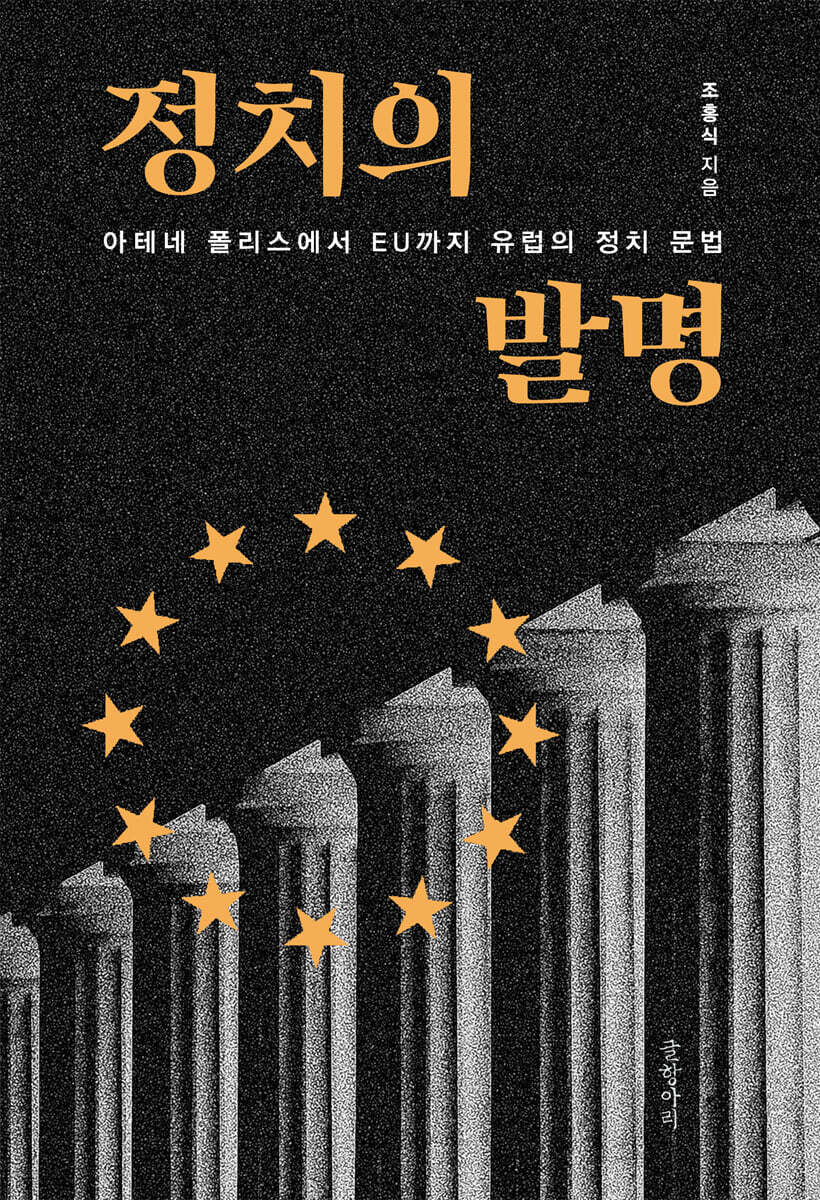
The Invention of Politics
 |
Description
Book Introduction
A perspective that penetrates civilization,
With a perspective that spans multiple eras
Unraveling 2500 Years of Political Grammar
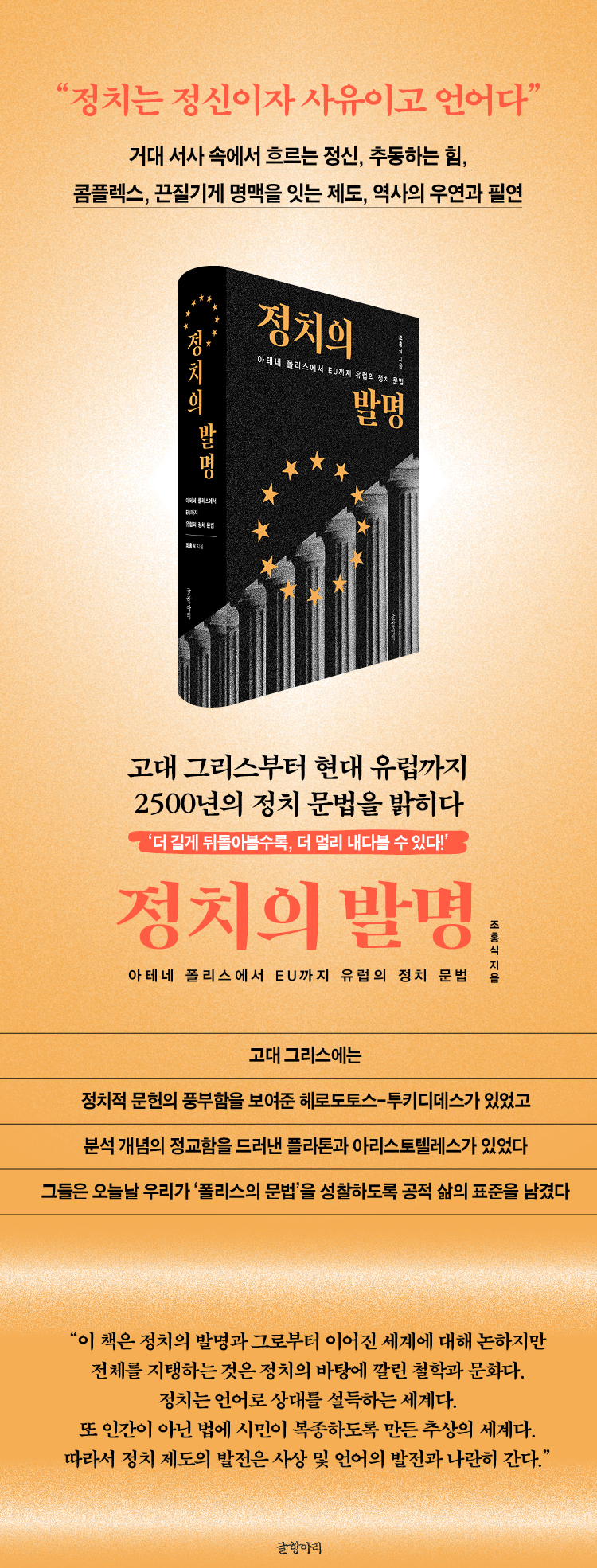
“Politics is spirit, thought, and language.”
Why were democracy and philosophy inseparable in the ancient Greek polis?
Why was the Roman Republic so wary of centralizing power?
How the Medieval Church Became a Model for the Modern State
Why was the sovereignty of European kings fundamentally weak?
Why the modern principle of popular sovereignty must be revolutionary.
Is the European Union a political model for the future world?
The further back you look, the further ahead you can see.
This statement by Churchill is a perspective that historians who study grand history have long taken.
Of course, just because it's huge doesn't mean it misses out on details.
The many major currents are a tangled web of living spirits, driving forces, complexes, tenacious institutions, and the contingencies and inevitabilities of history.
In his previous works, including “The Web of Civilization,” political scientist Cho Hong-sik has examined European history not only from a grand narrative and long-term perspective, but also from a comparative perspective with East Asia.
Comparison is the starting point of all perception.
Comparing ancient and modern times, contrasting Greece with the rest of Europe, and juxtaposing Europe with East Asia form the basis for examining the world today.
In this context, The Invention of Politics, which begins in Europe, the author's main research area, provides remarkable insights into analyzing modern politics.
This book discusses the invention of politics and the world that followed, but the underlying thread of the whole is the philosophy and culture that underpinned politics.
Politics is a world where you persuade others through language.
It is also an abstract world where citizens are made to obey laws that are not human.
Therefore, the development of political institutions goes hand in hand with the development of ideas and language.
Today's political philosophy, rhetoric, and argument have their origins in ancient Greece and Rome.
These ancient people honed their oratory skills, just as actors demonstrate their acting skills in the performance of tragedy, and also developed the ability to think in public spaces.
Language develops the ability to think, and philosophy can develop on this foundation.
Moreover, if the ancient Greeks had not conceptualized their political system under the name of 'democracy', we would not even have the opportunity to utilize that grammar today.
The ideas that were already at their peak in their time have endured for a long time, adapted to change, and as a result, constitute today's politics.
This book attempts to understand the grammar of European politics by tracing 2,500 years of history from ancient Greece.
Why grammar? Grammar is usually applied to language.
Ancient Greece, with its rich political literature (Herodotus-Thucydides), its tradition of political narrative, and its sophisticated analytical concepts (Plato-Aristotle), bequeathed us a standard of public life that allows us to reflect on the 'grammar of the polis' today.
Real politics was conceptualized by these ancient people through the prism of 'political science', and here it was organized into a single grammar that could be passed down to future generations.
With a perspective that spans multiple eras
Unraveling 2500 Years of Political Grammar
“Politics is spirit, thought, and language.”
Why were democracy and philosophy inseparable in the ancient Greek polis?
Why was the Roman Republic so wary of centralizing power?
How the Medieval Church Became a Model for the Modern State
Why was the sovereignty of European kings fundamentally weak?
Why the modern principle of popular sovereignty must be revolutionary.
Is the European Union a political model for the future world?
The further back you look, the further ahead you can see.
This statement by Churchill is a perspective that historians who study grand history have long taken.
Of course, just because it's huge doesn't mean it misses out on details.
The many major currents are a tangled web of living spirits, driving forces, complexes, tenacious institutions, and the contingencies and inevitabilities of history.
In his previous works, including “The Web of Civilization,” political scientist Cho Hong-sik has examined European history not only from a grand narrative and long-term perspective, but also from a comparative perspective with East Asia.
Comparison is the starting point of all perception.
Comparing ancient and modern times, contrasting Greece with the rest of Europe, and juxtaposing Europe with East Asia form the basis for examining the world today.
In this context, The Invention of Politics, which begins in Europe, the author's main research area, provides remarkable insights into analyzing modern politics.
This book discusses the invention of politics and the world that followed, but the underlying thread of the whole is the philosophy and culture that underpinned politics.
Politics is a world where you persuade others through language.
It is also an abstract world where citizens are made to obey laws that are not human.
Therefore, the development of political institutions goes hand in hand with the development of ideas and language.
Today's political philosophy, rhetoric, and argument have their origins in ancient Greece and Rome.
These ancient people honed their oratory skills, just as actors demonstrate their acting skills in the performance of tragedy, and also developed the ability to think in public spaces.
Language develops the ability to think, and philosophy can develop on this foundation.
Moreover, if the ancient Greeks had not conceptualized their political system under the name of 'democracy', we would not even have the opportunity to utilize that grammar today.
The ideas that were already at their peak in their time have endured for a long time, adapted to change, and as a result, constitute today's politics.
This book attempts to understand the grammar of European politics by tracing 2,500 years of history from ancient Greece.
Why grammar? Grammar is usually applied to language.
Ancient Greece, with its rich political literature (Herodotus-Thucydides), its tradition of political narrative, and its sophisticated analytical concepts (Plato-Aristotle), bequeathed us a standard of public life that allows us to reflect on the 'grammar of the polis' today.
Real politics was conceptualized by these ancient people through the prism of 'political science', and here it was organized into a single grammar that could be passed down to future generations.
- You can preview some of the book's contents.
Preview
index
Chapter 1: Introduction: The Political Grammar of Europe
Chapter 2 The Polis of Ancient Greece
1.
Grammar of the Police
The Value of Liberty | Isonomia: Equality Before the Law | Democracy: Rule by the Majority | Polis: A Strong Civic Community | Distinction between Politics and Economics | Stasis (Civil War) and Polemos (War)
2.
The social background of universality
The Poetic Birth of the 'Polis': Homer | A Feast of Words: From Rhetoric to Philosophy | Striving for and Devices of Universality
3.
Inheritance of police grammar
Frontier-led Unification | Openness and Integration: Rome and Christianity | Renaissance and Early Modern Times: The Legacy of the Polis
Chapter 3: Res Publica and Imperium in Ancient Rome
1.
Grammar of Res Publica
Republic or Empire? | The Rise of the Republic: The Birth of Liberty | The Dividing and Limiting Political System of the Republic | The Veto of the People: The Roman Electoral System | Roman Openness and the Formation of the Empire | The Rule of Law
2.
Rome is the birthplace of Europe
Secondary Rome | Roads and Architecture of Res Publica | Meritocracy in Ancient Times
3.
The Succession of Res Publica and Imperium
The Holy Roman Empire and the City Republics | The United States and the French Republic | Modern Politics and the Shadow of Rome
Chapter 4 Medieval Rome and Christendom
1.
The Chemistry of Political Grammar
Jerusalem and One God | Rome Embracing Christianity | Catholicism in the West, Orthodoxy in the East | Emperors and Popes | The Birth of the Western Rule of Law Tradition | Christianity of Love and Violence | The Revolutionary Nature of Christianity
2.
Christianity Controls Society
Family Institutions: The Strengthening of Monogamy | Individualism Born of Christianity | Christianity's Universal Love and Autonomous Community
3.
Reformation and Succession of Christianity
The Reformation and Nationalism | Communism and the Salvation of Humanity | Christian Democracy
Chapter 5: Medieval Kingdoms: France and England
1.
The universality and specificity of the European kingdoms
Byzantium and the Germanic Tradition | Foreign Invasion and Feudalism | The Two Bodies of the King | Kingdom and Parliament | From the Kingdom to Modernity | The Germanic Tradition: The Holy Roman Empire | 'Personal Union' and Institutional Integration
2.
Separation of state and society
Patriarchy and European Pluralism | The Birth of the State and the Bureaucracy | Noblesse Oblige
3.
Kingdom Survival
The Formation of Equal International Relations | The Personification of Community | Reign and Governance
Chapter 6: Modern Nations: Britain, the United States, and France
1.
Nation's Path and Grammar
From Kingdom to Nation | The Case of the Netherlands | The Rise of Nations | Counter-Nation | The Spread of Nations
2.
A melting pot of social integration
Political integration | Socio-cultural integration | Economic integration
3.
Nation, the Grammar of Succession and Transformation
The Athenian Polis and the Franco-American Nation | Rome's Res Publica/Imperium and the United States and France | Nation and Christendom | An International Society of Competition and Cooperation: Kingdoms and Nations
Chapter 7: The Modern Cosmopolis and the European Union
1.
International: Cooperation of Nations
Institutionalization of Cooperation | Great Power-Centred Order | Pool of Sovereignty
2.
Supranational: Transcending the Nation
Policy Integration, From Trade to Science and Technology | The Birth of a New Unit | European Currency and Demos
3.
Cosmopolis: A New Order and Grammar
A new empire, from center to periphery | New principles, the few over the many | New processes, persuasion over efficiency | World, follow Europe
Chapter 8 Conclusion: The Politics of Variety and Invention
Chapter 2 The Polis of Ancient Greece
1.
Grammar of the Police
The Value of Liberty | Isonomia: Equality Before the Law | Democracy: Rule by the Majority | Polis: A Strong Civic Community | Distinction between Politics and Economics | Stasis (Civil War) and Polemos (War)
2.
The social background of universality
The Poetic Birth of the 'Polis': Homer | A Feast of Words: From Rhetoric to Philosophy | Striving for and Devices of Universality
3.
Inheritance of police grammar
Frontier-led Unification | Openness and Integration: Rome and Christianity | Renaissance and Early Modern Times: The Legacy of the Polis
Chapter 3: Res Publica and Imperium in Ancient Rome
1.
Grammar of Res Publica
Republic or Empire? | The Rise of the Republic: The Birth of Liberty | The Dividing and Limiting Political System of the Republic | The Veto of the People: The Roman Electoral System | Roman Openness and the Formation of the Empire | The Rule of Law
2.
Rome is the birthplace of Europe
Secondary Rome | Roads and Architecture of Res Publica | Meritocracy in Ancient Times
3.
The Succession of Res Publica and Imperium
The Holy Roman Empire and the City Republics | The United States and the French Republic | Modern Politics and the Shadow of Rome
Chapter 4 Medieval Rome and Christendom
1.
The Chemistry of Political Grammar
Jerusalem and One God | Rome Embracing Christianity | Catholicism in the West, Orthodoxy in the East | Emperors and Popes | The Birth of the Western Rule of Law Tradition | Christianity of Love and Violence | The Revolutionary Nature of Christianity
2.
Christianity Controls Society
Family Institutions: The Strengthening of Monogamy | Individualism Born of Christianity | Christianity's Universal Love and Autonomous Community
3.
Reformation and Succession of Christianity
The Reformation and Nationalism | Communism and the Salvation of Humanity | Christian Democracy
Chapter 5: Medieval Kingdoms: France and England
1.
The universality and specificity of the European kingdoms
Byzantium and the Germanic Tradition | Foreign Invasion and Feudalism | The Two Bodies of the King | Kingdom and Parliament | From the Kingdom to Modernity | The Germanic Tradition: The Holy Roman Empire | 'Personal Union' and Institutional Integration
2.
Separation of state and society
Patriarchy and European Pluralism | The Birth of the State and the Bureaucracy | Noblesse Oblige
3.
Kingdom Survival
The Formation of Equal International Relations | The Personification of Community | Reign and Governance
Chapter 6: Modern Nations: Britain, the United States, and France
1.
Nation's Path and Grammar
From Kingdom to Nation | The Case of the Netherlands | The Rise of Nations | Counter-Nation | The Spread of Nations
2.
A melting pot of social integration
Political integration | Socio-cultural integration | Economic integration
3.
Nation, the Grammar of Succession and Transformation
The Athenian Polis and the Franco-American Nation | Rome's Res Publica/Imperium and the United States and France | Nation and Christendom | An International Society of Competition and Cooperation: Kingdoms and Nations
Chapter 7: The Modern Cosmopolis and the European Union
1.
International: Cooperation of Nations
Institutionalization of Cooperation | Great Power-Centred Order | Pool of Sovereignty
2.
Supranational: Transcending the Nation
Policy Integration, From Trade to Science and Technology | The Birth of a New Unit | European Currency and Demos
3.
Cosmopolis: A New Order and Grammar
A new empire, from center to periphery | New principles, the few over the many | New processes, persuasion over efficiency | World, follow Europe
Chapter 8 Conclusion: The Politics of Variety and Invention
Detailed image
Into the book
Koreans in the 2020s have been more influenced by the Greeks and Romans of the Mediterranean than by their geographical ancestors who lived on the Korean Peninsula in East Asia 2,500 years ago, or by their biological ancestors who lived in Manchuria or the Maritime Province and passed down their genes to us.
At least in the political sphere, we are descendants of Athenian citizens and descendants of Roman citizens.
--- p.14
The idea of obeying abstract laws rather than bowing and kneeling before others, and that laws apply equally to all, was central to ancient Greek democracy.
If ancient Greece had not conceptualized its political system under the name of democracy, we would likely not have inherited the legacy of its political grammar.
In other words, because ancient Greece had a political science that pondered the polis, the grammar of democracy was created, and thanks to this, later generations were able to develop democracy by accepting, modifying, or rejecting it.
This means that real politics was conceptualized through political science and, thanks to that, was organized into a single grammar and passed down to future generations.
--- p.45~46
However, few cultures acknowledge and take into account the fact that civil war or internal discord may always exist.
The Greeks' rule of one-few-many can also be seen as a system of various arrangements for coordinating the ever-present conflicts of internal interests.
(…) Ancient Greece not only pondered the three-dimensional link between states and international relations, but also presented the basic grammar of international relations that remains dominant to this day.
--- p.62~63
In democratic politics, speech and discussion were central, and even in the process of conducting a trial, the process of presenting each argument, defending it, and explaining the verdict was a feast of words.
Furthermore, words were also richly dealt with in places where religion and art were combined, such as in theater.
Ancient Greece eventually developed a genre of thought called rhetoric from speech, and finally philosophy.
This is in contrast to East Asia, where silence was highly valued.
The point we must note here is the social background that allowed ancient Greece to develop democracy.
The Greeks did not create democratic principles only in the political sphere.
Within the framework of the social banquet of words, democracy in the political field naturally emerged.
This means that the grammar of politics can only develop within a social culture.
--- p.71~72
When tracing the origins of European civilization, Athens, Rome, and Jerusalem form a trinity.
They all have ancient origins and by the 5th century BC had developed into distinct cultures with distinct identities.
Athens and Greece are moving from the Archaic period to the Classical period.
Rome was in a period of transition from a time ruled by kings to a unique political grammar called res publica.
Although it is difficult to detect such a distinct change in political grammar in Jerusalem, the Jewish national identity based on monotheism was already firmly established.
--- p.82
If Greece presented a refreshingly pure political grammar of direct democracy, in which all citizens gathered together to discuss and vote, Rome presented a thorough and novel political grammar of republicanism, in which two rulers were elected every year.
--- p.118~119
A characteristic of Europe, which emerged through Greece and Rome and continued into later periods, is its philosophical and systematic approach to political phenomena.
Following the Greek politics of Plato and Aristotle and the Roman politics of Polybius and Cicero, Saint Augustine and Thomas Aquinas appear in Christendom, and Bodin and Hobbes present central theories in Kingdom.
The Age of Nations is a period in which Rousseau and Locke provide the basic ideology.
--- p.126
In the late Roman Empire, Christianity, originating in Jerusalem, and the Roman principle of imperium met to form a single political system.
If we look more deeply into the origins of Christianity, we see that from the beginning it was the result of a fusion of the religion of the ancient Jewish people and Greek culture.
In other words, the medieval Christendom and kingdom system were another form in which ancient political and religious grammars were chemically combined.
--- p.186
The history of European political grammar was not a simple succession, but a process of selection, transformation, recombination, and invention.
The core of European political history is not simply the preservation of traditions, but the 'invention' of new types.
The Nation's transformation of the Kingdom's territorial order into a civic community was not a simple institutional reform, but an invention that redesigned the relationship between political subjects and power by developing the concepts of social contract and general will.
At least in the political sphere, we are descendants of Athenian citizens and descendants of Roman citizens.
--- p.14
The idea of obeying abstract laws rather than bowing and kneeling before others, and that laws apply equally to all, was central to ancient Greek democracy.
If ancient Greece had not conceptualized its political system under the name of democracy, we would likely not have inherited the legacy of its political grammar.
In other words, because ancient Greece had a political science that pondered the polis, the grammar of democracy was created, and thanks to this, later generations were able to develop democracy by accepting, modifying, or rejecting it.
This means that real politics was conceptualized through political science and, thanks to that, was organized into a single grammar and passed down to future generations.
--- p.45~46
However, few cultures acknowledge and take into account the fact that civil war or internal discord may always exist.
The Greeks' rule of one-few-many can also be seen as a system of various arrangements for coordinating the ever-present conflicts of internal interests.
(…) Ancient Greece not only pondered the three-dimensional link between states and international relations, but also presented the basic grammar of international relations that remains dominant to this day.
--- p.62~63
In democratic politics, speech and discussion were central, and even in the process of conducting a trial, the process of presenting each argument, defending it, and explaining the verdict was a feast of words.
Furthermore, words were also richly dealt with in places where religion and art were combined, such as in theater.
Ancient Greece eventually developed a genre of thought called rhetoric from speech, and finally philosophy.
This is in contrast to East Asia, where silence was highly valued.
The point we must note here is the social background that allowed ancient Greece to develop democracy.
The Greeks did not create democratic principles only in the political sphere.
Within the framework of the social banquet of words, democracy in the political field naturally emerged.
This means that the grammar of politics can only develop within a social culture.
--- p.71~72
When tracing the origins of European civilization, Athens, Rome, and Jerusalem form a trinity.
They all have ancient origins and by the 5th century BC had developed into distinct cultures with distinct identities.
Athens and Greece are moving from the Archaic period to the Classical period.
Rome was in a period of transition from a time ruled by kings to a unique political grammar called res publica.
Although it is difficult to detect such a distinct change in political grammar in Jerusalem, the Jewish national identity based on monotheism was already firmly established.
--- p.82
If Greece presented a refreshingly pure political grammar of direct democracy, in which all citizens gathered together to discuss and vote, Rome presented a thorough and novel political grammar of republicanism, in which two rulers were elected every year.
--- p.118~119
A characteristic of Europe, which emerged through Greece and Rome and continued into later periods, is its philosophical and systematic approach to political phenomena.
Following the Greek politics of Plato and Aristotle and the Roman politics of Polybius and Cicero, Saint Augustine and Thomas Aquinas appear in Christendom, and Bodin and Hobbes present central theories in Kingdom.
The Age of Nations is a period in which Rousseau and Locke provide the basic ideology.
--- p.126
In the late Roman Empire, Christianity, originating in Jerusalem, and the Roman principle of imperium met to form a single political system.
If we look more deeply into the origins of Christianity, we see that from the beginning it was the result of a fusion of the religion of the ancient Jewish people and Greek culture.
In other words, the medieval Christendom and kingdom system were another form in which ancient political and religious grammars were chemically combined.
--- p.186
The history of European political grammar was not a simple succession, but a process of selection, transformation, recombination, and invention.
The core of European political history is not simply the preservation of traditions, but the 'invention' of new types.
The Nation's transformation of the Kingdom's territorial order into a civic community was not a simple institutional reform, but an invention that redesigned the relationship between political subjects and power by developing the concepts of social contract and general will.
--- p.543
Publisher's Review
The distant and deep antiquity, the fast and experimental modernity
How the Grammar of the Ancient Polis Sustains the Present
The author analyzes European political grammar through six historical types: ancient polis and res publica, medieval Christianity and kingdom, modern nation, and contemporary cosmopolis.
Just as there are various types of language families based on basic rules such as morphology, syntax, and phonology in the grammar of a language, the grammar of European politics is seen as being created by combining these six types.
'Type' can be seen as a middle ground between complex historical reality and theoretical models.
Historical reality is so complex and multifaceted that it cannot be reduced to a model. However, analysis through types reveals concrete historical experiences while acknowledging theoretical abstractness.
The author, who takes a chronological narrative of ancient, medieval, and modern times, concretely captures how the breath of antiquity lives on in the political realities of modern Europe and Korea.
What makes Greece exceptional is that it invented both philosophy and democracy at the same time.
The ancient times are far and deep.
Modern times are fast and experimental.
Gaining insight from the gap between the two requires a perspective that is both close and somewhat distant, and thus the author embraces the vast history of politics to survey the grander historical landscape.
This book is unique in that it applies the framework of linguistic thinking to politics, but another unique aspect is that it creates a strong link between areas that have been overlooked or excluded in the curriculum of institutional political science.
The author meticulously researches medieval history, bringing back to life the Middle Ages, which cover a period of 1,000 years in chronology but are poor in narrative, with equal importance as ancient times or modern times.
The aim is to conceptualize the Middle Ages as 'Christendom' and to reveal how this has been inherited as the grammar of European politics today.
The author's argument, which considers the Middle Ages as an experimental field where conflicting principles coexisted to create a new order, is rich and persuasive.
The meticulous philosophical thinking of ancient Greece later had a great influence on the development of Christian doctrine, and with the wings of Christianity, the grammar of the ancient polis penetrated deep into Europe, Asia, and Africa.
Although it takes a step-by-step narrative, the book does not obscure the earlier periods as it moves from antiquity to the Middle Ages and from the Middle Ages to the modern era.
While novelty is the force of progress that propels history forward, the author does not neglect continuity.
For example, the philosophy and democracy of ancient Greece still play a role in the framework in which modern people live, and modern revolutionary spirit and individualism originated, above all, from the Christian world.
I believe that Jesus' revolutionary nature has led to the individualistic society we have today.
This book focuses on universal history, so continuity becomes central to the narrative.
Of course, universal does not necessarily mean central.
For example, unlike the Chinese emperors, Rome took an attitude of trying to overcome its inferiority complex due to its location on the periphery. Even when it founded its empire, it did not think of itself as occupying the geographical center of the world or as superior to all other civilizations.
However, the core themes of this book's narrative are that Greek philosophy possessed universality, that revolutionary Christianity was able to become a universal religion by embracing both the ambivalent concepts of individualism and welfare, and that Europe inherited these legacies and constantly refined itself toward universality.
A massive study reaching the roots of modernity
How Humble Origins Rise to the Top of Politics and Culture
The ancient Greeks tended to move in a general, abstract, and universal direction rather than a particular and individualistic one.
This revealed their presence in the public world, and the polis they established was strengthened by expressing its spiritual foundation in poetry.
Their excellence in collective thinking and their way of working together constituted the essence and core of politics.
The universality of the ancient Greeks can also be found in the types of political systems created by combining philosophy and political science. Rather than inductively classifying political bodies by observing specific political systems in reality, they classified ruling powers into one, few, and many by classifying the number of rulers, and then deductively classified the systems.
A philosophical and systematic approach to political phenomena has become a characteristic of Europe.
Following the Greek politics of Plato and Aristotle and the Roman politics of Polybius and Cicero, in medieval Christendom, Saint Augustine and Thomas Aquinas emerged, and in Kingdom, Bodin and Hobbes presented central theories.
In the era of modern nations, Rousseau and Locke provided the basic ideology.
In this flow, each force creates a point of prominence.
For example, the author analyzes how Rome grew into an empire by achieving military expansion with a much more open attitude than Athens while changing its political grammar.
Rome was a nation founded by a group of lowly people through shameful acts such as the mass abduction of women.
But even though Rome felt a complex about its own culture, it had a conviction that its future would be glorious, which formed its identity.
Those who remembered and did not hide the humble origins of their people not only did not discriminate against immigrants, but also established a policy of accepting slaves as citizens.
This became established as the political grammar of Europe, and in the Middle Ages, the Holy Roman Empire and the Italian city-states inherited the legacy of Rome, and in modern times, the United States and France spread it through revolution.
Later, in modern times, it spread to numerous new nations in the American continent, providing the basic grammar of modern democratic politics through the universalization of republicanism.
Nation's Europe, Awakening World Politics
Why Europe is stepping back from its nation-state to become a cosmopolis.
The vulnerability of traditional kingdoms played a decisive role in the birth of nations, which can be considered the vessels of modern democracy in Europe.
From Greece and Rome, Europe inherited a political culture that rejected tyranny, and the groups that established kingdoms had to be wary of the existing population as they were invaded by foreign powers such as the Germans, Vikings, and Magyars.
Moreover, it was subject to checks from the church that had secured continental influence.
Because the kingdom was so vulnerable, the grammar of the kingdom was able to transition to the nation for the first time in Europe.
The reason why the invention of the nation in Europe was so revolutionary was because it broke the patriarchal system in which the king was the master of the country and established a new order in which the citizens as a group were the masters of the country.
The forces that first created nations and brought them onto the political stage, from the Netherlands to France and the United States, all invented the grammar of modern politics not by fighting other ethnic groups, but by overthrowing the ruling order within their own cultural groups.
The ideological foundation that led to this revolutionary change was freedom and equality, which denied the ancien regime and tradition, and universal and open values.
This book, which begins in ancient times, was born from a question of understanding the unique and novel political experiment called the European Union.
The starting point was the question of how Europe could successfully achieve regional integration, which was difficult to understand in East Asia.
Tracing the factors of the European Union's success, we begin with the characteristics of a nation and reach the common foundation of Christendom, the network connectivity of the European kingdom, and the roots of the Roman Res Publica and the Greek Polis.
In the process, questions about the politics of cooperation and integration led to questions and concerns about the entire political sphere.
This journey ultimately began with a single question and expanded into an exploration of politics as a whole.
Therefore, if we continue to recall the starting point of modern times within the long flow of history, we will be able to read this book interactively and three-dimensionally.
How the Grammar of the Ancient Polis Sustains the Present
The author analyzes European political grammar through six historical types: ancient polis and res publica, medieval Christianity and kingdom, modern nation, and contemporary cosmopolis.
Just as there are various types of language families based on basic rules such as morphology, syntax, and phonology in the grammar of a language, the grammar of European politics is seen as being created by combining these six types.
'Type' can be seen as a middle ground between complex historical reality and theoretical models.
Historical reality is so complex and multifaceted that it cannot be reduced to a model. However, analysis through types reveals concrete historical experiences while acknowledging theoretical abstractness.
The author, who takes a chronological narrative of ancient, medieval, and modern times, concretely captures how the breath of antiquity lives on in the political realities of modern Europe and Korea.
What makes Greece exceptional is that it invented both philosophy and democracy at the same time.
The ancient times are far and deep.
Modern times are fast and experimental.
Gaining insight from the gap between the two requires a perspective that is both close and somewhat distant, and thus the author embraces the vast history of politics to survey the grander historical landscape.
This book is unique in that it applies the framework of linguistic thinking to politics, but another unique aspect is that it creates a strong link between areas that have been overlooked or excluded in the curriculum of institutional political science.
The author meticulously researches medieval history, bringing back to life the Middle Ages, which cover a period of 1,000 years in chronology but are poor in narrative, with equal importance as ancient times or modern times.
The aim is to conceptualize the Middle Ages as 'Christendom' and to reveal how this has been inherited as the grammar of European politics today.
The author's argument, which considers the Middle Ages as an experimental field where conflicting principles coexisted to create a new order, is rich and persuasive.
The meticulous philosophical thinking of ancient Greece later had a great influence on the development of Christian doctrine, and with the wings of Christianity, the grammar of the ancient polis penetrated deep into Europe, Asia, and Africa.
Although it takes a step-by-step narrative, the book does not obscure the earlier periods as it moves from antiquity to the Middle Ages and from the Middle Ages to the modern era.
While novelty is the force of progress that propels history forward, the author does not neglect continuity.
For example, the philosophy and democracy of ancient Greece still play a role in the framework in which modern people live, and modern revolutionary spirit and individualism originated, above all, from the Christian world.
I believe that Jesus' revolutionary nature has led to the individualistic society we have today.
This book focuses on universal history, so continuity becomes central to the narrative.
Of course, universal does not necessarily mean central.
For example, unlike the Chinese emperors, Rome took an attitude of trying to overcome its inferiority complex due to its location on the periphery. Even when it founded its empire, it did not think of itself as occupying the geographical center of the world or as superior to all other civilizations.
However, the core themes of this book's narrative are that Greek philosophy possessed universality, that revolutionary Christianity was able to become a universal religion by embracing both the ambivalent concepts of individualism and welfare, and that Europe inherited these legacies and constantly refined itself toward universality.
A massive study reaching the roots of modernity
How Humble Origins Rise to the Top of Politics and Culture
The ancient Greeks tended to move in a general, abstract, and universal direction rather than a particular and individualistic one.
This revealed their presence in the public world, and the polis they established was strengthened by expressing its spiritual foundation in poetry.
Their excellence in collective thinking and their way of working together constituted the essence and core of politics.
The universality of the ancient Greeks can also be found in the types of political systems created by combining philosophy and political science. Rather than inductively classifying political bodies by observing specific political systems in reality, they classified ruling powers into one, few, and many by classifying the number of rulers, and then deductively classified the systems.
A philosophical and systematic approach to political phenomena has become a characteristic of Europe.
Following the Greek politics of Plato and Aristotle and the Roman politics of Polybius and Cicero, in medieval Christendom, Saint Augustine and Thomas Aquinas emerged, and in Kingdom, Bodin and Hobbes presented central theories.
In the era of modern nations, Rousseau and Locke provided the basic ideology.
In this flow, each force creates a point of prominence.
For example, the author analyzes how Rome grew into an empire by achieving military expansion with a much more open attitude than Athens while changing its political grammar.
Rome was a nation founded by a group of lowly people through shameful acts such as the mass abduction of women.
But even though Rome felt a complex about its own culture, it had a conviction that its future would be glorious, which formed its identity.
Those who remembered and did not hide the humble origins of their people not only did not discriminate against immigrants, but also established a policy of accepting slaves as citizens.
This became established as the political grammar of Europe, and in the Middle Ages, the Holy Roman Empire and the Italian city-states inherited the legacy of Rome, and in modern times, the United States and France spread it through revolution.
Later, in modern times, it spread to numerous new nations in the American continent, providing the basic grammar of modern democratic politics through the universalization of republicanism.
Nation's Europe, Awakening World Politics
Why Europe is stepping back from its nation-state to become a cosmopolis.
The vulnerability of traditional kingdoms played a decisive role in the birth of nations, which can be considered the vessels of modern democracy in Europe.
From Greece and Rome, Europe inherited a political culture that rejected tyranny, and the groups that established kingdoms had to be wary of the existing population as they were invaded by foreign powers such as the Germans, Vikings, and Magyars.
Moreover, it was subject to checks from the church that had secured continental influence.
Because the kingdom was so vulnerable, the grammar of the kingdom was able to transition to the nation for the first time in Europe.
The reason why the invention of the nation in Europe was so revolutionary was because it broke the patriarchal system in which the king was the master of the country and established a new order in which the citizens as a group were the masters of the country.
The forces that first created nations and brought them onto the political stage, from the Netherlands to France and the United States, all invented the grammar of modern politics not by fighting other ethnic groups, but by overthrowing the ruling order within their own cultural groups.
The ideological foundation that led to this revolutionary change was freedom and equality, which denied the ancien regime and tradition, and universal and open values.
This book, which begins in ancient times, was born from a question of understanding the unique and novel political experiment called the European Union.
The starting point was the question of how Europe could successfully achieve regional integration, which was difficult to understand in East Asia.
Tracing the factors of the European Union's success, we begin with the characteristics of a nation and reach the common foundation of Christendom, the network connectivity of the European kingdom, and the roots of the Roman Res Publica and the Greek Polis.
In the process, questions about the politics of cooperation and integration led to questions and concerns about the entire political sphere.
This journey ultimately began with a single question and expanded into an exploration of politics as a whole.
Therefore, if we continue to recall the starting point of modern times within the long flow of history, we will be able to read this book interactively and three-dimensionally.
GOODS SPECIFICS
- Date of issue: November 21, 2025
- Format: Hardcover book binding method guide
- Page count, weight, size: 592 pages | 924g | 144*213*38mm
- ISBN13: 9791169094429
You may also like
카테고리
korean


korean

![GQ KOREA Mark (Monthly): December [2025]](http://librairie.coreenne.fr/cdn/shop/files/8ef265dbbfbf186523ed75ba7319009d.jpg?v=1765340328&width=3840)


