

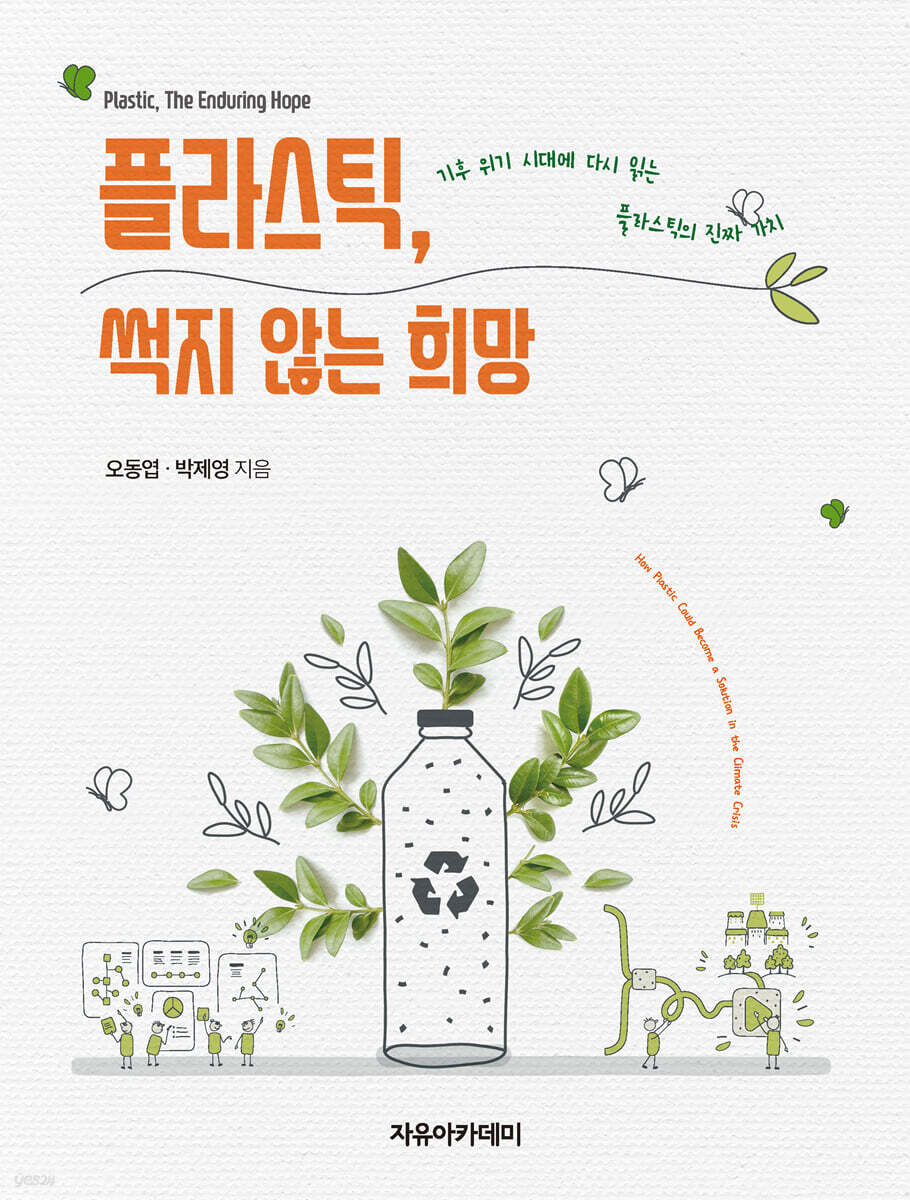
Plastic, the hope that doesn't rot
 |
Description
Book Introduction
This book unfolds the origins, present, and future of plastic as one long story.
Let's explore the possibilities and contradictions of how plastic, once considered a monster destroying the environment, can be reborn as another companion for humanity.
I'm not trying to blindly advocate for plastic.
However, this is a suggestion to take a second look at the beliefs we have taken for granted so far, such as “plastic is unconditionally bad” and “we must get rid of it.”
It's about giving plastic, which has been silent for a long time, a chance to speak, even if only for a moment.
Plastic is not just a simple material.
It contains all of human desire and technology, convenience and regret, ignorance and possibility.
Perhaps looking at that complex face as it is is the first question we truly need to ask in the era of climate crisis.
Now, shall we talk to plastic?
Let's explore the possibilities and contradictions of how plastic, once considered a monster destroying the environment, can be reborn as another companion for humanity.
I'm not trying to blindly advocate for plastic.
However, this is a suggestion to take a second look at the beliefs we have taken for granted so far, such as “plastic is unconditionally bad” and “we must get rid of it.”
It's about giving plastic, which has been silent for a long time, a chance to speak, even if only for a moment.
Plastic is not just a simple material.
It contains all of human desire and technology, convenience and regret, ignorance and possibility.
Perhaps looking at that complex face as it is is the first question we truly need to ask in the era of climate crisis.
Now, shall we talk to plastic?
- You can preview some of the book's contents.
Preview
index
Entering
Chapter 1: Materials That Tried to Save the Earth and Were Damned - Plastics, Born to Protect the Environment
1.
Plastic Becomes a Part of Our Lives: The Plastic Age
2.
Instead of ivory, the invention that saved elephants
3.
Plastics Contribute to Population Growth
4.
Energy-saving plastic
5.
Prometheus of Art, Plastic
Chapter 2: What is Plastic? - The Untold Truth About Plastic
1.
Plastic is a polymer
2.
Representative modern plastics: thermoplastics and thermosets
3.
Plastic Classification: What the 7 Recycling Marks Mean
4.
The story of the invention of a representative plastic
Chapter 3: Why Plastic Became the Villain: A Story of Environmental Pollution That Began Through Abuse and Misunderstanding
1.
The Curse of Non-Biogenic Plastic
2.
The Great Migration of Marine Plastic
3.
Microplastics: Small but Dangerous Particles
4.
Environmental hormones and chemophobia
Chapter 4: Where Does Discarded Plastic Go? - Current Waste Disposal Methods and Their Limitations
1.
Landfill: Space is tight, trash is plentiful.
2.
Incineration: Energy Recovery or Greenhouse Gas Increase?
3.
Recycling: It's Not as Easy as You Think
4.
Why Separating Waste Can Be Confusing Even When Done Correctly
Chapter 5: New Imaginations for Transforming Plastics - Bioplastics and Biodegradable Materials
1.
What is bioplastic?
2.
Is the theory that biodegradable plastics are useless really true?
3.
Biodegradable plastics are becoming increasingly advanced
4.
Biodegradable plastics, transformed into energy instead of waste.
Chapter 6: Can Technology Save Plastic? - Plastics from the Future
1.
Plastic and vegan leather to prevent slaughter and abuse
2.
Bacteria eat plastic?
3.
Mixing immiscible plastics
4.
Plastics That Transform: Vitrimmer and Self-Healing Materials
5.
Plastic with a Lifespan Timer: Designing Telomeres in Plastic
6.
Make anything slippery: but in an environmentally friendly way!
Chapter 7: Cooling the Earth with Plastic? - The Potential Reversal of Carbon-Reducing Materials
1.
Greenhouse gases and plastics
2.
Reducing carbon emissions through eco-friendly plastics
3.
Biomass as a result of photosynthesis
4.
Nature's Hints: The Era of Indestructible Carbon
5.
If we view plastic as a carbon storage
6.
Incorruptible hope buried underground
7.
Biochar: How to Lock Up Carbon Like Charcoal
Going Out: A New Look at Plastic
Chapter 1: Materials That Tried to Save the Earth and Were Damned - Plastics, Born to Protect the Environment
1.
Plastic Becomes a Part of Our Lives: The Plastic Age
2.
Instead of ivory, the invention that saved elephants
3.
Plastics Contribute to Population Growth
4.
Energy-saving plastic
5.
Prometheus of Art, Plastic
Chapter 2: What is Plastic? - The Untold Truth About Plastic
1.
Plastic is a polymer
2.
Representative modern plastics: thermoplastics and thermosets
3.
Plastic Classification: What the 7 Recycling Marks Mean
4.
The story of the invention of a representative plastic
Chapter 3: Why Plastic Became the Villain: A Story of Environmental Pollution That Began Through Abuse and Misunderstanding
1.
The Curse of Non-Biogenic Plastic
2.
The Great Migration of Marine Plastic
3.
Microplastics: Small but Dangerous Particles
4.
Environmental hormones and chemophobia
Chapter 4: Where Does Discarded Plastic Go? - Current Waste Disposal Methods and Their Limitations
1.
Landfill: Space is tight, trash is plentiful.
2.
Incineration: Energy Recovery or Greenhouse Gas Increase?
3.
Recycling: It's Not as Easy as You Think
4.
Why Separating Waste Can Be Confusing Even When Done Correctly
Chapter 5: New Imaginations for Transforming Plastics - Bioplastics and Biodegradable Materials
1.
What is bioplastic?
2.
Is the theory that biodegradable plastics are useless really true?
3.
Biodegradable plastics are becoming increasingly advanced
4.
Biodegradable plastics, transformed into energy instead of waste.
Chapter 6: Can Technology Save Plastic? - Plastics from the Future
1.
Plastic and vegan leather to prevent slaughter and abuse
2.
Bacteria eat plastic?
3.
Mixing immiscible plastics
4.
Plastics That Transform: Vitrimmer and Self-Healing Materials
5.
Plastic with a Lifespan Timer: Designing Telomeres in Plastic
6.
Make anything slippery: but in an environmentally friendly way!
Chapter 7: Cooling the Earth with Plastic? - The Potential Reversal of Carbon-Reducing Materials
1.
Greenhouse gases and plastics
2.
Reducing carbon emissions through eco-friendly plastics
3.
Biomass as a result of photosynthesis
4.
Nature's Hints: The Era of Indestructible Carbon
5.
If we view plastic as a carbon storage
6.
Incorruptible hope buried underground
7.
Biochar: How to Lock Up Carbon Like Charcoal
Going Out: A New Look at Plastic
Publisher's Review
How much plastic do we touch in a day?
The toothbrush you use to brush your teeth in the morning, the lid for your coffee cup, the packaging you use to pack your lunch, and even the workout clothes you wear in the evening.
We come into contact with plastic dozens, maybe hundreds of times a day.
If you add up the weight, it is said that the amount of plastic used by one Korean in a year is over 100 kg.
Surprisingly, this means consuming more than 30 plastic bottles every day.
How did plastic become so ingrained in our lives? What began as an inventor's idea to replace elephant ivory for a single billiard ball has become the most essential material that sustains the Earth today.
It's hard to imagine a life without plastic.
Medical, food, electronics, transportation, packaging, communications… Plastics are present, hidden or proud, in almost every area of our lives.
However, plastic, once considered a 'miraculous invention', is now being criticized as the main culprit in destroying the environment.
Microplastics, broken down into small pieces and floating in the ocean, threaten marine ecosystems.
Plastic has received attention because it does not decompose easily, but it also places a burden on the environment during the disposal process.
As a result, campaigns such as carrying tumblers, refusing straws, and shouting “Zero Plastic” have become part of everyday life.
But what if non-biodegradable plastic, paradoxically, could offer hope for the future? New materials that self-decompose in the ocean, plastics that heal wounds, and even living plastics that spores dormant in factories and awaken in the soil! Unimaginable scenarios are already unfolding in laboratories.
This book unfolds the origins, present, and future of plastic as one long story.
Let's explore the possibilities and contradictions of how plastic, once considered a monster destroying the environment, can be reborn as another companion for humanity.
I'm not trying to blindly advocate for plastic.
However, this is a suggestion to take a second look at the beliefs we have taken for granted so far, such as “plastic is unconditionally bad” and “we must get rid of it.”
It's about giving plastic, which has been silent for a long time, a chance to speak, even if only for a moment.
Plastic is not just a simple material.
It contains all of human desire and technology, convenience and regret, ignorance and possibility.
Perhaps looking at that complex face for what it is is the first question we truly need to ask in the age of climate crisis.
Now, shall we let plastic talk?
The toothbrush you use to brush your teeth in the morning, the lid for your coffee cup, the packaging you use to pack your lunch, and even the workout clothes you wear in the evening.
We come into contact with plastic dozens, maybe hundreds of times a day.
If you add up the weight, it is said that the amount of plastic used by one Korean in a year is over 100 kg.
Surprisingly, this means consuming more than 30 plastic bottles every day.
How did plastic become so ingrained in our lives? What began as an inventor's idea to replace elephant ivory for a single billiard ball has become the most essential material that sustains the Earth today.
It's hard to imagine a life without plastic.
Medical, food, electronics, transportation, packaging, communications… Plastics are present, hidden or proud, in almost every area of our lives.
However, plastic, once considered a 'miraculous invention', is now being criticized as the main culprit in destroying the environment.
Microplastics, broken down into small pieces and floating in the ocean, threaten marine ecosystems.
Plastic has received attention because it does not decompose easily, but it also places a burden on the environment during the disposal process.
As a result, campaigns such as carrying tumblers, refusing straws, and shouting “Zero Plastic” have become part of everyday life.
But what if non-biodegradable plastic, paradoxically, could offer hope for the future? New materials that self-decompose in the ocean, plastics that heal wounds, and even living plastics that spores dormant in factories and awaken in the soil! Unimaginable scenarios are already unfolding in laboratories.
This book unfolds the origins, present, and future of plastic as one long story.
Let's explore the possibilities and contradictions of how plastic, once considered a monster destroying the environment, can be reborn as another companion for humanity.
I'm not trying to blindly advocate for plastic.
However, this is a suggestion to take a second look at the beliefs we have taken for granted so far, such as “plastic is unconditionally bad” and “we must get rid of it.”
It's about giving plastic, which has been silent for a long time, a chance to speak, even if only for a moment.
Plastic is not just a simple material.
It contains all of human desire and technology, convenience and regret, ignorance and possibility.
Perhaps looking at that complex face for what it is is the first question we truly need to ask in the age of climate crisis.
Now, shall we let plastic talk?
GOODS SPECIFICS
- Date of issue: November 5, 2025
- Page count, weight, size: 196 pages | 170*224*10mm
- ISBN13: 9791158087746
- ISBN10: 1158087748
You may also like
카테고리
korean


korean

![GQ KOREA Mark (Monthly): December [2025]](http://librairie.coreenne.fr/cdn/shop/files/8ef265dbbfbf186523ed75ba7319009d.jpg?v=1765340328&width=3840)


