

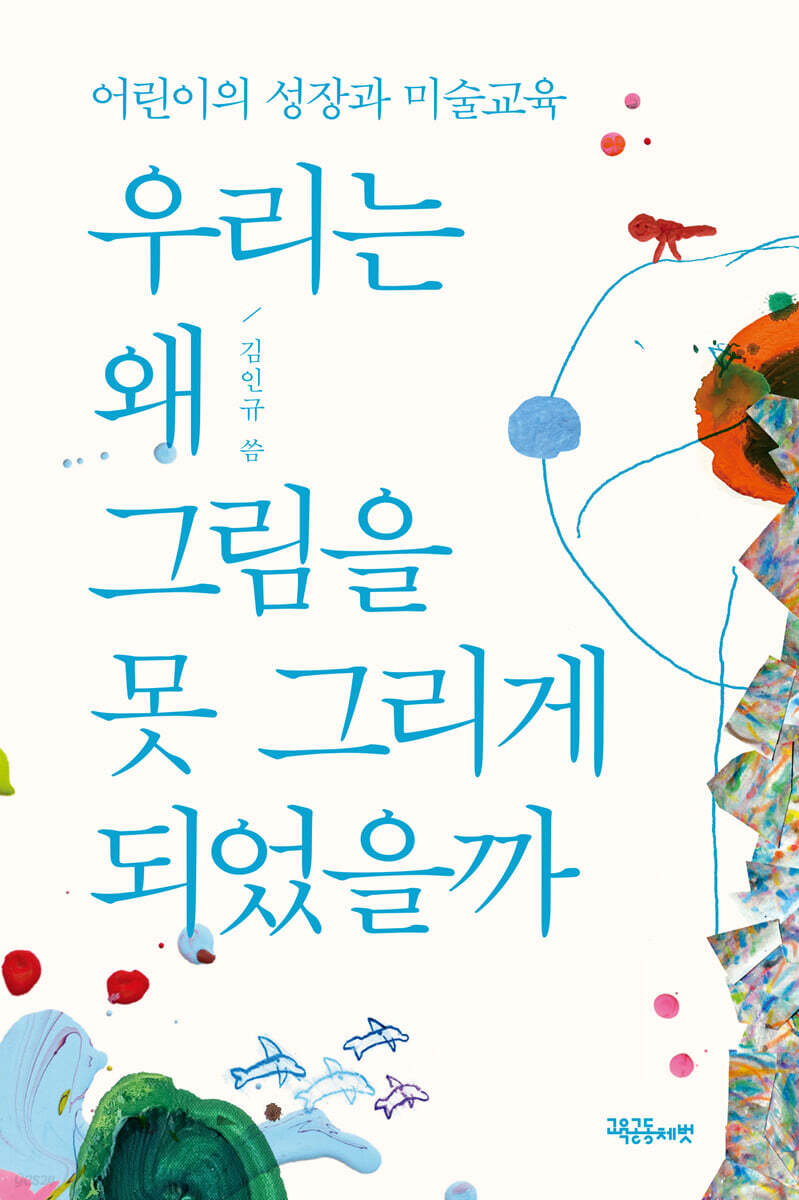
Why can't we draw?
 |
Description
Book Introduction
“Art begins with self-expression before it becomes an activity that is learned.
But at its foundation lies the teacher’s constant effort and role.”
How was it possible to have art classes that children eagerly await?
Captures sparkling educational moments created with children who were afraid of art, conscious of other people's gaze and comparing themselves to each other.
But at its foundation lies the teacher’s constant effort and role.”
How was it possible to have art classes that children eagerly await?
Captures sparkling educational moments created with children who were afraid of art, conscious of other people's gaze and comparing themselves to each other.
- You can preview some of the book's contents.
Preview
index
About the Book | Why I Wrote This Book
Ⅰ.
Drawing
1.
depart
2.
The emergence of figurative images
3.
Naming
4.
A child who cannot or does not name
5.
A child who tried to imitate his friend
6.
Children growing up together
7.
The beginning of reporting and drawing
8.
Look and draw in earnest
9.
What is 'See and Draw'?
10.
Epilogue ─ The Child Who Draws Well
Ⅱ.
Don't draw
1.
From Kamji activities
2.
Expansion of Kamji activities
3.
Kamji as a media exploration
4.
Epilogue ─ The Child Who Stubbornly Sticks to Kkamji
Ⅲ.
From the media
1.
From materiality
2.
From paint
3.
From three-dimensional materials
4.
Epilogue - Another Look at Clay Activities
Ⅳ.
Art as self-expression and its intellectual dimension
1.
What is self-expression?
2.
Self-expression and intellectual involvement in the Kkamji activity
3.
In the watercolor activity - two aspects of the intellectual dimension
4.
In calligraphy - intellectual dimension and self-expression
5.
Development in three-dimensional expression
6.
Epilogue - Self-Expression in Reporting and Drawing
V.
Across the image
1.
From free expression
2.
From drawing figures
3.
Into Kim Hong-do's "Wrestling"
4.
Epilogue - The Discovery of Space
Ⅵ.
The role of a constant teacher
1.
Children who are not free
2.
Art as an expression of one's own existence
3.
Development and growth
4.
As a social process
5.
Virtual spaces called classrooms and classes
6.
The unique nature of art classes
supplement
1.
Kindergarten curriculum
2.
Flower pot drawing process
3.
Kamji activity process
4.
Watercolor activity process
5.
Figure drawing process
6.
Calligraphy and ink course
7.
3D activity process
Acknowledgements
Ⅰ.
Drawing
1.
depart
2.
The emergence of figurative images
3.
Naming
4.
A child who cannot or does not name
5.
A child who tried to imitate his friend
6.
Children growing up together
7.
The beginning of reporting and drawing
8.
Look and draw in earnest
9.
What is 'See and Draw'?
10.
Epilogue ─ The Child Who Draws Well
Ⅱ.
Don't draw
1.
From Kamji activities
2.
Expansion of Kamji activities
3.
Kamji as a media exploration
4.
Epilogue ─ The Child Who Stubbornly Sticks to Kkamji
Ⅲ.
From the media
1.
From materiality
2.
From paint
3.
From three-dimensional materials
4.
Epilogue - Another Look at Clay Activities
Ⅳ.
Art as self-expression and its intellectual dimension
1.
What is self-expression?
2.
Self-expression and intellectual involvement in the Kkamji activity
3.
In the watercolor activity - two aspects of the intellectual dimension
4.
In calligraphy - intellectual dimension and self-expression
5.
Development in three-dimensional expression
6.
Epilogue - Self-Expression in Reporting and Drawing
V.
Across the image
1.
From free expression
2.
From drawing figures
3.
Into Kim Hong-do's "Wrestling"
4.
Epilogue - The Discovery of Space
Ⅵ.
The role of a constant teacher
1.
Children who are not free
2.
Art as an expression of one's own existence
3.
Development and growth
4.
As a social process
5.
Virtual spaces called classrooms and classes
6.
The unique nature of art classes
supplement
1.
Kindergarten curriculum
2.
Flower pot drawing process
3.
Kamji activity process
4.
Watercolor activity process
5.
Figure drawing process
6.
Calligraphy and ink course
7.
3D activity process
Acknowledgements
Into the book
Ultimately, education is about helping children grow.
The goal of art education should not be to make children good at art, but rather to help them discover and grow themselves through art.
And I had the good fortune to watch that process.
The children also responded with joy.
(……) Looking at the art education curriculum so far, it seems that the emphasis is on ‘art’ and only how to teach or learn.
But I think the emphasis should be shifted to 'child'.
This is only natural when we say that art is based on self-expression.
In that case, art can also become a window that shows children's appearance.
When we say that self-expression that cannot be hidden is revealed through art, it will provide a good reference point for adults who have to accompany children in their lives.
My journey over the years has been a process of exploring the meaning and role of art education through observing children growing up with art.
--- From "Publishing a Book"
The case of Figure 1-12 is very interesting, as anyone who sees it will think it is a drawing of a snake.
But you can see that he didn't intend to draw a snake from the beginning.
This is because the shape of its body is free-spirited and different from that of a typical snake.
After drawing the shape, the child first thought of a snake and drew eyes and a tongue in places like the head to create a snake.
The picture below is more interesting.
The shape of the part where the head shape is found is open to the outside.
Nevertheless, the child saw the shape of a head in it and drew eyes and a tongue to create a snake.
This is a passage that shows that children's drawing is a very dynamic activity.
Drawing may seem closer to discovering.
I can't help but be amazed by that discovery.
--- 「Part Ⅰ, 〈3.
From "Naming"
In general, in 'see and draw', people tend to put emphasis on 'draw'.
I'm more interested in how to draw well.
However, the key in ‘report and draw’ is ‘reporting’.
It is a matter of seeing the reality.
A direct encounter is established between the person drawing and the object.
Children must discover the difference between the images they know and reality and face the unfamiliarity of it.
At this point, the children are confused.
“Huh, that’s strange?” Then he looks at a loss as to what to do about it.
I tell those kids to draw weird things if they look weird.
To allow ourselves to perceive things that appear different from what we know.
But children ultimately have to compromise between what they know and what they see.
By repeating this type of conflict, children can be said to be taking steps toward a world beyond what they know.
So, ‘seeing and drawing’ is the process of facing the objects of the world with one’s own eyes and containing them within oneself.
This is why growing children should immerse themselves in ‘seeing and drawing.’
--- 「Part Ⅰ, 〈9.
From "What is 'See and Draw'?"
For children, whether they are good at drawing or not is a very sensitive issue.
Comparisons between children, such as 'who draws well' and 'who draws poorly', are constantly occurring.
A sense of superiority or inferiority may arise, and some people may become frustrated and ashamed and avoid drawing.
In reality, what is easy for one child can be very difficult for another.
There is an innate difference in observation and expressive power, and this is revealed in the drawings.
In my case, after class, we would gather the drawings and have time to critique them together.
It was like that from the third grade onwards. Some children would not show their drawings, and even if they were shown them, they would hide and not show up.
Then, as the position continued, I could see that it gradually became more natural and comfortable.
(……) At this time, the teacher’s role is crucial.
Teachers must carefully observe each child to determine where they are having difficulty.
And when giving appropriate advice, you should find out what the child has accomplished, even if it is just a little bit, and encourage him/her.
--- 「Part Ⅰ, 〈10.
From "Epilogue - A Child Who Draws Well"
The important thing here was that 'you shouldn't draw anything'.
At first, the children were puzzled when I told them that I wasn't drawing anything.
Some children couldn't accept that they weren't drawing anything.
However, this activity had two goals.
The goal was to help children break free from the stereotype that art involves drawing something.
Another was to experience paper and pencil as more than just drawing tools.
When children rub their pencils against the paper to blacken it, they encounter the pencil and paper as more than just drawing tools, but as objects or substances in their own right.
You will fully experience the feel and texture along with the rubbing sound.
The color of the pencil also comes in a variety of feelings beyond just black.
--- 「Part II, 〈1.
From the activities of Kamji
One of the core aspects of the field of art is that it has materiality.
In other words, it can be said to be an activity that expresses itself by utilizing objects.
Objects used in art tend to be traditionally perceived as merely materials or means for expressing something, but it should be noted that the materials themselves have expressive properties.
(……) If you present a topic and start an activity by saying, ‘Let’s express something,’ children will begin to handle the materials intentionally according to the goal of expression. On the other hand, if you only provide the materials without presenting any topic, children can react to the material properties of the materials and engage in activities impulsively.
At this point, artistic activity becomes a sensory activity before it becomes conscious.
At such times, children can immerse themselves in a process of self-expression based on their senses.
--- 「Part III, 〈1.
From "From Materiality"
It is truly amazing to feel your own aesthetic and find a sense of accomplishment in it.
The sense of accomplishment you get from completing a given task and the sense of accomplishment you feel from discovering and performing it on your own are bound to be on a different level.
In the latter, self-power and self-purpose arise.
It becomes beautiful regardless of its usefulness.
The feeling of being there yourself is indescribable.
This can be said to be the biggest reason for doing art.
But it must be learned.
Of course, there are children who can do this without learning, but they will be a very small minority.
(……) A strong supporter called a teacher and a safe space called a classroom make it possible.
--- 「Part IV, 〈1.
From “What is Self-Expression?”
No matter what the given task, the teacher must simultaneously see both sides of the child's activity.
Understanding that your child is on a journey of growth, you must stand by their side and decide what to encourage and inspire.
And we also have to decide when and how to intervene and help.
Because the child is now drawing a new world.
--- 「Part IV, 〈6.
From "Epilogue - Self-expression in Reporting and Drawing"
The power of images is strong.
The moment it is produced, it forms a world.
So, no matter how freely you express the picture you draw, it ends up settling into a world.
This is why we repeat drawings in a familiar way.
Commercially produced and distributed images also enter children's minds and become firmly established.
When you draw by imagination or draw freely, you are usually not imagining yourself and you are not drawing freely.
(……) So I thought that images could also be objects of play, and I wanted to have a play time of cutting up the images produced for that purpose, redistributing them, and combining them.
Of course, even in such a process of redistribution and rearrangement, children are likely to follow familiar mechanisms, but I thought that changing the order once imposed would be a process that makes it more flexible.
For this, I used the collage technique.
--- 「Part V, 〈1.
From “Free Expression”
But the real reason we are afraid of drawing is that the standards for evaluating good drawing have already been formed socially and culturally.
Even if there is a level of individual talent in drawing well, the standards and values for evaluating it are not personal at all.
There is no room for individuality or uniqueness.
In this way, ‘self-expression’ grows while being excluded and suppressed.
It is a condition that is already given to children.
Going back to Cizek, in order to 'freely activate the independent nature within children,' teachers must go beyond 'not interfering' and instead provide more assistance and support.
We must not let ourselves be discouraged by comparison and must firmly support those who can do things on their own.
It's a very continuous process.
--- 「Part VI, 〈1.
From “Children Who Are Not Free”
Artistic expression plays a role in showing children's appearances in an unpredictable way.
There is another background to the child's emotional and psychological dimensions that goes beyond whether he or she is good or bad.
Art, unlike other subjects, is not bound by set knowledge or norms, but has a special nature based on self-expression, which is why it contains such things.
Maybe that is the power of artistic expression.
It is about expressing the child's inner self.
It can be said that art teachers play a role in accompanying children in that way.
--- 「Part VI, 〈3.
From “Development and Growth”
Behaviors that would otherwise be controlled or prohibited can also be revealed within the scope of expression.
Because it is an expression.
Vandalizing school property and vandalizing art supplies are two entirely different things.
In art class, you can mess things up or express things in a weird way.
Since it is a material, handling it is an expressive activity in itself.
This allows children to experiment and explore self-expression.
During the course of the activity, it is inevitable that the classroom will be disrupted.
As long as it doesn't harm others or disrupt class.
--- 「Part VI, 〈5.
From “Virtual Spaces of Classrooms and Lessons”
The unique characteristic of art education is that the process and outcome of learning are children's 'expressive activities.'
And the expression is purely based on the creative activities of children.
Because it is never taught by teachers.
The teacher can create the conditions and atmosphere, but he cannot dictate the content of the expression.
Because it is purely the children's responsibility.
I called it 'self-expression'.
(……) Ultimately, expression becomes the children’s responsibility, and it becomes the teacher’s responsibility to provide materials that can stimulate and encourage children’s desire to express themselves, and to create such an atmosphere.
If expression is the learning content of art classes, learning becomes entirely the responsibility of the children, and the teacher is in a position to support it.
This is a unique aspect of art education.
It is the core of art education that has been neglected so far.
The goal of art education should not be to make children good at art, but rather to help them discover and grow themselves through art.
And I had the good fortune to watch that process.
The children also responded with joy.
(……) Looking at the art education curriculum so far, it seems that the emphasis is on ‘art’ and only how to teach or learn.
But I think the emphasis should be shifted to 'child'.
This is only natural when we say that art is based on self-expression.
In that case, art can also become a window that shows children's appearance.
When we say that self-expression that cannot be hidden is revealed through art, it will provide a good reference point for adults who have to accompany children in their lives.
My journey over the years has been a process of exploring the meaning and role of art education through observing children growing up with art.
--- From "Publishing a Book"
The case of Figure 1-12 is very interesting, as anyone who sees it will think it is a drawing of a snake.
But you can see that he didn't intend to draw a snake from the beginning.
This is because the shape of its body is free-spirited and different from that of a typical snake.
After drawing the shape, the child first thought of a snake and drew eyes and a tongue in places like the head to create a snake.
The picture below is more interesting.
The shape of the part where the head shape is found is open to the outside.
Nevertheless, the child saw the shape of a head in it and drew eyes and a tongue to create a snake.
This is a passage that shows that children's drawing is a very dynamic activity.
Drawing may seem closer to discovering.
I can't help but be amazed by that discovery.
--- 「Part Ⅰ, 〈3.
From "Naming"
In general, in 'see and draw', people tend to put emphasis on 'draw'.
I'm more interested in how to draw well.
However, the key in ‘report and draw’ is ‘reporting’.
It is a matter of seeing the reality.
A direct encounter is established between the person drawing and the object.
Children must discover the difference between the images they know and reality and face the unfamiliarity of it.
At this point, the children are confused.
“Huh, that’s strange?” Then he looks at a loss as to what to do about it.
I tell those kids to draw weird things if they look weird.
To allow ourselves to perceive things that appear different from what we know.
But children ultimately have to compromise between what they know and what they see.
By repeating this type of conflict, children can be said to be taking steps toward a world beyond what they know.
So, ‘seeing and drawing’ is the process of facing the objects of the world with one’s own eyes and containing them within oneself.
This is why growing children should immerse themselves in ‘seeing and drawing.’
--- 「Part Ⅰ, 〈9.
From "What is 'See and Draw'?"
For children, whether they are good at drawing or not is a very sensitive issue.
Comparisons between children, such as 'who draws well' and 'who draws poorly', are constantly occurring.
A sense of superiority or inferiority may arise, and some people may become frustrated and ashamed and avoid drawing.
In reality, what is easy for one child can be very difficult for another.
There is an innate difference in observation and expressive power, and this is revealed in the drawings.
In my case, after class, we would gather the drawings and have time to critique them together.
It was like that from the third grade onwards. Some children would not show their drawings, and even if they were shown them, they would hide and not show up.
Then, as the position continued, I could see that it gradually became more natural and comfortable.
(……) At this time, the teacher’s role is crucial.
Teachers must carefully observe each child to determine where they are having difficulty.
And when giving appropriate advice, you should find out what the child has accomplished, even if it is just a little bit, and encourage him/her.
--- 「Part Ⅰ, 〈10.
From "Epilogue - A Child Who Draws Well"
The important thing here was that 'you shouldn't draw anything'.
At first, the children were puzzled when I told them that I wasn't drawing anything.
Some children couldn't accept that they weren't drawing anything.
However, this activity had two goals.
The goal was to help children break free from the stereotype that art involves drawing something.
Another was to experience paper and pencil as more than just drawing tools.
When children rub their pencils against the paper to blacken it, they encounter the pencil and paper as more than just drawing tools, but as objects or substances in their own right.
You will fully experience the feel and texture along with the rubbing sound.
The color of the pencil also comes in a variety of feelings beyond just black.
--- 「Part II, 〈1.
From the activities of Kamji
One of the core aspects of the field of art is that it has materiality.
In other words, it can be said to be an activity that expresses itself by utilizing objects.
Objects used in art tend to be traditionally perceived as merely materials or means for expressing something, but it should be noted that the materials themselves have expressive properties.
(……) If you present a topic and start an activity by saying, ‘Let’s express something,’ children will begin to handle the materials intentionally according to the goal of expression. On the other hand, if you only provide the materials without presenting any topic, children can react to the material properties of the materials and engage in activities impulsively.
At this point, artistic activity becomes a sensory activity before it becomes conscious.
At such times, children can immerse themselves in a process of self-expression based on their senses.
--- 「Part III, 〈1.
From "From Materiality"
It is truly amazing to feel your own aesthetic and find a sense of accomplishment in it.
The sense of accomplishment you get from completing a given task and the sense of accomplishment you feel from discovering and performing it on your own are bound to be on a different level.
In the latter, self-power and self-purpose arise.
It becomes beautiful regardless of its usefulness.
The feeling of being there yourself is indescribable.
This can be said to be the biggest reason for doing art.
But it must be learned.
Of course, there are children who can do this without learning, but they will be a very small minority.
(……) A strong supporter called a teacher and a safe space called a classroom make it possible.
--- 「Part IV, 〈1.
From “What is Self-Expression?”
No matter what the given task, the teacher must simultaneously see both sides of the child's activity.
Understanding that your child is on a journey of growth, you must stand by their side and decide what to encourage and inspire.
And we also have to decide when and how to intervene and help.
Because the child is now drawing a new world.
--- 「Part IV, 〈6.
From "Epilogue - Self-expression in Reporting and Drawing"
The power of images is strong.
The moment it is produced, it forms a world.
So, no matter how freely you express the picture you draw, it ends up settling into a world.
This is why we repeat drawings in a familiar way.
Commercially produced and distributed images also enter children's minds and become firmly established.
When you draw by imagination or draw freely, you are usually not imagining yourself and you are not drawing freely.
(……) So I thought that images could also be objects of play, and I wanted to have a play time of cutting up the images produced for that purpose, redistributing them, and combining them.
Of course, even in such a process of redistribution and rearrangement, children are likely to follow familiar mechanisms, but I thought that changing the order once imposed would be a process that makes it more flexible.
For this, I used the collage technique.
--- 「Part V, 〈1.
From “Free Expression”
But the real reason we are afraid of drawing is that the standards for evaluating good drawing have already been formed socially and culturally.
Even if there is a level of individual talent in drawing well, the standards and values for evaluating it are not personal at all.
There is no room for individuality or uniqueness.
In this way, ‘self-expression’ grows while being excluded and suppressed.
It is a condition that is already given to children.
Going back to Cizek, in order to 'freely activate the independent nature within children,' teachers must go beyond 'not interfering' and instead provide more assistance and support.
We must not let ourselves be discouraged by comparison and must firmly support those who can do things on their own.
It's a very continuous process.
--- 「Part VI, 〈1.
From “Children Who Are Not Free”
Artistic expression plays a role in showing children's appearances in an unpredictable way.
There is another background to the child's emotional and psychological dimensions that goes beyond whether he or she is good or bad.
Art, unlike other subjects, is not bound by set knowledge or norms, but has a special nature based on self-expression, which is why it contains such things.
Maybe that is the power of artistic expression.
It is about expressing the child's inner self.
It can be said that art teachers play a role in accompanying children in that way.
--- 「Part VI, 〈3.
From “Development and Growth”
Behaviors that would otherwise be controlled or prohibited can also be revealed within the scope of expression.
Because it is an expression.
Vandalizing school property and vandalizing art supplies are two entirely different things.
In art class, you can mess things up or express things in a weird way.
Since it is a material, handling it is an expressive activity in itself.
This allows children to experiment and explore self-expression.
During the course of the activity, it is inevitable that the classroom will be disrupted.
As long as it doesn't harm others or disrupt class.
--- 「Part VI, 〈5.
From “Virtual Spaces of Classrooms and Lessons”
The unique characteristic of art education is that the process and outcome of learning are children's 'expressive activities.'
And the expression is purely based on the creative activities of children.
Because it is never taught by teachers.
The teacher can create the conditions and atmosphere, but he cannot dictate the content of the expression.
Because it is purely the children's responsibility.
I called it 'self-expression'.
(……) Ultimately, expression becomes the children’s responsibility, and it becomes the teacher’s responsibility to provide materials that can stimulate and encourage children’s desire to express themselves, and to create such an atmosphere.
If expression is the learning content of art classes, learning becomes entirely the responsibility of the children, and the teacher is in a position to support it.
This is a unique aspect of art education.
It is the core of art education that has been neglected so far.
--- 「Part VI, 〈6.
From “The Unique Character of Art Education”
From “The Unique Character of Art Education”
Publisher's Review
Children who are afraid of drawing
Everyone instinctively enjoys drawing.
If you think back to your childhood, you would happily draw on the walls, windows, and furniture of your house.
But at some point, those children start to be afraid of drawing.
Middle and high school students often find art boring or difficult activities, especially drawing.
Adults also consider drawing to be something they do not enjoy.
Since when did we become unable to draw?
The author wonders if things may have been off to a bad start, and visits kindergartens and elementary school classrooms to meet the children.
This book contains the author's four years of experience working with children as a middle school art teacher.
Those years were a time for children to freely express themselves through art and grow, and for the author, it was a time that allowed him to establish a new perspective on art education.
Structure of this book
This book is divided into six parts.
Part Ⅰ.
'Drawing' deals with drawing, which can be said to be the most basic and core of art.
Starting from the age of one when children begin to draw for the first time, we trace the children's journey through the stages of drawing figurative images, influencing each other and sometimes shrinking and sometimes growing.
The author especially emphasizes the activity of 'report and draw', and although the emphasis is usually placed on 'drawing' in 'report and draw', the author says that the key is 'reporting'.
Part II.
'Not Drawing' is a subversive process that breaks away from the idea of 'drawing' when thinking of art and advocates 'not drawing anything'.
It is also known as ‘Kkamji activity’.
The goal is to break away from the stereotype that you have to draw something and experience paper and pencil as more than just tools for drawing.
Even in activities that involve simply painting in black, the moments when children's individuality and creativity are displayed are truly amazing.
Part III.
In 'From the Media', we focus on the fact that art has materiality.
When no subject is presented and only materials are provided, art activity becomes a sensory activity before it becomes conscious.
The author confesses that seeing children stimulated by new materials and unleashing their creativity and imagination makes him want to provide them with unique materials and media.
Art fundamentally functions as a means of self-expression, but it can also be learned.
'Part VI.
In 'Art as Self-Expression and its Intellectual Dimension', the author states that in order to discover and immerse oneself in the joy of expression, one needs someone's support and assistance, and that a strong supporter like a teacher and a safe space like a classroom make this possible.
'Part V.
In 'Across the Image', images are playfully twisted into objects of play.
Images are powerful enough to form a world the moment they are created, but they are not absolute.
By utilizing techniques such as collage techniques or bringing traditional art scenes into the present, children are freed from the burden of having to draw well and continue with light and cheerful activities.
'Ⅵ.
In 'The Role of the Teacher', the characteristics of art subjects and the role of teachers are discussed.
The author questions the tendency to view the teacher's role in children's art as meaningless.
Children are no longer free, so leaving them alone does not mean they will be creative.
This is where the teacher's role lies.
Unlike other subjects, we must also pay attention to the unique aspect of art, which is based on self-expression rather than being confined to fixed knowledge or norms.
In the virtual space of the classroom, children create new dynamics through experimentation and failure through art activities without set answers.
Children growing up with art
The author, who says that “education is ultimately about helping children grow,” emphasizes that the goal of art education is not to make children good at art, but to help them discover and grow themselves through art.
The author's perspective is revealed in the book when he "pays warm attention to the movements of children's hands."
Even though the drawing is a bit awkward, the author says, “It’s not that he can’t draw, he has definitely achieved something in his own way.”
Because “the child is now drawing a new world.”
If art can become a medium for expressing the uniqueness of one's existence, we may have one more important means of expression in our lives.
Just like the main characters in this book, who freely expressed themselves through art, grew, and created shining educational scenes.
Everyone instinctively enjoys drawing.
If you think back to your childhood, you would happily draw on the walls, windows, and furniture of your house.
But at some point, those children start to be afraid of drawing.
Middle and high school students often find art boring or difficult activities, especially drawing.
Adults also consider drawing to be something they do not enjoy.
Since when did we become unable to draw?
The author wonders if things may have been off to a bad start, and visits kindergartens and elementary school classrooms to meet the children.
This book contains the author's four years of experience working with children as a middle school art teacher.
Those years were a time for children to freely express themselves through art and grow, and for the author, it was a time that allowed him to establish a new perspective on art education.
Structure of this book
This book is divided into six parts.
Part Ⅰ.
'Drawing' deals with drawing, which can be said to be the most basic and core of art.
Starting from the age of one when children begin to draw for the first time, we trace the children's journey through the stages of drawing figurative images, influencing each other and sometimes shrinking and sometimes growing.
The author especially emphasizes the activity of 'report and draw', and although the emphasis is usually placed on 'drawing' in 'report and draw', the author says that the key is 'reporting'.
Part II.
'Not Drawing' is a subversive process that breaks away from the idea of 'drawing' when thinking of art and advocates 'not drawing anything'.
It is also known as ‘Kkamji activity’.
The goal is to break away from the stereotype that you have to draw something and experience paper and pencil as more than just tools for drawing.
Even in activities that involve simply painting in black, the moments when children's individuality and creativity are displayed are truly amazing.
Part III.
In 'From the Media', we focus on the fact that art has materiality.
When no subject is presented and only materials are provided, art activity becomes a sensory activity before it becomes conscious.
The author confesses that seeing children stimulated by new materials and unleashing their creativity and imagination makes him want to provide them with unique materials and media.
Art fundamentally functions as a means of self-expression, but it can also be learned.
'Part VI.
In 'Art as Self-Expression and its Intellectual Dimension', the author states that in order to discover and immerse oneself in the joy of expression, one needs someone's support and assistance, and that a strong supporter like a teacher and a safe space like a classroom make this possible.
'Part V.
In 'Across the Image', images are playfully twisted into objects of play.
Images are powerful enough to form a world the moment they are created, but they are not absolute.
By utilizing techniques such as collage techniques or bringing traditional art scenes into the present, children are freed from the burden of having to draw well and continue with light and cheerful activities.
'Ⅵ.
In 'The Role of the Teacher', the characteristics of art subjects and the role of teachers are discussed.
The author questions the tendency to view the teacher's role in children's art as meaningless.
Children are no longer free, so leaving them alone does not mean they will be creative.
This is where the teacher's role lies.
Unlike other subjects, we must also pay attention to the unique aspect of art, which is based on self-expression rather than being confined to fixed knowledge or norms.
In the virtual space of the classroom, children create new dynamics through experimentation and failure through art activities without set answers.
Children growing up with art
The author, who says that “education is ultimately about helping children grow,” emphasizes that the goal of art education is not to make children good at art, but to help them discover and grow themselves through art.
The author's perspective is revealed in the book when he "pays warm attention to the movements of children's hands."
Even though the drawing is a bit awkward, the author says, “It’s not that he can’t draw, he has definitely achieved something in his own way.”
Because “the child is now drawing a new world.”
If art can become a medium for expressing the uniqueness of one's existence, we may have one more important means of expression in our lives.
Just like the main characters in this book, who freely expressed themselves through art, grew, and created shining educational scenes.
GOODS SPECIFICS
- Date of issue: February 22, 2025
- Page count, weight, size: 360 pages | 476g | 140*210*25mm
- ISBN13: 9788968801914
- ISBN10: 8968801916
You may also like
카테고리
korean


korean

![GQ KOREA Mark (Monthly): December [2025]](http://librairie.coreenne.fr/cdn/shop/files/8ef265dbbfbf186523ed75ba7319009d.jpg?v=1765340328&width=3840)


