

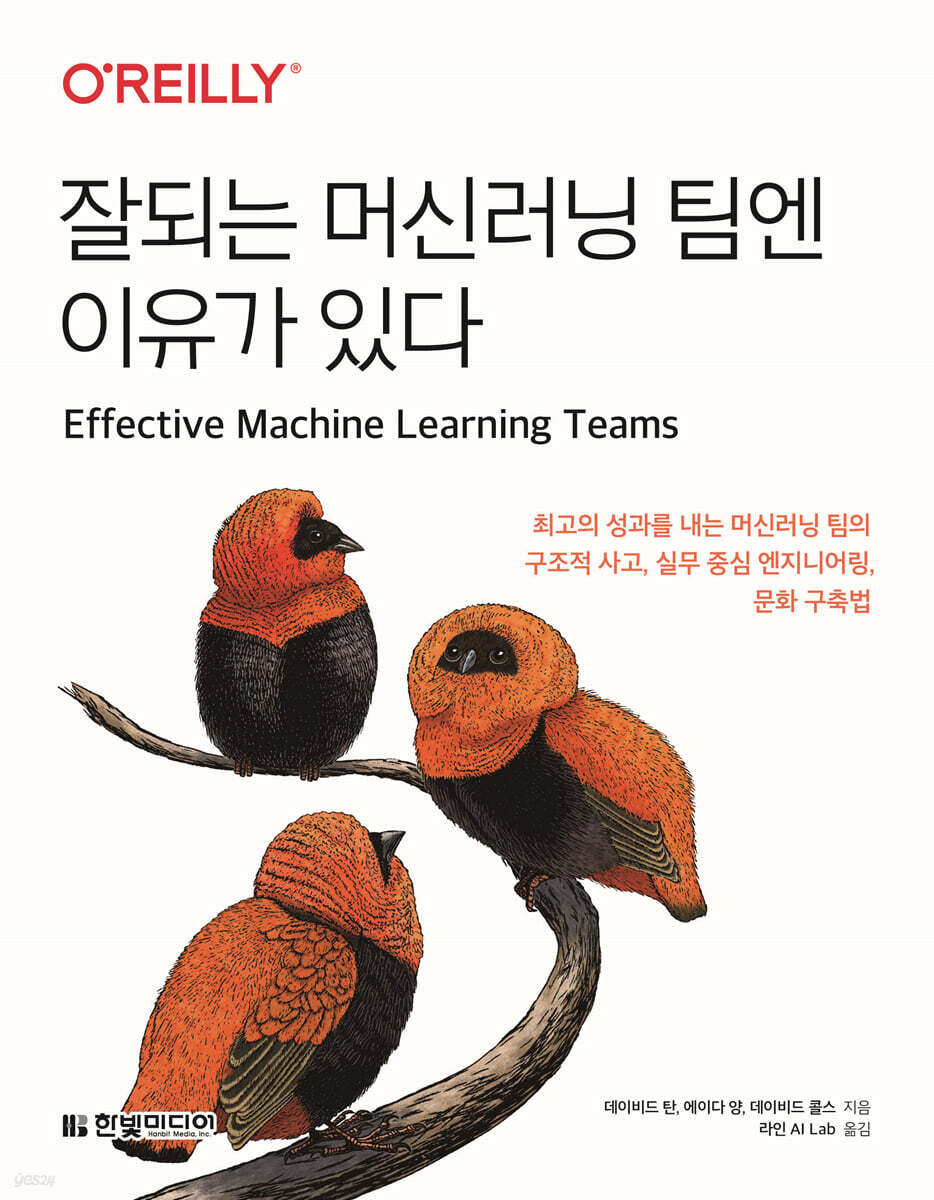
There's a reason why machine learning teams are so successful.
 |
Description
Book Introduction
How to analyze the structure of a machine learning project and connect it to optimal performance.
It contains all the product development and management know-how and team operation strategies, including automated testing, refactoring, MLOps, and collaboration technologies!
While the technology for training ML models is already widespread across many organizations, connecting them to products that deliver value to real customers remains a challenge.
Models often remain in the PoC stage without being deployed, and even after months of development, projects can be stranded due to performance degradation, technical debt, and conflicts between teams.
This book presents practical methods to solve such realistic problems.
Beyond simple algorithms and tool usage, this book covers practical aspects of how teams plan, collaborate, and continuously improve products. From MLOps and CI/CD to automated testing, container environment configuration, and team collaboration structures, it goes beyond simply "how to excel in ML" to answer the fundamental question of "how ML teams should work." I confidently recommend this book to anyone considering team, culture, process, and organizational strategy beyond ML technology.
It contains all the product development and management know-how and team operation strategies, including automated testing, refactoring, MLOps, and collaboration technologies!
While the technology for training ML models is already widespread across many organizations, connecting them to products that deliver value to real customers remains a challenge.
Models often remain in the PoC stage without being deployed, and even after months of development, projects can be stranded due to performance degradation, technical debt, and conflicts between teams.
This book presents practical methods to solve such realistic problems.
Beyond simple algorithms and tool usage, this book covers practical aspects of how teams plan, collaborate, and continuously improve products. From MLOps and CI/CD to automated testing, container environment configuration, and team collaboration structures, it goes beyond simply "how to excel in ML" to answer the fundamental question of "how ML teams should work." I confidently recommend this book to anyone considering team, culture, process, and organizational strategy beyond ML technology.
- You can preview some of the book's contents.
Preview
index
CHAPTER 01 Challenges and Better Directions in Providing ML Solutions
_1.1 Expectations and Reality for ML
_1.2 How to Use Systems Thinking and Lean
_1.3 Conclusion
[PART 01 PRODUCT AND DELIVERY]
CHAPTER 02 Products and Delivery Techniques for ML Teams
_2.1 ML product found
_2.2 Getting Started: Preparing Your Team for Success
_2.3 Product Delivery
_2.4 Conclusion
[PART 02 Engineering]
CHAPTER 03 Effective Dependency Management: Principles and Tools
_3.1 What if your code always worked, everywhere?
_3.2 A brief introduction to Docker and batect
_3.3 Conclusion
CHAPTER 04 Effective Dependency Management in Practice
_4.1 ML Development Workflow
_4.2 Safe Dependency Management
_4.3 Conclusion
CHAPTER 05 Automated Testing: Going Fast and Avoiding Problems
_5.1 Automated Testing: The Fundamentals of Fast and Reliable Iteration
_5.2 Components of a Comprehensive Test Strategy for ML Systems
_5.3 Software Testing
_5.4 Conclusion
CHAPTER 06 Automated Testing: Testing ML Models
_6.1 Model Testing
_6.2 Essential complementary techniques for model testing
_6.3 Next Step: Applying What You've Learned
_6.4 Conclusion
CHAPTER 07 Using the Code Editor Effectively with Simple Techniques
_7.1 The Benefits of Knowing an IDE (and Its Amazing Simplicity)
_7.2 Plan: Increase Productivity in Two Steps
_7.3 Conclusion
CHAPTER 08 Refactoring and Technical Debt Management
_8.1 Technical Debt: Sand in the Gears
_8.2 How to refactor a notebook (or problematic codebase)
_8.3 Managing Technical Debt in the Real World
_8.4 Conclusion
CHAPTER 09 Continuous Delivery for MLOps and ML (CD4ML)
_9.1 MLOps' Strengths and Missing Puzzle Pieces
_9.2 Continuous Delivery for ML (CD4ML)
_9.3 How CD4ML Supports ML Governance and Responsible AI
_9.4 Conclusion
[PART 03 Team]
CHAPTER 10 ELEMENTS OF AN EFFECTIVE ML TEAM
_10.1 Common Problems Facing ML Teams
_10.2 Internal Components of an Effective Team
_10.3 Improving Flow Through Engineering Efficiency
_10.4 Conclusion
CHAPTER 11 Effective ML Organizations
_11.1 Common Challenges Facing ML Organizations
_11.2 Effective organizational structure at the team level
_11.3 Effective Leadership
_11.4 Conclusion
_1.1 Expectations and Reality for ML
_1.2 How to Use Systems Thinking and Lean
_1.3 Conclusion
[PART 01 PRODUCT AND DELIVERY]
CHAPTER 02 Products and Delivery Techniques for ML Teams
_2.1 ML product found
_2.2 Getting Started: Preparing Your Team for Success
_2.3 Product Delivery
_2.4 Conclusion
[PART 02 Engineering]
CHAPTER 03 Effective Dependency Management: Principles and Tools
_3.1 What if your code always worked, everywhere?
_3.2 A brief introduction to Docker and batect
_3.3 Conclusion
CHAPTER 04 Effective Dependency Management in Practice
_4.1 ML Development Workflow
_4.2 Safe Dependency Management
_4.3 Conclusion
CHAPTER 05 Automated Testing: Going Fast and Avoiding Problems
_5.1 Automated Testing: The Fundamentals of Fast and Reliable Iteration
_5.2 Components of a Comprehensive Test Strategy for ML Systems
_5.3 Software Testing
_5.4 Conclusion
CHAPTER 06 Automated Testing: Testing ML Models
_6.1 Model Testing
_6.2 Essential complementary techniques for model testing
_6.3 Next Step: Applying What You've Learned
_6.4 Conclusion
CHAPTER 07 Using the Code Editor Effectively with Simple Techniques
_7.1 The Benefits of Knowing an IDE (and Its Amazing Simplicity)
_7.2 Plan: Increase Productivity in Two Steps
_7.3 Conclusion
CHAPTER 08 Refactoring and Technical Debt Management
_8.1 Technical Debt: Sand in the Gears
_8.2 How to refactor a notebook (or problematic codebase)
_8.3 Managing Technical Debt in the Real World
_8.4 Conclusion
CHAPTER 09 Continuous Delivery for MLOps and ML (CD4ML)
_9.1 MLOps' Strengths and Missing Puzzle Pieces
_9.2 Continuous Delivery for ML (CD4ML)
_9.3 How CD4ML Supports ML Governance and Responsible AI
_9.4 Conclusion
[PART 03 Team]
CHAPTER 10 ELEMENTS OF AN EFFECTIVE ML TEAM
_10.1 Common Problems Facing ML Teams
_10.2 Internal Components of an Effective Team
_10.3 Improving Flow Through Engineering Efficiency
_10.4 Conclusion
CHAPTER 11 Effective ML Organizations
_11.1 Common Challenges Facing ML Organizations
_11.2 Effective organizational structure at the team level
_11.3 Effective Leadership
_11.4 Conclusion
Detailed image

Publisher's Review
Uncovering the secrets of top-performing machine learning teams!
With countless machine learning (ML) projects stalling at the PoC stage or failing due to poor performance and inter-team conflict, this book goes beyond simple technical solutions and offers a solution focused on team management and collaboration strategies. It covers the entire process from ML model development, productization, deployment, and continuous improvement, and contains practical methodologies that can be applied effectively in real-world projects.
Large-scale language models (LLMs) have revolutionized ML and AI projects, facilitating automation and providing powerful foundational models.
However, LLM is not a panacea for all problems, and traditional ML/DL techniques are still often more appropriate.
Additionally, effectively leveraging LLM requires a high level of expertise and management beyond simply calling APIs, including prompt engineering, fine-tuning, building a RAG (Augmented Search Generation) system, and validating and evaluating results.
Traditional ML team operating principles and a systematic engineering approach are still essential to effectively perform these complex tasks.
This book explains the latest engineering techniques, such as MLOps, CI/CD, and automated testing, as well as specific practical strategies based on Lean principles and team collaboration strategies, to help ML teams and AI project teams continue to achieve results even amidst these changes.
I recommend this book to all practitioners and leaders who want to maximize performance by approaching complex problems structurally.
Main contents
● ML product development method based on lean principles (reducing failures and repeating success)
● Practical Uses of MLOps and CI/CD (How to Reduce Performance Degradation and Technical Debt)
Automated testing, container environment configuration, and refactoring techniques (a practical ML product development process)
● Organizational structure and collaboration strategy for ML teams (team operation considering efficiency and effectiveness)
With countless machine learning (ML) projects stalling at the PoC stage or failing due to poor performance and inter-team conflict, this book goes beyond simple technical solutions and offers a solution focused on team management and collaboration strategies. It covers the entire process from ML model development, productization, deployment, and continuous improvement, and contains practical methodologies that can be applied effectively in real-world projects.
Large-scale language models (LLMs) have revolutionized ML and AI projects, facilitating automation and providing powerful foundational models.
However, LLM is not a panacea for all problems, and traditional ML/DL techniques are still often more appropriate.
Additionally, effectively leveraging LLM requires a high level of expertise and management beyond simply calling APIs, including prompt engineering, fine-tuning, building a RAG (Augmented Search Generation) system, and validating and evaluating results.
Traditional ML team operating principles and a systematic engineering approach are still essential to effectively perform these complex tasks.
This book explains the latest engineering techniques, such as MLOps, CI/CD, and automated testing, as well as specific practical strategies based on Lean principles and team collaboration strategies, to help ML teams and AI project teams continue to achieve results even amidst these changes.
I recommend this book to all practitioners and leaders who want to maximize performance by approaching complex problems structurally.
Main contents
● ML product development method based on lean principles (reducing failures and repeating success)
● Practical Uses of MLOps and CI/CD (How to Reduce Performance Degradation and Technical Debt)
Automated testing, container environment configuration, and refactoring techniques (a practical ML product development process)
● Organizational structure and collaboration strategy for ML teams (team operation considering efficiency and effectiveness)
GOODS SPECIFICS
- Date of issue: May 30, 2025
- Page count, weight, size: 484 pages | 183*235*19mm
- ISBN13: 9791169213875
- ISBN10: 1169213871
You may also like
카테고리
korean


korean

![GQ KOREA Mark (Monthly): December [2025]](http://librairie.coreenne.fr/cdn/shop/files/8ef265dbbfbf186523ed75ba7319009d.jpg?v=1765340328&width=3840)


