

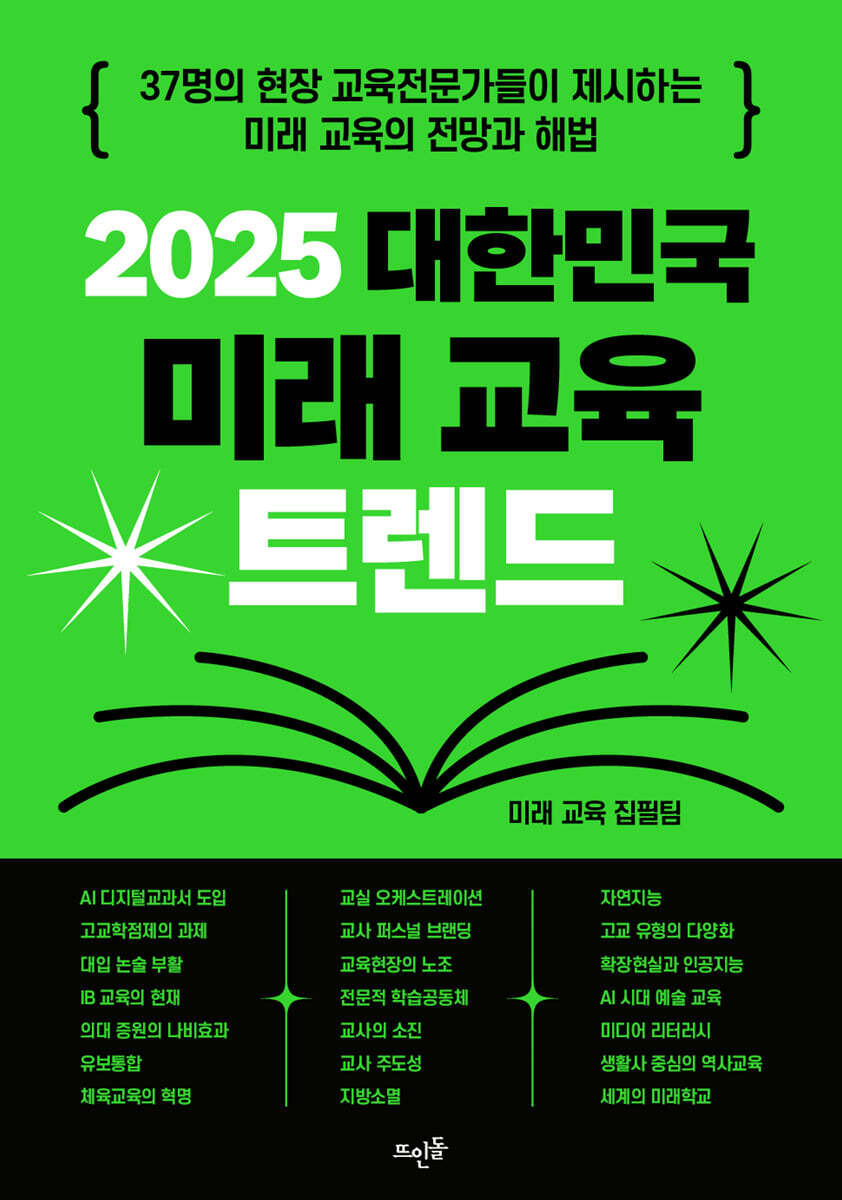
2025 Future Education Trends in Korea
 |
Description
Book Introduction
An era of great transformation in education, The most definitive guide for those seeking a new direction! In 2025, the Korean education system will face revolutionary changes. Various educational policies, including the 2022 revised curriculum, introduction of AI digital textbooks, increased medical school enrollment, the high school credit system, expansion of IB schools, and the integration of pre-school and kindergarten, will be reflected in the field. As a result, the educational field will experience major changes, confusion, and conflict. This book is written by 37 education experts who have personally encountered and found solutions in their respective fields. They closely examine and diagnose current educational policies from a field perspective and explore the future direction of education. Furthermore, it presents specific alternatives on how to accept and develop changes in future education. It also presents a vision of how the main players in education—students, teachers, parents, and the community—can collaborate to create a better educational environment. Under the recognition that education is not something that occurs solely within schools but is something that is created by the entire society, we explore the roles of each entity and ways of cooperation. The records of teachers in the field who have been diligently working to change our education system will serve as valuable data for not only the education community but also everyone living in this society, allowing them to gauge future changes in society. |
- You can preview some of the book's contents.
Preview
index
Recommendation
Toward an education that brings hope to everyone _ Lim Tae-hee
The Compass of Education that Opens the Future _ Jeong Seong-guk
Finding the Direction of Change to Protect the Essence of Education _ Hayosang
Opening remarks: One year since the implementation of the "Five Laws on Educational Rights," our journey toward the future of education _ Lee Jun-kwon
Part 1: The Reality of South Korea's Education Policy
01 The Time for a Comprehensive Revision of the School Violence Prevention Act _ Kim Tae-hoon
02 The Butterfly Effect of Medical School Recruitment _ Ha Yu-jeong
03 The Rise of Students with Physical Illness: What is the Future of Elementary Physical Education? _ Lee Seon-jae
04 2022 Revised Curriculum and Diversification of High School Types _ Seungwoo Lee
05 A Kindergarten Teacher's Look into Preschool Integration _ Eun-jin Oh
06 Can the High School Credit System Be the Beginning of Reform? _ Song Su-yeon
07 IB, A Difficult Step Toward Meaningful Assessment _ Eun-ah Lee
08 AI Digital Textbooks and Various EdTech Technologies _ Kim Soo-ho
Part 2: Teachers Preparing for the Future
01 Leading the Future of Education with Personal Branding _ Jo Min-hee
02 Teacher Burnout: How Can We Address It? _ Ryu Seong-chang
03 A Professional Learning Community Leading Educational Change _ Kim Cha-myeong
04 Voluntary Training for Teachers, by Teachers _ Son Ji-seon
05 Student-Teacher and Teacher-Teacher Collaborative Leadership _ Choi Seon-gyeong
06 Finding the Future Direction of Education through Classroom Orchestration _ Kim Yu-ri
Part 3: The Future of Individualized Education
01 Transforming Students' Brains and Minds through School Physical Education _ Lim Seong-cheol
Will the 2022 Revised Curriculum Be the Answer for Future History Education? _ Lee Jeong-hwan
03 The Reality of English Education as Seen Through English Camps _ Heo Jun-seok
04 Why We Need to Teach and Learn About Future Society and Economics _ Jo Hee-jung
05 Concerns and Direction of Arts Education in the AI Era _ Joanna
06 Physical Education in Korea: Now is the Opportunity _ Lee Do-young
07 AI Revolution? The Speaking Revolution Comes First! _ Yoon Soo-young
Part 4: The Future of AI Digital Education
01 Media Literacy Education: A Necessity, Not a Need _ Ji-Hoon Jeong
02 In the AI Era, Ask Questions! _ Jeong Ye-seul
03 Introduction of Two-Way Communication Tools at Home and Abroad and the Future Direction of Digital Education in Korea _ Minji Son
04 Classroom Revolution Using Google Workspace EDU+ and Gemini _ Kang Kyung-wook
05 An Apology for AI Digital Textbooks _ Jaebeom Cho
06 Augmented Reality and AI Meet, Opening New Horizons for Future Education _ Kim Soo-hyun
07 Direction of Life Guidance in the Digital Age _ Son Deok-je
Part 5: A New Alternative for Future Education in Korea
01 2028 College Entrance Exams: How Should Elementary, Middle, and High School Students Prepare? _Park Eun-seon
02 Life Strategy for College Admissions _ Bae Hye-rim
03 The Resurgence of College Entrance Essays: How to Prepare _ Yoon Ji-seon
04 The Role of Special Self-Governing Provinces in Overcoming Local Depopulation and Declining School-Age Populations _ Oh Jun-young
05 Together School: Opening a Communication-Based Education Policy _ Kwon Ki-jeong
06 World's Future Schools _ Park Chan-young
07 Why Nature-Friendly Barefoot Play Education is Necessary in the AI Era _ Kwon Taek-hwan
08 Future Education, Future Unions, and the Education Hidden in the Digital Age _ Yoon Mi-sook
Conclusion: For the Year 2025 for All of Us _ Ji-seon Yoon
Toward an education that brings hope to everyone _ Lim Tae-hee
The Compass of Education that Opens the Future _ Jeong Seong-guk
Finding the Direction of Change to Protect the Essence of Education _ Hayosang
Opening remarks: One year since the implementation of the "Five Laws on Educational Rights," our journey toward the future of education _ Lee Jun-kwon
Part 1: The Reality of South Korea's Education Policy
01 The Time for a Comprehensive Revision of the School Violence Prevention Act _ Kim Tae-hoon
02 The Butterfly Effect of Medical School Recruitment _ Ha Yu-jeong
03 The Rise of Students with Physical Illness: What is the Future of Elementary Physical Education? _ Lee Seon-jae
04 2022 Revised Curriculum and Diversification of High School Types _ Seungwoo Lee
05 A Kindergarten Teacher's Look into Preschool Integration _ Eun-jin Oh
06 Can the High School Credit System Be the Beginning of Reform? _ Song Su-yeon
07 IB, A Difficult Step Toward Meaningful Assessment _ Eun-ah Lee
08 AI Digital Textbooks and Various EdTech Technologies _ Kim Soo-ho
Part 2: Teachers Preparing for the Future
01 Leading the Future of Education with Personal Branding _ Jo Min-hee
02 Teacher Burnout: How Can We Address It? _ Ryu Seong-chang
03 A Professional Learning Community Leading Educational Change _ Kim Cha-myeong
04 Voluntary Training for Teachers, by Teachers _ Son Ji-seon
05 Student-Teacher and Teacher-Teacher Collaborative Leadership _ Choi Seon-gyeong
06 Finding the Future Direction of Education through Classroom Orchestration _ Kim Yu-ri
Part 3: The Future of Individualized Education
01 Transforming Students' Brains and Minds through School Physical Education _ Lim Seong-cheol
Will the 2022 Revised Curriculum Be the Answer for Future History Education? _ Lee Jeong-hwan
03 The Reality of English Education as Seen Through English Camps _ Heo Jun-seok
04 Why We Need to Teach and Learn About Future Society and Economics _ Jo Hee-jung
05 Concerns and Direction of Arts Education in the AI Era _ Joanna
06 Physical Education in Korea: Now is the Opportunity _ Lee Do-young
07 AI Revolution? The Speaking Revolution Comes First! _ Yoon Soo-young
Part 4: The Future of AI Digital Education
01 Media Literacy Education: A Necessity, Not a Need _ Ji-Hoon Jeong
02 In the AI Era, Ask Questions! _ Jeong Ye-seul
03 Introduction of Two-Way Communication Tools at Home and Abroad and the Future Direction of Digital Education in Korea _ Minji Son
04 Classroom Revolution Using Google Workspace EDU+ and Gemini _ Kang Kyung-wook
05 An Apology for AI Digital Textbooks _ Jaebeom Cho
06 Augmented Reality and AI Meet, Opening New Horizons for Future Education _ Kim Soo-hyun
07 Direction of Life Guidance in the Digital Age _ Son Deok-je
Part 5: A New Alternative for Future Education in Korea
01 2028 College Entrance Exams: How Should Elementary, Middle, and High School Students Prepare? _Park Eun-seon
02 Life Strategy for College Admissions _ Bae Hye-rim
03 The Resurgence of College Entrance Essays: How to Prepare _ Yoon Ji-seon
04 The Role of Special Self-Governing Provinces in Overcoming Local Depopulation and Declining School-Age Populations _ Oh Jun-young
05 Together School: Opening a Communication-Based Education Policy _ Kwon Ki-jeong
06 World's Future Schools _ Park Chan-young
07 Why Nature-Friendly Barefoot Play Education is Necessary in the AI Era _ Kwon Taek-hwan
08 Future Education, Future Unions, and the Education Hidden in the Digital Age _ Yoon Mi-sook
Conclusion: For the Year 2025 for All of Us _ Ji-seon Yoon
Detailed image
.jpg)
Into the book
The changing times also demand a change in the image of teachers.
Teachers must now move beyond simply being conveyors of the curriculum and acquire the qualities of proactive lesson designers.
Beyond the question of 'what' and 'how' to teach students who will live in the era of digital transformation, we are also being asked to fundamentally consider 'why' we should teach them.
This can only be achieved through a deep understanding of new policies and educational directions.
--- p.16
It is said that when providing first aid, the survival rate increases if CPR is performed within 4 minutes.
There is also a golden time in relationships between students.
Every year, we prepare measures to improve how we deal with school violence.
The School Violence Prevention Act is becoming more time-consuming and complex as procedures are supplemented while leaving it as is.
It is time for a comprehensive revision of the School Violence Prevention Act.
The definition of school violence must be narrowed, and procedures must be simplified and processed quickly.
--- p.32
There are also concerns that the expansion of medical schools will lead to a domino effect where students in science and engineering departments at major local universities will move to universities in Seoul.
As top students move to the expanded medical school, upper-middle-ranking students move to the top-ranking science and engineering departments, and lower-middle-ranking students move to the middle-ranking science and engineering departments, the hollowing out phenomenon at local universities may become more evident.
The expansion of local medical school enrollment was intended to reduce the imbalance in educational resources between the metropolitan area and local areas, but in reality, it could lead to a chain reaction of students moving between schools and departments, resulting in an outflow of talented local talent.
--- p.40
We must also take into account concerns that the relaxation of the five-grade grading system may not be unconditionally positive.
Students will be torn between taking subjects that don't calculate rank in order to get good grades and taking subjects they want to take.
In addition, since it is inevitable that the discriminatory power of school grades will decrease in admissions to top universities, it is highly likely that the comprehensive student record selection process will eventually be expanded or the minimum academic performance standard for the CSAT will be strengthened.
If so, it is also true that problem-solving classes are likely to continue as they are now.
--- p.60
The first of the UN Convention on the Rights of the Child is ‘non-discrimination.’
All children should enjoy equal rights, regardless of their parents, race, religion, or disability.
According to this, the most urgent need in early childhood education and childcare is support for children who are being discriminated against.
If so, the first thing that should be implemented within a limited budget and in accordance with the principle of non-discrimination is not the integration of reserved children, but education for infants and toddlers with disabilities.
--- p.70
In early childhood education, the top priority should be ‘children’ and ‘education.’
Educational institutions cannot handle all social welfare work.
It is also necessary to consider whether children wish to stay at the kindergarten from morning to evening.
Many kindergartens now offer morning and evening care.
However, only a few infants stay here.
Looking at the children left in the classroom that has become quiet after everyone has left, I always worry that they might feel empty and afraid, waiting for their parents.
--- p.72
Amidst a mix of optimism and concern, the high school credit system is finally implemented.
Because the student autonomy and choice implied by the system are directly linked to the discourse of educational democratization, which is a practical expansion of the scope of school education, it is believed that regression will not be easy.
In this situation, the most urgent task is to clearly identify the challenges we face and devise concrete solutions while responding quickly to on-site experiences and reactions.
--- p.80
It's important to recognize that the IB isn't the answer for every student. It's certainly a program that favors students who enjoy inquiry and writing.
Not all schools in the country need to be IB accredited.
However, we should at least give students who want to focus on a subject of interest and develop their critical thinking, curiosity, and collaboration skills the opportunity.
Since the Korean college entrance exam system is unavoidable, we should no longer force students to memorize knowledge and pile up workbooks to solve problems in this era of the Fourth Industrial Revolution.
--- p.110~111
High-touch, high-tech education is an innovative approach that aims to provide students with a richer learning experience by balancing their emotions and skills, led by teachers.
Within this, AIDT plays a key role in high-tech, and for this to be most effective, teachers must take the initiative in motivating and stimulating students' emotions.
In other words, high-touch, high-tech education is largely dependent on the teacher's capabilities.
--- p.119
As a teacher, personal branding is the process of clearly defining your educational values and communicating them effectively.
By building a unique image, highlighting strengths, and communicating their expertise through personal branding, teachers can establish themselves as trusted figures within the educational community.
This ultimately contributes to improving students' learning experiences and expanding educational impact.
--- p.127
A teacher's beliefs interact with his or her actions, which in turn influence his or her future behavior.
Students observe and are influenced by their teachers' personality, language, behavior, and attitude.
That is why the self-efficacy of teachers, who teach students, the masters of the future, and help them grow, is so important.
But what is the current state of teachers' self-efficacy?
--- p.159
Recognizing students as agents of action does not mean allowing them to study alone, in isolation, or leaving them to do whatever they want.
Learning is not something you do alone, but rather a process of learning through collaborative communication with teachers, peers, etc.
It is not about learning only what students want or satisfying their personal interests.
We must respect students' interests, but we must not just teach them what they want to learn or settle for temporary satisfaction. We must also ensure that they have a sense of social influence and responsibility for their own actions.
Rather than acquiring knowledge piecemeal, applying what you learn to your own life increases your agency.
--- p.172
In the 2022 revised curriculum, life history provides students with a deeper understanding of the lives of those who lived in that era by telling them the rich stories of their experiences.
In particular, if we approach specific life stories centered around people as a 'narrative', we will not only be able to understand the experiences of people in the past more vividly, but also access history more easily.
--- p.210
Economic education will provide students with a strong safety net in a future where uncertainty is accelerating and unforeseen crises are likely to arise.
The difference in perspectives on economic education is directly reflected in the curriculum and has a long-term impact on students' lives.
--- p.226
To reduce behavioral problems among students in the digital age, teachers must strive to understand their students' trends and culture.
It is necessary to communicate with students through Facebook, Instagram, KakaoTalk, etc., and to take interest in student culture that is trending on TikTok, YouTube, etc.
It can be dangerous if only teachers are unaware of the profanity, vulgarity, and immoral and sexual language that is being used as if it were nothing more than a show.
Knowing what platforms your children are using can help you spot and prevent behavioral problems.
--- p.330~331
Difficulties are expected not only in Jeonbuk and Gangwon, but also in many regions across the country.
However, this situation could be a golden opportunity to reduce the number of students per class.
Special autonomous provinces and education offices must set common goals to enhance the educational competitiveness of their respective regions.
We must expand the scope of school autonomy and educational welfare to overcome the decline in the school-age population and prevent the extinction of local regions.
--- p.376~377
Although the Ministry of Education has declared that it will expand the adoption of digital-based education, it can be said that it has failed to build consensus and provide guidance to teachers who will implement the policy.
Field teachers felt that their opinions were not properly reflected in policy formulation and operation, and that projects were not being carried out sequentially.
Isn't this the result of accumulated distrust and dissatisfaction with the top-down educational policy projects promoted by the Ministry of Education and the Office of Education?
Teachers must now move beyond simply being conveyors of the curriculum and acquire the qualities of proactive lesson designers.
Beyond the question of 'what' and 'how' to teach students who will live in the era of digital transformation, we are also being asked to fundamentally consider 'why' we should teach them.
This can only be achieved through a deep understanding of new policies and educational directions.
--- p.16
It is said that when providing first aid, the survival rate increases if CPR is performed within 4 minutes.
There is also a golden time in relationships between students.
Every year, we prepare measures to improve how we deal with school violence.
The School Violence Prevention Act is becoming more time-consuming and complex as procedures are supplemented while leaving it as is.
It is time for a comprehensive revision of the School Violence Prevention Act.
The definition of school violence must be narrowed, and procedures must be simplified and processed quickly.
--- p.32
There are also concerns that the expansion of medical schools will lead to a domino effect where students in science and engineering departments at major local universities will move to universities in Seoul.
As top students move to the expanded medical school, upper-middle-ranking students move to the top-ranking science and engineering departments, and lower-middle-ranking students move to the middle-ranking science and engineering departments, the hollowing out phenomenon at local universities may become more evident.
The expansion of local medical school enrollment was intended to reduce the imbalance in educational resources between the metropolitan area and local areas, but in reality, it could lead to a chain reaction of students moving between schools and departments, resulting in an outflow of talented local talent.
--- p.40
We must also take into account concerns that the relaxation of the five-grade grading system may not be unconditionally positive.
Students will be torn between taking subjects that don't calculate rank in order to get good grades and taking subjects they want to take.
In addition, since it is inevitable that the discriminatory power of school grades will decrease in admissions to top universities, it is highly likely that the comprehensive student record selection process will eventually be expanded or the minimum academic performance standard for the CSAT will be strengthened.
If so, it is also true that problem-solving classes are likely to continue as they are now.
--- p.60
The first of the UN Convention on the Rights of the Child is ‘non-discrimination.’
All children should enjoy equal rights, regardless of their parents, race, religion, or disability.
According to this, the most urgent need in early childhood education and childcare is support for children who are being discriminated against.
If so, the first thing that should be implemented within a limited budget and in accordance with the principle of non-discrimination is not the integration of reserved children, but education for infants and toddlers with disabilities.
--- p.70
In early childhood education, the top priority should be ‘children’ and ‘education.’
Educational institutions cannot handle all social welfare work.
It is also necessary to consider whether children wish to stay at the kindergarten from morning to evening.
Many kindergartens now offer morning and evening care.
However, only a few infants stay here.
Looking at the children left in the classroom that has become quiet after everyone has left, I always worry that they might feel empty and afraid, waiting for their parents.
--- p.72
Amidst a mix of optimism and concern, the high school credit system is finally implemented.
Because the student autonomy and choice implied by the system are directly linked to the discourse of educational democratization, which is a practical expansion of the scope of school education, it is believed that regression will not be easy.
In this situation, the most urgent task is to clearly identify the challenges we face and devise concrete solutions while responding quickly to on-site experiences and reactions.
--- p.80
It's important to recognize that the IB isn't the answer for every student. It's certainly a program that favors students who enjoy inquiry and writing.
Not all schools in the country need to be IB accredited.
However, we should at least give students who want to focus on a subject of interest and develop their critical thinking, curiosity, and collaboration skills the opportunity.
Since the Korean college entrance exam system is unavoidable, we should no longer force students to memorize knowledge and pile up workbooks to solve problems in this era of the Fourth Industrial Revolution.
--- p.110~111
High-touch, high-tech education is an innovative approach that aims to provide students with a richer learning experience by balancing their emotions and skills, led by teachers.
Within this, AIDT plays a key role in high-tech, and for this to be most effective, teachers must take the initiative in motivating and stimulating students' emotions.
In other words, high-touch, high-tech education is largely dependent on the teacher's capabilities.
--- p.119
As a teacher, personal branding is the process of clearly defining your educational values and communicating them effectively.
By building a unique image, highlighting strengths, and communicating their expertise through personal branding, teachers can establish themselves as trusted figures within the educational community.
This ultimately contributes to improving students' learning experiences and expanding educational impact.
--- p.127
A teacher's beliefs interact with his or her actions, which in turn influence his or her future behavior.
Students observe and are influenced by their teachers' personality, language, behavior, and attitude.
That is why the self-efficacy of teachers, who teach students, the masters of the future, and help them grow, is so important.
But what is the current state of teachers' self-efficacy?
--- p.159
Recognizing students as agents of action does not mean allowing them to study alone, in isolation, or leaving them to do whatever they want.
Learning is not something you do alone, but rather a process of learning through collaborative communication with teachers, peers, etc.
It is not about learning only what students want or satisfying their personal interests.
We must respect students' interests, but we must not just teach them what they want to learn or settle for temporary satisfaction. We must also ensure that they have a sense of social influence and responsibility for their own actions.
Rather than acquiring knowledge piecemeal, applying what you learn to your own life increases your agency.
--- p.172
In the 2022 revised curriculum, life history provides students with a deeper understanding of the lives of those who lived in that era by telling them the rich stories of their experiences.
In particular, if we approach specific life stories centered around people as a 'narrative', we will not only be able to understand the experiences of people in the past more vividly, but also access history more easily.
--- p.210
Economic education will provide students with a strong safety net in a future where uncertainty is accelerating and unforeseen crises are likely to arise.
The difference in perspectives on economic education is directly reflected in the curriculum and has a long-term impact on students' lives.
--- p.226
To reduce behavioral problems among students in the digital age, teachers must strive to understand their students' trends and culture.
It is necessary to communicate with students through Facebook, Instagram, KakaoTalk, etc., and to take interest in student culture that is trending on TikTok, YouTube, etc.
It can be dangerous if only teachers are unaware of the profanity, vulgarity, and immoral and sexual language that is being used as if it were nothing more than a show.
Knowing what platforms your children are using can help you spot and prevent behavioral problems.
--- p.330~331
Difficulties are expected not only in Jeonbuk and Gangwon, but also in many regions across the country.
However, this situation could be a golden opportunity to reduce the number of students per class.
Special autonomous provinces and education offices must set common goals to enhance the educational competitiveness of their respective regions.
We must expand the scope of school autonomy and educational welfare to overcome the decline in the school-age population and prevent the extinction of local regions.
--- p.376~377
Although the Ministry of Education has declared that it will expand the adoption of digital-based education, it can be said that it has failed to build consensus and provide guidance to teachers who will implement the policy.
Field teachers felt that their opinions were not properly reflected in policy formulation and operation, and that projects were not being carried out sequentially.
Isn't this the result of accumulated distrust and dissatisfaction with the top-down educational policy projects promoted by the Ministry of Education and the Office of Education?
--- p.420
Publisher's Review
An era of great transformation in education,
The most definitive guide for those seeking a new direction!
2025 will undoubtedly be the most chaotic year for education in South Korea.
The 2022 revised curriculum will be fully implemented, and AI digital textbooks will be introduced.
The increase in medical school admissions shook up the college admissions landscape, and the introduction of the high school credit system suddenly gave students great 'freedom.'
Meanwhile, children are growing up precariously, lacking in physical strength and digital addiction, all while pursuing the goal of college entrance.
The educational gap is growing more serious by the day, as if it were a direct reflection of the social structure.
How will we raise future generations in this reality?
Here are the stories of 37 education experts who have personally encountered and found answers in their respective fields.
Teachers who started online classes and brought students together in depopulated areas during the coronavirus pandemic.
Teachers who are the first to implement digital textbooks and auxiliary tools and generously share their research findings with colleagues.
Teachers who worry about the physical and emotional development needed not only for college entrance exams but also for life as a whole.
This book contains realistic and specific suggestions and information that would otherwise be impossible.
We analyze key educational issues and trends for 2025 and propose future education!
The Teacher Creators Association (Kyo-Kyeop), an organization formed by current teachers to develop educational digital content, has selected the core educational issues and trends that teachers and parents should most consider and focus on in the curriculum in 2025, following last year's selection. The analysis and forecast of education in 2025 are made through keywords such as the introduction of AI digital textbooks, the high school credit system, the revival of the college entrance essay test, the butterfly effect of increasing medical school enrollment, the integration of pre-school and kindergarten, innovation in physical education, classroom orchestration, teacher personal branding, professional learning communities, teacher burnout, teacher leadership, local extinction, natural intelligence, extended reality and artificial intelligence, and media literacy.
This time in particular, we selected and compiled 100 manuscripts submitted by educators across the country.
As it carefully selects only the topics and content that must be addressed in today's education, it will serve as an important resource for those in the education field as well as anyone living in this society, allowing them to gauge future social changes.
Structure of this book
『2025 Future Education Trends in Korea』 is composed of five parts.
Part 1 addresses important issues currently occurring in the educational field.
It contains diagnoses and alternatives from education experts on the most pressing issues, including the School Violence Prevention Act, increased medical school enrollment, changes in college entrance exams due to the revised curriculum, and the integration of kindergartens and daycare centers.
Part 1 provides an understanding of the background and purpose behind the various educational policies in various fields, and provides a clear understanding of the actual content reflected in the policies.
Part 2 contains efforts to develop teachers' expertise as comprehensive managers rather than mere imparters of knowledge.
Concepts like personal branding, professional learning communities, and classroom orchestration offer a glimpse into the intense research and exploration teachers engage with in education.
By examining the changing role of teachers in future education, we can also gauge how the skills required of students will change.
Part 3: The Future of Individual Education examines the realities facing individual subjects such as physical education, economics, English, history, and art.
We diagnose how issues such as college entrance system reform, technological advancements, and class disparities are affecting individual education.
Additionally, we can examine specifically what kind of investments and responses are needed in education to cultivate future talent.
Part 4, The Future of AI Digital Education, explains the reality we will face starting in 2025, when AI digital textbooks will be fully introduced.
Rather than vague anxiety, it provides practical information to help you move forward with undeniable change.
It also presents a lifestyle guidance direction that is suited to these changing times.
Part 5, New Alternatives for Future Education in Korea, presents a direction for change that the education community and all those who have become members of society through education can achieve together, based on all the changes and situational awareness described above.
The most definitive guide for those seeking a new direction!
2025 will undoubtedly be the most chaotic year for education in South Korea.
The 2022 revised curriculum will be fully implemented, and AI digital textbooks will be introduced.
The increase in medical school admissions shook up the college admissions landscape, and the introduction of the high school credit system suddenly gave students great 'freedom.'
Meanwhile, children are growing up precariously, lacking in physical strength and digital addiction, all while pursuing the goal of college entrance.
The educational gap is growing more serious by the day, as if it were a direct reflection of the social structure.
How will we raise future generations in this reality?
Here are the stories of 37 education experts who have personally encountered and found answers in their respective fields.
Teachers who started online classes and brought students together in depopulated areas during the coronavirus pandemic.
Teachers who are the first to implement digital textbooks and auxiliary tools and generously share their research findings with colleagues.
Teachers who worry about the physical and emotional development needed not only for college entrance exams but also for life as a whole.
This book contains realistic and specific suggestions and information that would otherwise be impossible.
We analyze key educational issues and trends for 2025 and propose future education!
The Teacher Creators Association (Kyo-Kyeop), an organization formed by current teachers to develop educational digital content, has selected the core educational issues and trends that teachers and parents should most consider and focus on in the curriculum in 2025, following last year's selection. The analysis and forecast of education in 2025 are made through keywords such as the introduction of AI digital textbooks, the high school credit system, the revival of the college entrance essay test, the butterfly effect of increasing medical school enrollment, the integration of pre-school and kindergarten, innovation in physical education, classroom orchestration, teacher personal branding, professional learning communities, teacher burnout, teacher leadership, local extinction, natural intelligence, extended reality and artificial intelligence, and media literacy.
This time in particular, we selected and compiled 100 manuscripts submitted by educators across the country.
As it carefully selects only the topics and content that must be addressed in today's education, it will serve as an important resource for those in the education field as well as anyone living in this society, allowing them to gauge future social changes.
Structure of this book
『2025 Future Education Trends in Korea』 is composed of five parts.
Part 1 addresses important issues currently occurring in the educational field.
It contains diagnoses and alternatives from education experts on the most pressing issues, including the School Violence Prevention Act, increased medical school enrollment, changes in college entrance exams due to the revised curriculum, and the integration of kindergartens and daycare centers.
Part 1 provides an understanding of the background and purpose behind the various educational policies in various fields, and provides a clear understanding of the actual content reflected in the policies.
Part 2 contains efforts to develop teachers' expertise as comprehensive managers rather than mere imparters of knowledge.
Concepts like personal branding, professional learning communities, and classroom orchestration offer a glimpse into the intense research and exploration teachers engage with in education.
By examining the changing role of teachers in future education, we can also gauge how the skills required of students will change.
Part 3: The Future of Individual Education examines the realities facing individual subjects such as physical education, economics, English, history, and art.
We diagnose how issues such as college entrance system reform, technological advancements, and class disparities are affecting individual education.
Additionally, we can examine specifically what kind of investments and responses are needed in education to cultivate future talent.
Part 4, The Future of AI Digital Education, explains the reality we will face starting in 2025, when AI digital textbooks will be fully introduced.
Rather than vague anxiety, it provides practical information to help you move forward with undeniable change.
It also presents a lifestyle guidance direction that is suited to these changing times.
Part 5, New Alternatives for Future Education in Korea, presents a direction for change that the education community and all those who have become members of society through education can achieve together, based on all the changes and situational awareness described above.
GOODS SPECIFICS
- Date of issue: November 15, 2024
- Page count, weight, size: 432 pages | 742g | 165*235*28mm
- ISBN13: 9788958070481
You may also like
카테고리
korean


korean

![GQ KOREA Mark (Monthly): December [2025]](http://librairie.coreenne.fr/cdn/shop/files/8ef265dbbfbf186523ed75ba7319009d.jpg?v=1765340328&width=3840)


